
Overview
Catholicism is the faith of the Catholic Church, the largest Christian body, with about 1.4 billion baptised members by its own count. It shares the ancient creeds with other Christians, but several things set it apart. Catholics are in communion with the pope, the bishop of Rome, whom they regard as the apostle Peter's successor. They hold that revelation comes through Scripture and Tradition together, interpreted with authority by the bishops united with the pope. Worship centres on seven sacraments, above all the Mass, and Catholics honour Mary and the saints as intercessors. Besides the large Latin Church, it includes Eastern Catholic churches with their own liturgies. Once centred on Europe, most Catholics now live in the Americas, Africa and Asia.[7, 9–13]
History
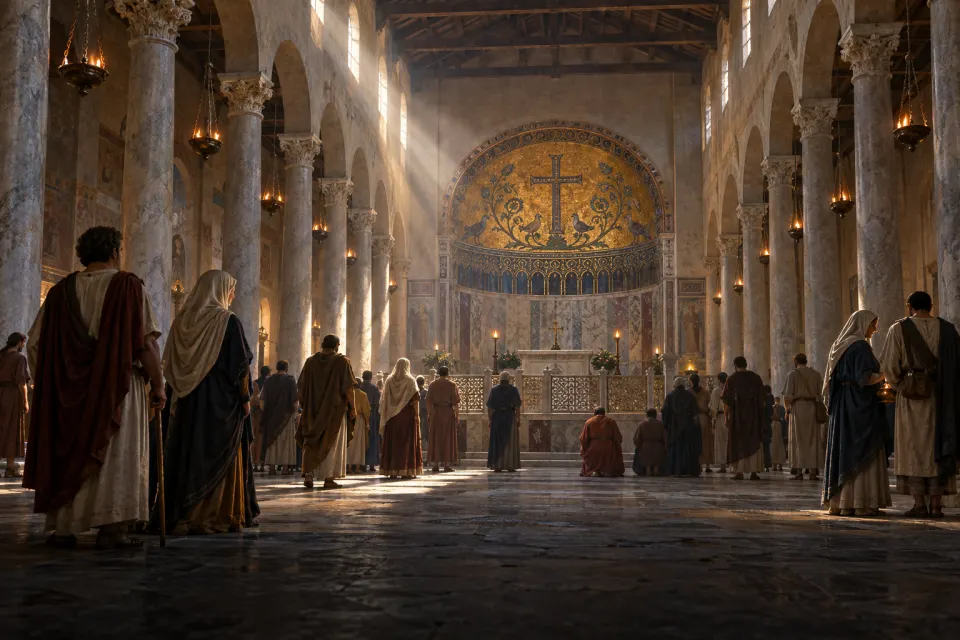
Peter's see and the early church c. 30–1054 CE
Catholics hold that Jesus made the apostle Peter the rock of his church, and that Peter, martyred in Rome, handed his authority to the city's bishops. Historians describe slower growth: Rome was honoured as the church where Peter and Paul died, and its bishops claimed wider authority step by step, notably Leo I in the fifth century. As Roman rule collapsed in the West, popes such as Gregory the Great (590–604) became leading figures. The Latin West and Greek East drifted apart; mutual excommunications in 1054 became the traditional date of their split.[14–17]
Medieval Christendom 1050–1500
Gregory VII (1073–85) led a reform against simony and lay control of church offices, and Innocent III (1198–1216) claimed authority over kings. The Fourth Lateran Council of 1215 required yearly confession and communion and named the change in the Mass transubstantiation. Franciscan and Dominican friars preached in the towns, while Thomas Aquinas and others built theology in the universities. The same church preached crusades and from the 1230s sent papal inquisitors against heresy. The popes' stay at Avignon (1309–77) and a schism of rival popes (1378–1417) damaged their prestige.[18–22]
Reformation and Catholic renewal 1517–1650
Luther's protest of 1517 began the Reformation, and much of northern Europe left Rome's communion. Catholic renewal was already under way: the Jesuits, founded by Ignatius of Loyola, won papal approval in 1540. The Council of Trent (1545–63) fixed the canon of scripture, affirmed seven sacraments and justification by faith and works together, and ordered seminaries for priests. Rome also created a Roman Inquisition (1542) and an Index of forbidden books (1559); the Inquisition condemned Galileo in 1633. The Latin missal issued in 1570 to carry out Trent's reforms stayed in obligatory use for four centuries.[23–27]
Empire and mission 1492–1800
Catholicism spread with the Spanish and Portuguese empires, whose kings received from popes wide control over the church in their colonies. Friars and Jesuits baptised millions in the Americas, often alongside conquest, forced labour and the destruction of Indigenous religion; some, like the Dominican Bartolomé de Las Casas, denounced the abuses. In Asia, Francis Xavier preached in India and Japan, and Jesuits such as Matteo Ricci adapted to Chinese culture until Rome banned the Chinese rites in the eighteenth century. The Spanish Inquisition, authorised by the pope in 1478 but run by the crown, pursued converts from Judaism and Islam until 1834.[28–31]
From revolution to Vatican II 1789–1965
The French Revolution and later liberal states stripped the Church of land and privilege, and in 1870 Italy seized Rome, ending the Papal States. That year the First Vatican Council, under Pius IX, defined papal infallibility. Leo XIII's encyclical Rerum novarum (1891) founded modern Catholic social teaching, and the Lateran Treaty of 1929 created Vatican City. The Second Vatican Council (1962–65), called by John XXIII, allowed Mass in local languages, embraced ecumenism and religious freedom, and in Nostra aetate rejected blaming the Jews collectively for Jesus' death.[32–35]
A world church 1965–today
John Paul II (1978–2005), the first non-Italian pope in over four centuries, travelled widely and backed Poland's Solidarity movement. From the 1980s, and above all after The Boston Globe's reporting in 2002, inquiries in many countries exposed sexual abuse of children by clergy and its cover-up by bishops; a 2004 US study counted 4,392 accused priests since 1950, and a French commission in 2021 estimated 216,000 victims of clergy, a figure whose survey method some scholars disputed. Francis (2013–25), the first pope from the Americas, apologised to survivors and tightened church law against abuse and its cover-up. Leo XIV, born in Chicago, succeeded him in 2025. By Church figures, Africa now has more Catholics than Europe.[2, 36–40]
Key moments
- c. 530 CEBenedict writes his Rule · Monte Cassino, Italy
- 800 CECharlemagne crowned emperor · St Peter's Basilica, Rome
- c. 863 CECyril and Methodius among the Slavs · Great Moravia (Czechia and Slovakia)
- 1054 CEThe Great Schism · Constantinople and Rome
- 1095 CEThe First Crusade · Clermont to Jerusalem
- 1204 CECrusaders sack Constantinople · Constantinople
- c. 1209 CEFrancis of Assisi and the friars · Assisi and Rome
- 1215 CEThe Fourth Lateran Council · Lateran Palace, Rome
- 1348 CEThe Black Death: penance and pogroms · Europe
- c. 1455 CEThe Gutenberg Bible · Mainz, Germany
- 1491 CEKongo becomes a Christian kingdom · Mbanza Kongo (São Salvador), Angola
- 1531 CEOur Lady of Guadalupe · Tepeyac, Mexico City
- 1545 CEThe Council of Trent · Trent, then in the Holy Roman Empire (now Trento, Italy)
- 1555 CEThe Peace of Augsburg · Augsburg
- 1562 CELanda burns the Maya books · Maní, Yucatán, Mexico
- 1614 CEJapan bans Christianity; the hidden Christians · Nagasaki region, Japan
- 1633 CEThe trial of Galileo · Rome
- 1648 CEPeace of Westphalia · Münster and Osnabrück
- 1680 CEThe Pueblo Revolt · New Mexico
- 1706 CEThe burning of the prophet Kimpa Vita · Kingdom of Kongo (northern Angola)
- 1784 CEKorea's lay-founded church · Seoul, Korea
- 1790 CEThe Revolution and the Church · France
- 1870 CEVatican I defines papal infallibility · St Peter's Basilica, Rome
- 1962 CESecond Vatican Council · Rome
- 1968 CEMedellín and liberation theology · Medellín, Colombia
- 1986 CEPraying together at Assisi · Assisi, Italy
- 2019 CEDocument on Human Fraternity · Abu Dhabi
Beliefs
Scripture and Tradition
Catholics believe God's revelation reaches them through the Bible and through the living Tradition handed on from the apostles. Interpreting both with authority falls to the Magisterium, the bishops teaching in union with the pope. The Catholic Old Testament includes seven books, among them Tobit, Judith and 1–2 Maccabees, that most Protestants set apart as the Apocrypha.[11, 41]
The papacy
the office of the pope
Catholics regard the pope as Peter's successor and the visible head of the whole Church, with full authority over it. Since 1870 they have held that when he solemnly defines a doctrine of faith or morals ex cathedra, 'from the chair', for the whole Church, he is kept from error. This does not make popes sinless, and most papal teaching is not of this solemn kind.[42–43]
Sacraments · sacramenta
holy signs
Catholics count seven sacraments: baptism, confirmation, the Eucharist, penance or reconciliation, anointing of the sick, holy orders and marriage. They teach that Christ instituted each one and that each is an outward sign that truly gives the grace it signifies. Baptism, confirmation and ordination can be received only once in a lifetime.[5, 44]
Real Presence
Catholics believe that at Mass the bread and wine become the body and blood of Christ in their substance while keeping their outward appearance. The Church calls this transubstantiation, a term used at the Fourth Lateran Council and confirmed at Trent. Consecrated hosts are kept in the tabernacle and adored outside Mass.[19, 45]
Mary and the saints
Catholics honour Mary as Mother of God and hold two dogmas defined by popes: her Immaculate Conception, free from original sin (1854), and her Assumption body and soul into heaven (1950). Saints, whose holiness the Church confirms by canonisation, are asked to pray for the living, a veneration the Church distinguishes from the worship owed to God alone.[46–47]
Purgatory · purgatorium
Catholics believe that many who die in God's grace but are not yet fully purified pass through purgatory, a temporary cleansing before heaven. The living can help them by prayer, by having Masses offered and by gaining indulgences, which is why Catholics pray for the dead, above all on All Souls' Day, 2 November.[48]
Practice
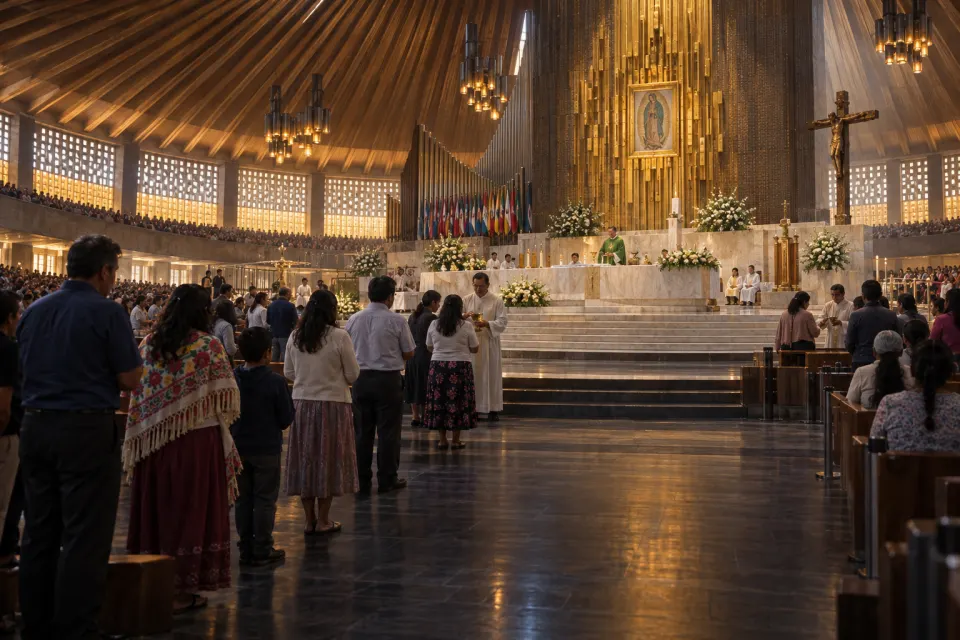
The Mass · Missa
Catholics are obliged to attend Mass every Sunday and on certain holy days. The Mass has two main parts: the Liturgy of the Word, with Bible readings and a homily, and the Liturgy of the Eucharist, when the priest consecrates bread and wine and the people receive communion. It is celebrated every day of the year except Good Friday.[49]
Sacraments through life
Most Catholics are baptised as infants. Latin Catholic children usually make their first confession and first communion around the age of seven and are confirmed later; Eastern Catholics give baptism, confirmation and communion together to infants. Church law requires confession of serious sins at least once a year. Marriage, ordination and the anointing of the seriously ill mark later stages.[19, 50]
Fasting and devotions
Latin Catholics fast on Ash Wednesday and Good Friday and abstain from meat on Fridays, a rule many bishops' conferences limit to Lent. Outside the liturgy they pray the rosary, a cycle of Our Fathers and Hail Marys spent meditating on the lives of Jesus and Mary, walk the Stations of the Cross and make pilgrimages to shrines.[51–52]
Religious life
Men and women in religious orders take vows of poverty, chastity and obedience. Monks follow the Rule of Benedict; Franciscan and Dominican friars preach and serve the poor; Jesuits run schools and missions; and many congregations of sisters staff hospitals and schools. Enclosed nuns, such as the Carmelites reformed by Teresa of Ávila, devote their lives to prayer.[53–54]
Holy days
The year ahead
| Date | Holy day | Reckoned |
|---|---|---|
| 1 November 2026 | All Saints' Day | 1 November |
| 25 December 2026 | Christmas | 25 December |
| 10 February 2027 | Ash Wednesday | 46 days before Easter Sunday (Gregorian reckoning) |
| 21 March 2027 | Palm Sunday | 7 days before Easter Sunday (Gregorian reckoning) |
| 26 March 2027 | Good Friday | 2 days before Easter Sunday (Gregorian reckoning) |
| 28 March 2027 | Easter Sunday | Easter Sunday (Gregorian reckoning) |
| 16 May 2027 | Pentecost | 49 days after Easter Sunday (Gregorian reckoning) |
| 15 August 2027 | Assumption of Mary | 15 August |
Easter and Holy Week
Sunday after the first full moon of spring (March or April)
The centre of the Catholic year. The three days from Holy Thursday evening through Good Friday and the Easter Vigil recall the Last Supper, the crucifixion and the resurrection. Adults are often baptised at the Vigil.[55]
Christmas
25 December
The feast of Jesus' birth, prepared for by the four Sundays of Advent. Catholic tradition gives Christmas several Masses, beginning at midnight, and its season runs into January, taking in the Epiphany.[56]
Ash Wednesday
46 days before Easter (February or March)
The first day of Lent, the season of penance before Easter. Priests mark worshippers' foreheads with ashes as a sign of mortality and repentance, and Latin Catholics fast that day.[51, 57]
Assumption of Mary
15 August
Celebrates the belief that Mary was taken body and soul into heaven, which Pius XII defined as dogma in 1950. It is one of the Church's holy days of obligation, on which Catholics are expected to attend Mass.[46, 58]
People
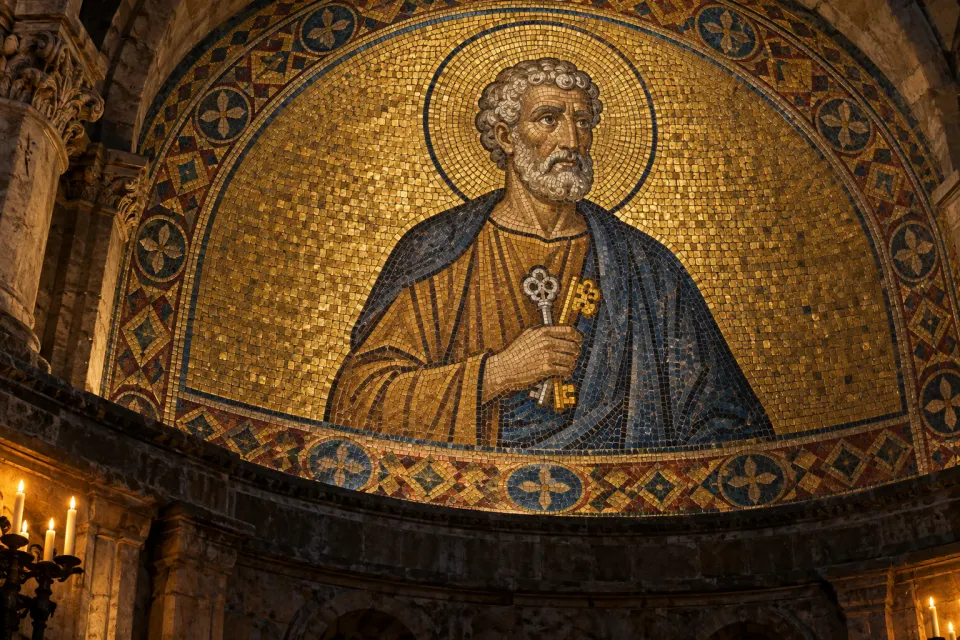
Peter
saint · died c. 64 CE
A fisherman and leader of Jesus' twelve apostles. Catholics hold that Jesus named him the rock on which the Church is built and count him as the first pope. Early writers place his martyrdom in Rome under Nero, though how he came to lead the church there is debated.[14, 59]

Mary
saint · 1st century BCE–1st century CE
The mother of Jesus, honoured by Catholics as Mother of God and first among the saints. Devotion to her runs through Catholic prayer, from the Hail Mary and the rosary to feasts, shrines and reported apparitions such as those at Guadalupe and Lourdes.[46, 60]

Francis of Assisi
saint · c. 1182–1226
A cloth merchant's son who gave up his wealth to live in poverty and preach. He founded the Friars Minor, whose rule the pope approved in 1223, and was made a saint two years after his death. Pope Francis took his name.[61]

Thomas Aquinas
scholar · 1225–1274
An Italian Dominican friar who joined Aristotle's philosophy to Christian theology, above all in his Summa theologiae, which he left almost finished at his death. Canonised in 1323, he was later named a Doctor of the Church and the patron of Catholic schools.[62]

Teresa of Ávila
saint · 1515–1582
A Spanish Carmelite nun who founded stricter, reformed convents and wrote classics of mystical prayer, among them The Interior Castle. In 1970 she and Catherine of Siena became the first women declared Doctors of the Church.[63]
Scripture
The Bible
c. 1000 BCE–c. 100 CE; canon fixed 1546
The Catholic Bible has 46 Old Testament books, including the deuterocanonical ones, and 27 in the New Testament. For a thousand years the Western church read it in Jerome's Latin Vulgate, which Trent declared authentic; Catholics now use approved translations in their own languages.[4, 65]
Confessions
c. 400
Augustine of Hippo (354–430), the North African bishop whose ideas on grace and sin shaped Western theology, wrote this book in his forties. It reflects on his early life, his years of searching and his conversion, and is addressed throughout to God as prayer and praise.[66]
Catechism of the Catholic Church
1992
A summary of Catholic teaching issued by John Paul II after the Second Vatican Council, in four parts: the creed, the sacraments, moral life and prayer. It serves as the reference for national catechisms and teachers.[67]
Places

St Peter's Basilica, Vatican City
ITA · UNESCO World Heritage, 1984
Begun in 1506 under Julius II and largely finished by 1615, over the shrine Catholics revere as Peter's tomb; Bramante, Michelangelo, who designed the dome, and Bernini, who added the piazza decades later, all shaped it. It hosts the great papal liturgies and stands within Vatican City, a World Heritage Site.[68]
Basilica of San Francesco, Assisi
ITA · UNESCO World Heritage, 2000
Begun after Francis was made a saint in 1228, this pair of churches, one built above the other, holds his tomb and frescoes by Cimabue, Giotto, Simone Martini and Pietro Lorenzetti. It is part of the Assisi World Heritage Site.[69]
Sanctuary of Our Lady of Lourdes
FRA
In 1858 a fourteen-year-old, Bernadette Soubirous, reported eighteen visions of Mary at a grotto here. The Church accepted them, and Lourdes grew into one of the great pilgrimage centres of Europe, visited by millions, many of them sick people hoping for healing.[70]
Basilica of Our Lady of Guadalupe
MEX
At Tepeyac, then outside Mexico City, where tradition says Mary appeared in December 1531 to Juan Diego, an Indigenous convert canonised in 2002. Her image on his cloak is venerated in a basilica that is among the most famous shrines of Latin America.[71]
Art & objects
Public-domain objects from museum collections. Select one to see it at the museum.
 Virgin of the Immaculate ConceptionItaly, 1710–20
 The Institution of the RosaryItaly, c. 1590
 Saint Francis before the Pope (The Approval of the Franciscan Rule)Italy, 1390–1400
 The Adoration of the EucharistFlanders, c. 1626
 Reliquary Monstrance in the form of a ChurchBrunswick, c. 1484
 The Assumption of the VirginGreece, 1577–79
 Reliquary Monstrance with a Tooth of Saint John the BaptistGermany, 1433; container: 900/1200
 Portrait of Pope Sixtus IV della RovereSpain, c. 1476–82
 Monstrance with the "Paten of Saint Bernward"paten: Germany, Lower Saxony, Hildesheim; monstrance: Germany, Lower Saxony, Brunswick, Gothic period, paten: 12th century; monstrance: 14th century, c. 1180–1190
 Book-Shaped ReliquaryIvory: Ottonian, Lorrain; Frame: Germany, Lower Saxony, Brunswick, Gothic period, 14th century, c. 1000
 Portrait of Pope Innocent X PamphiliItaly, designed 1647–48; cast 1650–1700
 Saint Ignatius Loyola with Saints and Martyrs of the Jesuit Ordersecond half of the 17th century
 Pope Benedict XV (1854–1922)modeled 1915, cast probably before 1950
 RosaryGerman, ca. 1500–1525
Numbers
- Baptised Catholics
- c. 1.3–1.4 billion (2024)[9]
1.422 billion is the Church's own count of baptised members for 2024. Independent estimates run lower: Britannica gives some 1.3 billion; Pew counted 1.1 billion in 2010.
- Where Catholics live
- Americas 48%, Africa 20%, Europe 20%, Asia 11% (2024)[40, 72]
Church statistics. In 1910 about two-thirds of Catholics lived in Europe (Pew Research Center).
- Largest Catholic population
- Brazil[73]
Brazil has the most Catholics of any country, though their share of its people has fallen, to about 57% in the 2022 census.
National censuses
| Country | Year | Count | Share |
|---|---|---|---|
| Canada Catholic | 2021 | 10,880,360 | 29.9% |
| Australia Catholic | 2021 | 5,075,905 | 20.0% |
| New Zealand Catholicism nfd + Roman Catholic | 2018 | 468,759 | 10.0% |
Source: Australian Bureau of Statistics, Census of Population and Housing 2021, 'Religious affiliation in Australia' (Table 4), CC BY 4.0. Adapted from Statistics Canada, Table 98-10-0342-01 Religion by visible minority and generation status: Canada, provinces and territories, census metropolitan areas and census agglomerations with parts, released 2022-10-26. This does not constitute an endorsement by Statistics Canada of this product. Source: Stats NZ, 2018 Census, licensed by Stats NZ for re-use under the Creative Commons Attribution 4.0 International licence.
Common misconceptions
Myth Catholics worship Mary and the saints.
Fact Catholic teaching reserves worship, or adoration, for God alone. Mary and the saints receive veneration: Catholics honour them and ask them to pray on their behalf, much as one might ask a friend to pray. Theologians mark the difference with separate terms: latria for the adoration of God, dulia (for Mary, hyperdulia) for the honour shown to saints.[47]
Myth Catholic priests can never be married.
Fact Celibacy is a rule of the Latin Church, not a doctrine. Most Eastern Catholic churches ordain married men as priests, though their bishops are unmarried. The Latin Church itself makes exceptions in certain cases, and since the Second Vatican Council it has ordained married men as permanent deacons.[6, 74]
Glossary
- Magisterium
- The teaching authority of the Church, exercised by the bishops together with the pope as their head, which Catholics believe Christ entrusted to the apostles and their successors.[11]
- Holy See
- The pope's office as the central government of the Catholic Church, recognised in international law. It is distinct from Vatican City, the small state that gives it territorial independence.[75]
- Roman Curia
- The offices through which the pope governs the worldwide Church. Since a 2022 reform they are all called dicasteries, such as the Dicastery for the Doctrine of the Faith.[76]
- Conclave
- The locked meeting in the Sistine Chapel at which cardinals under the age of 80 elect a pope by a two-thirds majority; white smoke announces the result.[77]
- Encyclical
- A formal letter from the pope to the bishops and faithful, used for major teaching, such as Rerum novarum (1891) or Laudato si' (2015).[78]
- Canonisation
- The pope's declaration that a dead person is a saint in heaven, after an inquiry into their life and, normally, miracles attributed to their prayers; beatification is the stage before it.[79]
- Indulgence
- A remission of the temporal punishment still due for sins already forgiven, granted by the Church for prayers or good works. Abuses in preaching them, including payments, provoked Luther's protest of 1517.[80]
- Canon law
- The Church's own legal system. The Latin Church follows the Code of Canon Law of 1983; the Eastern Catholic churches share a code issued in 1990.[81]
Sources
Each statement above was checked against published sources; the verdict says whether it stood as written, was corrected or was hedged.
- VerifiedBritannica, Roman Catholicism; Worldmark, Christianity: Roman Catholicism.
- VerifiedBritannica, Leo XIV; CNN, Robert Prevost elected as first American pope and takes the name Leo XIV; PBS NewsHour, Cardinal Prevost elected next pope, first American pontiff; Vatican News, Pope's October prayer intention (supporting).
- VerifiedBritannica, Vatican City; Britannica, Roman Catholicism; Bowker, Concise Oxford Dictionary of World Religions, Holy See, via Encyclopedia.com.
- VerifiedWorldmark, Christianity: Roman Catholicism; Britannica, Biblical canon; NCE, Canon, Biblical.
- VerifiedBritannica, Roman Catholicism; Encyclopedia.com, Christianity roman catholicism.
- VerifiedBritannica, Celibacy; Encyclopedia.com, Christianity roman catholicism; Oxford Reference, Oxford Dictionary of the Christian Church, Uniat Churches.
- VerifiedBritannica, Eastern rite church; Encyclopedia.com, Christianity roman catholicism; Oxford Reference, Uniat Churches.
- VerifiedBritannica, Second Vatican Council; NCE, Tridentine Mass.
- HedgedBritannica, Roman Catholicism; Pew Research Center, The Global Catholic Population; Catholic Culture (supporting); Vatican News, New data of Annuario Pontificio 2026 (supporting).
- VerifiedBritannica, Roman Catholicism; Pew 2013; Encyclopedia.com, Christianity roman catholicism.
- VerifiedBritannica, Magisterium; NCE, Teaching Authority of the Church.
- VerifiedBritannica, Roman Catholicism; Encyclopedia.com, Christianity roman catholicism.
- VerifiedPew 2013; Encyclopedia.com, Christianity roman catholicism; Vatican News 2026 (supporting).
- VerifiedBritannica, Saint Peter the Apostle; NCE, Peter, Apostle, St..
- VerifiedEncyclopedia.com, Christianity roman catholicism; Britannica, Saint Peter; Britannica, Papal primacy; NCE/Encyclopedia of Religion, Papacy.
- VerifiedBritannica, Papacy: the medieval papacy; Encyclopedia.com, Christianity roman catholicism; NCE, Papacy.
- VerifiedBritannica, East-West Schism; Encyclopedia.com, Christianity roman catholicism.
- VerifiedBritannica, Saint Gregory VII; NCE, Papacy.
- VerifiedBritannica, Lateran Council; NCE, Lateran Councils; NCE, First Communion; NCE, Transubstantiation.
- VerifiedBritannica, Friar; Stanford Encyclopedia of Philosophy, Thomas Aquinas.
- VerifiedBritannica, Inquisition; Encyclopaedia Judaica, Inquisition, via Encyclopedia.com; NCE, Papacy; Britannica, Roman Catholicism.
- VerifiedBritannica, Roman Catholicism: The Babylonian Captivity; NCE, Papacy.
- VerifiedBritannica, Martin Luther; Encyclopedia.com, Christianity roman catholicism.
- VerifiedBritannica, Jesuits; NCE, Jesuits.
- VerifiedBritannica, Council of Trent; Encyclopedia.com, Christianity roman catholicism.
- VerifiedBritannica, Inquisition; EJ, Inquisition; Encyclopedia.com.
- CorrectedBritannica, Missal; NCE, Tridentine Mass.
- VerifiedBritannica, Royal patronage; NCE, Patronato Real.
- VerifiedBritannica, Roman Catholicism; Britannica, Bartolomé de Las Casas; Encyclopedia of Western Colonialism, Christianity and Colonial Expansion in the Americas, via Encyclopedia.com; Oxford Research Encyclopedia of Latin American History, Colonial Mosaic of Indigenous New Spain.
- VerifiedBritannica, Chinese Rites Controversy; NCE, Chinese Rites Controversy; NCE, Xavier, Francis, St.; NCE, Ricci, Matteo.
- VerifiedBritannica, Spain: The Spanish Inquisition; EJ, Inquisition.
- VerifiedBritannica, Roman question; Encyclopedia.com, Christianity roman catholicism; NCE, Lateran Pacts.
- VerifiedBritannica, Papal infallibility; NCE, Vatican Council I.
- VerifiedBritannica, What is Rerum novarum?; NCE, Rerum Novarum; NCE, Lateran Pacts.
- VerifiedBritannica, Second Vatican Council; NCE, Vatican Council II.
- VerifiedBritannica, Saint John Paul II; NCE, John Paul II, Pope.
- VerifiedBritannica, What was The Boston Globe's Spotlight series?; Contemporary American Religion, Child Abuse by Clergy, via Encyclopedia.com; CIASE, Sexual Violence in the Catholic Church, France 1950–2020.
- HedgedJohn Jay College of Criminal Justice; Library of Congress catalogue record for the John Jay study (supporting); CIASE final report; France 24, French Catholic Church inquiry finds at least 216,000 paedophilia cases; National Catholic Register / Catholic News Agency, French Catholic Academy Critiques Landmark Abuse Report.
- CorrectedBritannica, Francis summary; National Catholic Reporter, Pope Francis makes 'Vos Estis' clergy abuse law permanent; Religion News Service, Pope Francis, charismatic reformer and disruptor, dies at 88; Vatican News, New norms for the whole Church (supporting).
- HedgedBritannica, Roman Catholicism, Roman Catholicism in Africa and Asia; Pew Research Center, How the Global Religious Landscape Changed From 2010 to 2020; Catholic Culture (supporting); zenit.org (supporting); Vatican News 2026 (supporting).
- VerifiedEncyclopedia.com, Christianity roman catholicism; Britannica, Biblical canon; NCE, Canon, Biblical.
- VerifiedBritannica, Papal infallibility and Ex cathedra declaration; NCE, Infallibility; Encyclopedia.com, Christianity roman catholicism.
- VerifiedNCE, Infallibility; Britannica, Papal infallibility.
- VerifiedBritannica, Sacrament; Encyclopedia.com, Christianity roman catholicism; Britannica, Roman Catholicism.
- VerifiedBritannica, Lateran Council; NCE, Transubstantiation; Encyclopedia.com, Christianity roman catholicism.
- VerifiedBritannica, Pius IX; NCE, Immaculate Conception; NCE, Assumption of Mary; Encyclopedia.com, Christianity roman catholicism.
- VerifiedNCE, Mary, Blessed Virgin, Devotion to; Britannica, Veneration of the saints; Encyclopedia.com, Christianity roman catholicism.
- VerifiedBritannica, purgatory summary; Encyclopedia.com, Christianity roman catholicism; NCE, All Souls' Day; NCE, Purgatory.
- VerifiedBritannica, Liturgy of the Word; Encyclopedia.com, Christianity roman catholicism.
- VerifiedBritannica, The Seven Sacraments; NCE, First Communion; NCE, Confirmation; Encyclopedia.com, Christianity roman catholicism.
- VerifiedBritannica, Ash Wednesday; Encyclopedia.com, Christianity roman catholicism; NCE, Fast and Abstinence.
- VerifiedBritannica, Rosary; NCE, Rosary; NCE, Stations of the Cross; Encyclopedia.com, Christianity roman catholicism.
- VerifiedBritannica, Religious order; Encyclopedia.com, Christianity roman catholicism; Britannica, Jesuits.
- VerifiedBritannica, Saint Teresa of Ávila summary; NCE, Teresa of Avila, St..
- VerifiedBritannica, Easter summary; Encyclopedia.com, Christianity roman catholicism; NCE, Easter and its Cycle.
- VerifiedBritannica, Christmas; NCE, Christmas and its Cycle; Encyclopedia.com, Christianity roman catholicism.
- VerifiedBritannica, Ash Wednesday; Encyclopedia.com, Christianity roman catholicism.
- VerifiedBritannica, Holy days of obligation; Encyclopedia.com, Christianity roman catholicism.
- VerifiedBritannica, Saint Peter the Apostle; NCE, Peter, Apostle, St..
- VerifiedBritannica, Our Lady of Guadalupe; NCE, Lourdes; NCE, Guadalupe, Our Lady of; Encyclopedia.com, Christianity roman catholicism.
- VerifiedBritannica, Saint Francis of Assisi; NCE, Francis of Assisi, St..
- VerifiedStanford Encyclopedia of Philosophy, Thomas Aquinas; NCE, Thomas Aquinas, St.; Britannica, Saint Thomas Aquinas: Legacy.
- VerifiedBritannica, Saint Teresa of Ávila summary; NCE, Teresa of Avila, St..
- HedgedBritannica, Saint John Paul II; NCE, John Paul II, Pope; NCE, Catechism of the Catholic Church.
- VerifiedBritannica, Biblical literature: versions; NCE, Vulgate; Encyclopedia.com, Christianity roman catholicism.
- VerifiedBritannica, Confessions; Stanford Encyclopedia of Philosophy, Augustine of Hippo; NCE, Augustine, St..
- VerifiedNCE, Catechism of the Catholic Church; Britannica, Saint John Paul II and Catechism.
- CorrectedBritannica, St. Peter's Basilica; NCE, St. Peter's Basilica; UNESCO World Heritage Centre, Vatican City.
- VerifiedBritannica, San Francesco; UNESCO World Heritage Centre, Assisi, the Basilica of San Francesco and Other Franciscan Sites; NCE, Assisi.
- VerifiedBritannica, Saint Bernadette of Lourdes; NCE/Gale, Lourdes.
- VerifiedBritannica, Our Lady of Guadalupe; NCE, Guadalupe, Our Lady of.
- HedgedBritannica, Roman Catholicism, Roman Catholicism in Africa and Asia; Pew Research Center, The Global Catholic Population; Pew Research Center, How the Global Religious Landscape Changed From 2010 to 2020; Catholic Culture (supporting); zenit.org (supporting); Vatican News 2026 (supporting).
- VerifiedPew 2013; agenciadenoticias.ibge.gov.br; Pew Research Center, Catholicism Has Declined in Latin America Over the Past Decade; Vatican News, Pontifical Yearbook 2025 (supporting).
- CorrectedBritannica, Holy order; NCE, Vatican Council II; NCE/Encyclopedia of Religion, Celibacy; Pastoral Provision (supporting).
- VerifiedBowker, Concise Oxford Dictionary of World Religions, Holy See; Britannica, Vatican City.
- VerifiedBritannica, Roman Curia; NCE, Curia, Roman.
- VerifiedBritannica, Papal conclave: procedure; NCE, Conclave.
- VerifiedNCE, Encyclical; Britannica, Laudato si'.
- VerifiedBritannica, How Does Someone Become a Saint?; NCE, Canonization of Saints.
- CorrectedBritannica, indulgence summary; NCE, Indulgences.
- VerifiedBritannica, Code of Canon Law; NCE, Canon Law, History of; Oxford Reference, Uniat Churches.
Last fact-checked 3 October 2026.