Overview
Christianity is the religion centred on Jesus of Nazareth, a Jewish teacher executed by the Romans around 30 CE, whom Christians acknowledge as the Christ, the Son of God and the saviour of humanity. It grew out of Judaism and keeps its faith in one God, whom most Christians confess as a Trinity of Father, Son and Holy Spirit. Its scripture, the Bible, joins the Hebrew Bible, which Christians call the Old Testament, to the New Testament. With an estimated 2.3 billion followers in 2020, it is the world's largest religion. Its churches fall broadly into Catholic, Protestant and Orthodox families, alongside fast-growing Pentecostal and independent movements. Born in the Middle East, it now has more followers in sub-Saharan Africa than anywhere else.[3–4, 7, 9–11]
History

Jesus and the first believers c. 30–100 CE
Jesus, a Jewish preacher from Galilee, proclaimed the coming kingdom of God, gathered disciples and was crucified in Jerusalem on the orders of the Roman governor Pontius Pilate, probably around 30 CE. His followers soon reported that he had risen and appeared to them. At first they were a group within Judaism, led in Jerusalem by Peter and James. Paul of Tarsus, once a persecutor of the movement, took its message to non-Jews, and the decision to admit Gentiles without making them become Jews set the faith on course to be a separate religion.[12–15]
Persecution, empire and creeds 64–451
For more than two centuries Christians were a minority, meeting in homes under bishops and facing bouts of Roman persecution, beginning when Nero blamed them for the fire of Rome in 64. Constantine, the first emperor to profess the faith, agreed with Licinius in 313 that all might worship freely, and in 325 called the Council of Nicaea, which declared the Son of one substance with the Father. Theodosius I made Nicene faith the imperial standard from 380. Disputes over Christ's nature then divided the churches: the Church of the East in Persia declared its independence in 424, and the churches of Egypt, Syria and Armenia rejected the Council of Chalcedon in 451.[16–19]
Medieval East and West c. 600–1500
Missionaries carried the faith to the Slavs, and monks of the Church of the East reached Tang China in the 7th century. From the 630s Arab armies brought Syria, Egypt and Persia under Muslim rule; Christians there kept their churches and stayed numerous for centuries, but slowly became minorities. The Greek East and Latin West drifted apart over language, papal authority and doctrine. Mutual excommunications in 1054 came to symbolise the split, which hardened when crusaders sacked Constantinople in 1204, during the wars Latin Christians waged for the Holy Land from 1095 to 1291.[20–23]
Reformation and worldwide expansion 1500–1800
In 1517 the German friar Martin Luther attacked the sale of indulgences, and the dispute grew into a contest over whether the pope or the Bible held final authority. The Reformation split Western Christianity into the Catholic Church and Protestant traditions, among them Lutheran, Reformed, Anglican and Anabaptist; Catholics answered at the Council of Trent (1545–63), and religious rivalries fed the Thirty Years' War (1618–48). Spanish and Portuguese expansion carried Catholicism to the Americas, Africa and Asia. In the Americas, conquest and forced labour devastated Indigenous peoples; a few missionaries, notably Bartolomé de Las Casas, denounced the abuses.[24–27]
A global faith 1800–today
In the 19th century Protestant and Catholic missions spread across Africa, Asia and the Pacific, often alongside European empires, though much of the growth came through local catechists and Bible translations. Pentecostalism, which grew from a revival on Azusa Street, Los Angeles, beginning in 1906, spread worldwide. The World Council of Churches was founded in 1948, and the Catholic Second Vatican Council (1962–65) brought Mass in local languages. By 2020 sub-Saharan Africa held the largest share of the world's Christians, while numbers in Europe were falling and many raised as Christians had left the faith.[11, 28–31]
Key moments
- c. 30 CELife of Jesus · Galilee and Judea
- c. 50 CEPaul's letters · Eastern Mediterranean
- c. 80 CEThe Gospels are written · Eastern Mediterranean
- c. 270 CEAntony and the desert monks · Egypt, east of the Nile
- c. 301 CEArmenia becomes Christian · Vagharshapat, Armenia
- 313 CEThe Edict of Milan · Milan and Nicomedia (İzmit)
- 325 CECouncil of Nicaea · Nicaea (İznik, Türkiye)
- c. 340 CEAksum turns to Christ · Aksum, Ethiopia
- 367 CEAthanasius lists 27 books · Alexandria
- 380 CETheodosius makes Nicene faith the law · Thessalonica
- 431 CECouncil of Ephesus · Ephesus (Selçuk, Türkiye)
- 451 CECouncil of Chalcedon · Chalcedon (Istanbul)
- c. 530 CEBenedict writes his Rule · Monte Cassino, Italy
- c. 537 CEThe temple of Isis at Philae is closed · Philae, near Aswan, Egypt
- 537 CEHagia Sophia · Constantinople (Istanbul)
- c. 726 CEByzantium bans its icons · Constantinople
- 800 CECharlemagne crowned emperor · St Peter's Basilica, Rome
- c. 863 CECyril and Methodius among the Slavs · Great Moravia (Czechia and Slovakia)
- c. 957 CEOlga of Kyiv is baptised · Kyiv and Constantinople
- 988 CEThe Baptism of Rus' · Kyiv
- c. 1590 CEThe European witch trials · Europe, above all the German lands
- 1670 CESpinoza's Treatise · Amsterdam
- 1851 CEThe Taiping Heavenly Kingdom · Nanjing, China
- 1859 CEDarwin's Origin of Species · London and Oxford, England
- 1945 CEPancasila: Indonesia's five principles · Jakarta, Indonesia
Beliefs
Trinity
Christians believe in one God who exists as three persons, Father, Son and Holy Spirit, equal and sharing one divine being. The word does not appear in the New Testament; the doctrine was worked out in the 4th century, notably at the councils of Nicaea (325) and Constantinople (381), and nearly all churches affirm it.[32]
Incarnation
God taking on human flesh
Christians hold that in Jesus the eternal Son of God became a human being. The Council of Chalcedon (451) defined him as one person in two natures, fully divine and fully human. Catholic, Orthodox and most Protestant churches accept this formula; the Oriental Orthodox churches confess the same Christ but word his unity differently.[33–34]
Salvation
Christians hold that sin estranges humanity from God and that Jesus' crucifixion and his rising on the third day reconcile people to God. Paul wrote that without the resurrection faith would be empty, and it grounds the hope that the dead will rise to eternal life. Churches explain this atonement in several ways; Orthodox theology speaks of theosis, a sharing in God's life.[35–36]
Holy Spirit and the Church
Christians believe the Holy Spirit came upon the first disciples at Pentecost and still guides believers, and the New Testament calls the community of believers the body of Christ. Catholics and Orthodox read scripture within the church's tradition and honour bishops as successors of the apostles; Protestants make the Bible the final authority.[37–38]
Second Coming
Christians expect Christ to come again in glory as judge of all, living and dead, and to complete God's kingdom, with a new heaven and a new earth. Teachings on heaven, hell and, for Catholics, purgatory fill out this hope, and the Book of Revelation, which pictures the end, is read by some literally and by others symbolically.[39]
Practice

Baptism
Baptism with water, almost always in the name of the Father, Son and Holy Spirit, is the rite of entry into the church. Catholic, Orthodox, Anglican and many Protestant churches baptise infants, while Baptists, Pentecostals and others baptise only those old enough to profess faith. Water may be poured or sprinkled, or the person fully immersed.[40]
Eucharist and Sunday worship · εὐχαριστία
The Eucharist, also called Holy Communion, the Lord's Supper or the Mass, recalls Jesus' last meal with blessed bread and wine and is the central act of worship for most churches. Catholics and Orthodox believe Christ is truly present in it; some Protestants see a memorial. Most Christians worship on Sunday, the day of the resurrection, and say the Lord's Prayer, which Jesus taught according to the Gospels.[41–43]
Sacraments and rites of passage
Catholic and Orthodox churches count seven sacraments, which mark the stages of life and faith: baptism, confirmation (chrismation), the Eucharist, penance, anointing of the sick, marriage and ordination. Most Protestant churches keep only baptism and the Lord's Supper as rites instituted by Christ, and some, such as Baptists, call them ordinances rather than sacraments.[44]
Love of God and neighbour
In the Gospels Jesus sums up the law in two commandments: to love God with all one's being and one's neighbour as oneself. Christian ethics builds on these, and churches have long made care for the sick and poor a duty; healing played a part in the early church's growth, and Christian missionaries went on to found many hospitals, notably across Africa.[45]
Holy days
The year ahead
| Date | Holy day | Reckoned |
|---|---|---|
| 25 December 2026 | Christmas | 25 December |
| 6 January 2027 | Epiphany | 6 January |
| 7 January 2027 | Christmas (Julian calendar) | 25 December in the Julian calendar |
| 10 February 2027 – 27 March 2027 | Lent | 46 days before Easter Sunday (Gregorian reckoning) |
| 26 March 2027 | Good Friday | 2 days before Easter Sunday (Gregorian reckoning) |
| 28 March 2027 | Easter Pascha | Easter Sunday (Gregorian reckoning) |
| 2 May 2027 | Pascha (Orthodox Easter) Πάσχα | Pascha (Julian reckoning) |
| 16 May 2027 | Pentecost | 49 days after Easter Sunday (Gregorian reckoning) |
Easter · Pascha
First Sunday after the first full moon of spring (22 March–25 April in the West)
The principal Christian festival, celebrating Jesus' resurrection. It closes Holy Week, which recalls his entry into Jerusalem, last supper and crucifixion. Orthodox churches reckon the date by the Julian calendar, so their Easter usually falls later.[46]
Christmas
25 December; 7 January in churches using the Julian calendar
The feast of Jesus' birth, kept in Rome on 25 December from about 336 and prepared for by Advent. Orthodox churches that follow the Julian calendar keep it on what is 7 January in the Gregorian calendar; the Armenian Church keeps 6 January.[47]
Lent
About forty days before Easter (February–April)
A season of fasting, prayer and almsgiving before Easter, recalling Jesus' forty days in the wilderness. Western churches begin it on Ash Wednesday; Eastern churches keep a Great Lent beginning on a Monday seven weeks before Easter.[48]
People

Jesus of Nazareth
founder · c. 6–4 BCE – c. 30 CE
A Galilean Jew, baptised by John the Baptist, who had a short public career as a travelling preacher and healer before his crucifixion in Jerusalem. Christians call him Christ, Greek for 'anointed', translating the Hebrew 'Messiah', and most believe him to be God made human.[2, 49]

Mary
saint · early 1st century CE
The mother of Jesus. The Gospels of Matthew and Luke say she conceived him as a virgin, and the Council of Ephesus upheld her title Theotokos, 'God-bearer'. Catholics and Orthodox honour her above all other saints; most Protestants respect her but reject prayer to her.[50]

Peter
saint · died c. 64 CE
A Jewish fisherman whom Jesus named Cephas, 'Rock', and who led the twelve apostles. Early tradition says he died a martyr in Rome under Nero, and the Catholic Church regards him as the first pope.[51]

Paul of Tarsus
saint · died c. 62–64 CE
A Jew from Tarsus who persecuted the early believers, then, after what he described as a vision of the risen Jesus, became the leading missionary to the Gentiles. Thirteen New Testament letters bear his name; scholars accept seven as certainly his.[52–53]
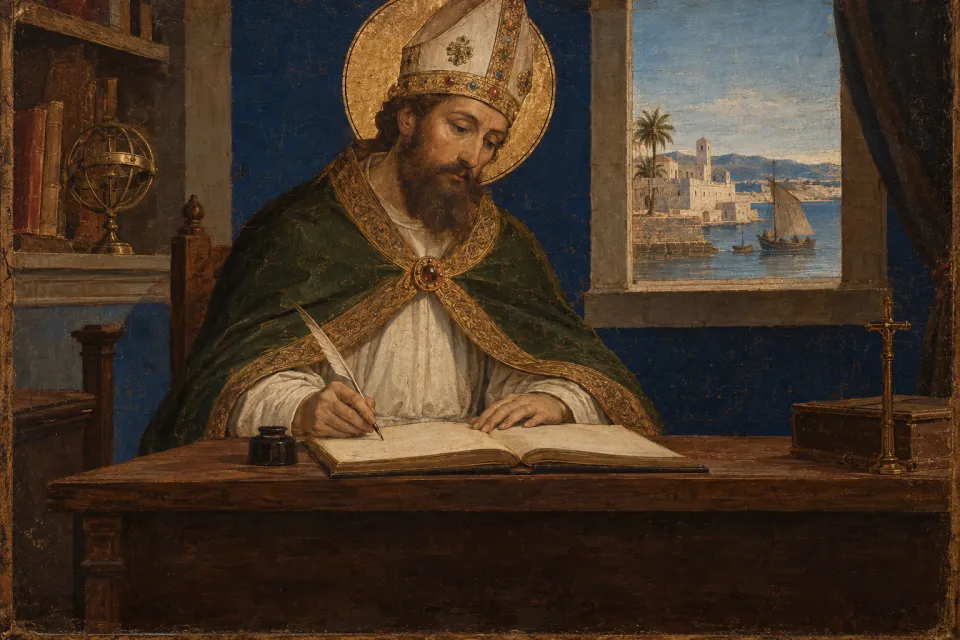
Augustine of Hippo
scholar · 354–430
Bishop of Hippo in North Africa from 396 and perhaps the most influential Christian thinker after Paul. His Confessions, The City of God and his teaching on grace and predestination shaped Western theology, Catholic and later Protestant.[54]
Scripture
The Bible
The Old Testament is the Hebrew Bible, counted by Protestants as 39 books; Catholic and Orthodox Bibles include further books, giving Catholics 46. The New Testament's 27 books are shared by all major churches, though agreement on the list took centuries.[55]
The four Gospels
c. 70–110 CE
Matthew, Mark, Luke and John tell of Jesus' life, teaching, death and resurrection. The first three, the Synoptic Gospels, share so much material and wording that they can be read side by side; John follows its own order and has long theological discourses.[56]
The Nicene Creed
325, enlarged 381
A statement of faith in the Trinity and in Christ, linked to the councils of Nicaea (325) and Constantinople (381). It is the one creed accepted by Catholic, Orthodox, Anglican and major Protestant churches, though East and West still differ over the Western addition that the Spirit proceeds from the Father 'and the Son'.[57]
Places
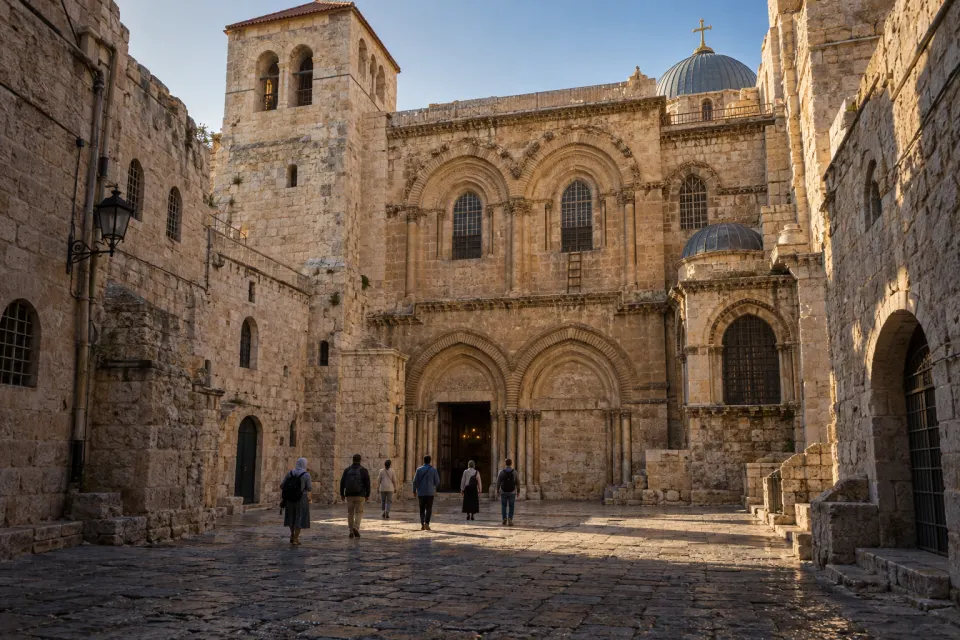
Church of the Holy Sepulchre, Jerusalem
PSE · UNESCO World Heritage, 1981
Built over the traditional site of Jesus' crucifixion and tomb, Constantine's first church here was dedicated around 336; the present building dates mainly from Crusader rebuilding and 1810. Greek, Latin, Armenian, Coptic and other churches share it.[58]
Church of the Nativity, Bethlehem
PSE · UNESCO World Heritage, 2012
Christian tradition has placed Jesus' birth in a cave here since the 2nd century. The first church was completed in 339, and the building that replaced it after a 6th-century fire still stands.[59]
Hagia Sophia, Istanbul
TUR · UNESCO World Heritage, 1985
Justinian I built this great domed church in 532–537 as the cathedral of Constantinople. After the Ottoman conquest of 1453 it became a mosque, then a museum in 1935, and a mosque again in 2020.[60]
Rock-hewn churches of Lalibela
ETH · UNESCO World Heritage, 1978
Eleven churches carved from solid rock in the Ethiopian highlands, credited by tradition to King Lalibela (late 12th–early 13th century), who meant them as a new Jerusalem. They remain a pilgrimage centre of the Ethiopian Orthodox Tewahedo Church.[61]
Where it spread
| Region | From | How |
|---|---|---|
| Israel | 30 CE | Jerusalem and Galilee |
| Palestine | 30 CE | Jerusalem and Bethlehem |
| Syria | 34 CE | Damascus |
| Turkey | 40 CE | Antioch and Paul's journeys |
| Cyprus | 45 CE | Paul and Barnabas |
| Greece | 50 CE | Philippi, Thessalonica, Corinth |
| Italy | 50 CE | A community in Rome by the 40s |
| Lebanon | 50 CE | Tyre and Sidon |
| Egypt | 60 CE | Alexandria; tradition credits Mark, and Christians are attested there by the 2nd century |
| Jordan | 70 CE | Pella, by tradition |
| Albania | 100 CE | Dyrrachium (Durrës); its first bishops are known from church tradition |
| Iraq | 150 CE | Adiabene (Erbil) and Mesopotamia; later the heartland of the Church of the East |
| France | 160 CE | Lyon's martyrs of 177 |
| Algeria | 180 CE – 1150 CE | Augustine's Hippo; the last bishops are attested in the 11th century |
| Tunisia | 180 CE – 1300 CE | Carthage; the ancient North African church had faded by around the 12th–14th centuries |
| Spain | 200 CE | |
| United Kingdom | 200 CE | Alban, Britain's first recorded martyr, 3rd century |
| Iran | 250 CE | Christians under the Sasanians; today mostly Armenians and Assyrians |
| Austria | 300 CE | Roman Noricum |
| Bulgaria | 300 CE | Serdica; the Bulgarian state converted in 864 |
| Germany | 300 CE | Trier and Cologne |
| Croatia | 300 CE | Roman Salona; the Croats were baptized in the 7th–9th centuries |
| India | 300 CE | St Thomas Christians; their tradition dates the church to 52 CE |
| Kosovo | 300 CE | Roman Dardania |
| Libya | 300 CE – 1100 CE | Cyrenaica and Tripolitania; Synesius of Cyrene was a bishop about 410 |
| North Macedonia | 300 CE | |
| Malta | 300 CE | Paul's shipwreck (c. 60) by tradition; catacombs attest Christians by the 4th century; continuity under Arab rule is debated |
| Portugal | 300 CE | Braga |
| Romania | 300 CE | Scythia Minor (Dobruja) |
| Slovenia | 300 CE | Roman Poetovio (Ptuj) and Emona |
| Armenia | 301 CE | Traditional date; historians often suggest about 314 |
| Eritrea | 330 CE | Kingdom of Aksum |
| Ethiopia | 330 CE | EGY. Aksum under King Ezana |
| Georgia | 330 CE | Saint Nino and King Mirian III |
| Belgium | 350 CE | Tongeren |
| Switzerland | 380 CE | |
| Azerbaijan | 400 CE | Caucasian Albania; Christians today are mainly Russian Orthodox |
| Bosnia and Herzegovina | 400 CE | |
| Ireland | 431 CE | Palladius; Patrick's mission is dated to 432 by tradition |
| Saudi Arabia | 500 CE – 640 CE | Najran, an important Christian center before Islam |
| Sudan | 543 CE – 1500 CE | The Nubian kingdoms of Nobadia, Makuria and Alwa |
| China | 635 CE – 845 CE | Church of the East under the Tang |
| Netherlands | 690 CE | Willibrord at Utrecht; Maastricht earlier |
| Luxembourg | 700 CE | Willibrord's abbey at Echternach |
| Czechia | 850 CE | Frankish missions first; Cyril and Methodius reached Great Moravia in 863 |
| Slovakia | 850 CE | Frankish missions first; Cyril and Methodius reached Great Moravia in 863 |
| Montenegro | 870 CE | |
| Serbia | 870 CE | Serbs baptized about 870 |
| Denmark | 965 CE | Harald Bluetooth's Jelling stone |
| Poland | 966 CE | Baptism of Mieszko I |
| Russia | 988 CE | TUR. Baptism of Kyivan Rus' |
| Ukraine | 988 CE | TUR. Baptism of Kyivan Rus' |
| Belarus | 990 CE | Polotsk |
| Greenland | 1000 CE – 1450 CE | Norse settlements; a bishop's seat from 1126, last written record 1408 |
| Hungary | 1000 CE | Stephen I |
| Iceland | 1000 CE | NOR. Adopted by the Althing |
| Norway | 1000 CE | Olaf Tryggvason; Olaf II's church law at Moster, 1024 |
| Sweden | 1000 CE | Olof Skötkonung; conversion was gradual |
| Finland | 1150 CE | The southwest first; the church was organized in the 12th century |
| Latvia | 1200 CE | Riga, founded 1201 |
| Estonia | 1220 CE | |
| China | 1294 CE – 1368 CE | Church of the East and a Franciscan mission in Khanbaliq (Beijing) under the Yuan |
| Moldova | 1350 CE | Principality of Moldavia |
| Lithuania | 1387 CE | Baptism under Jogaila; an earlier conversion under Mindaugas (1251) did not last |
| Angola | 1491 CE | PRT. Kingdom of Kongo, baptism at Mbanza Kongo |
| DR Congo | 1491 CE | PRT. Lands of the Kongo kingdom; wider growth with missions from the 1880s |
| Dominican Republic | 1494 CE | ESP. La Isabela, then Santo Domingo (1496–98) |
| Haiti | 1503 CE | ESP. Spanish towns in western Hispaniola; French Saint-Domingue from the 1600s |
| Puerto Rico | 1508 CE | ESP |
| Jamaica | 1509 CE | ESP |
| Colombia | 1510 CE | ESP. Santa María la Antigua del Darién (1510–24), then coastal towns |
| Cuba | 1511 CE | ESP |
| Malaysia | 1511 CE | PRT. Portuguese Malacca |
| Venezuela | 1515 CE | ESP. Missions at Cumaná; Coro became the first diocese in 1531 |
| Mexico | 1519 CE | ESP. Veracruz; Mexico City from 1521 |
| Panama | 1519 CE | ESP. Panamá Viejo |
| Guatemala | 1524 CE | ESP |
| Honduras | 1524 CE | ESP |
| Nicaragua | 1524 CE | ESP |
| El Salvador | 1525 CE | ESP |
| Brazil | 1532 CE | PRT. First Mass in 1500; first settlements in the 1530s |
| Peru | 1532 CE | ESP |
| Ecuador | 1534 CE | ESP. Quito |
| Paraguay | 1537 CE | ESP. Asunción |
| Bolivia | 1538 CE | ESP. La Plata (Sucre) |
| Indonesia | 1538 CE | Ambon and the Moluccas; Francis Xavier arrived in 1546 |
| Chile | 1541 CE | ESP |
| Sri Lanka | 1543 CE | PRT. Portuguese Franciscans; later Dutch and British missions |
| Japan | 1549 CE | Francis Xavier; kept in secret during the ban of 1614–1873 |
| Belize | 1550 CE | Spanish missions among the Maya (Lamanai, Tipu); British settlers from the 1600s |
| Argentina | 1553 CE | ESP. Santiago del Estero |
| Timor-Leste | 1556 CE | Dominican baptisms about 1556; a lasting mission at Lifau from the 1640s |
| Mozambique | 1560 CE | Portuguese coast and Zambezi valley; missions lapsed 1834–1881, then resumed |
| Costa Rica | 1563 CE | ESP. Cartago |
| Philippines | 1565 CE | ESP. Cebu; Magellan's visit in 1521 did not last |
| United States | 1565 CE | ESP. St Augustine, Florida |
| Thailand | 1567 CE | Portuguese Dominicans at Ayutthaya |
| China | 1582 CE | PRT. Matteo Ricci and the Jesuit mission; Portuguese Macau earlier |
| Trinidad and Tobago | 1592 CE | |
| Bangladesh | 1600 CE | Portuguese Catholics at Chittagong and Dhaka |
| Myanmar | 1600 CE | Catholic Bayingyi since the 1600s; Baptist mission from 1813; today mostly Kachin, Chin and Karen |
| Canada | 1608 CE | FRA. Quebec; Port-Royal (1605) was briefly abandoned |
| Vietnam | 1615 CE | Jesuit mission at Hội An |
| Guyana | 1616 CE | |
| Kazakhstan | 1620 CE | Orthodox Ural Cossacks at Oral; Russian settlers spread in the 1700s–1800s |
| Uruguay | 1624 CE | Franciscan mission at Santo Domingo de Soriano |
| Bahamas | 1648 CE | Eleutheran settlers |
| Suriname | 1650 CE | |
| South Africa | 1652 CE | Cape Colony; Moravian mission to the Khoikhoi from 1737 |
| Greenland | 1721 CE | NOR. Hans Egede's mission |
| Mauritius | 1722 CE | Catholic missions under French rule |
| Senegal | 1779 CE | Saint-Louis and Gorée |
| South Korea | 1784 CE | CHN. Founded by Korean lay believers |
| North Korea | 1784 CE | Shares Korea's 1784 origins; Pyongyang was a major Christian center before 1945; religion is state-controlled today |
| Australia | 1788 CE | GBR |
| Sierra Leone | 1792 CE | Freetown |
| Namibia | 1805 CE | LMS mission at Warmbad (1805–11); lasting missions from the 1840s |
| New Zealand | 1814 CE | AUS. Samuel Marsden and the CMS mission, Bay of Islands |
| Madagascar | 1818 CE | LMS mission; banned 1835–1861 but kept in secret |
| Singapore | 1819 CE | |
| Gambia | 1820 CE | Bathurst (Banjul) |
| Liberia | 1822 CE | |
| Ghana | 1828 CE | Basel Mission at Osu; earlier Anglican work at Cape Coast and a Portuguese chapel at Elmina |
| Lesotho | 1833 CE | |
| Fiji | 1835 CE | Methodist mission at Lakeba |
| Equatorial Guinea | 1841 CE | Bioko: Baptists from 1841, Catholic missions from 1858 |
| Gabon | 1842 CE | |
| Nigeria | 1842 CE | GHA. Badagry |
| New Caledonia | 1843 CE | |
| Kenya | 1844 CE | Johann Krapf near Mombasa; a Portuguese-era church (1590s–1729) left no community |
| Botswana | 1845 CE | |
| Cameroon | 1845 CE | |
| Vanuatu | 1848 CE | |
| Pakistan | 1849 CE | Missions in the Punjab; a Jesuit church in Lahore (1595–1614) did not last |
| Taiwan | 1859 CE | Dutch and Spanish missions of the 1620s–1660s did not last |
| Zimbabwe | 1859 CE | Inyati mission; wide growth after 1890 |
| Tanzania | 1860 CE | Zanzibar mission; Bagamoyo on the mainland from 1868 |
| Benin | 1861 CE | |
| Solomon Islands | 1870 CE | Anglican Melanesian Mission; a Catholic mission of 1845–52 did not last |
| Papua New Guinea | 1871 CE | London Missionary Society, led by Pacific Islander teachers |
| Malawi | 1875 CE | |
| Guinea | 1877 CE | Spiritan mission at Boffa |
| Uganda | 1877 CE | |
| eSwatini | 1880 CE | A Wesleyan mission of 1844–47 was abandoned; missions resumed about 1880 |
| Laos | 1881 CE | Catholic villages in the south |
| Congo | 1883 CE | |
| Zambia | 1885 CE | |
| Togo | 1892 CE | |
| Central African Republic | 1894 CE | |
| Côte d'Ivoire | 1895 CE | |
| Mali | 1895 CE | White Fathers at Ségou and Timbuktu |
| Burundi | 1898 CE | |
| Burkina Faso | 1900 CE | |
| Rwanda | 1900 CE | |
| Sudan | 1900 CE | Missions resumed after 1899; Khartoum and the Nuba Mountains |
| South Sudan | 1900 CE | |
| Chad | 1929 CE | |
| Nepal | 1951 CE | A Capuchin mission of 1715–69 did not last |
| Mongolia | 1990 CE | Churches grew after 1990 |
Art & objects
Public-domain objects from museum collections. Select one to see it at the museum.
 The AnnunciationMantua, 1484/1519
 The Annunciation, from The Life of the VirginGermany, c. 1503, published 1511
 The NativityAustria, 1507–10
 The NativityItaly, c. 1465
 The Baptism of ChristItaly, 1500–05
 The CrucifixionItaly, 1401–04
 Stonyhurst Hours (Use of Sarum)Flanders, c. 1400–10
 Resurrection of ChristHolland, c. 1665
 CrucifixionGermany, 1508
 Virgin and ChildFrance, c. 1245
 Christ EnthronedGermany, n.d.
 CrucifixMeuse, c. 1150
 Plaque with the CrucifixionLimoges, 1200–10
 Saint Gregory as AuthorGermany, 1188/1200
Numbers
- Christians worldwide
- c. 2.3 billion (2020)[9]
Pew: 2.3 billion, 28.8% of humanity, in 2020. The World Christian Database, counting more broadly, gives 2.5 billion for 2020 and 2.6 billion for 2025.
- Catholics
- About half of all Christians[62]
Pew: 50% of Christians in 2010. World Christian Database: 1.27 billion Catholics in 2025.
National censuses
| Country | Year | Count | Share |
|---|---|---|---|
| India Christian | 2011 | 27,819,588 | 2.3% |
| United Kingdom (England and Wales) Christian | 2021 | 27,522,672 | 46.2% |
| Canada Christian | 2021 | 19,373,330 | 53.3% |
| Australia Total Christian | 2021 | 11,148,814 | 43.9% |
| New Zealand all Christian responses | 2018 | 1,738,638 | 37.0% |
Source: Australian Bureau of Statistics, Census of Population and Housing 2021, 'Religious affiliation in Australia' (Table 4), CC BY 4.0. Source: Office of the Registrar General & Census Commissioner, India, Census of India 2011, Table C-01 Population by religious community and its appendix, under the Government Open Data License – India. Source: Office for National Statistics licensed under the Open Government Licence v.3.0 Adapted from Statistics Canada, Table 98-10-0342-01 Religion by visible minority and generation status: Canada, provinces and territories, census metropolitan areas and census agglomerations with parts, released 2022-10-26. This does not constitute an endorsement by Statistics Canada of this product. Source: Stats NZ, 2018 Census, licensed by Stats NZ for re-use under the Creative Commons Attribution 4.0 International licence.
How we know
The historical Jesus
Historians almost all agree that Jesus existed. Besides the New Testament, the Jewish historian Josephus and the Roman historian Tacitus mention him, though they confirm little beyond his existence and execution under Pilate. Scholars broadly agree that he was a Jewish preacher from Galilee, baptised by John, who announced the kingdom of God and was crucified by the Romans. Whether he rose from the dead or was divine is a matter of faith that historical method cannot test.[63–65]
How the Gospels were written
The Gospels were written in Greek, decades after Jesus' death, and circulated anonymously; the names Matthew, Mark, Luke and John come from later tradition. Most scholars date Mark to around 70 CE, Matthew and Luke to roughly the 80s, and John to about 90–110. The prevailing view is that Matthew and Luke both drew on Mark and on a lost collection of sayings called Q. Paul's letters, from around 50 onward, are older than all four.[66–69]
Common misconceptions
Myth Christianity is essentially a Western, European religion.
Fact It began in Roman Judaea, and some of its oldest churches are in Egypt, Syria, Iraq, Armenia, Ethiopia and India. Europe was its centre of gravity for centuries, but by 2020 about two-thirds of Christians lived in Africa, Asia and Latin America, with sub-Saharan Africa the largest single region.[70]
Myth Historians doubt that Jesus ever existed.
Fact Almost no historians of the period, whatever their beliefs, doubt that he lived. They debate which sayings and deeds go back to him, and the resurrection lies beyond what history can decide, but his existence as a Jewish teacher crucified under Pontius Pilate is treated as secure.[63, 65]
Glossary
- Gospel · εὐαγγέλιον
- Greek euangelion, 'good news', rendered in Old English as god-spell: the Christian message about Jesus, and each of the four books that tell his story.[71]
- Christ · Χριστός
- A title, not a surname: Greek christos, 'anointed', translating the Hebrew for Messiah.[72]
- Apostle · ἀπόστολος
- Greek for 'one who is sent': the twelve disciples Jesus chose, and others such as Paul.[73]
- Sacrament
- A rite that churches believe conveys God's grace through visible signs; Augustine called it the visible form of an invisible grace. Catholics and Orthodox count seven, most Protestants two.[74]
- Saint
- A holy person honoured after death. The first saints were martyrs; Catholics and Orthodox ask saints to pray for them, and the Catholic Church names saints by canonisation.[75]
- Icon · εἰκών
- A sacred image of Christ, Mary or a saint, central to Orthodox devotion; the Second Council of Nicaea (787) upheld its veneration against the Iconoclasts.[76]
- Ecumenism
- From Greek oikoumenē, 'the inhabited world': the movement for unity among churches, which took shape after the Edinburgh missionary conference of 1910.[77]
- Theotokos · Θεοτόκος
- Greek for 'God-bearer': Mary's title as mother of the incarnate Son, upheld at the Council of Ephesus in 431.[78]
Sources
Each statement above was checked against published sources; the verdict says whether it stood as written, was corrected or was hedged.
- VerifiedBritannica, Christianity; Encyclopedia.com.
- VerifiedBritannica, Jesus; Encyclopedia.com; Yale, Martin, RLST 152 lecture 2.
- VerifiedBritannica, Trinity; Encyclopedia.com.
- VerifiedBritannica, Bible; Encyclopedia.com.
- VerifiedBritannica, Christianity; Encyclopedia.com.
- CorrectedBritannica, bishop; Encyclopedia.com.
- VerifiedBritannica, Christianity; Pew, Global Christianity: Traditions.
- VerifiedBritannica, cross; Encyclopedia.com.
- VerifiedPew, How the Global Religious Landscape Changed From 2010 to 2020; Center for the Study of Global Christianity; Britannica, Christianity.
- VerifiedBritannica, Jesus; Encyclopedia.com.
- VerifiedPew, Christian population change; Center for the Study of Global Christianity, Status of Global Christianity, 2025.
- VerifiedBritannica, Jesus; EoR, Jesus; Yale, Martin, RLST 152 lecture 13; Encyclopedia.com.
- VerifiedBritannica, Jesus; Encyclopedia.com.
- VerifiedEncyclopedia.com; Britannica, Saint Paul.
- VerifiedEncyclopedia.com; Britannica, Saint Paul.
- VerifiedEncyclopedia.com; Britannica, Nero; Britannica, Edict of Milan.
- VerifiedBritannica, Constantine I; Encyclopedia.com; app event `milan-313`, `council-of-nicaea-325`.
- VerifiedBritannica, Theodosius I; NCE, Theodosius I, Roman Emperor.
- VerifiedBritannica, Nestorianism; NCE, Assyrian Church of the East; NCE, Orthodox and Oriental Orthodox Churches; Pew 2011 Traditions.
- VerifiedBritannica, Saints Cyril and Methodius; Encyclopedia.com.
- VerifiedPrinceton University Press, J. Tannous, The Making of the Medieval Middle East; Britannica, Copt.
- VerifiedBritannica, East-West Schism; Encyclopedia.com; Britannica, Crusades.
- VerifiedBritannica, Crusades; Encyclopedia.com.
- VerifiedBritannica, Martin Luther; Encyclopedia.com.
- VerifiedBritannica, Martin Luther; Encyclopedia.com.
- VerifiedBritannica, Thirty Years' War; Encyclopedia.com.
- VerifiedBritannica, encomienda; Encyclopedia.com.
- VerifiedEncyclopedia.com; J. Bonk, Missiology 27/1; Britannica, Protestantism.
- VerifiedBritannica, Pentecostalism; Encyclopedia.com.
- VerifiedBritannica, World Council of Churches; Encyclopedia.com.
- VerifiedPew, Christian population change; Center for the Study of Global Christianity, Status 2025.
- VerifiedBritannica, Trinity; Encyclopedia.com.
- VerifiedBritannica, Jesus; Encyclopedia.com.
- VerifiedBritannica, Nestorianism; NCE, Orthodox and Oriental Orthodox Churches; Encyclopedia.com.
- VerifiedEncyclopedia.com; Britannica, Christianity.
- VerifiedBritannica, Easter holiday; Encyclopedia.com.
- VerifiedBritannica, Pentecost; Encyclopedia.com.
- VerifiedEncyclopedia.com; Britannica, apostolic succession.
- VerifiedBritannica, Second Coming; Encyclopedia.com.
- VerifiedBritannica, baptism; Encyclopedia.com.
- VerifiedBritannica, Eucharist; Encyclopedia.com.
- VerifiedEncyclopedia.com; Britannica, Eucharist.
- VerifiedBritannica, Lord's Prayer; Encyclopedia.com.
- VerifiedBritannica, The Seven Sacraments of the Roman Catholic Church; Encyclopedia.com.
- CorrectedBritannica, Christianity: Love as the basis for Christian ethics; Encyclopedia.com.
- VerifiedBritannica, Easter; Encyclopedia.com.
- VerifiedBritannica, Christmas; Encyclopedia.com.
- VerifiedBritannica, Lent; Encyclopedia.com.
- VerifiedBritannica, Jesus; Encyclopedia.com.
- VerifiedBritannica, Mary; Encyclopedia.com.
- VerifiedBritannica, Saint Peter the Apostle; Encyclopedia.com.
- VerifiedBritannica, Saint Paul; Encyclopedia.com.
- VerifiedBritannica, Saint Paul; Yale, Martin, RLST 152 lecture 14.
- VerifiedBritannica, Saint Augustine; Encyclopedia.com.
- VerifiedBritannica, Old Testament; Encyclopedia.com; Yale, Martin, RLST 152 lecture 2.
- VerifiedBritannica, Synoptic Gospels; NCE, Synoptic Gospels.
- VerifiedBritannica, Nicene Creed; Encyclopedia.com.
- VerifiedBritannica, Holy Sepulchre; UNESCO WHC, Old City of Jerusalem and its Walls.
- VerifiedUNESCO WHC, Birthplace of Jesus: Church of the Nativity…; Encyclopedia.com.
- VerifiedBritannica, Hagia Sophia; UNESCO WHC, Historic Areas of Istanbul; app event `hagia-sophia-537`.
- VerifiedUNESCO WHC, Rock-Hewn Churches, Lalibela; Britannica, Lalibela.
- VerifiedPew, Global Christianity: Traditions; Center for the Study of Global Christianity, Status 2025.
- VerifiedEoR, Jesus; Yale, Martin, RLST 152 lecture 13.
- VerifiedYale, Martin, lecture 13; Britannica, Jesus.
- VerifiedYale, Martin, lecture 13; Britannica, Jesus; EoR, Jesus.
- VerifiedYale, Martin, lecture 2; Britannica, Gospel.
- VerifiedNCE, Mark, Gospel According to; Britannica, Gospel According to Mark; Yale, Martin, lecture 6.
- VerifiedNCE, Synoptic Gospels; Britannica, Gospel According to Mark; Yale, Martin, lecture 13.
- VerifiedYale, Martin, lecture 2; Britannica, New Testament.
- VerifiedCenter for the Study of Global Christianity, Status 2025; Pew, Christian population change; Encyclopedia.com; NCE, Orthodox and Oriental Orthodox Churches.
- VerifiedBritannica, Gospel; EoR, Gospel.
- VerifiedBritannica, Jesus; Encyclopedia.com.
- VerifiedBritannica, Apostle; NCE, Apostle.
- VerifiedBritannica, sacrament; Encyclopedia.com.
- VerifiedBritannica, saint; Encyclopedia.com.
- VerifiedBritannica, Iconoclastic Controversy; Encyclopedia.com.
- VerifiedBritannica, ecumenism; Encyclopedia.com.
- VerifiedBritannica, Mary; NCE, Theotokos.
Last fact-checked 3 October 2026.