
Overview
Manichaeism was a world religion founded in the third century CE by Mani, a prophet from Babylonia in present-day Iraq. He taught that two eternal realms, Light and Darkness, had become mixed, leaving particles of divine light trapped in the material world. Mani presented himself as the last messenger after Zoroaster, the Buddha and Jesus, and wrote his scriptures himself so that they could not be distorted. His church had two ranks: a small, strictly ascetic Elect and a larger body of Hearers who supported them. Missionaries carried the faith from Roman North Africa to China, and for a time it was the state religion of the Uyghur empire. Persecuted almost everywhere, it eventually died out, and for centuries it was known mainly through its enemies' writings.[9–14]
History
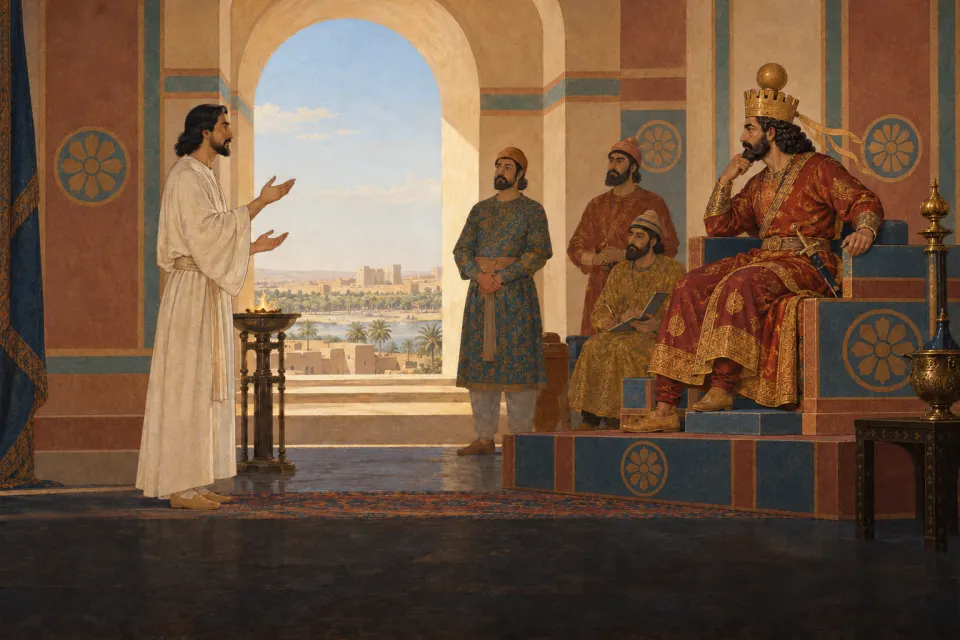
Mani, the Twin and the king 216–c. 274/277 CE
Mani was born in 216 in Babylonia, near Ctesiphon on the Tigris. His father raised him among the Elchasaites, Jewish-Christian baptists who practised constant ritual washing. By his church's account, a heavenly Twin appeared to him as a boy and again at about 24, ordering him to leave the baptists and teach the world. Around 240 he sailed to India; on his return the newly crowned Shāpūr I let him preach throughout the empire. Under Bahrām I the Zoroastrian priesthood, led by Kerdīr, turned the court against him, and he died in chains at Bēlābād (Gundeshapur) between 274 and 277.[15–19]
Westward into the Roman world 3rd–6th centuries CE
Mani organised missions in his own lifetime. His disciple Addā worked in Roman Syria and reached Alexandria, and by about 300 the faith had spread through Egypt and North Africa to Rome. Around 297–302 Diocletian outlawed it as a hostile Persian sect. Christian emperors renewed the bans and, from the late 4th century, enforced them more harshly. The young Augustine was a Hearer at Carthage for about nine years from c. 373; as a bishop he became its most effective critic. The religion had all but vanished from western Europe by c. 500 and from the eastern provinces during the sixth century.[20–24]
Persia, the caliphate and the Silk Road 3rd–10th centuries CE
In Mesopotamia and Iran the church outlived repeated persecution, and its head sat at Ctesiphon, later at Baghdad. Abbasid caliphs hunted suspected heretics (zindīqs), a label closely tied to Manichaeism, and in the 10th century pressure drove the leader's seat to Samarkand. Meanwhile Mār Ammō's mission to Parthia had opened the road east, and Sogdian merchants carried the faith along the Silk Road. A Manichaean cleric reached the Chinese court in 694; in 731–732 the Tang permitted the religion to foreigners but forbade it to Chinese subjects.[25–28]
State religion of the Uyghurs 762–11th century CE
In 762 or 763 Bögü Khan, ruler of the Uyghur steppe empire in Mongolia, adopted Manichaeism and made it his state's religion. Under Uyghur protection, Manichaean temples opened in several Chinese cities. When the Kyrgyz sacked the Uyghur capital in 840, many Uyghurs resettled around Turfan, and in their kingdom of Qocho the faith remained the rulers' religion; most surviving Manichaean art comes from this setting. Buddhism displaced it as the kingdom's dominant faith there by around the 11th century, though a Manichaean minority may have lingered in the region into the 13th. In China proper the Tang banned it in 843 and persecuted its clergy.[29–33]
The Religion of Light in South China 10th century–c. 1600 or later
The faith found refuge in Fujian, where it survived as the Míngjiào, the Religion of Light, looking much like a Buddhist or Daoist sect and stressing a vegetarian diet. Song officials condemned its members as vegetable-eating demon worshippers and repeatedly tried to suppress them. Under the Mongol Yuan dynasty a stone statue showing Mani as the Buddha of Light was carved for Cao'an, a small hillside temple near Quanzhou. When the organised religion finally ended is debated, with estimates from the 15th–16th centuries to the early 20th. Local people still honour the statue as a Buddhist deity.[34–38]
Key moments
- c. 242 CEMani's religion of light · Sasanian Persia
Beliefs
Two Principles · 二宗
Light and Darkness
Manichaeans held that two uncreated principles exist side by side: the Realm of Light, ruled by the Father of Greatness, harmonious and good, and the Realm of Darkness, chaotic and driven by greed. Both realms were pictured as real substances: light could literally be swallowed, and the visible world was later built from the bodies of defeated demons.[39]
Three Times · 三際
beginning, middle and end
History has three stages. Once the two realms were wholly apart; in the middle time, the present, they are mingled because Darkness attacked the Light; at the end they will be separated again for ever. Chinese Manichaean texts summed up the faith as the teaching of the Two Principles and Three Times.[40]
The Living Soul
divine light trapped in the world
To meet the attack, the Father of Greatness sent out divine beings; the first of them, the Primal Man, was overcome and his light swallowed by the powers of darkness. The cosmos was then built as a great mechanism for recovering that light, the suffering Living Soul present in plants, soil, water and every creature. Western Manichaeans called it the suffering Jesus.[41]
Gnosis
saving knowledge
In the myth, the first humans were fashioned by demons as prisons for light, which is why the body and sexual desire belong to Darkness. Salvation comes through knowledge brought by envoys of the Light: awakened by it, a person recognises that the soul is divine in origin and works to free it and the light around it.[42–43]
Apostle of Light
Mani as the last prophet
Manichaeans believed one truth had been taught by a chain of messengers, among them Adam, Zoroaster, the Buddha and Jesus, but each left it unwritten and their followers distorted it. Mani was the last and final one, the Paraclete whom Jesus had promised, sent with a message for every people at once.[44]
Practice
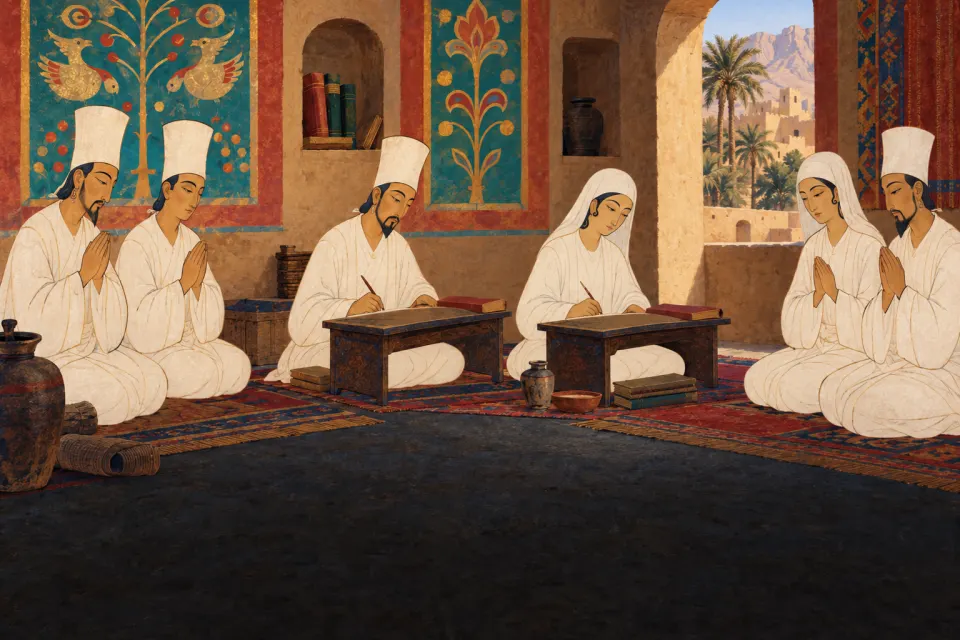
The rule of the Elect
The Elect, both men and women, lived celibate and owned almost nothing, often travelling to preach. They ate no meat, drank no wine and could not farm, harvest or prepare food, since such work was thought to wound the light hidden in plants and soil. Their days were given to prayer, hymns, study and teaching.[45]
The life of the Hearers
Most Manichaeans were Hearers (auditors), who married, worked and kept a milder code of ten commandments. Their chief duty was to give the Elect food, clothing and shelter. They were urged to avoid fathering or bearing children, and they hoped for a better rebirth rather than entering Paradise at once.[46]
The sacred meal
Each day Hearers brought fruit and vegetables, with melons and cucumbers especially prized, to the Elect. Manichaeans believed that the Elect's purified bodies released the light inside the food as they ate, prayed and sang, sending it back towards the Realm of Light. Augustine, once a Hearer, later ridiculed this belief.[47]
Confession · Xwāstwānīft
Because neither Elect nor Hearers could keep their rules perfectly, regular confession and absolution were central to community life: weekly, and above all at the yearly Bēma. In Central Asia believers recited set confession texts, in Sogdian and Old Uyghur, that listed possible sins against each of the commandments one by one.[48]
Holy days
Bēma
End of the fasting month, c. 7 Ādār (Babylonian), late February or March
The year's great feast, honouring Mani's death and his continuing presence. It closed a month of fasting and the religious year. A raised throne of five steps stood before the community, who confessed, received absolution and shared a sacred meal.[49–50]
Sunday and Monday
Every week
Sunday, adopted from Christian custom, was the Hearers' day of fasting, prayer and hymns. Monday was the Elect's special day of confession, sermons and mutual forgiveness, and they fasted on both days.[51]
People
Mani
founder · 216–c. 274/277 CE
Founder of the religion, who preached, organised a church and wrote its scriptures himself. He was also a painter, and his followers made Manichaeism a religion of finely written, richly illuminated books. Long after his church disappeared from Iran, Persian tradition remembered him as 'Mani the painter'.[52–53]
Mār Ammō
teacher · 3rd century CE
Disciple whom Mani sent to Parthia, in north-eastern Iran, partly because he knew its language, opening the mission field to the east; the eastern Manichaean church honoured him as its founding missionary.[54]
Mār Addā
teacher · 3rd century CE
Leader of the first mission into the Roman empire, sent out by Mani himself. Manichaean histories say he worked in Syria, won converts at the court of Palmyra and travelled as far as Alexandria.[55]
Augustine of Hippo
other · 354–430 CE
North African thinker who was a Manichaean Hearer for nine years before turning to orthodox Christianity in 386. As bishop of Hippo he wrote work after work against his former faith, and these long shaped how the West saw it.[56]
Bögü Khan
ruler
Uyghur ruler who in 762/763 made Manichaeism the religion of his steppe empire. A later trilingual inscription at Karabalgasun recalls the conversion and the new rules, such as vegetarianism and abstaining from alcohol, that followed.[57]
Scripture
Living Gospel
c. 240s CE
Mani's chief scripture, also called the Great Gospel, written early in his mission. Only scraps survive, but a Coptic codex from Medinet Madi seems to hold a commentary on it, and a Kellis letter probably refers to it.[58]
Šābuhragān
c. 240s CE
Mani's summary of his teaching in Middle Persian, dedicated to Shāpūr I; tradition calls it his only work in that language.[59]
Book of Pictures · Ārdhang / Eikōn
A set of paintings Mani made to teach his intricate cosmology through images during oral instruction. The original is lost, but later editions remained canonical art for his followers for about a thousand years, and some 10th-century fragments may survive.[60]
Kephalaia
Coptic collections of discourses in which Mani answers questions and explains doctrine, as remembered and developed by his disciples. Two large Kephalaia codices were among the books found at Medinet Madi in Egypt; others were later edited in Berlin and Dublin.[61]
Places

Kellis (Ismant el-Kharab)
EGY
Roman-era village in Egypt's Dakhla Oasis where excavations since the 1980s have found 4th-century letters, psalms and school exercises of Manichaean families, who regarded themselves as true Christians, alongside their neighbours.[62]
Khar Balgas (Karabalgasun)
MNG · UNESCO World Heritage, 2004
Ruined capital of the Uyghur steppe empire on the Orkhon River, where a trilingual inscription told of the khan's conversion. The Kyrgyz sacked it in 840; it lies within the Orkhon Valley World Heritage site.[63]
Qocho (Gaochang)
CHN · UNESCO World Heritage, 2014
Ruined city near Turfan, capital of the Uyghur kingdom where Manichaeism was a royal faith. German expeditions recovered thousands of manuscript fragments and paintings in the area; the city is part of a Silk Roads World Heritage listing.[64]
Cao'an
CHN · UNESCO World Heritage, 2021
Small temple on Huabiao Hill near Quanzhou, Fujian, sheltering a stone statue showing Mani as the Buddha of Light. Since 2021 it has been a component of the Quanzhou World Heritage property.[65]
Where it spread
| Region | From | How |
|---|---|---|
| Iraq | 240 CE – 1000 CE | Mani's Babylonia; its leaders sat at Ctesiphon, then Baghdad |
| Iran | 250 CE – 1000 CE | Sasanian Persia, despite persecution; Mani died in prison |
| Egypt | 270 CE – 600 CE | IRQ. Alexandria and Lycopolis; Coptic texts from Kellis in the Dakhla Oasis |
| Italy | 300 CE – 500 CE | Rome, despite imperial bans |
| Tunisia | 300 CE – 500 CE | EGY. Carthage, where the young Augustine was a Manichaean hearer |
| Algeria | 350 CE – 500 CE | Roman Numidia |
| China | 700 CE – 1600 CE | At the Tang court from 694; last survived in Fujian, at Cao'an near Quanzhou |
| Uzbekistan | 700 CE – 1200 CE | Sogdian communities; its leader moved to Samarkand in the 10th century |
| Mongolia | 762 CE – 840 CE | UZB. State religion of the Uyghur Khaganate after Bögü Khan's conversion |
How we know
Through hostile eyes
Until the 20th century, scholars knew Manichaeism almost entirely from its opponents: Augustine's anti-Manichaean works, other Greek, Latin and Syriac refutations, and the Acts of Archelaus, a fictional life of Mani that long shaped Christian memory of him. Muslim authors preserved more neutral material; Ibn al-Nadīm's Fihrist (c. 987–988) and al-Bīrūnī quoted Mani's own books. These sources remain valuable, but each filtered the religion through its own agenda.[66–67]
Texts from the sand
Discoveries transformed the field. German expeditions to Turfan in the early 1900s found thousands of fragments in Iranian languages and Old Uyghur, and three Chinese Manichaean texts emerged from the Dunhuang library cave in the same decade. In 1929–30 seven Coptic codices from Medinet Madi in Egypt reached the market. The tiny Greek Cologne Mani Codex, a life of Mani, was deciphered in 1970, and excavations at Kellis from the 1980s added a living community's papers.[68–71]
Open questions
Scholars still debate whether Mani died in 274 or 277, and how far his system should be classed as Gnostic. Medieval churchmen called the Paulicians, Bogomils and Cathars 'Manichaeans', but no direct historical link to Mani's church has been established. How long the religion lasted in southern China, and whether recent Mani worship in Fujian is survival or revival, also remain open.[72–75]
Common misconceptions
Myth 'Manichaean' is just a word for seeing the world in black and white.
Fact The word comes from a real religion, which opponents turned into a byword for heresy and which is now often used loosely for stark either-or thinking. Mani's teaching was subtler: it held that the present world is a mixture in which nearly everything contains both light and darkness, and it built a disciplined community, scriptures, hymns and art around freeing the light.[76–77]
Myth Manichaeism was a Christian heresy.
Fact Church writers treated it as one, and in the Roman world it often presented itself as the true Christianity. Scholars now see it as a religion in its own right: Mani drew on Christianity, Zoroastrianism and Buddhism, wrote his own scriptures and founded a separate church of his own.[78–79]
Glossary
- Elect
- The religion's full members and clergy: celibate, vegetarian ascetics whose ritual meals were believed to free light from food.[80]
- Hearer
- A lay follower (Latin auditor) who lived in the world, kept a lighter rule and supported the Elect with alms.[81]
- Bēma
- Greek for 'platform' or 'judge's seat': the raised throne at the centre of the chief Manichaean feast, and the name of the feast itself.[82]
- Twin
- Mani's heavenly companion and alter ego (Greek syzygos, Arabic al-Tawm), who revealed his teaching and sent him out to preach.[83]
- Archēgos
- Title of Mani's successors as head of the whole church, based first in Ctesiphon, later in Baghdad and Samarkand.[84]
- Elchasaites
- A Jewish-Christian baptist sect in Mesopotamia that honoured the prophet Elchasai; Mani grew up among them.[85]
- Míngjiào · 明教
- 'Religion of Light': the name of Manichaeism in China, especially in Fujian from the 10th century.[86]
- Paraclete
- The figure Jesus promised to send after him; Mani claimed to be that promised Paraclete.[87]
- Jesus patibilis
- 'Suffering Jesus': Western Manichaean name for the divine light imprisoned in nature.[88]
- Xwāstwānīft
- Parthian word for confession, used for Central Asian confession texts listing a believer's possible sins.[89]
Sources
Each statement above was checked against published sources; the verdict says whether it stood as written, was corrected or was hedged.
- VerifiedEncyclopaedia Iranica, W. Sundermann, Mani; J. D. BeDuhn, Manichaeism, New Dictionary of the History of Ideas; Britannica, Manichaeism.
- VerifiedBritannica, Mani; Encyclopaedia Iranica, W. Sundermann, Mani; E. L. Daniel, Manicheanism, Encyclopedia of Islam and the Muslim World.
- VerifiedBritannica, Manichaeism; Encyclopaedia Iranica, W. Sundermann, Mani; S. N. C. Lieu, Manichaeism in the Roman Empire, Encyclopedia of Religion 2nd ed.; Brill, book page for Zs. Gulácsi, Mani's Pictures.
- VerifiedEncyclopaedia Iranica, W. Sundermann, Manicheism i. General survey; J. D. BeDuhn, Manichaeism, New Dictionary of the History of Ideas.
- VerifiedBritannica, Manichaeism; Encyclopaedia Iranica, W. Sundermann, Manicheism i. General survey; J. D. BeDuhn, Manichaeism, New Dictionary of the History of Ideas.
- VerifiedBritannica, Manichaeism; S. N. C. Lieu, Manichaeism in Central Asia and China, Encyclopedia of Religion 2nd ed.; S. N. C. Lieu, Manichaeism in the Roman Empire, Encyclopedia of Religion 2nd ed.; Encyclopaedia Iranica, Coptic Manichean texts.
- VerifiedEncyclopaedia Iranica, Bēma; J. Bowker, Manichaeism, Concise Oxford Dictionary of World Religions, on Encyclopedia.com; J. Ries, Manichaeism, New Catholic Encyclopedia.
- HedgedJ. D. BeDuhn, Manichaeism, New Dictionary of the History of Ideas; Encyclopaedia Iranica, W. Sundermann, Manicheism i. General survey; S. N. C. Lieu, Manichaeism in Central Asia and China, Encyclopedia of Religion 2nd ed.; Britannica, Manichaeism.
- VerifiedBritannica, Manichaeism; Encyclopaedia Iranica, W. Sundermann, Mani.
- VerifiedBritannica, Manichaeism; J. D. BeDuhn, Manichaeism, New Dictionary of the History of Ideas; Encyclopaedia Iranica, W. Sundermann, Manicheism i. General survey.
- VerifiedBritannica, Manichaeism; Encyclopaedia Iranica, W. Sundermann, Mani; J. D. BeDuhn, Manichaeism, New Dictionary of the History of Ideas.
- VerifiedBritannica, Manichaeism; Encyclopaedia Iranica, W. Sundermann, Manicheism i. General survey; J. D. BeDuhn, Manichaeism, New Dictionary of the History of Ideas.
- VerifiedBritannica, Manichaeism; Encyclopaedia Iranica, W. Sundermann, Manicheism i. General survey.
- VerifiedEncyclopaedia Iranica, W. Sundermann, Manicheism i. General survey; J. D. BeDuhn, Manichaeism, New Dictionary of the History of Ideas; S. N. C. Lieu, Manichaeism in the Roman Empire, Encyclopedia of Religion 2nd ed..
- VerifiedBritannica, Mani; Encyclopaedia Iranica, W. Sundermann, Mani; J. Ries, Manichaeism, New Catholic Encyclopedia.
- VerifiedEncyclopaedia Iranica, W. Sundermann, Mani; S. N. C. Lieu, Manichaeism in the Roman Empire, Encyclopedia of Religion 2nd ed.; Britannica, Mani; J. D. BeDuhn, Manichaeism, New Dictionary of the History of Ideas.
- VerifiedEncyclopaedia Iranica, W. Sundermann, Mani; Britannica, Mani; J. Ries, Manichaeism, New Catholic Encyclopedia.
- VerifiedEncyclopaedia Iranica, W. Sundermann, Manicheism v. Missionary activity and technique; Britannica, Mani; J. Ries, Manichaeism, New Catholic Encyclopedia.
- VerifiedEncyclopaedia Iranica, W. Sundermann, Mani; Britannica, Mani; E. L. Daniel, Manicheanism, Encyclopedia of Islam and the Muslim World; Britannica, Manichaeism.
- VerifiedEncyclopaedia Iranica, W. Sundermann, Manicheism v. Missionary activity and technique; S. N. C. Lieu, Manichaeism in the Roman Empire, Encyclopedia of Religion 2nd ed.; Britannica, Manichaeism.
- VerifiedEncyclopaedia Iranica, W. Sundermann, Manicheism v. Missionary activity and technique; S. N. C. Lieu, Manichaeism in the Roman Empire, Encyclopedia of Religion 2nd ed.; J. Ries, Manichaeism, New Catholic Encyclopedia.
- CorrectedS. N. C. Lieu, Manichaeism in the Roman Empire, Encyclopedia of Religion 2nd ed.; J. Ries, Manichaeism, New Catholic Encyclopedia; Encyclopaedia Iranica, W. Sundermann, Manicheism v. Missionary activity and technique; Britannica, Manichaeism.
- VerifiedEncyclopaedia Iranica, Augustine; Stanford Encyclopedia of Philosophy, Augustine of Hippo; S. N. C. Lieu, Manichaeism in the Roman Empire, Encyclopedia of Religion 2nd ed.; Britannica, Saint Augustine.
- HedgedBritannica, Manichaeism; S. N. C. Lieu, Manichaeism in the Roman Empire, Encyclopedia of Religion 2nd ed.; Encyclopaedia Iranica, W. Sundermann, Manicheism i. General survey.
- VerifiedEncyclopaedia Iranica, W. Sundermann, Manicheism i. General survey; E. L. Daniel, Manicheanism, Encyclopedia of Islam and the Muslim World; Britannica, Manichaeism.
- VerifiedE. L. Daniel, Manicheanism, Encyclopedia of Islam and the Muslim World; Britannica, Manichaeism; Encyclopaedia Iranica, W. Sundermann, Manicheism i. General survey.
- VerifiedEncyclopaedia Iranica, W. Sundermann, Manicheism v. Missionary activity and technique; S. N. C. Lieu, Manichaeism in Central Asia and China, Encyclopedia of Religion 2nd ed.; E. L. Daniel, Manicheanism, Encyclopedia of Islam and the Muslim World.
- VerifiedBritannica, Manichaeism; Encyclopaedia Iranica, W. Sundermann, Manicheism v. Missionary activity and technique; S. N. C. Lieu, Manichaeism in Central Asia and China, Encyclopedia of Religion 2nd ed..
- VerifiedEncyclopaedia Iranica, W. Sundermann, Manicheism v. Missionary activity and technique; S. N. C. Lieu, Manichaeism in Central Asia and China, Encyclopedia of Religion 2nd ed.; Britannica, Manichaeism; E. L. Daniel, Manicheanism, Encyclopedia of Islam and the Muslim World.
- VerifiedS. N. C. Lieu, Manichaeism in Central Asia and China, Encyclopedia of Religion 2nd ed.; J. Ries, Manichaeism, New Catholic Encyclopedia; Encyclopaedia Iranica, S. N. C. Lieu, Chinese Turkestan vii. Manicheism.
- VerifiedBritannica, Uyghur; Encyclopaedia Iranica, W. Sundermann, Manicheism i. General survey; Encyclopaedia Iranica, Zs. Gulácsi, Manichean art; A. Benkato and P. Dilley, Towards a Comparative Manichaean Manuscriptology, ISAW Papers 29.4.
- HedgedEncyclopaedia Iranica, W. Sundermann, Manicheism i. General survey; Britannica, Manichaeism; J. D. BeDuhn, Manichaeism, New Dictionary of the History of Ideas.
- VerifiedBritannica, Manichaeism; Encyclopaedia Iranica, W. Sundermann, Manicheism v. Missionary activity and technique; S. N. C. Lieu, Manichaeism in Central Asia and China, Encyclopedia of Religion 2nd ed..
- VerifiedEncyclopaedia Iranica, S. N. C. Lieu, Chinese Turkestan vii. Manicheism; Ma Xiaohe and Wang Chuan, On the Xiapu Ritual Manual Mani the Buddha of Light, Religions 9.7; S. N. C. Lieu, Manichaeism in Central Asia and China, Encyclopedia of Religion 2nd ed.; Wang Yanbin, Cao'an in the Ancestral World, Religions 15.2.
- CorrectedMa Xiaohe and Wang Chuan, On the Xiapu Ritual Manual Mani the Buddha of Light, Religions 9.7; Wang Yanbin, Cao'an in the Ancestral World, Religions 15.2; Encyclopaedia Iranica, S. N. C. Lieu, Chinese Turkestan vii. Manicheism.
- HedgedWang Yanbin, Cao'an in the Ancestral World, Religions 15.2; S. N. C. Lieu, Manichaeism in Central Asia and China, Encyclopedia of Religion 2nd ed.; UNESCO, component list of property 1561.
- HedgedJ. D. BeDuhn, Manichaeism, New Dictionary of the History of Ideas; Encyclopaedia Iranica, W. Sundermann, Manicheism v. Missionary activity and technique; S. N. C. Lieu, Manichaeism in Central Asia and China, Encyclopedia of Religion 2nd ed..
- VerifiedS. N. C. Lieu, Manichaeism in Central Asia and China, Encyclopedia of Religion 2nd ed.; Wang Yanbin, Cao'an in the Ancestral World, Religions 15.2; Encyclopaedia Iranica, W. Sundermann, Manicheism i. General survey.
- VerifiedEncyclopaedia Iranica, W. Sundermann, Manicheism i. General survey; J. D. BeDuhn, Manichaeism, New Dictionary of the History of Ideas; Britannica, Manichaeism.
- VerifiedBritannica, Manichaeism; J. Ries, Manichaeism, New Catholic Encyclopedia; Ma Xiaohe and Wang Chuan, On the Xiapu Ritual Manual Mani the Buddha of Light, Religions 9.7; Encyclopaedia Iranica, Šābuhragān.
- VerifiedEncyclopaedia Iranica, W. Sundermann, Manicheism i. General survey; J. D. BeDuhn, Manichaeism, New Dictionary of the History of Ideas; S. N. C. Lieu, Manichaeism in the Roman Empire, Encyclopedia of Religion 2nd ed..
- VerifiedEncyclopaedia Iranica, W. Sundermann, Manicheism i. General survey; J. Ries, Manichaeism, New Catholic Encyclopedia.
- VerifiedBritannica, Manichaeism; Encyclopaedia Iranica, W. Sundermann, Manicheism i. General survey; J. D. BeDuhn, Manichaeism, New Dictionary of the History of Ideas.
- VerifiedBritannica, Manichaeism; Encyclopaedia Iranica, W. Sundermann, Manicheism i. General survey; Encyclopaedia Iranica, W. Sundermann, Mani; S. N. C. Lieu, Manichaeism in the Roman Empire, Encyclopedia of Religion 2nd ed..
- VerifiedEncyclopaedia Iranica, W. Sundermann, Manicheism i. General survey; S. N. C. Lieu, Manichaeism in the Roman Empire, Encyclopedia of Religion 2nd ed.; J. D. BeDuhn, Manichaeism, New Dictionary of the History of Ideas.
- VerifiedEncyclopaedia Iranica, W. Sundermann, Manicheism i. General survey; J. Ries, Manichaeism, New Catholic Encyclopedia; J. D. BeDuhn, Manichaeism, New Dictionary of the History of Ideas.
- VerifiedEncyclopaedia Iranica, W. Sundermann, Manicheism i. General survey; J. Ries, Manichaeism, New Catholic Encyclopedia; S. N. C. Lieu, Manichaeism in the Roman Empire, Encyclopedia of Religion 2nd ed..
- VerifiedEncyclopaedia Iranica, W. Sundermann, Manicheism i. General survey; Encyclopaedia Iranica, Bēma; J. Ries, Manichaeism, New Catholic Encyclopedia.
- CorrectedEncyclopaedia Iranica, Bēma; J. Ries, Manichaeism, New Catholic Encyclopedia; J. Bowker, Manichaeism, Concise Oxford Dictionary of World Religions, on Encyclopedia.com.
- VerifiedEncyclopaedia Iranica, Bēma; J. Bowker, Manichaeism, Concise Oxford Dictionary of World Religions, on Encyclopedia.com.
- VerifiedEncyclopaedia Iranica, Festivals ii. Manichean; J. Ries, Manichaeism, New Catholic Encyclopedia; J. Bowker, Manichaeism, Concise Oxford Dictionary of World Religions, on Encyclopedia.com.
- VerifiedEncyclopaedia Iranica, W. Sundermann, Manicheism i. General survey; S. N. C. Lieu, Manichaeism in the Roman Empire, Encyclopedia of Religion 2nd ed.; A. Benkato and P. Dilley, Towards a Comparative Manichaean Manuscriptology, ISAW Papers 29.4.
- CorrectedEncyclopaedia Iranica, W. Sundermann, Mani; E. L. Daniel, Manicheanism, Encyclopedia of Islam and the Muslim World.
- CorrectedS. N. C. Lieu, Manichaeism in Central Asia and China, Encyclopedia of Religion 2nd ed.; Britannica, Manichaeism.
- CorrectedS. N. C. Lieu, Manichaeism in the Roman Empire, Encyclopedia of Religion 2nd ed.; Britannica, Manichaeism.
- VerifiedStanford Encyclopedia of Philosophy, Augustine of Hippo; S. N. C. Lieu, Manichaeism in the Roman Empire, Encyclopedia of Religion 2nd ed.; Encyclopaedia Iranica, Augustine; Britannica, Saint Augustine.
- VerifiedS. N. C. Lieu, Manichaeism in Central Asia and China, Encyclopedia of Religion 2nd ed.; Encyclopaedia Iranica, W. Sundermann, Manicheism v. Missionary activity and technique; Encyclopaedia Iranica, S. N. C. Lieu, Chinese Turkestan vii. Manicheism.
- VerifiedEncyclopaedia Iranica, W. Sundermann, Mani; S. N. C. Lieu, Manichaeism in the Roman Empire, Encyclopedia of Religion 2nd ed.; A. Benkato and P. Dilley, Towards a Comparative Manichaean Manuscriptology, ISAW Papers 29.4; S. N. C. Lieu, Manichaeism in Central Asia and China, Encyclopedia of Religion 2nd ed..
- CorrectedBritannica, Shāpuragān; Encyclopaedia Iranica, Šābuhragān.
- VerifiedBrill, book page for Zs. Gulácsi, Mani's Pictures; Encyclopaedia Iranica, W. Sundermann, Mani.
- VerifiedEncyclopaedia Iranica, W. Sundermann, Mani; S. N. C. Lieu, Manichaeism in the Roman Empire, Encyclopedia of Religion 2nd ed.; Encyclopaedia Iranica, Coptic Manichean texts.
- VerifiedS. N. C. Lieu, Manichaeism in the Roman Empire, Encyclopedia of Religion 2nd ed.; A. Benkato and P. Dilley, Towards a Comparative Manichaean Manuscriptology, ISAW Papers 29.4; Encyclopaedia Iranica, W. Sundermann, Manicheism i. General survey.
- VerifiedBritannica, Uyghur; S. N. C. Lieu, Manichaeism in Central Asia and China, Encyclopedia of Religion 2nd ed.; UNESCO World Heritage Centre, Orkhon Valley Cultural Landscape.
- VerifiedEncyclopaedia Iranica, S. N. C. Lieu, Chinese Turkestan vii. Manicheism; Encyclopaedia Iranica, Zs. Gulácsi, Manichean art; UNESCO, component list of Silk Roads: the Routes Network of Chang'an-Tianshan Corridor.
- VerifiedUNESCO, component list of property 1561; UNESCO World Heritage Centre, Quanzhou: Emporium of the World in Song-Yuan China; S. N. C. Lieu, Manichaeism in Central Asia and China, Encyclopedia of Religion 2nd ed.; Wang Yanbin, Cao'an in the Ancestral World, Religions 15.2.
- VerifiedS. N. C. Lieu, Manichaeism in the Roman Empire, Encyclopedia of Religion 2nd ed.; Encyclopaedia Iranica, W. Sundermann, Manicheism i. General survey; J. Ries, Manichaeism, New Catholic Encyclopedia; Encyclopaedia Iranica, W. Sundermann, Mani.
- VerifiedEncyclopaedia Iranica, W. Sundermann, Mani; E. L. Daniel, Manicheanism, Encyclopedia of Islam and the Muslim World.
- VerifiedS. N. C. Lieu, Manichaeism in Central Asia and China, Encyclopedia of Religion 2nd ed.; Encyclopaedia Iranica, Coptic Manichean texts; Encyclopaedia Iranica, W. Sundermann, Manicheism v. Missionary activity and technique.
- VerifiedS. N. C. Lieu, Manichaeism in the Roman Empire, Encyclopedia of Religion 2nd ed.; A. Benkato and P. Dilley, Towards a Comparative Manichaean Manuscriptology, ISAW Papers 29.4; Encyclopaedia Iranica, Coptic Manichean texts.
- VerifiedS. N. C. Lieu, Manichaeism in the Roman Empire, Encyclopedia of Religion 2nd ed.; Universität zu Köln, Papyrussammlung, Der Kölner Mani-Kodex; Encyclopaedia Iranica, W. Sundermann, Mani.
- VerifiedEncyclopaedia Iranica, W. Sundermann, Manicheism i. General survey; S. N. C. Lieu, Manichaeism in the Roman Empire, Encyclopedia of Religion 2nd ed.; A. Benkato and P. Dilley, Towards a Comparative Manichaean Manuscriptology, ISAW Papers 29.4.
- VerifiedEncyclopaedia Iranica, W. Sundermann, Mani; Britannica, Manichaeism; J. Ries, Manichaeism, New Catholic Encyclopedia.
- VerifiedEncyclopaedia Iranica, W. Sundermann, Manicheism i. General survey; J. D. BeDuhn, Manichaeism, New Dictionary of the History of Ideas; Britannica, Manichaeism.
- VerifiedBritannica, Manichaeism; J. Ries, Manichaeism, New Catholic Encyclopedia; S. N. C. Lieu, Manichaeism in the Roman Empire, Encyclopedia of Religion 2nd ed..
- VerifiedEncyclopaedia Iranica, W. Sundermann, Manicheism i. General survey; Ma Xiaohe and Wang Chuan, On the Xiapu Ritual Manual Mani the Buddha of Light, Religions 9.7; S. N. C. Lieu, Manichaeism in Central Asia and China, Encyclopedia of Religion 2nd ed..
- VerifiedEncyclopaedia Iranica, W. Sundermann, Manicheism i. General survey; Merriam-Webster, Manichaean; Oxford Reference, Manichaean (supporting).
- VerifiedJ. D. BeDuhn, Manichaeism, New Dictionary of the History of Ideas; Britannica, Manichaeism; Encyclopaedia Iranica, W. Sundermann, Manicheism i. General survey.
- VerifiedS. N. C. Lieu, Manichaeism in the Roman Empire, Encyclopedia of Religion 2nd ed.; Encyclopaedia Iranica, Augustine; Stanford Encyclopedia of Philosophy, Augustine of Hippo; Britannica, Saint Augustine.
- CorrectedBritannica, Manichaeism; J. Ries, Manichaeism, New Catholic Encyclopedia.
- VerifiedEncyclopaedia Iranica, W. Sundermann, Manicheism i. General survey; J. D. BeDuhn, Manichaeism, New Dictionary of the History of Ideas; Britannica, Manichaeism.
- VerifiedEncyclopaedia Iranica, W. Sundermann, Manicheism i. General survey; S. N. C. Lieu, Manichaeism in the Roman Empire, Encyclopedia of Religion 2nd ed.; Britannica, Manichaeism.
- VerifiedEncyclopaedia Iranica, Bēma; J. Ries, Manichaeism, New Catholic Encyclopedia.
- VerifiedEncyclopaedia Iranica, W. Sundermann, Mani; S. N. C. Lieu, Manichaeism in the Roman Empire, Encyclopedia of Religion 2nd ed.; E. L. Daniel, Manicheanism, Encyclopedia of Islam and the Muslim World.
- VerifiedEncyclopaedia Iranica, W. Sundermann, Manicheism i. General survey; E. L. Daniel, Manicheanism, Encyclopedia of Islam and the Muslim World.
- VerifiedEncyclopaedia Iranica, W. Sundermann, Mani; S. N. C. Lieu, Manichaeism in the Roman Empire, Encyclopedia of Religion 2nd ed.; J. D. BeDuhn, Manichaeism, New Dictionary of the History of Ideas.
- VerifiedEncyclopaedia Iranica, S. N. C. Lieu, Chinese Turkestan vii. Manicheism; Ma Xiaohe and Wang Chuan, On the Xiapu Ritual Manual Mani the Buddha of Light, Religions 9.7.
- VerifiedEncyclopaedia Iranica, W. Sundermann, Mani; S. N. C. Lieu, Manichaeism in the Roman Empire, Encyclopedia of Religion 2nd ed..
- VerifiedS. N. C. Lieu, Manichaeism in the Roman Empire, Encyclopedia of Religion 2nd ed.; Encyclopaedia Iranica, W. Sundermann, Manicheism i. General survey.
- VerifiedEncyclopaedia Iranica, W. Sundermann, Manicheism i. General survey; J. Ries, Manichaeism, New Catholic Encyclopedia.
Last fact-checked 3 October 2026.