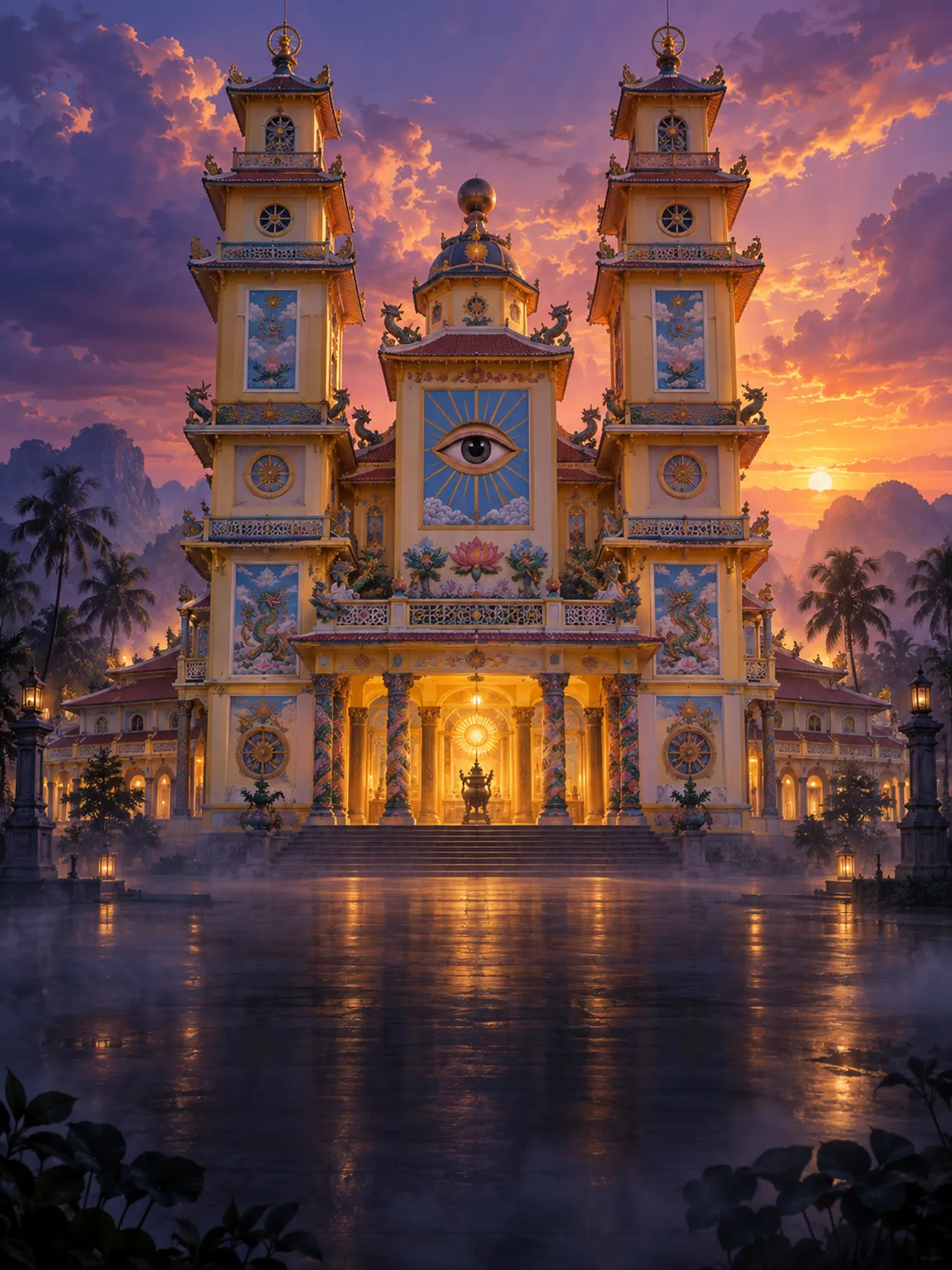
Overview
Caodaism, or Cao Dai, is a Vietnamese religion founded in 1926 that openly sets out to unite the teachings of East and West. Its founder, Ngô Văn Chiêu, a Vietnamese official under French colonial rule, said he received messages from a Supreme Being, Cao Đài, through séances, instructing him that earlier religions had each carried only part of a single truth, now to be reunited. Cao Dai combines Confucian ethics, Daoist spirit communication, Buddhist teachings on karma and rebirth, and a hierarchy of pope, cardinals and archbishops borrowed from Roman Catholicism, and it venerates saints as varied as Buddha, Jesus, Confucius and the French writer Victor Hugo. Centred on a "Holy See" at Tây Ninh, it grew rapidly in southern Vietnam, was repeatedly caught up in the country's politics and wars, and survived suppression after 1975 to become one of Vietnam's largest home-grown religions.[1–4, 6–7]
History

Revelation and founding 1919–1926
Ngô Văn Chiêu, an administrator for the French colonial government, began receiving what he took to be messages from a supreme deity during séances from 1919, using spirit-writing techniques such as table-turning and a basket-and-pencil "planchette", methods that show the clear influence of contemporary Theosophy and French Spiritualism on educated Vietnamese circles. From 1923 the businessman Lê Văn Trung organised Chiêu's revelation into a structured movement, building a hierarchy modelled on the Roman Catholic Church, with himself as its first "pope". The religion was formally inaugurated at a ceremony in Tây Ninh on 18 November 1926 that drew tens of thousands of people.[1, 9–11]
Rapid growth and nationalist politics 1926–1955
Cao Dai's promise of an indigenous, unifying faith appealed strongly to Vietnamese resentful of French rule and the foreign origins of Catholicism; by conservative estimate it counted half a million followers by 1930 and grew to more than a million within the decade, embracing a substantial share of the population of what became South Vietnam. From 1943, during the Japanese occupation, Cao Dai raised its own army, and after the Second World War it became an organised political and military force in southern Vietnam, at times allying with and at times opposing the Saigon government.[7, 12]
Disbanded, then suppressed 1955–1990s
In 1955–56 President Ngô Đình Diệm disbanded Cao Dai's private army and forced its leader, Phạm Công Tắc, into exile, ending the sect's independent political and military power. After the communist victory of 1975, the new government curtailed Cao Dai further, confiscating many of its churches and arresting or laicising clergy, leaving the Tây Ninh Holy See largely inactive; many adherents fled abroad, founding Cao Dai communities in the United States, France, Cambodia and Australia.[13–15]
Recognition and revival 1990s–present
Religious policy eased gradually from the late 1980s, and in 1997 the Vietnamese state held a ceremony at Tây Ninh formally recognising Cao Dai as an organised religion, though under government-approved governance that some believers accepted only reluctantly. Worship at the Tây Ninh Holy See and at temples across southern Vietnam and the diaspora has continued since, making Cao Dai one of Vietnam's largest religious movements outside Buddhism and Christianity.[16]
Key moments
- 1926 CECaodaism · Tây Ninh, Vietnam
Beliefs
Cao Đài · Cao Đài
"High Tower" or "High Palace", a Daoist epithet for the Supreme Being
Cao Dai teaches belief in a single Supreme Being, Cao Đài, the source of all the world's religions, who is never depicted in human form but represented by a Divine Eye set in a triangle, displayed on the façade of every temple.[2]
Universal convergence
By Cao Dai teaching, God has revealed himself to humanity in stages: two earlier revelations produced Confucianism, Daoism, Buddhism and Christianity among others, each suited to its own time and people, and a third, delivered through Chiêu, is now meant to unite and complete them for a new, interconnected age.[17]
Spirit communication · cơ bút
séance, spirit-writing
Ongoing contact with Cao Đài and other spiritual beings is maintained through mediums using séance techniques inherited from the religion's founding revelations; messages received this way have continued to shape doctrine and to confirm appointments within the church hierarchy.[9]
Universal sainthood
Cao Dai honours an open-ended company of "saints" who, in its teaching, served humanity or truth in their own time and tradition: alongside the Buddha, Confucius, Jesus and Muhammad stand secular figures such as Joan of Arc, Julius Caesar, Sun Yat-sen and the French novelist Victor Hugo.[4]
Practice

Temple worship
Cao Dai worship centres on rituals performed in temples up to four times a day, consisting of prayer, chanting and simple offerings of incense, tea, wine and flowers presented with highly stylised ceremony before the Divine Eye.[18]
Hierarchy and governance
The religion is organised, in deliberate imitation of the Roman Catholic Church, under a pope, a college of cardinals and archbishops, with clergy ranks that believers can rise through; the Vietnamese state has since 1997 required this governance to operate under official oversight.[5, 16]
People
Ngô Văn Chiêu · Ngô Văn Chiêu
founder · b. 1878; death date disputed
A Vietnamese civil servant under the French colonial administration, Chiêu said he began receiving messages from the Supreme Being Cao Đài in séances from 1919; his revelation became the basis of the religion formally founded in 1926.[1]
Lê Văn Trung · Lê Văn Trung
other
A former government official and businessman, Trung organised Chiêu's revelation into an institutional religion from 1923, built its Roman Catholic-style hierarchy and its Tây Ninh "cathedral", and became Cao Dai's first "pope".[11]
Phạm Công Tắc · Phạm Công Tắc
other
Cao Dai's leading figure during its years of political and military power, Phạm Công Tắc held the title Hộ Pháp ("Protector of the Law") and was forced into exile in 1956 after President Ngô Đình Diệm disbanded the sect's army.[13]
Places

Tây Ninh Holy See
VNM
Cao Dai's central temple and administrative seat, about 60 miles (100 km) from Ho Chi Minh City, built from the 1920s under Lê Văn Trung as the religion's "cathedral" and headquarters; it remains Cao Dai's spiritual and administrative centre today.[6, 11]
Numbers
- Followers (rough estimate)
- c. 2 million or more[8]
Reference-work estimate; no census count exists
National censuses
| Country | Year | Count | Share |
|---|---|---|---|
| Australia Caodaism | 2021 | 677 | 0.0% |
| New Zealand Cao Dai | 2018 | 6 | 0.0% |
Source: Australian Bureau of Statistics, Census of Population and Housing 2021, 'Religious affiliation in Australia' (Table 4), CC BY 4.0. Source: Stats NZ, 2018 Census, licensed by Stats NZ for re-use under the Creative Commons Attribution 4.0 International licence.
Common misconceptions
Myth Cao Dai is just a loose mixture of other religions with no beliefs of its own.
Fact Cao Dai has a coherent theology, built around a single Supreme Being, a staged history of revelation and an organised clergy; it draws on other traditions deliberately, as evidence for its claim that all religions share one divine source, rather than borrowing at random.[17, 19]
Myth Cao Dai was destroyed after the communist victory in 1975 and no longer exists.
Fact Cao Dai's independent political and military power ended well before 1975, and the religion itself was heavily suppressed afterward, but it was never eliminated: the state formally recognised it again in 1997, and millions of adherents still worship at the Tây Ninh Holy See and in temples in Vietnam and abroad.[14, 16, 20]
Glossary
- Thiên Nhãn · Thiên Nhãn
- The "Divine Eye": the image of a single eye set in a triangle that represents the Supreme Being, Cao Đài, on every temple façade.[2]
- Tòa Thánh · Tòa Thánh
- "Holy See": Cao Dai's central temple and administrative seat at Tây Ninh.[6]
- Giáo Tông · Giáo Tông
- "Pope": the head of the Cao Dai hierarchy, a title first held by Lê Văn Trung.[11]
- Hộ Pháp · Hộ Pháp
- "Protector of the Law": a senior clerical title in the Cao Dai hierarchy, held by Phạm Công Tắc during the religion's years of political power.[13]
- Cơ bút · cơ bút
- Spirit-writing or séance communication: the method by which Cao Dai's founding revelations, and later doctrine, were said to be received from spiritual beings.[9]
- Tam giáo · Tam giáo
- The "Three Teachings": Confucianism, Daoism and Buddhism, the three older East Asian traditions Cao Dai claims to unite along with Christianity.[21]
Sources
Each statement above was checked against published sources; the verdict says whether it stood as written, was corrected or was hedged.
- VerifiedBritannica, Ngo Van Chieu; Encyclopedia of Occultism and Parapsychology, Cao Dai.
- VerifiedBritannica, Cao Dai; Encyclopedia of Religion, 2nd ed., Cao Dai.
- VerifiedBritannica, Cao Dai; Encyclopedia of Religion, 2nd ed., Cao Dai.
- VerifiedBritannica, Cao Dai; Encyclopedia of Religion, 2nd ed., Cao Dai.
- VerifiedBritannica, Cao Dai; Encyclopedia of Religion, 2nd ed., Cao Dai.
- VerifiedBritannica, Cao Dai; New Catholic Encyclopedia, Cao Dai.
- VerifiedEncyclopedia of Religion, 2nd ed., Cao Dai; Britannica, Vietnam: Ethnic groups.
- CorrectedBritannica, Cao Dai; Encyclopedia of Religion, 2nd ed., Cao Dai.
- VerifiedBritannica, Ngo Van Chieu; New Catholic Encyclopedia, Cao Dai.
- CorrectedEncyclopedia of Religion, 2nd ed., Cao Dai; Britannica, Ngo Van Chieu.
- VerifiedBritannica, Ngo Van Chieu; Encyclopedia of Religion, 2nd ed., Cao Dai.
- VerifiedBritannica, Cao Dai; Encyclopedia of Religion, 2nd ed., Cao Dai.
- VerifiedBritannica, Cao Dai; New Catholic Encyclopedia, Cao Dai.
- VerifiedEncyclopedia of Religion, 2nd ed., Cao Dai; Britannica, Vietnam: Ethnic groups.
- VerifiedBritannica, Cao Dai; New Catholic Encyclopedia, Cao Dai.
- VerifiedEncyclopedia of Religion, 2nd ed., Cao Dai; Britannica, Vietnam: Ethnic groups.
- CorrectedEncyclopedia of Occultism and Parapsychology, Cao Dai; Britannica, Ngo Van Chieu.
- VerifiedEncyclopedia of Religion, 2nd ed., Cao Dai; Britannica, Cao Dai.
- CorrectedEncyclopedia of Occultism and Parapsychology, Cao Dai; Britannica, Cao Dai.
- VerifiedEncyclopedia of Religion, 2nd ed., Cao Dai; Britannica, Cao Dai.
- VerifiedBritannica, Cao Dai; Encyclopedia of Religion, 2nd ed., Cao Dai.
Last fact-checked 3 October 2026.