
Overview
Daoism, also spelled Taoism, is China's own organised religion and, with Confucianism, one of its two great native traditions of thought. Its starting point is the Dao, the "Way": the nameless source of everything and the pattern by which nature unfolds, to which people are urged to return through simplicity, stillness and action that does not force. Its classics are the Daodejing, credited to the sage Laozi, and the Zhuangzi. From the 2nd century CE these ideas joined older cults and healing and longevity arts in movements with priests, scriptures and liturgies, beginning with the Celestial Masters. Daoism has no single creed, and its edges blur into Confucianism, Buddhism and popular religion. It is one of five religions the Chinese state recognises, and is most visible today in Taiwan and among Chinese communities abroad.[2, 5, 15–19]
History

Sages and the Way c. 4th–2nd century BCE
Tradition makes Laozi an archivist at the Zhou court, older than Confucius, and says he wrote down his teaching for a border guard before vanishing westward; historians treat this account, first set down by Sima Qian around 100 BCE, as legend. Bamboo slips from a tomb at Guodian, sealed around 300 BCE, hold the oldest known Daodejing passages, and most scholars think the book grew from sayings gathered by many hands until it reached roughly its present form in the 3rd century BCE. The Zhuangzi took shape in the same centuries. Han historians grouped such works as daojia, the "lineage of the Way", and early Han courtiers of the Huang-Lao school read Laozi as a manual for ruling by non-interference.[1, 20–23]
Lord Lao and the Celestial Masters 2nd–3rd century CE
By the late Han, Laozi was worshipped as a god: in 166 CE Emperor Huan sacrificed to him in the palace, and texts presented him as the Dao in human form, descending age after age to teach. By Daoist tradition, Lord Lao appeared in 142 CE to Zhang Daoling in the mountains of Sichuan and named him Celestial Master. Zhang's church had 24 parishes led by libationers; the sick confessed their faults in written petitions, and households gave five pecks of rice a year. His grandson Zhang Lu ruled a religious state in Hanzhong until he submitted to the warlord Cao Cao in 215, after which resettled followers carried the movement across north China.[4, 24–27]
Revelations and the Three Caverns 4th–6th century
When north China fell to invaders early in the 4th century, refugee Celestial Masters met the older occult traditions of the south, recorded by the scholar Ge Hong. Between 364 and 370 the visionary Yang Xi received the Shangqing ("Highest Clarity") scriptures for an aristocratic family linked to Mount Mao, putting meditation and visualisation first. Around 400 Ge Hong's grand-nephew Ge Chaofu produced the Lingbao ("Numinous Treasure") scriptures, which borrowed Buddhist ideas such as universal salvation and centred on communal liturgy. In the 5th century Lu Xiujing catalogued these corpora as the "Three Caverns", the frame of every later canon, and the name daojiao, "teaching of the Way", came into use.[28–32]
Emperors, alchemists and new orders 618–1644
The Tang emperors, surnamed Li, claimed Laozi as their ancestor, and Xuanzong set the Daodejing in the civil-service examinations. From the late Tang, and above all in the Song, the quest for a mineral elixir gave way to inner alchemy. The Celestial Masters, now seated on Mount Longhu in Jiangxi, became known as the Zhengyi ("Orthodox Unity") order. In the north under Jurchen rule, Wang Chongyang founded Quanzhen ("Complete Perfection") in the 1160s, and his disciple Qiu Chuji won the favour of Chinggis Khan. The Ming printed in 1445 the canon still used today, and clergy of many lineages came to be registered under either Zhengyi or Quanzhen.[6, 12, 33–37]
Suppression and revival 1644–today
The Qing court favoured Confucianism and Tibetan Buddhism, though Quanzhen's Longmen branch prospered at Beijing's White Cloud Abbey. In the 20th century reformers branded much popular religion superstition and seized or destroyed temples. The People's Republic set up the China Taoist Association in 1957, and in the Cultural Revolution of 1966–1976 Red Guards attacked temples, priests were killed or sent for re-education and texts were destroyed. Controls eased from 1979 and temples reopened; in 2018 the state counted 9,000 registered Daoist temples. The 63rd Celestial Master, Zhang Enpu, moved to Taiwan in 1949, and Daoist ritual there has flourished since the 1960s.[38–44]
Key moments
- c. 300 BCELaozi and the Dao · Zhou China
- c. 142 CEThe Way of the Celestial Masters · Sichuan, China
Beliefs
Dao · 道
the Way
Daoists speak of the Dao as the nameless source from which all things come and to which they return; the Daodejing calls "Dao" a name it is forced to use. It is not a creator who wills the world into being but an ever-present process that works spontaneously. In the religion it also takes personal form, appearing as deities and as Laozi himself.[15, 25]
Wuwei · 無為
non-action, action without forcing
The sage, and ideally the ruler, acts without striving or imposing, following the grain of things as water yields yet overcomes the hard. Wuwei is not idleness: the Daodejing holds that by not forcing, nothing is left undone. The Zhuangzi pictures it in craftsmen, like the cook whose knife stays sharp for years because it never hacks.[16]
Qi, yin and yang · 氣 · 陰陽
breath-energy; the two complementary forces
All things are made of qi, breath or vital energy, which divides into the complementary forces of yin and yang and cycles through the five phases. Daoists see the human body as a small copy of the cosmos, with its own heavens and gods, so caring for the body and ordering the world are one task.[45–46]
Transcendence · 仙
xian, immortal or transcendent
Many Daoists have sought not only long life but transformation into a xian, a transcendent who escapes ordinary death. Texts describe two broad goals: union with the Dao, and promotion to office in the heavenly bureaucracy. Collections of the lives of immortals, compiled from Han times onward, held up models of the quest, often tied to local cults.[47–48]
The heavenly bureaucracy · 三清
Sanqing, the Three Pure Ones
Daoists picture heaven as an imperial government. At its summit are the Three Pure Ones, embodiments of the Dao, one of whom is the deified Laozi; below serve the Jade Emperor, the Three Officials of heaven, earth and water, and countless local gods, who can be promoted or demoted. Priests address them in writing, much as officials petitioned the throne.[7–8]
Merit and repentance
From the Celestial Masters on, Daoists have tied illness and misfortune to moral faults, which heavenly officials record, and sought cures through confession and good works. Later "morality books" blended Confucian duty, Daoist merit-keeping and Buddhist karma, and circulated very widely from the Ming onward.[49–50]
Practice

Priests and ordination
A daoshi, or Daoist priest, is ordained with registers listing the spirit generals he can summon. Zhengyi priests usually inherit the office within their families, marry, and serve local temples and households. In Taiwan they are called "black-head" priests, distinct from the "red-head" ritual masters (fashi), exorcists who work with spirit mediums.[10, 51–52]
Rites for the dead
Priests perform "merit" rituals at funerals to free the dead from the underworld and send them on to heaven. Since the Song such services have included purifying the soul by fire and talismans, and many rites now close with a feast for wandering souls, a practice borrowed from Buddhism.[53–55]
Monastic life
Quanzhen monks and nuns take vows of celibacy, leave home after a novitiate and live under monastic rule; under the Mongols about a third of its clergy were women. Training stresses meditation and inner alchemy. Its chief house, Beijing's White Cloud Abbey, also hosts the China Taoist Association.[11, 56–57]
Longevity and inner alchemy · 養生 · 內丹
"Nourishing life" (yangsheng) covers breathing exercises, gymnastic stretching, diet and sexual disciplines meant to keep qi flowing and lengthen life; modern qigong and taijiquan draw on it. Inner alchemy (neidan), which spread from the 8th century, uses the language of the furnace for meditation that refines essence, breath and spirit within the body until an "immortal embryo" is born.[58–60]
Holy days
The year ahead
| Date | Holy day | Reckoned |
|---|---|---|
| 14 February 2027 | Birthday of the Jade Emperor 天公生 | 9th day of the first lunar month, Chinese lunar calendar |
| 22 March 2027 | Birthday of Lord Lao 太上老君聖誕 | 15th day of the second lunar month, Chinese lunar calendar |
| 16 August 2027 | Zhongyuan Festival 中元 | 15th day of the undefined lunar month, Chinese lunar calendar |
Birthday of Lord Lao
15th day of the 2nd lunar month
Daoists keep the 15th day of the second lunar month as Laozi's birthday. Quanzhen communities have invoked him on this date as their first patriarch since at least the 13th century.[61]
Zhongyuan Festival · 中元
15th day of the 7th lunar month (July or August)
The feast of the Earth Official, who is believed to pardon the sins of the dead, falls in the "ghost month", when the underworld's gates are thought to open. Priests hold rites of fasting and offering to release lost souls; Buddhists keep the same day as Ullambana.[62]
Jiao (Offering) · 醮
Every three, five or more years, as local custom sets
A jiao is a great communal festival, lasting several days or longer, that renews a community's bond with its patron god. Behind closed temple doors Zhengyi priests hold audience with the high gods, while outside there are processions, theatre and mediums in trance.[63]
People

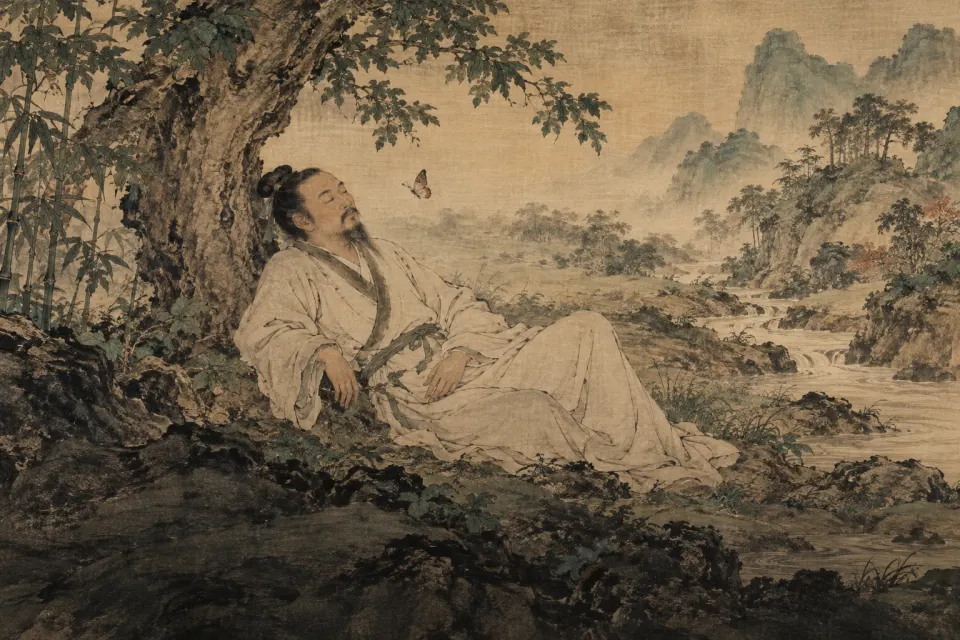
Zhuang Zhou (Zhuangzi) · 莊周
teacher · c. 369–286 BCE
Zhuang Zhou is credited with at least the seven "inner chapters" of the Zhuangzi; beyond anecdotes in that book, little is known of his life. His parables of relative values, free wandering and calm before death made him the tradition's second classical voice.[64]
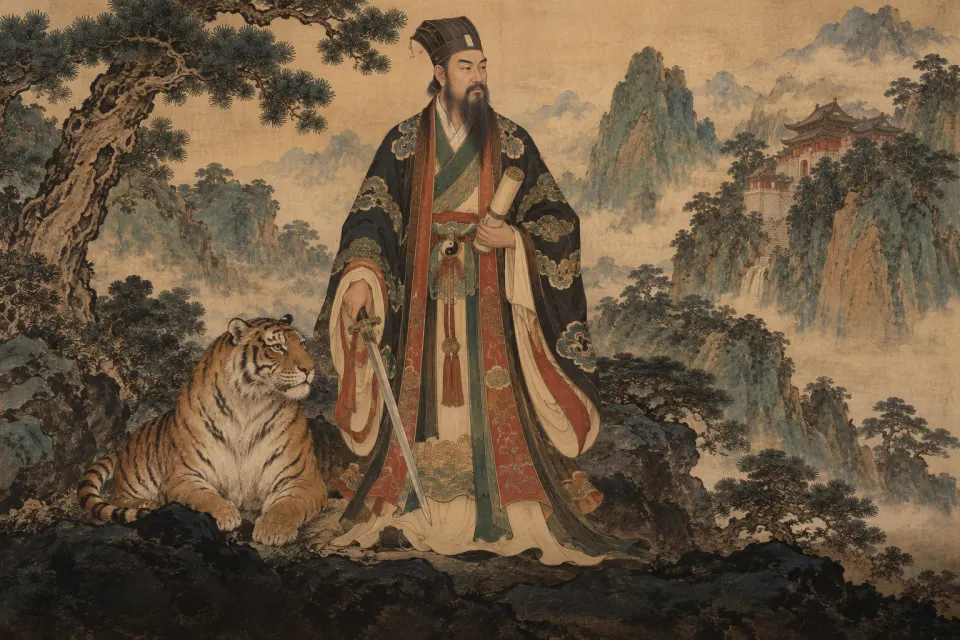
Zhang Daoling · 張道陵
founder · 2nd century CE
Zhang Daoling is honoured as the first Celestial Master, who by Daoist tradition received a covenant from Lord Lao in 142 CE. Outside sources mention only his grandson Zhang Lu, so some historians doubt the details. The Zhengyi order traces a hereditary line of Celestial Masters from him.[4, 65–66]

Ge Hong · 葛洪
scholar · 283–343
Ge Hong, from a leading southern family, wrote the Baopuzi, a defence of the pursuit of immortality that ranks elixirs from the alchemist's furnace above herbal remedies. His relatives were central to the revelations that followed.[67]
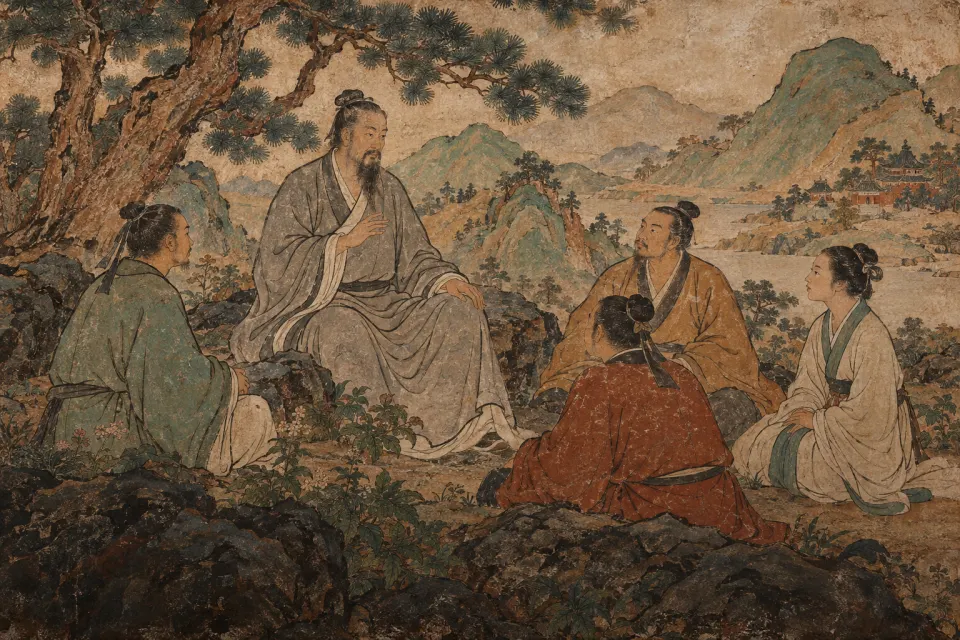
Wang Chongyang · 王重陽
founder · 1113–1170
Wang Zhe, known as Wang Chongyang, was a hermit and inner-alchemy adept who began preaching in Shandong in 1167 and founded Quanzhen. His leading disciples, later counted as the Seven Perfected, included a woman, Sun Bu'er, and spread the order across north China.[36, 68]
Scripture
Daodejing · 道德經
c. 4th–3rd century BCE
The "Classic of the Way and Its Power" runs to about 5,000 characters in 81 short chapters, much of it rhymed and without a single proper name. It speaks of the nameless Dao, of the sage who acts without forcing, and of rule with few laws. Silk copies from Mawangdui, made before 168 BCE, put the "Power" half first. Daoists also recite it as scripture.[69–71]
Zhuangzi · 莊子
4th–3rd century BCE
The Zhuangzi survives in 33 chapters as edited by Guo Xiang around 300 CE from a longer text of 52; only the first seven are usually credited to Zhuang Zhou. Its fables, among them the butterfly dream, unsettle fixed values and celebrate spontaneity.[64, 72]
Liezi · 列子
Partly 2nd century CE or later
Named after Master Lie, the Liezi ranks after the Daodejing and the Zhuangzi among the classics. The scholar A. C. Graham showed that parts of it cannot be earlier than the 2nd century CE, though it seems to keep older material, including passages from the lost longer Zhuangzi.[73]
Daozang (Daoist Canon) · 道藏
1445, with a 1607 supplement
The canon gathers about 1,500 works of scripture, ritual, alchemy, hagiography and philosophy. Its Ming edition, printed in 1445 with a supplement in 1607, underlies all modern editions. Earlier canons were compiled from the Tang onward; Khubilai Khan had one burned in 1281.[6, 74–75]
Places
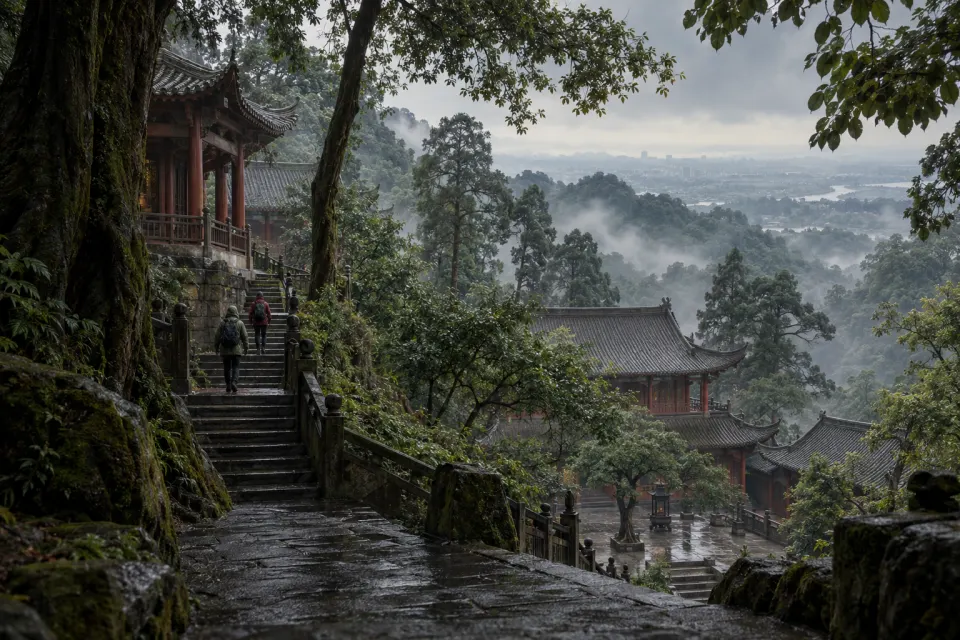
Mount Qingcheng
CHN · UNESCO World Heritage, 2000
This mountain above the Chengdu plain is honoured as a birthplace of Daoism; the Changdao temple marks where Zhang Daoling is said to have preached, though his revelation is usually placed on nearby Mount Heming. It is inscribed by UNESCO with the Dujiangyan irrigation system.[76]
Wudang Mountains
CHN · UNESCO World Heritage, 1994
The Wudang range in Hubei is the cult centre of Zhenwu, the Perfected Warrior, whom the Yongle emperor made protector of the Ming dynasty and honoured with lavish building. The UNESCO-listed complex preserves Daoist structures going back as far as the 7th century.[77]
Mount Longhu
CHN
Dragon-Tiger Mountain in Jiangxi was for centuries the seat of the Celestial Masters, who were officially charged with ordaining Daoist priests from the Song onward.[35]
White Cloud Abbey (Baiyun Guan), Beijing
CHN
Quanzhen's leading monastery, where Wang Changyue, abbot from 1656, made the Longmen branch the main line of the order and ordained clergy from across the empire. Today the China Taoist Association has its offices there.[57, 78]
Art & objects
Public-domain objects from museum collections. Select one to see it at the museum.
 Temple Seal of the Daoist God ZhenwuChina, Qing dynasty (1636–1912), 17th–18th century
 The Daoist God of Thunder with his EntourageChina, Ming dynasty (1368–1662), 17th century
 Bowl with God of Longevity (Shoulao) and Eight Daoist ImmortalsChina, Ming dynasty (1368–1644), Wanli reign mark and period (1572–1620)
 Vestment (For a Second-degree Taoist Priest)China, Qing dynasty (1644–1911), 1801/50
 Mirror with Images of Daoist DeitiesChina, Eastern Han dynasty (25–220 CE),
2nd or 3rd century CE
Mirror with Images of Daoist DeitiesChina, Eastern Han dynasty (25–220 CE),
2nd or 3rd century CE Daoist God Zhenwu (Perfected Warrior), Supreme Emperor of the Dark HeavenChina, Ming dynasty (1368–1644), Zhengtong period (1435–1449), dated 1439
 Paintings after Ancient Masters: Laozi Riding an OxChina, Ming dynasty (1368–1644), 1598–1652
 Album of Daoist and Buddhist Themes: Procession of Daoist Deities: Leaf 1China, Southern Song dynasty (1127-1279), 1200s
 Daoist immortal LaoziChina, Ming dynasty (1368–1644), 1438
 Mirror with Queen Mother of the West, Lord of the East, and mythical creaturesChina, Eastern Han dynasty (25–220), 2nd–3rd century
 Daoist divine officialChina, Ming dynasty (1368–1644), Chenghua period (1465–87), dated 1482
 Canonization scroll of Li ZhongChina, Ming dynasty (1368–1644), colophon dated 1641
 Three Taoist ScripturesChina, 20th century
 Daoist priest’s ritual robe with Eight TrigramsChina, Qing dynasty (1644–1911), 19th century
Numbers
- Adults in Taiwan who identify as Daoist
- 24% (2023 survey)[14]
42% say they were raised Daoist.
- Registered Daoist temples in mainland China
- c. 9,000 (2018)[43]
With more than 40,000 clergy. Unregistered temples and shrines are not counted.
National censuses
| Country | Year | Count | Share |
|---|---|---|---|
| Australia Taoism | 2021 | 6,149 | 0.0% |
| Canada Taoist | 2021 | 5,555 | 0.0% |
| United Kingdom (England and Wales) Other religion: Taoist | 2021 | 3,724 | 0.0% |
| New Zealand Taoism | 2018 | 1,098 | 0.0% |
Source: Australian Bureau of Statistics, Census of Population and Housing 2021, 'Religious affiliation in Australia' (Table 4), CC BY 4.0. Source: Office for National Statistics licensed under the Open Government Licence v.3.0 Adapted from Statistics Canada, Table 98-10-0342-01 Religion by visible minority and generation status: Canada, provinces and territories, census metropolitan areas and census agglomerations with parts, released 2022-10-26. This does not constitute an endorsement by Statistics Canada of this product. Source: Stats NZ, 2018 Census, licensed by Stats NZ for re-use under the Creative Commons Attribution 4.0 International licence.
How we know
Philosophy or religion?
Chinese bibliographers, and later Western scholars, split Daoism into daojia, the thought of Laozi and Zhuangzi, and daojiao, the religion, often casting the second as a corruption of the first. Most specialists now reject that picture. The classics arose amid practices of self-cultivation and ritual, the religion has always treated the Daodejing as scripture, and the split owes much to Neo-Confucian, Buddhist and Protestant polemic. The labels survive as shorthand, not as names for two separate traditions.[79–80]
Why Daoists are hard to count
Chinese religion has not usually been a matter of membership. Most people who burn incense to Daoist gods, hire priests for funerals or consult fengshui do not call themselves Daoist, and many temples house Buddhist, Daoist and folk gods together. Surveys find fewer than 0.5% of mainland adults naming Daoism as their religion, while estimates for Taiwan range from about 13% to 24%. China's government itself says it cannot count Buddhist and Daoist believers accurately.[13, 81–82]
Common misconceptions
Myth Laozi founded Daoism by writing the Daodejing in the 6th century BCE.
Fact The Daodejing appears to be a compilation by many hands that reached its present shape around the 3rd century BCE, and Laozi's life is legend. Organised Daoism dates from the 2nd century CE, and Daoists themselves treat Laozi less as a founder than as a recurring manifestation of the Dao.[1–3, 25]
Myth Daoism, Buddhism and Confucianism are separate faiths, so a person has to belong to one of them.
Fact In China the Three Teachings have long been combined. Lay people pray at Daoist and Buddhist temples alike as needs arise, many temples house gods of more than one tradition, and a well-known image compares the three to an iceberg whose separate peaks merge below the waterline.[17]
Glossary
- Dao · 道
- The "Way": in Daoism, the nameless source and ordering process of all things, to which practitioners seek to return.[15]
- Wuwei · 無為
- "Non-action": acting without forcing or striving, in accord with the nature of things.[16]
- Qi · 氣
- Breath, vital energy: the stuff of which all things and beings are made.[45]
- Xian · 仙
- An immortal or transcendent: a person who through practice escapes ordinary ageing and death.[47]
- Fashi · 法師
- A "ritual master": a lay exorcist, often working with spirit mediums, distinct from the ordained daoshi.[52]
- Fu · 符
- A talisman written in a script meant for the gods; worn, posted up, or burned and swallowed with water for protection and healing.[83]
- Jiao · 醮
- "Offering": the great communal ritual by which a community renews its bond with its gods.[63]
- Neidan · 內丹
- Inner alchemy: meditation that refines essence, breath and spirit within the body, described in the language of laboratory alchemy.[60]
- Sanqing · 三清
- The Three Pure Ones, the highest Daoist gods, each ruling a heaven; one is the deified Laozi.[7]
- Daojia and daojiao · 道家 · 道教
- "Lineage of the Way" and "teaching of the Way": old Chinese terms, later used to separate philosophical from religious Daoism.[22, 32]
Sources
Each statement above was checked against published sources; the verdict says whether it stood as written, was corrected or was hedged.
- VerifiedStanford Encyclopedia of Philosophy, Religious Daoism; Britannica, Laozi; Stanford Encyclopedia of Philosophy, Laozi; Britannica, Taoism: General characteristics.
- VerifiedStanford Encyclopedia of Philosophy, Religious Daoism; Encyclopedia of Religion, 2nd ed.; Britannica, Taoism: Development of the Taoist religion from the 2nd to the 6th century.
- VerifiedStanford Encyclopedia of Philosophy, Religious Daoism; Britannica, Laozi; Stanford Encyclopedia of Philosophy, Laozi.
- VerifiedBritannica, Taoism: Development of the Taoist religion from the 2nd to the 6th century; Stanford Encyclopedia of Philosophy, Religious Daoism; Encyclopedia of Taoism; Encyclopedia of Religion, 2nd ed..
- VerifiedBritannica, What is the Difference Between Daoism and Confucianism?; Stanford Encyclopedia of Philosophy, Religious Daoism; Britannica, Taoism: General characteristics.
- VerifiedEncyclopedia of Taoism; Encyclopedia of Religion, 2nd ed.; Internet Encyclopedia of Philosophy, Daoist Philosophy.
- VerifiedStanford Encyclopedia of Philosophy, Religious Daoism; Encyclopedia of Religion, 2nd ed.; Britannica, Laozi.
- VerifiedEncyclopedia of Religion, 2nd ed.; Stanford Encyclopedia of Philosophy, Religious Daoism; Encyclopedia of Taoism; Britannica, Taoism: Development of the Taoist religion from the 2nd to the 6th century.
- VerifiedPew Research Center, Measuring Religion in China; Encyclopedia of Taoism; Encyclopedia of Religion, 2nd ed..
- VerifiedEncyclopedia of Taoism; Stanford Encyclopedia of Philosophy, Religious Daoism; Pew Research Center, Measuring Religion in China.
- VerifiedStanford Encyclopedia of Philosophy, Religious Daoism; Encyclopedia of Taoism; Encyclopedia of Religion, 2nd ed..
- VerifiedEncyclopedia of Religion, 2nd ed.; Stanford Encyclopedia of Philosophy, Religious Daoism; Pew Research Center, Measuring Religion in China.
- VerifiedPew Research Center, Measuring Religion in China; Todd M. Johnson and Brian J. Grim, The World's Religions in Figures.
- VerifiedPew Research Center, Religion and Spirituality in East Asian Societies; Todd M. Johnson and Brian J. Grim, The World's Religions in Figures.
- VerifiedStanford Encyclopedia of Philosophy, Religious Daoism; Britannica, dao; Britannica, Taoism: General characteristics.
- VerifiedBritannica, Tao-te Ching; Stanford Encyclopedia of Philosophy, Religious Daoism; Britannica, Taoism: Religious goals of the individual; Internet Encyclopedia of Philosophy, Daoist Philosophy.
- VerifiedEncyclopedia of Religion, 2nd ed.; Stanford Encyclopedia of Philosophy, Religious Daoism; Pew Research Center, Measuring Religion in China.
- VerifiedPew Research Center, Measuring Religion in China; State Council Information Office of the PRC, White paper China's Policies and Practices on Protecting Freedom of Religious Belief.
- VerifiedBritannica, Taoism: Taoism and other religions; Encyclopedia of Religion, 2nd ed.; Todd M. Johnson and Brian J. Grim, The World's Religions in Figures.
- VerifiedBritannica, Taoism: General characteristics; Britannica, Laozi; Stanford Encyclopedia of Philosophy, Laozi.
- VerifiedBritannica, Taoism: General characteristics; Stanford Encyclopedia of Philosophy, Religious Daoism; Internet Encyclopedia of Philosophy, Daoist Philosophy.
- VerifiedEncyclopedia of Taoism; Stanford Encyclopedia of Philosophy, Religious Daoism; Encyclopedia of Religion, 2nd ed..
- VerifiedBritannica, Taoism: History; Stanford Encyclopedia of Philosophy, Religious Daoism.
- VerifiedStanford Encyclopedia of Philosophy, Religious Daoism; Britannica, Taoism: Taoism and other religions; Britannica, Laozi.
- VerifiedStanford Encyclopedia of Philosophy, Religious Daoism; Britannica, Laozi; Encyclopedia of Religion, 2nd ed..
- VerifiedBritannica, Taoism: Development of the Taoist religion from the 2nd to the 6th century; Encyclopedia of Taoism; Britannica, Zhang Daoling.
- VerifiedBritannica, Taoism: Development of the Taoist religion from the 2nd to the 6th century; Encyclopedia of Taoism; Encyclopedia of Religion, 2nd ed..
- VerifiedStanford Encyclopedia of Philosophy, Religious Daoism; Encyclopedia of Religion, 2nd ed.; Britannica, Taoism: The Maoshan Revelations.
- VerifiedBritannica, Taoism: The Maoshan Revelations; Stanford Encyclopedia of Philosophy, Religious Daoism; Encyclopedia of Religion, 2nd ed..
- VerifiedStanford Encyclopedia of Philosophy, Religious Daoism; Britannica, Taoism: The Lingbao scriptures and liturgies; Encyclopedia of Religion, 2nd ed.; Internet Encyclopedia of Philosophy, Daoist Philosophy.
- VerifiedEncyclopedia of Religion, 2nd ed.; Stanford Encyclopedia of Philosophy, Religious Daoism.
- VerifiedEncyclopedia of Taoism; Encyclopedia of Religion, 2nd ed..
- VerifiedEncyclopedia of Religion, 2nd ed.; Britannica, Taoism: Taoism under the Tang, Song, and later dynasties; Stanford Encyclopedia of Philosophy, Laozi.
- VerifiedBritannica, Taoism: Taoism under the Tang, Song, and later dynasties; Stanford Encyclopedia of Philosophy, Religious Daoism; Encyclopedia of Religion, 2nd ed..
- VerifiedBritannica, Taoism: Taoism under the Tang, Song, and later dynasties; Stanford Encyclopedia of Philosophy, Religious Daoism; Internet Encyclopedia of Philosophy, Daoist Philosophy.
- VerifiedEncyclopedia of Taoism; Britannica, Taoism: Taoism under the Tang, Song, and later dynasties; Stanford Encyclopedia of Philosophy, Religious Daoism.
- VerifiedEncyclopedia of Taoism; Encyclopedia of Religion, 2nd ed.; Britannica, Taoism: Taoism under the Tang, Song, and later dynasties.
- VerifiedEncyclopedia of Religion, 2nd ed.; Pew Research Center, Measuring Religion in China; Stanford Encyclopedia of Philosophy, Religious Daoism.
- VerifiedPew Research Center, Measuring Religion in China; Internet Encyclopedia of Philosophy, Daoist Philosophy.
- VerifiedPew Research Center, Measuring Religion in China; Encyclopedia of Religion, 2nd ed..
- VerifiedPew Research Center, Measuring Religion in China; Internet Encyclopedia of Philosophy, Daoist Philosophy; Todd M. Johnson and Brian J. Grim, The World's Religions in Figures.
- VerifiedEncyclopedia of Religion, 2nd ed.; Pew Research Center, Measuring Religion in China.
- VerifiedState Council Information Office of the PRC, White paper China's Policies and Practices on Protecting Freedom of Religious Belief; Pew Research Center, Measuring Religion in China; Freedom House, The Battle for China's Spirit: Chinese Buddhism and Taoism (supporting).
- VerifiedBritannica, Taoism: Taoism and other religions; Encyclopedia of Religion, 2nd ed..
- VerifiedEncyclopedia of Religion, 2nd ed.; Stanford Encyclopedia of Philosophy, Religious Daoism.
- VerifiedBritannica, Taoism: General characteristics; Encyclopedia of Religion, 2nd ed..
- VerifiedStanford Encyclopedia of Philosophy, Religious Daoism; Britannica, Taoism: Religious goals of the individual; Encyclopedia of Religion, 2nd ed..
- VerifiedStanford Encyclopedia of Philosophy, Religious Daoism; Britannica, Taoism: Development of the Taoist religion from the 2nd to the 6th century.
- VerifiedStanford Encyclopedia of Philosophy, Religious Daoism; Britannica, Taoism: Development of the Taoist religion from the 2nd to the 6th century; Encyclopedia of Taoism.
- VerifiedBritannica, Taoism: Taoism under the Tang, Song, and later dynasties; Encyclopedia of Religion, 2nd ed..
- VerifiedEncyclopedia of Religion, 2nd ed.; Stanford Encyclopedia of Philosophy, Religious Daoism.
- VerifiedBritannica, Taoism: Taoism and other religions; Stanford Encyclopedia of Philosophy, Religious Daoism; Britannica, Taoism: Developments outside the official current.
- VerifiedStanford Encyclopedia of Philosophy, Religious Daoism; Encyclopedia of Taoism.
- VerifiedBritannica, Taoism: Taoism under the Tang, Song, and later dynasties; Encyclopedia of Religion, 2nd ed..
- VerifiedEncyclopedia of Taoism; Britannica, Taoism: Taoism and other religions.
- VerifiedEncyclopedia of Taoism; Encyclopedia of Religion, 2nd ed..
- VerifiedStanford Encyclopedia of Philosophy, Religious Daoism; Encyclopedia of Religion, 2nd ed..
- VerifiedStanford Encyclopedia of Philosophy, Religious Daoism; Britannica, Taoism: Religious goals of the individual.
- VerifiedStanford Encyclopedia of Philosophy, Religious Daoism; Encyclopedia of Religion, 2nd ed.; Pew Research Center, Measuring Religion in China.
- VerifiedStanford Encyclopedia of Philosophy, Religious Daoism; Britannica, Taoism: Taoism under the Tang, Song, and later dynasties.
- CorrectedStanford Encyclopedia of Philosophy, Laozi; Encyclopedia of Religion.
- VerifiedPew Research Center, Measuring Religion in China; Encyclopedia of Buddhism.
- VerifiedEncyclopedia of Taoism; Stanford Encyclopedia of Philosophy, Religious Daoism; Britannica, Taoism: Taoism and other religions.
- VerifiedBritannica, Zhuang Zhou; Stanford Encyclopedia of Philosophy, Zhuangzi; Stanford Encyclopedia of Philosophy, Religious Daoism.
- VerifiedEncyclopedia of Religion, 2nd ed.; Encyclopedia of Taoism.
- VerifiedEncyclopedia of Taoism; Britannica, Zhang Daoling; Encyclopedia of Religion, 2nd ed..
- VerifiedEncyclopedia of Religion, 2nd ed.; Stanford Encyclopedia of Philosophy, Religious Daoism; Britannica, Taoism: The Maoshan Revelations.
- VerifiedEncyclopedia of Taoism; Encyclopedia of Religion, 2nd ed.; Stanford Encyclopedia of Philosophy, Religious Daoism.
- VerifiedBritannica, Taoism: General characteristics; Stanford Encyclopedia of Philosophy, Religious Daoism; Stanford Encyclopedia of Philosophy, Laozi.
- VerifiedStanford Encyclopedia of Philosophy, Laozi; Internet Encyclopedia of Philosophy, Daoist Philosophy; Encyclopedia of Taoism.
- VerifiedStanford Encyclopedia of Philosophy, Laozi; Encyclopedia of Religion, 2nd ed.; Britannica, Taoism: General characteristics.
- VerifiedStanford Encyclopedia of Philosophy, Zhuangzi; Internet Encyclopedia of Philosophy, Daoist Philosophy; Britannica, Zhuang Zhou.
- VerifiedStanford Encyclopedia of Philosophy, Religious Daoism; Internet Encyclopedia of Philosophy, Daoist Philosophy; Britannica, Taoism.
- VerifiedBritannica, Daozang; Internet Encyclopedia of Philosophy, Daoist Philosophy; Encyclopedia of Taoism.
- VerifiedStanford Encyclopedia of Philosophy, Religious Daoism; Encyclopedia of Taoism; Encyclopedia of Taoism.
- VerifiedUNESCO World Heritage Centre, Mount Qingcheng and the Dujiangyan Irrigation System; Encyclopedia of Taoism; Encyclopedia of Religion, 2nd ed..
- VerifiedEncyclopedia of Religion, 2nd ed.; UNESCO World Heritage Centre, Ancient Building Complex in the Wudang Mountains; Stanford Encyclopedia of Philosophy, Religious Daoism.
- VerifiedEncyclopedia of Religion, 2nd ed.; Stanford Encyclopedia of Philosophy, Religious Daoism; Encyclopedia of Taoism.
- VerifiedBritannica, Taoism; Britannica, What is the Difference Between Daoism and Confucianism?; Stanford Encyclopedia of Philosophy, Religious Daoism; Internet Encyclopedia of Philosophy, Daoist Philosophy.
- VerifiedEncyclopedia of Taoism; Internet Encyclopedia of Philosophy, Daoist Philosophy.
- VerifiedPew Research Center, Measuring Religion in China; State Council Information Office of the PRC, White paper China's Policies and Practices on Protecting Freedom of Religious Belief; Todd M. Johnson and Brian J. Grim, The World's Religions in Figures.
- VerifiedTodd M. Johnson and Brian J. Grim, The World's Religions in Figures; Pew Research Center, Religion and Spirituality in East Asian Societies.
- VerifiedStanford Encyclopedia of Philosophy, Religious Daoism; Britannica, Taoism: Development of the Taoist religion from the 2nd to the 6th century.
Last fact-checked 3 October 2026.