
Overview
Zen is the meditation-centred branch of Mahāyāna Buddhism, known as Chan in China, Sŏn in Korea and Thiền in Vietnam — all ways of saying the Sanskrit dhyāna, "meditation." It traces its authority to an unbroken line of teachers reaching back, through the legendary Indian monk Bodhidharma, to the Buddha, each generation's awakening confirmed directly by a living master rather than by scripture alone. Zen communities study sūtras and keep monastic rites, but prize a sudden, direct seeing of one's own buddha-nature over gradual accumulation of merit. Two Japanese lineages, Rinzai and Sōtō, remain its largest schools; Korea's Jogye order and Vietnam's Trúc Lâm carry the same practice forward today.[1–4, 6–8]
History

Bodhidharma and a legendary founding 5th–6th century CE (traditional)
Zen has no securely documented founder. Tradition credits an Indian meditation master, Bodhidharma, with carrying true Buddhism to China, placing him around 520 at the court of the Liang emperor Wu, who asked how much merit his patronage of monasteries had earned him; Bodhidharma is said to have answered that deeds done for merit bring no enlightenment. Other stories put him meditating silently for years facing a wall near the Shaolin Monastery. Near-contemporary accounts disagree on his origin and age, and the first biography was written about a century after his death, so historians treat the details as legend.[9–11]
Huineng and the sudden-awakening lineage 7th–8th century
The sixth patriarch, Huineng, is said to have been an illiterate woodcutter who won the succession from the fifth patriarch Hongren in a poetry contest against the senior monk Shenxiu, besting him with a verse on a mind already pure. Around 730 the monk Shenhui declared Huineng's "Southern Lineage" the only legitimate transmission, condemning rivals for teaching a merely gradual path. The Platform Sūtra, compiled in Huineng's name in the 780s, made this sudden, unmediated seeing of buddha-nature Chan's defining claim and became its central scripture by the Song dynasty.[12–14]
The Five Houses and Song-dynasty Chan 8th–13th century
Huineng's heir Mazu Daoyi taught that enlightenment is not separate from daily activity, declaring that "the ordinary mind is the Way." After the Tang dynasty's upheavals, rural Chan monasteries multiplied and diversified into five main lineages — Linji, Caodong, Fayan, Yunmen and Guiyang — each with its own training style. Song-dynasty monks turned recorded sayings of past masters into a literature of "public cases," compiling anthologies such as the Blue Cliff Record (c. 1125) and the Gateless Barrier (1229) that remain basic Zen textbooks today.[15–17]
Spread to Korea, Japan and Vietnam 8th–13th century
In Korea, monks founded nine mountain meditation centres in the 8th and 9th centuries, mostly Linji-affiliated; the monk Chinul (1158–1210) later merged this Sŏn meditation with Hwaŏm doctrinal study into the school that became Korea's main Buddhist order, the Jogye. In Japan, Eisai transmitted Rinzai teaching in 1191, and Dōgen, after studying Chan in China from 1223 to 1227, founded the Sōtō lineage and its monastery, Eihei-ji. In Vietnam, King Trần Nhân Tông founded the Trúc Lâm ("Bamboo Forest") school in the 13th century, blending Mahāyāna with Confucian ethics and Taoist cosmology.[18–20]
Key moments
- c. 520 CEBodhidharma and Chan · Luoyang region, China
- c. 1227 CEJapan's Kamakura reformers · Kyoto and Kamakura, Japan
Beliefs
Sudden awakening · 頓悟 dunwu; Japanese satori
instant seeing of one's true nature
Zen holds that every being already carries buddha-nature and can realize it directly, not merely through accumulating years of textual study. A verse attributed to Bodhidharma calls this "a special transmission outside the scriptures, not relying on words or letters; pointing directly to the human mind, seeing true nature is becoming a Buddha."[4, 21]
Dharma transmission · 傳法 chuánfǎ; Japanese denpō
Zen authority passes from a recognized master to a disciple whose awakening the master confirms directly, not through ordination alone. Lineage charts trace every living teacher back through generations of patriarchs to the Buddha, grounding a teacher's standing and justifying the funeral and memorial rites Zen priests perform.[22]
Ordinary mind · 平常心 píngchángxīn
Building on Mazu's teaching, many Zen schools hold that awakening is not separate from everyday activity such as eating or sweeping a courtyard. Baizhang Huaihai expressed the same spirit in his rule that "a day without work is a day without food," linking enlightenment to ordinary labour.[15, 23]
Practice

Zazen · 坐禪 zuòchán; Japanese zazen
Sōtō's founder Dōgen taught shikantaza, "just sitting," holding that meditation and enlightenment are not separate stages but a single act performed here and now. Rinzai temples instead typically pair seated meditation with intensive kōan practice directed by a teacher.[24–25]
Kōan practice · 公案 gōng'àn; Japanese kōan
Students work through kōan — brief, often paradoxical episodes drawn from past masters' sayings — in private interviews meant to break ordinary logical thought. Rinzai teachers have used a sudden shout or a strike to jolt a student past habitual thinking, and the 18th-century reformer Hakuin popularized sustained concentration on kōans such as "what is the sound of one hand clapping?"[26–28]
Rules of purity · 清規 qīngguī; Japanese shingi
From the Song dynasty, Chan monasteries wrote out codes of daily conduct that supplemented, rather than replaced, the older monastic rules. These "pure rules" grew out of customs such as communal farming at Baizhang's monastery and were later applied to Chinese Buddhist monasteries generally, whether or not formally Chan.[29]
Zen arts
In medieval Japan, Zen monks of the elite Five Mountain temples who had studied in China introduced Chinese ink painting, calligraphy and garden design to Japanese rulers. The tea ceremony and the dry-landscape rock garden became known as expressions of a Zen aesthetic, though "Zen" later gained a separate, secular meaning in the West, often detached from Buddhist practice.[30–31]
People

Bodhidharma
founder · fl. 6th century CE (traditional)
Credited by tradition as the Indian monk who brought Chan to China, in stories that place him at Emperor Wu's court around 520 and meditating for years facing a wall near the Shaolin Monastery. Near-contemporary sources disagree on his origin and age, and historians treat most details as later legend.[9–11]

Huineng · 惠能
teacher · 638–713
An illiterate woodcutter who won recognition as the sixth patriarch over the senior monk Shenxiu and founded Chan's dominant Southern Lineage. He taught in Guangdong for some 37 years, insisting that awakening comes from suddenly seeing one's own already-pure nature, not gradual practice.[12–14, 32]
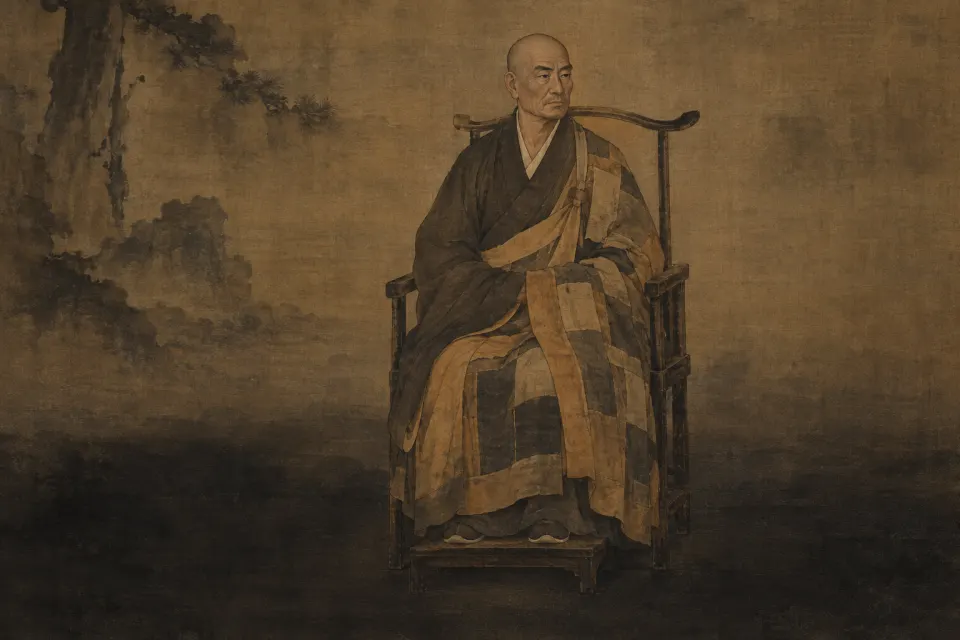
Linji Yixuan · 臨濟義玄
founder · d. 866
A Tang-dynasty Chan master whose vigorous, often startling teaching style gave its name to the Linji lineage, known in Japan as Rinzai. Eisai transmitted this lineage to Japan in 1191, and it remains, with Sōtō, one of the two major schools of Japanese Zen.[6, 19, 33]

Dōgen · 道元
founder · 1200–1253
Orphaned at seven and ordained at thirteen, Dōgen studied for years on Mount Hiei before travelling to China, where he gained enlightenment under the Chan master Rujing. Back in Japan he founded the Sōtō lineage and Eihei-ji, the Fukui monastery where he spent his final years.[19, 34]

Hakuin · 白隠
teacher · 1686–1769
An itinerant monk who revived Rinzai Zen in 18th-century Japan from a small temple in Hara, after years of poverty among his peasant parishioners. He taught that direct realization was open to the humblest believer and must be joined to a moral life, and his kōans and bold ink paintings remain central to Rinzai training today.[28, 35]
Scripture
Platform Sūtra · 六祖壇經 Liùzǔ tánjīng
compiled 780s, attributed to Huineng
The only text outside the Indian canon ever to carry the title "sūtra," ordinarily reserved for the Buddha's own words. It weaves together a hagiography of Huineng, sermons and a line of patriarchs, and became Chan's central scripture by the Song dynasty.[14, 36]
Blue Cliff Record · 碧巖錄 Bìyán lù
compiled c. 1125
An anthology of 100 kōan with verse and prose commentary, compiled by the Song-dynasty master Yuanwu Keqin. Together with the 1229 Gateless Barrier, it remains one of the basic textbooks of Zen training.[17, 37]
Shōbōgenzō · 正法眼藏
1231–1253
Dōgen's masterwork, written in both Japanese and Chinese, elaborates Zen teaching and practice. It was largely ignored for several centuries before being rehabilitated in the 1700s and is now ranked among the classics of Japanese Buddhism.[38]
Places
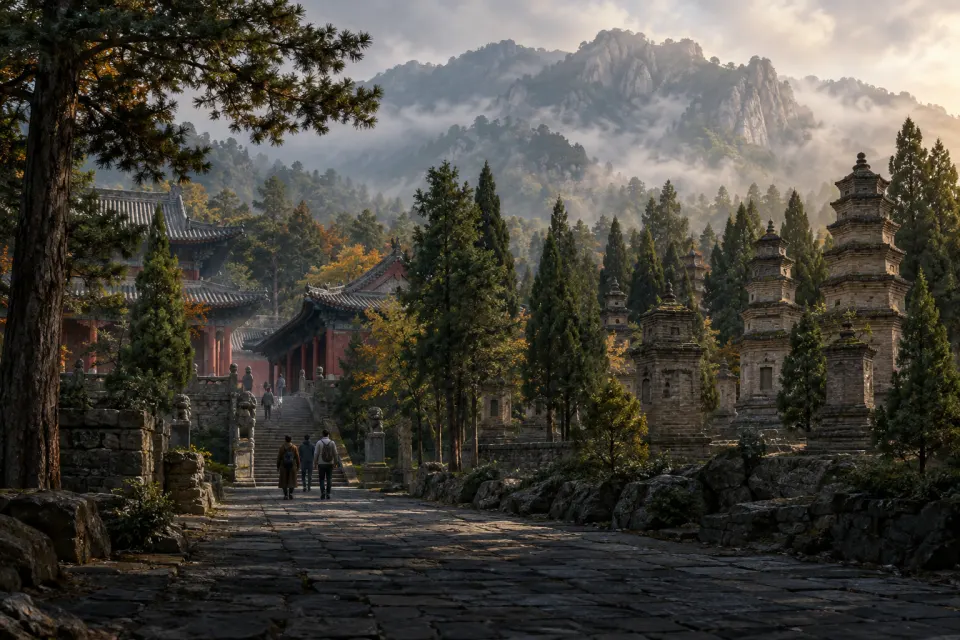
Shaolin Monastery
CHN · UNESCO World Heritage, 2010
Part of the Dengfeng monument cluster on Mount Song in Henan. Chan tradition ties the monastery to Bodhidharma's legendary wall-gazing retreat and credits him with teaching its monks, later famed for martial arts, techniques of meditation.[10, 39]
Tenryū-ji
JPN · UNESCO World Heritage, 1994
A Rinzai temple in Kyoto, converted from an imperial villa in 1339 and named among the sect's great temples. Its garden survives even though fire destroyed the original Buddhist halls during civil war.[40]
Tongdosa
KOR · UNESCO World Heritage, 2018
One of seven mountain monasteries on Korea's Sansa World Heritage listing, reflecting centuries in which meditation practice coexisted with doctrinal study and shaped Korean Sŏn Buddhism.[41]
Yên Tử
VNM · UNESCO World Heritage, 2025
A sacred mountain landscape in Quảng Ninh province where King Trần Nhân Tông founded the Trúc Lâm school in the 13th century. The site remains a living pilgrimage destination for Vietnamese Thiền Buddhists.[20, 42]
Art & objects
Public-domain objects from museum collections. Select one to see it at the museum.
 DarumaJapan, c. 1550
 Bodhidharma Meditating Facing a CliffChina, Song dynasty (960-1279), late 1200s
 Lineage Portrait of Buddhist MonksChina, Qing dynasty (1644–1911), 1600s
 Calligraphy in Semi-Cursive Style (xing-caoshu)China, Qing dynasty (1644–1911), c. 1660–1709
 Bodhidharma crossing the Yangzi River on a reedChina, Yuan dynasty (1271–1368), before 1317
 Bodhidharma in meditationChina, Ming dynasty (1368–1644), 17th century
 Portrait of the Ōbaku Zen Monk Jifei Ruyi (Sokuhi Nyoitsu)Japan, Edo period (1615–1868), 1666
 Table screen with Bodhidharma and landscape of Jinshan IslandChina, Qing dynasty (1644–1911), Qianlong period (1736–95), mid-18th century
 Bodhidharma Seated in MeditationChina, Ming dynasty (1368–1644)
 BodhidharmaJapan, Momoyama period (1573–1615), early 17th century
 The Sixth Patriarch of Zen at the Moment of EnlightenmentJapan, Edo period (1615–1868), 1635–45
 Portrait of BodhidharmaJapan, Edo period (1615–1868), mid-18th century
 Zen Saying by Dahui Zonggao on the Passage of TimeJapan, Nanbokuchō period (1336–1392), mid-14th century
Numbers
National censuses
| Country | Year | Count | Share |
|---|---|---|---|
| New Zealand Zen Buddhism | 2018 | 1,401 | 0.0% |
Source: Stats NZ, 2018 Census, licensed by Stats NZ for re-use under the Creative Commons Attribution 4.0 International licence.
Common misconceptions
Myth Zen is a secular mindfulness technique, not a religion.
Fact Zen is a Buddhist monastic tradition with its own scriptures, precepts, ordination, and funeral and memorial rites performed by priests. Its mid-20th-century popularizers, writing for Western readers after World War II, often presented it as a culture-free spiritual technique detached from any religious institution, a framing many scholars have since challenged.[43]
Myth Zen rejects scripture and tradition in favour of pure spontaneity.
Fact Zen monks and nuns study Buddhist scriptures, Chinese classics and a large body of Zen literature alongside meditation. What is distinctive is not a rejection of texts but the insistence that reading alone cannot produce awakening, which only a living teacher can confirm.[44]
Glossary
- zazen · 坐禪
- Seated meditation; in Sōtō, practiced as shikantaza, "just sitting," held to be enlightenment itself rather than a means to it.[24]
- kōan · 公案 gōng'àn
- A brief, often paradoxical episode or saying from a past master, used in Zen training to break through ordinary logical thought.[26]
- satori · 悟; Chinese wu or dunwu
- Sudden, direct awakening to one's own buddha-nature, as opposed to a gradual building-up of merit or insight.[21]
- dhyāna
- Sanskrit "meditation"; the root of the words Chan, Zen, Sŏn and Thiền.[3]
- qīngguī · 清規; Japanese shingi
- "Rules of purity": codes of monastic conduct that spread from Chan monasteries to Chinese Buddhist monasteries generally.[29]
- dharma transmission · 傳法 chuánfǎ
- A master's confirmation that a disciple has attained the same awakening as the lineage's earlier teachers, back to the Buddha.[22]
- Rinzai · 臨濟; Chinese Linji
- The Japanese Zen lineage descended from Linji Yixuan, stressing abrupt awakening through kōan practice and dramatic teaching methods.[6]
- Sōtō · 曹洞; Chinese Caodong
- The Japanese Zen lineage founded by Dōgen, Japan's largest Zen school, centred on shikantaza meditation.[6, 19]
Sources
Each statement above was checked against published sources; the verdict says whether it stood as written, was corrected or was hedged.
- VerifiedBritannica, Zen; SEP, Chan Buddhism.
- VerifiedBritannica, Zen; Encyclopedia of Buddhism, Chan School.
- VerifiedBritannica, Zen; Encyclopedia of Buddhism, Chan School.
- VerifiedBritannica, Zen; SEP, Chan Buddhism.
- VerifiedBritannica, Zen; Encyclopedia of Buddhism, Chan School.
- VerifiedBritannica, Zen; Encyclopedia of Buddhism, Chan School; Encyclopedia of Buddhism, Buddhism: Buddhism in Korea; UNESCO WHC 1732.
- VerifiedBritannica, Zen; Encyclopedia of Buddhism, Chan School.
- VerifiedBritannica, Zen; SEP, Chan Buddhism.
- VerifiedBritannica, Bodhidharma; Encyclopedia of Buddhism, Bodhidharma.
- CorrectedBritannica, Bodhidharma; Encyclopedia of Religion, Bodhidharma.
- VerifiedBritannica, Bodhidharma; Encyclopedia of Buddhism, Chan School.
- VerifiedBritannica, Hui-neng; Encyclopedia of Buddhism, Chan School.
- VerifiedEncyclopedia of Buddhism, Chan School; Britannica, Hui-neng.
- VerifiedEncyclopedia of Buddhism, Chan School; Britannica, Hui-neng.
- VerifiedEncyclopedia of Buddhism, Chan School; SEP, Chan Buddhism.
- VerifiedSEP, Chan Buddhism; Encyclopedia of Buddhism, Chan School.
- VerifiedBritannica, Zen; SEP, Chan Buddhism.
- CorrectedEncyclopedia of Buddhism, Buddhism: Buddhism in Korea; Britannica, Zen.
- VerifiedBritannica, Rinzai; Britannica, Dōgen; Encyclopedia of Buddhism, Chan School.
- VerifiedUNESCO WHC 1732; Britannica, Zen.
- VerifiedBritannica, Zen; SEP, Chan Buddhism.
- VerifiedBritannica, Zen; Encyclopedia of Buddhism, Chan School.
- VerifiedEncyclopedia of Buddhism, Chan School; SEP, Chan Buddhism.
- VerifiedBritannica, Dōgen; Encyclopedia of Buddhism, Chan School.
- VerifiedBritannica, Rinzai; Encyclopedia of Buddhism, Chan School.
- VerifiedBritannica, Zen; Encyclopedia of Buddhism, Chan School.
- VerifiedBritannica, Rinzai; Encyclopedia of Buddhism, Chan School.
- CorrectedBritannica, Hakuin; Encyclopedia of Buddhism, Hakuin.
- VerifiedBritannica, Zen; Encyclopedia of Buddhism, Chan School.
- VerifiedBritannica, Zen; Encyclopedia of Buddhism, Chan School.
- CorrectedBritannica, Zen; SEP, Chan Buddhism.
- VerifiedBritannica, Hui-neng; Encyclopedia of Buddhism, Chan School.
- VerifiedEncyclopedia of Buddhism, Chan School; Britannica, Rinzai.
- VerifiedBritannica, Dōgen; Encyclopedia of Buddhism, Chan School.
- CorrectedBritannica, Hakuin; Encyclopedia of Buddhism, Hakuin.
- VerifiedSEP, Chan Buddhism; Encyclopedia of Buddhism, Chan School.
- VerifiedBritannica, Zen; SEP, Chan Buddhism.
- VerifiedBritannica, Dōgen; Encyclopedia of Buddhism, Chan School.
- VerifiedUNESCO WHC 1305; Britannica, Bodhidharma.
- VerifiedBritannica, Rinzai; UNESCO WHC 688 advisory body evaluation.
- VerifiedUNESCO WHC 1562; Encyclopedia of Buddhism, Buddhism: Buddhism in Korea.
- VerifiedUNESCO WHC 1732; Britannica, Zen.
- VerifiedBritannica, Zen; SEP, Chan Buddhism.
- VerifiedBritannica, Zen; Encyclopedia of Buddhism, Chan School.
Last fact-checked 3 October 2026.