
Overview
Mahāyāna, the "Great Vehicle", is generally reckoned the largest of Buddhism's three main branches and is the form that shaped the Buddhism of China, Korea, Japan and Vietnam. It grew up in India around the turn of the Common Era through new scriptures, the Mahāyāna sūtras, which present themselves as the Buddha's own words. Their ideal is the bodhisattva, who vows to become a fully awakened buddha in order to free all beings. Its thinkers taught that nothing has a fixed, independent essence, and many held that every being carries the seed of buddhahood. Devotion to buddhas and bodhisattvas such as Amitābha and the compassionate Avalokiteśvara is central to popular practice. It is no single church: it spans India's philosophical schools and East Asia's many schools, from Zen meditation to Pure Land devotion and the Lotus lineages of Nichiren.[4, 6, 10–13]
History

A new kind of scripture c. 1st century BCE – 3rd century CE
Mahāyāna has no founding date. Its earliest trace is a body of sūtras composed in India in the first centuries CE, perhaps a little earlier, which claim to give teachings the Buddha meant for bodhisattvas. Fragments of a Perfection of Wisdom sūtra in Gāndhārī, radiocarbon-dated to roughly 47–147 CE, are the oldest manuscripts, and Lokakṣema's Chinese translations of about 179 CE give the first firm date. Scholars now think the movement grew inside existing monasteries, not as a breakaway sect: its monks kept the old monastic codes, and Chinese pilgrims met followers and non-followers living side by side. Few inscriptions mention it, and Gregory Schopen has argued, against some critics, that it left little visible mark on Indian practice before about the 5th century.[14–17]
Philosophers and great monasteries c. 2nd – 12th century
Around the 2nd or 3rd century the monk Nāgārjuna, probably in southern India, gave the Perfection of Wisdom's teaching of emptiness rigorous philosophical form, founding the Madhyamaka ("Middle Way") school. In the 4th–5th centuries the brothers Asaṅga and Vasubandhu systematized Yogācāra, which analysed how the mind builds experience. Other texts taught that every being holds the "embryo" of a buddha. Monastic centres such as Nālandā drew students from across Asia, among them the Chinese pilgrim Xuanzang. Late in the 1st millennium tantric Buddhism, the Vajrayāna, grew out of the Mahāyāna. Buddhism then lost ground in India, and the sack of the great monasteries around 1200 ended its last major centres.[18–23]
China makes it its own c. 1st – 12th century
Buddhism reached China from Central Asia in the 1st century CE, and Mahāyāna sūtras were among the first texts put into Chinese. The Kuchean monk Kumārajīva, brought to Chang'an in 401 or 402, made fluent versions of the Lotus, Diamond and other sūtras that became East Asia's standard texts. Under the Sui and Tang (6th–9th centuries) Chinese masters built schools of their own: Tiantai around the Lotus Sūtra, Huayan around the Flower Garland Sūtra, and the Pure Land and Chan (Zen) movements. Emperor Wuzong's suppression, at its height in 845, stripped the monasteries of much of their wealth. From the Song dynasty Chan held most great public monasteries, and a blend of Chan and Pure Land practice came to dominate.[24–28]
Korea, Japan and Vietnam 4th – 19th century
From China the Mahāyāna reached Korea, where a monk sent by a Chinese ruler arrived at the Goguryeo court in 372, and from Korea it passed to Japan in the 6th century. In the 13th century Korea's Goryeo court had the whole canon carved on more than 80,000 woodblocks, appealing to the Buddha for protection against the Mongols. In Japan Saichō and Kūkai founded Tendai and Shingon in the early 9th century, and in the Kamakura period Hōnen, Shinran, Dōgen and Nichiren launched new Pure Land, Zen and Lotus schools. In Vietnam, Chinese-style Mahāyāna with Thiền (Chan) meditation became the main tradition, meeting Theravāda in the south.[29–32]
Reform, repression and a global reach 19th century – today
Modern states reshaped the tradition. Japan's Meiji government forcibly separated Buddhism from Shinto after 1868 and in 1872 lifted the penalties on clergy who married or ate meat; every Japanese denomination now accepts married clergy. In China the monk Taixu (1890–1947) pressed for reforms that his heirs called "Humanistic Buddhism", the inspiration of large Taiwanese movements such as Foguangshan and Tzu Chi. In the Cultural Revolution (1966–76) temples were wrecked and clergy persecuted; since 1978 many have been restored under state regulation. Sōka Gakkai, Zen and Pure Land missions, and teachers such as the Vietnamese monk Thích Nhất Hạnh carried Mahāyāna to the West.[33–36]
Key moments
- c. 1 CEMahāyāna sūtras appear · India
- c. 68 CEBuddhism enters China · Luoyang, China
- c. 401 CEKumārajīva's translations · Chang'an (Xi'an), China
- c. 450 CENālandā, the great monastery · Nālandā, Bihar, India
- c. 552 CEBuddhism reaches Japan · Yamato (Nara region), Japan
- c. 641 CEBuddhism reaches Tibet · Lhasa, Tibet
- 645 CEXuanzang returns from India · Chang'an (Xi'an), China
- c. 800 CEBorobudur · Central Java, Indonesia
- 805 CESaichō and Kūkai found Tendai and Shingon · Mount Hiei and Mount Kōya, Japan
- 868 CEThe printed Diamond Sūtra · Dunhuang, Gansu, China
- c. 1251 CEThe Tripiṭaka Koreana · Ganghwa Island, Goryeo (Korea)
Beliefs
The bodhisattva path · bodhisattva
"awakening being"
Mahāyāna asks its followers to aim not at the arhat's personal release from rebirth but at full buddhahood, so as to help all beings. The path opens with bodhicitta, the resolve to awaken for others' sake, and texts map it across ten stages and countless lifetimes. Other Buddhists also revere bodhisattvas; what is distinctive is the call for anyone to take up the path.[37–40]
The perfections · pāramitā
The bodhisattva cultivates six perfections: generosity, ethical conduct, patience, vigour, meditation and wisdom; some lists add four more, including skill in means, to make ten. The merit of good deeds is dedicated to the welfare of all beings.[41–42]
Emptiness · śūnyatā
Mahāyāna teaches that nothing has svabhāva, an independent, unchanging own-nature: things exist only in dependence on causes, conditions and the minds that conceive them. Nāgārjuna presented this as a middle way between belief in eternal essences and nihilism, and distinguished a conventional truth, how things work in daily life, from an ultimate truth, their emptiness.[43–45]
Consciousness only · vijñaptimātra
Yogācāra holds that the world we take to be outside us is shaped by consciousness. It posits a "storehouse consciousness" (ālayavijñāna) that carries the seeds of past actions, and analyses things under three natures: imagined, dependent and perfected. Xuanzang brought the system to China as the Faxiang school.[46–48]
Buddha-nature · tathāgatagarbha; Chinese 佛性 foxing
Many Mahāyāna texts teach that all beings carry the "embryo of a buddha", an awakened nature hidden by defilements. In East Asia this became central: Chan teaches that awakening means seeing one's original nature, and Tiantai thinkers controversially extended buddha-nature even to plants and stones.[49–50]
Many buddhas, three bodies · trikāya
Mahāyāna sūtras describe buddhas beyond counting, many with their own pure lands, and the Lotus Sūtra reveals the Buddha's life as immeasurably long; its teaching of skill in means holds that all paths lead to one vehicle, buddhahood. The three-body doctrine says a buddha has a truth body that is ultimate reality, a bliss body seen in the pure lands, and emanation bodies, like Śākyamuni, that appear on earth.[51–53]
Practice

Honouring the sūtras
Mahāyāna sūtras urge their users to recite, copy, teach and worship them for great merit. Reciting and hand-copying the Lotus Sūtra became central devotional acts, and short texts such as the Heart and Diamond sūtras are chanted in temple services across East Asia.[54–55]
Calling on Amitābha · 念佛 nianfo; Japanese nembutsu
The most widespread practice is reciting the name of the buddha Amitābha (Amituofo, Amida). Pure Land Buddhists believe sincere invocation brings rebirth in his western paradise, Sukhāvatī, where awakening is assured. Chinese practitioners often combine it with meditation.[28, 56]
Meditation · 禪 chan; Japanese zazen
The Chan school, named from the Sanskrit word for meditation, became Seon in Korea, Zen in Japan and Thiền in Vietnam. Its training joins seated meditation with gong'an (kōan), recorded exchanges between masters and students used to break through ordinary thinking.[57]
Monastic life and diet
Mahāyāna never wrote its own monastic code: monks and nuns in China, Korea, Taiwan and Vietnam ordain under the rules of an early Indian school, the Dharmaguptaka, which still preserves full ordination for women. Chinese, Korean and Vietnamese monastics keep a vegetarian diet, as do many lay devotees; Tibetan and Mongolian Buddhists usually eat meat.[58–59]
Holy days
The year ahead
| Date | Holy day | Reckoned |
|---|---|---|
| 8 December 2026 | Rōhatsu (Japan) 臘八 | 8 December |
| 15 January 2027 | Enlightenment Day (Laba) 臘八 | 8th day of the undefined lunar month, Chinese lunar calendar |
| 8 April 2027 | Hanamatsuri (Japan) 花祭 | 8 April |
| 13 May 2027 | The Buddha's Birthday (Fódàn) 佛誕 | 8th day of the fourth lunar month, Chinese lunar calendar |
| 13 August 2027 – 15 August 2027 | Obon (Japan) お盆 | 13 August |
| 16 August 2027 | Ghost Festival (Ullambana) 盂蘭盆 | 15th day of the undefined lunar month, Chinese lunar calendar |
The Buddha's Birthday · Fodan; Hanamatsuri (Japan)
8th day of the 4th lunar month (April–May); 8 April in Japan
East Asian Buddhists mark the birth separately from the Buddha's awakening and death. Temples hold processions and services and pour scented water over a small statue of the infant Buddha.[60]
Ghost Festival · Ullambana; Yulanpen; Obon (Japan); Vu Lan (Vietnam)
15th of the 7th lunar month (Aug–Sept); Obon in Japan, mid-July or mid-August
Families make offerings for their ancestors and for wandering hungry ghosts, and in Japan light lamps to guide the dead home. Its founding story tells how the Buddha's disciple Maudgalyāyana (Mulian) rescued his mother from suffering as a hungry ghost.[61]
Enlightenment Day · Laba (China); Rōhatsu (Japan)
8th day of the 12th lunar month; 8 December in Japan
Commemorates the Buddha's awakening. Zen monasteries hold an intensive week of meditation leading up to the day.[62]
People

Nāgārjuna
scholar · c. 150–250 CE
An Indian monk, probably from the south, often called the most important Buddhist philosopher after the Buddha. His Root Verses on the Middle Way, some 450 stanzas, became Madhyamaka's basic text; Kumārajīva's translations of it founded China's Three Treatise school, and a later form of his thought became Tibet's official philosophy.[18, 63]
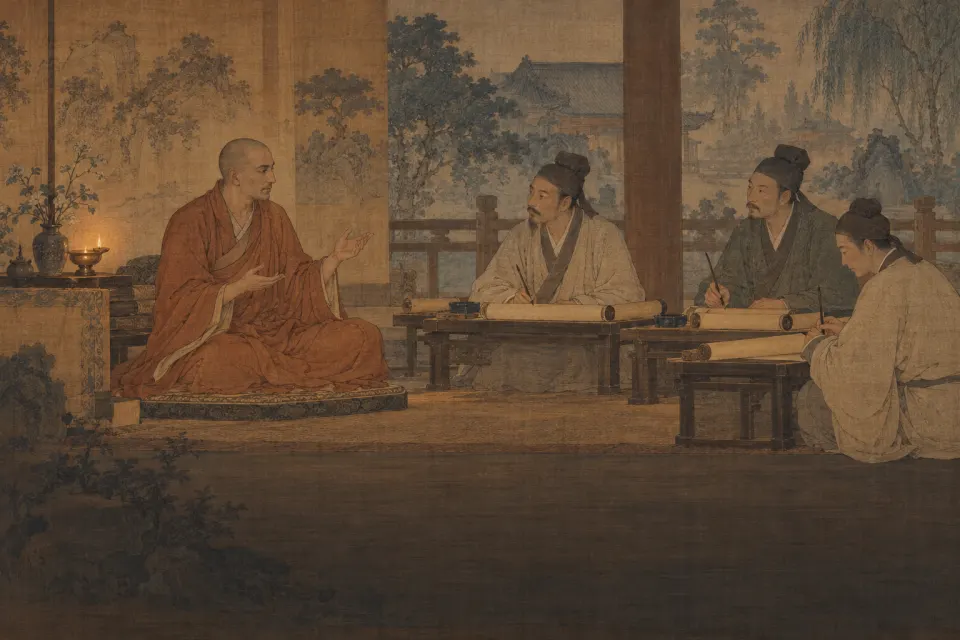
Kumārajīva · 鳩摩羅什
scholar · c. 344–413 (or 409)
Born in Kucha on the Silk Road to an Indian father and a Kuchean princess, he was captured by a Chinese army in the 380s and held for years before reaching Chang'an. His team there translated dozens of works, and his readable versions are the ones East Asians still use.[64]

Zhiyi · 智顗
founder · 538–597
Chinese monk regarded as the real founder of Tiantai, named after his mountain base in Zhejiang. He ranked all the Buddha's teachings in one scheme with the Lotus Sūtra at the top, and taught emptiness, provisional existence and the middle as three aspects of one truth.[65]

Avalokiteśvara (Guanyin) · 觀音 Guanyin; Japanese Kannon
deity
The bodhisattva of compassion, the most widely revered in Mahāyāna, believed to hear the cries of the suffering and save them from danger. A chapter of the Lotus Sūtra praises him; Chinese art increasingly showed the figure as female from about the 10th–12th centuries, and Tibetans regard the Dalai Lamas as his incarnations.[66]
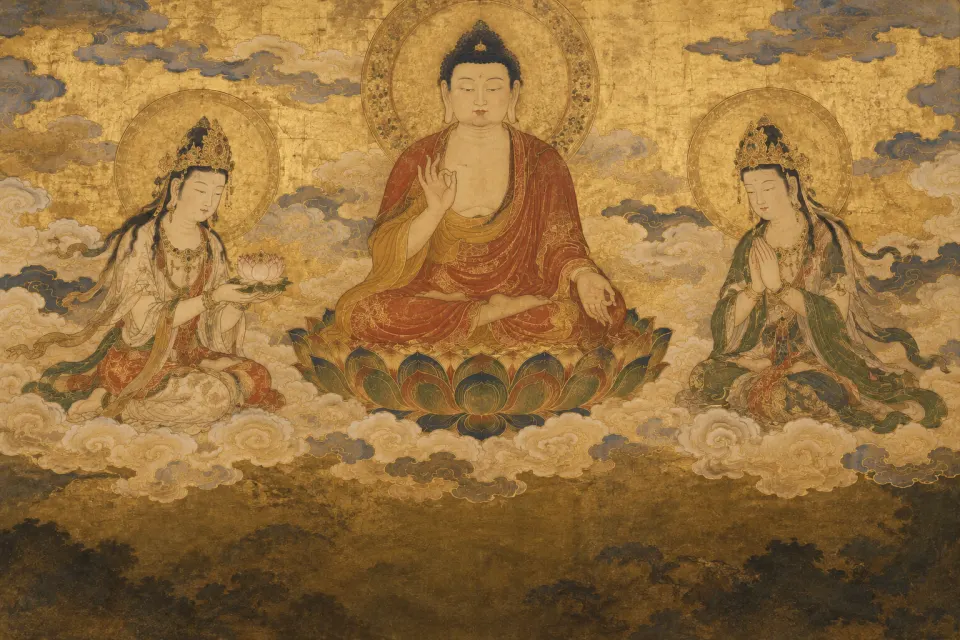
Amitābha · 阿彌陀 Amituofo; Japanese Amida
deity
The buddha of "immeasurable light", who according to the Pure Land sūtras vowed long ago to create a western paradise, Sukhāvatī, for all who call on him. He is often flanked by the bodhisattvas Avalokiteśvara and Mahāsthāmaprāpta.[67]

Nichiren · 日蓮
founder · 1222–1282
Japanese monk who concluded in 1253 that the Lotus Sūtra alone held the Buddha's true teaching for the present age. He taught chanting its title, Namu Myōhō Renge Kyō; the Nichiren schools and the lay movement Sōka Gakkai descend from him.[68]
Scripture
The Perfection of Wisdom sūtras · Prajñāpāramitā
1st century BCE/CE onward
A family of sūtras on the wisdom that sees emptiness, from 8,000 to 100,000 lines long, plus short condensed forms. The Perfection of Wisdom in 8,000 Lines is generally thought the oldest; a version survives in a 1st-century Gāndhārī manuscript.[69]
Heart Sūtra · Prajñāpāramitāhṛdaya; 心經 Xinjing
1st millennium CE (debated)
A one-page distillation of the Perfection of Wisdom in which Avalokiteśvara teaches that form is emptiness, ending in a mantra; the most often recited scripture in East Asian Buddhism. Some scholars, following Jan Nattier, argue it was first put together in Chinese; others disagree.[70–71]
Diamond Sūtra · Vajracchedikā; 金剛經 Jingang jing
translated c. 400 CE
A short and very popular Perfection of Wisdom text, put into Chinese by Kumārajīva. A woodblock-printed copy dated 868, found at Dunhuang and now in the British Library, is the earliest printed book that carries a date.[72]
Lotus Sūtra · Saddharmapuṇḍarīka; 法華經 Fahua jing
c. 1st–2nd century CE
Compiled in stages in the first centuries CE and best known in Kumārajīva's translation of 406, it teaches the one vehicle and skill in means and reveals the Buddha as eternal. It underpins the Tiantai/Tendai and Nichiren schools and is widely seen as East Asia's most important scripture.[73]
Places
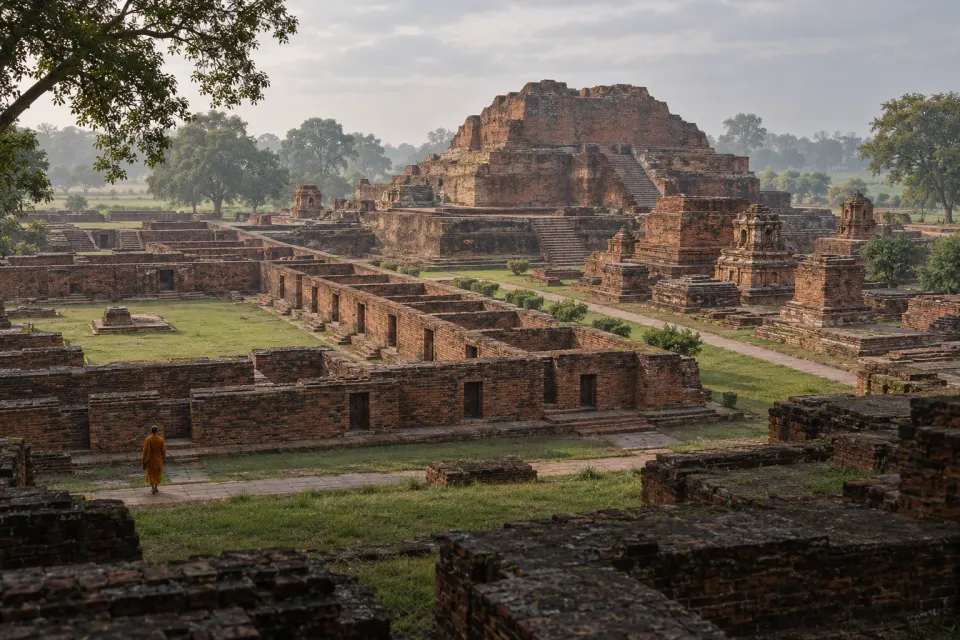
Nālandā
IND · UNESCO World Heritage, 2016
Remains of a monastic centre in Bihar active for some 800 years, one of the great seats of Buddhist learning in India, where Xuanzang studied. It was sacked and abandoned in the 13th century; the site is a World Heritage property.[74]
Mount Wutai
CHN · UNESCO World Heritage, 2009
Five peaks in Shanxi revered as the home of Mañjuśrī, bodhisattva of wisdom, and long a goal of pilgrims from across Asia. Its 53 monasteries include Foguang Temple's hall of 857, a rare Tang timber building. UNESCO listed it in 2009.[75]
Tōdai-ji
JPN · UNESCO World Heritage, 1998
Emperor Shōmu's great temple in Nara, head of the Kegon school and part of the World Heritage property of ancient Nara. Its nearly 15-metre bronze Vairocana Buddha was dedicated in 752; the present hall was completed in 1709.[76]
Haeinsa
KOR · UNESCO World Heritage, 1995
A mountain monastery in South Korea whose purpose-built 15th-century halls still store the 13th-century Tripiṭaka Koreana woodblocks, prized for their accuracy and used as the basis of modern editions of the Chinese canon.[77]
Art & objects
Public-domain objects from museum collections. Select one to see it at the museum.
 Guanyin (Avalokiteshvara) Standing before Flaming Aureole and Holding a Water BottleChina, Eastern or Western Wei dynasty, c. mid–5th century (rededicated 594)
 Sutra CoverChina, Ming dynasty (1368–1644), c. 1590's
 Jingoji Sutra and WrapperJapan, Late 12th century
 South Sea GuanyinChina, Song dynasty (960–1279)
 Figure of GuanyinDehua, c. 1700
 Preaching Amitabha with Avalokiteshvara and Manjushri, folio 186 (verso), from a Manuscript of the Perfection of Wisdom in Eight Thousand Lines (Ashtasahasrika Prajnaparamita-sutra)Eastern India, Bihar, Vikramashila Monastery. Painting: Nepal, Kathmandu, Sunday, September 14, 1119 (year 239 of the Newar Samvat in the month of Ashvina)
 Ratnasambhava, Akshobhya, Vairochana with attendants, Amitabha, and Amoghasiddhi, Top cover, from a Manuscript of the Perfection of Wisdom in Eight Thousand Lines (Ashtasahasrika Prajnaparamita-sutra)Eastern India, Bihar, Vikramashila Monastery. Paintings: Nepal, Kathmandu, Sunday, September 14, 1119 (year 239 of the Newar Samvat in the month of Ashvina)
 Standing AmitabhaKorea, Unified Silla period (676-935), 800s
 Shakyamuni Triad: Buddha Attended by Manjushri and SamantabhadraChina, Fuzhou, Fujian Province, Yuan dynasty (1271-1368), late 1300s
 Buddha Amitabha Descending from His Pure LandChina, Southern Song dynasty (1127–1279), late 13th century
 “Universal Gateway,” Chapter 25 of the Lotus SutraJapan, Kamakura period (1185–1333), dated 1257
 Buddha Vairocana (Dari)China, Liao dynasty (907–1125), 11th century
Numbers
- Mahāyāna Buddhists worldwide
- c. 200–375 million (estimates)[9]
Censuses rarely ask about branch. Worldmark (Gale) gave 200–250 million; the World Religion Database puts Mahāyānists at 4.6% of the world (2025), roughly 340–375 million. No source gives a single central figure, so no `count` is given.
National censuses
| Country | Year | Count | Share |
|---|---|---|---|
| New Zealand Mahayana Buddhism | 2018 | 1,026 | 0.0% |
Source: Stats NZ, 2018 Census, licensed by Stats NZ for re-use under the Creative Commons Attribution 4.0 International licence.
How we know
Where did the Mahāyāna come from?
No source records a founding, so scholars reconstruct one from the sūtras, a few inscriptions and early Chinese translations. Theories have traced it to lay worshippers at stūpas (Akira Hirakawa), to shrines for sacred books (Gregory Schopen) or to forest ascetics. David Drewes and others find little evidence for any of these and stress that the sūtras circulated inside ordinary monasteries, carried by preachers who recited them.[78]
The Buddha's word?
Mahāyāna sūtras present themselves as the Buddha's sermons, and Mahāyāna Buddhists have received them so. Tradition adds that some were kept hidden until people were ready: Nāgārjuna is said to have fetched the Perfection of Wisdom from the nāgas, serpent beings beneath the sea. Historians date most of the sūtras between the 1st century BCE and the 4th century CE.[79]
Common misconceptions
Myth Hīnayāna is simply another name for Theravāda.
Fact Hīnayāna, "Lesser Vehicle", is a disparaging label that Mahāyāna texts gave to non-Mahāyāna paths; no school ever called itself that. The 7th-century pilgrim Yijing noted that the old monastic schools could not be sorted into the two vehicles. Theravāda is a living tradition with its own name.[80]
Myth Emptiness means that nothing exists.
Fact In Madhyamaka, emptiness means that things lack independent, fixed essences, not that they are unreal. Things still arise and function through causes and conditions, and Nāgārjuna's middle way explicitly rejects nihilism as well as belief in eternal substances.[81]
Glossary
- Mahāyāna · महायान
- "Great Vehicle": the branch of Buddhism centred on the Mahāyāna sūtras and the bodhisattva's aim of buddhahood for all beings.[3–4]
- Hīnayāna
- "Lesser Vehicle": a polemical Mahāyāna term for non-Mahāyāna paths; not a self-designation.[80]
- arhat
- "Worthy one": a person who has reached nirvana by following a buddha's teaching; Mahāyāna treats this goal as short of full buddhahood.[82]
- bodhicitta
- "Awakening mind": the resolve to become a buddha for the sake of all beings.[38]
- pāramitā
- "Perfection": one of the six (or ten) virtues a bodhisattva cultivates.[41]
- śūnyatā
- "Emptiness": the absence in all things of an independent, fixed own-nature (svabhāva).[43]
- upāya
- "Skill in means": adapting the teaching to each hearer's needs.[52]
- tathāgatagarbha
- "Embryo of the Tathāgata": the buddha-nature believed to be present in every being.[49]
- trikāya
- The three bodies of a buddha: the truth body (dharmakāya), the bliss body (sambhogakāya) and the emanation body (nirmāṇakāya).[53]
- pure land · 淨土 jingtu
- A realm created by a buddha's vows where beings can easily reach awakening, above all Amitābha's Sukhāvatī.[83]
- nianfo · 念佛; Japanese nembutsu
- "Recollecting the Buddha": in East Asia mainly the recitation of Amitābha's name.[56]
- daimoku · 題目
- The chanted title of the Lotus Sūtra, Namu Myōhō Renge Kyō, central to Nichiren Buddhism.[68]
Sources
Each statement above was checked against published sources; the verdict says whether it stood as written, was corrected or was hedged.
- VerifiedBritannica, Mahayana; Drewes, CJBS 16; Encyclopedia of Buddhism, Mahāyāna.
- VerifiedDrewes 2021; Schopen, Encyclopedia of Buddhism; Britannica, Mahayana.
- VerifiedBritannica, Buddhism: Mahayana; Worldmark, Buddhism: Mahayana Buddhism.
- VerifiedBritannica, Mahayana; Worldmark, Mahayana Buddhism; Encyclopedia of Buddhism, Bodhisattva Path.
- VerifiedBritannica, Diamond Sutra; Britannica, Lotus Sutra; Worldmark, Mahayana Buddhism; Encyclopedia of Buddhism, Amitābha.
- VerifiedBritannica, Buddhism: Celestial buddhas and bodhisattvas; Britannica, Mañjuśrī; Encyclopedia of Buddhism, Avalokiteśvara; The Met, Compassion, Mercy, and Love: Guanyin and the Virgin Mary.
- VerifiedPew Research Center, Buddhists; New Catholic Encyclopedia, Mahayana; Worldmark, Mahayana Buddhism; Britannica, Buddhism: Vajrayana.
- VerifiedBritannica, Yogachara; SEP, Tiantai Buddhism; SEP, Huayan Buddhism; Encyclopedia of Religion, Buddhism: Buddhism in China; Britannica, Nichiren Buddhism.
- CorrectedWorldmark, Mahayana Buddhism; ARDA, National Profiles: The World; Pew, Buddhists; Pew, Buddhist population change.
- VerifiedPew, Buddhists; ARDA/WRD 2025; Britannica, Buddhism: Korea and Japan.
- VerifiedDrewes 2021; Schopen, Encyclopedia of Buddhism; Britannica, Mahayana.
- VerifiedSEP, Nāgārjuna; Britannica, Buddhism: Mahayana; Oxford Dictionary of World Religions, Tathāgata, via Encyclopedia.com.
- VerifiedEoR, Buddhism in China; Britannica, Buddhism: Pure Land; SEP, Chan Buddhism.
- VerifiedDrewes 2021; Britannica, Mahayana; Schopen, Encyclopedia of Buddhism.
- VerifiedKarashima, ARIRIAB 16; LMU Munich, Buddhist Manuscripts from Gandhāra, Publications; Schopen, Encyclopedia of Buddhism; Drewes 2021.
- VerifiedDrewes 2021; Schopen, Encyclopedia of Buddhism.
- HedgedSchopen, Encyclopedia of Buddhism; Drewes 2021.
- VerifiedSEP, Nāgārjuna; SEP, Madhyamaka; Britannica, Nagarjuna summary.
- VerifiedSEP, Yogācāra; Britannica, Yogachara.
- VerifiedBritannica, Buddhism: Mahayana; Oxford Dictionary of World Religions, Tathāgata, via Encyclopedia.com.
- VerifiedUNESCO WHC, Archaeological Site of Nalanda Mahavihara; Britannica, Xuanzang; EoR, Xuanzang.
- VerifiedBritannica, Buddhism: Vajrayana; EoR, Buddhism: Buddhism in India.
- VerifiedBritannica, Buddhism: The demise of Buddhism in India; UNESCO WHC 1502; EoR, Buddhism in India.
- VerifiedEoR, Buddhism in China; Britannica, Buddhism: Central Asia and China; Schopen, Encyclopedia of Buddhism.
- VerifiedBritannica, Kumarajiva; Encyclopedia of Buddhism, Kumārajīva.
- VerifiedEoR, Buddhism in China; SEP, Tiantai Buddhism; SEP, Huayan Buddhism; Britannica, Zhiyi.
- VerifiedBritannica, Buddhism: Central Asia and China; Encyclopedia of Buddhism, Persecutions; SEP, Huayan Buddhism.
- VerifiedSEP, Chan Buddhism; EoR, Buddhism in China; Encyclopedia of Buddhism, Yanshou.
- VerifiedBritannica, Goguryeo; EoR, Buddhism: Buddhism in Korea; Britannica, Buddhism: Korea and Japan.
- VerifiedUNESCO advisory evaluation 737; Britannica, Haein Temple.
- VerifiedEoR, Buddhism: Buddhism in Japan; Britannica, Buddhism: Pure Land; Britannica, Hōnen; Britannica, Dōgen.
- VerifiedEoR, Buddhism: Buddhism in Southeast Asia; Britannica, Buddhism.
- CorrectedEoR, Buddhism in Japan; Britannica, Shinbutsu shūgō; Encyclopedia of Buddhism, Clerical Marriage in Japan; Princeton University Press, R. Jaffe, Neither Monk nor Layman.
- VerifiedBritannica, Taixu; Encyclopedia of Buddhism, Taixu; Encyclopedia of Buddhism, Foguangshan; Encyclopedia of Buddhism, Ciji.
- VerifiedBritannica, Buddhism: Central Asia and China; EoR, Buddhism in China.
- VerifiedBritannica, Sōka-gakkai; Britannica, Engaged Buddhism; New Catholic Encyclopedia, Mahayana, Encyclopedia.com page as c7.
- VerifiedBritannica, Mahayana; Worldmark, Mahayana Buddhism; Encyclopedia of Buddhism, Bodhisattva Path.
- VerifiedEncyclopedia of Buddhism, Bodhisattva Path; SEP, Śāntideva; IEP, Śāntideva.
- VerifiedBritannica, Bhūmi; Encyclopedia of Buddhism, Bodhisattva Path; Schopen, Encyclopedia of Buddhism.
- VerifiedDrewes 2021; Encyclopedia of Buddhism, Bodhisattva Path; Britannica, Mahayana.
- VerifiedBritannica, Pāramitā; Oxford Reference, Pāramitā.
- VerifiedEncyclopedia.com, Bodhisattva; Britannica, Mahayana.
- VerifiedSEP, Nāgārjuna; Britannica, Nagarjuna summary.
- VerifiedSEP, Madhyamaka; Britannica, Nagarjuna summary.
- VerifiedSEP, Madhyamaka; Britannica, Paramārtha-satya.
- VerifiedSEP, Yogācāra; Britannica, Yogachara.
- VerifiedSEP, Yogācāra; Britannica, Ālaya-vijñāna; Britannica, Trisvabhāva.
- VerifiedSEP, Yogācāra; Britannica, Buddhism: Yogachara, Vijnanavada, Faxiang, Hosso.
- VerifiedBritannica, Buddhism: Mahayana; Oxford Dictionary of World Religions, Tathāgata, via Encyclopedia.com; Encyclopedia of Religion, Chan School.
- VerifiedSEP, Chan Buddhism; Encyclopedia of Religion, Chan School; SEP, Tiantai Buddhism.
- VerifiedNew Catholic Encyclopedia, Mahayana; Britannica, Lotus Sutra; Britannica, Sambhogakaya.
- VerifiedEncyclopedia of Buddhism, Lotus Sūtra; Britannica, Pāramitā; SEP, Tiantai Buddhism.
- VerifiedBritannica, Trikaya; Oxford Dictionary of World Religions, Trikāya, via Encyclopedia.com.
- VerifiedDrewes 2021; Encyclopedia of Buddhism, Lotus Sūtra.
- VerifiedEncyclopedia of Buddhism, Lotus Sūtra; Encyclopedia of Buddhism, Heart Sūtra; Britannica, Diamond Sutra.
- VerifiedBritannica, Pure Land Buddhism; Encyclopedia of Buddhism, Nianfo; EoR, Amitābha.
- VerifiedSEP, Chan Buddhism; Encyclopedia of Religion, Chan School; Britannica, Buddhism: Pure Land.
- VerifiedDrewes 2021; Encyclopedia of Religion, Nuns: Buddhist Nuns; Oxford Research Encyclopedia of Religion, Sangha as an Institution.
- VerifiedWorldmark, Mahayana Buddhism; Britannica, Vegetarianism; Britannica, Wudi.
- VerifiedBritannica, Vesak; EoR, Buddhist Religious Year.
- VerifiedBritannica, Hungry Ghost Festival; Britannica, Bon Festival; Encyclopedia of Buddhism, Ghost Festival; EoR, Buddhist Religious Year.
- VerifiedBritannica, Vesak; Encyclopedia of Buddhism, Zen Buddhism via Encyclopedia.com.
- VerifiedSEP, Nāgārjuna; Britannica, Kumarajiva.
- VerifiedEncyclopedia of Buddhism, Kumārajīva; Britannica, Kumarajiva.
- VerifiedBritannica, Zhiyi; SEP, Tiantai Buddhism; Encyclopedia of Religion, Tiantai.
- VerifiedEncyclopedia of Buddhism, Avalokiteśvara; Britannica, Avalokiteshvara; The Met, Guanyin and the Virgin Mary.
- VerifiedBritannica, Pure Land Buddhism / Mahasthamaprapta; EoR, Amitābha.
- VerifiedBritannica, Nichiren; Britannica, Daimoku; Britannica, Sōka-gakkai; EoR, Buddhism in Japan.
- VerifiedEoR, Prajñāpāramitā Literature; Drewes 2021; Karashima 2013.
- VerifiedEncyclopedia of Buddhism, Heart Sūtra; Britannica, Heart Sutra.
- HedgedEncyclopedia of Buddhism, Heart Sūtra; J. Attwood, The Buddhas of the Three Times and the Chinese Origins of the Heart Sutra, Journal of the Oxford Centre for Buddhist Studies 15; J. Nattier, The Heart Sūtra: A Chinese Apocryphal Text?, JIABS 15.2.
- VerifiedBritannica, Diamond Sutra; British Library / IDP, Buddhist texts: The Diamond Sutra.
- VerifiedEncyclopedia of Buddhism, Lotus Sūtra; Britannica, Lotus Sutra; EoR, Buddhism, Schools of: Chinese Buddhism.
- CorrectedUNESCO WHC 1502; Britannica, Xuanzang; Britannica, Buddhism: The demise of Buddhism in India.
- VerifiedUNESCO advisory evaluation 1279; Britannica, Mañjuśrī; `_unesco.tsv`.
- VerifiedBritannica, Great Buddha Hall; Britannica, Kegon; UNESCO advisory evaluation 870.
- VerifiedUNESCO advisory evaluation 737; Britannica, Tripitaka Koreana; Britannica, Haein Temple.
- VerifiedDrewes 2021; Schopen, Encyclopedia of Buddhism.
- VerifiedIEP, Nāgārjuna; Britannica, Buddhism: Mahayana; Drewes 2021.
- VerifiedBritannica, Buddhism: Mahayana; Worldmark, Mahayana Buddhism; Drewes 2021.
- VerifiedSEP, Madhyamaka; SEP, Nāgārjuna; Britannica, Nagarjuna summary.
- VerifiedBritannica, Buddhism: The major systems and their literature; Worldmark, Mahayana Buddhism; Britannica, Pratyeka-buddha.
- VerifiedBritannica, Pure Land Buddhism; EoR, Amitābha.
Last fact-checked 3 October 2026.