
Overview
Vajrayāna, the "vajra vehicle", is the tantric form of Buddhism. It shares the Mahāyāna goal of buddhahood for the sake of all beings but offers what its teachers call a faster road, using initiation, mantra, visualised deities and maṇḍalas under the close guidance of a master. It took shape in India between roughly the 6th and 8th centuries and spread to China and Japan, where its heir is Shingon, and to Tibet, Mongolia and the Himalaya, where it became the dominant form of Buddhism. Tibetan Buddhism joins tantric ritual to Mahāyāna philosophy and monastic discipline. Perhaps 18–20 million people follow it today, most in Tibetan areas of China, Bhutan, Mongolia, Nepal and India, and since 1959 exiled teachers have carried it worldwide.[1, 11–15]
History

Tantra in India c. 600 – 1200 CE
Buddhist tantra probably began as a minority, esoteric practice, becoming clearly visible only in the 7th century, though spells and mantras appear in Mahāyāna writings much earlier. Tantras such as the Guhyasamāja and Hevajra became central scriptures. The Pāla kings founded monastic universities such as Vikramaśīla (c. 800), where tantra entered the curriculum. Turkic armies sacked these around 1200; historians debate how far that alone explains the decline, but Buddhism faded from most of India over the following centuries, and many surviving scholars moved to Nepal and Tibet.[16–19]
The True Word in China and Japan 716 – 9th century
Three Indian masters brought esoteric teachings to Tang China: Śubhākarasiṃha, who arrived in 716 and translated the Mahāvairocana Sūtra, and Vajrabodhi and his pupil Amoghavajra, who arrived in 720. Their Zhenyan ("True Word") school enjoyed imperial favour until the persecution of 845. The monk Kūkai studied under Huiguo in Chang'an in 804–806 and went home to found Shingon; the emperor granted him Mount Kōya in 816 and Tōji in Kyoto in 823. Shingon rites became fixtures of court ritual, and Shingon remains a major Japanese school.[20–23]
The early spread in Tibet 7th century – 842
Tibetan histories trace Buddhism to the 7th-century emperor Songtsen Gampo and his Chinese and Nepalese queens, though it gained little ground for decades. The emperor Trisong Detsen embraced it and built Samye, Tibet's first monastery (c. 779), where the Indian abbot Śāntarakṣita ordained the first seven Tibetan monks; tradition adds the tantric master Padmasambhava, said to have tamed the land's hostile spirits. A later debate at Samye went, by Tibetan accounts, to the Indian side over the Chinese. After 842 the empire collapsed and the monasteries lost their patrons; later chronicles blame the emperor Langdarma.[24–28]
The later spread and the schools c. 950 – 1419
From the late 10th century Tibetans sought new teachers and texts in India and Nepal. The rulers of Guge invited the Bengali master Atiśa, who arrived in 1042; his disciples formed the Kadam order. Drokmi's Hevajra teachings became the core of the Sakya school, named after a monastery founded in 1073. Marpa, a pupil of Nāropa, taught the yogi Milarepa, whose disciple Gampopa shaped the Kagyu orders. Keepers of the older tantras and revealed "treasures" came to be called Nyingma, the "ancient" school, while Bon built its own canon and monasteries. Mongol khans made Sakya lamas regents of Tibet; in 1409 Tsongkhapa founded Ganden, seat of the Geluk.[29–35]
Dalai Lamas, Mongols and Himalayan states 1578 – 1950
In 1578 the Mongol ruler Altan Khan gave the Geluk leader Sönam Gyatso the title Dalai Lama, and Geluk Buddhism spread across Mongolia. In 1642 the Khoshut Mongol Güshi Khan made the Fifth Dalai Lama ruler of Tibet, uniting religious and political authority until 1959; he began the Potala Palace in 1645. In Mongolia Zanabazar, recognised in 1639, began the line of Jebtsundamba Khutugtus. The Drukpa Kagyu lama Zhabdrung Ngawang Namgyel, arriving from Tibet in 1616, unified Bhutan. Qing envoys sat in Lhasa from the 1720s, but from 1913 the 13th Dalai Lama ran a de facto independent Tibet.[36–40]
Destruction, exile and revival 1930s – today
Communist governments devastated the tradition. Purges in 1936–39 destroyed Mongolia's monasteries. Chinese troops entered Tibet in 1950; after a failed rising in Lhasa in March 1959 the 14th Dalai Lama fled to India, and by the end of the Cultural Revolution (1966–76) almost all Tibetan monasteries had been destroyed or closed. Rebuilding began around 1980 under close state control. Tibet's status remains disputed: Beijing calls 1950 the liberation of Chinese territory, which the exile administration rejects, though the Dalai Lama has sought autonomy rather than independence since the 1980s. Exiled lamas, meanwhile, founded centres across Asia, Europe and the Americas.[15, 41–45]
Key moments
- c. 641 CEBuddhism reaches Tibet · Lhasa, Tibet
- c. 779 CESamye, Tibet's first monastery · Samye, Yarlung valley, Tibet
- c. 800 CEBorobudur · Central Java, Indonesia
- c. 1578 CEAltan Khan names the Dalai Lama · Kokonor (Qinghai) region
- 1642 CEThe Fifth Dalai Lama rules Tibet · Shigatse and Lhasa, Tibet
- 1959 CEThe Dalai Lama goes into exile · Lhasa to India
Beliefs
The vajra vehicle · Vajrayāna; rdo rje theg pa
"Diamond" or "thunderbolt" vehicle
Tantric teachers present their path as part of the Mahāyāna, aiming at the same goal, buddhahood for the good of all beings, but reaching it far faster: possibly within one life rather than over countless aeons, because its methods engage body, speech and mind together. The vajra stands for an awakened mind that cannot be destroyed and cuts through ignorance.[9, 46]
Wisdom and method · prajñā and upāya
In the tantric view, awakening comes from realising that principles which seem opposed are one: wisdom, the insight into emptiness, and compassionate "skilful means". Art shows this as a male and female deity in embrace, called yab-yum ("father-mother") in Tibetan, images meant for those taught their meaning. The vajra and bell in the hands echo this same union.[9, 47]
The nature of mind
The highest teachings point directly to the mind's own nature, described as luminous and pure from the beginning. Nyingma masters teach this as Dzogchen, the "Great Perfection", which Bon shares; Kagyu and Geluk teachers speak of Mahāmudrā, the "Great Seal". Tsongkhapa insisted that realisation must rest on a precise understanding of emptiness reached through Madhyamaka reasoning.[48–49]
Reincarnate lamas · sprul sku (tulku)
"Emanation body"
Tibetan Buddhists hold that advanced teachers can direct their rebirth, so a lama's successor may be sought as a child. Such lines began with the Karmapas in the 13th–14th centuries and spread to every school. The Dalai Lamas are revered as emanations of Avalokiteśvara, the bodhisattva of compassion; searchers weigh the late lama's hints, oracles, visions and tests such as recognising his belongings.[50–51]
Buddhahood in this very body · 即身成仏 sokushin jōbutsu
Shingon teaches that the cosmic Buddha Mahāvairocana (Dainichi) is the universe itself and preaches through it at every moment. By joining body, speech and mind to his through mudrā, mantra and meditation on the maṇḍala, the "three mysteries", a practitioner can realise buddhahood in this present body, as Kūkai argued in a treatise of that name.[52]
Practice

Empowerment · abhiṣeka; dbang (wang)
Tantric practice begins with an empowerment, a rite in which a qualified master introduces students into a deity's maṇḍala and authorises the meditation, mantra and texts that belong to it. Initiation brings vows of its own, and Geluk teachers open it only to students already grounded in study. Shingon's equivalent is kanjō, in which water is sprinkled on the initiate.[6, 53]
Devotion to the guru
Tradition treats the teacher as indispensable: Tibetans often add the lama as a fourth refuge beside the Buddha, his teaching and the community. The lama chooses the student's meditation deity and judges when the student is ready for deeper teachings, and in meditation the student aims to merge with deity and lama alike.[7]
Mantra, prayer wheels and flags
Mantras, sacred syllables recited aloud or silently, run through every tantric practice. The commonest Tibetan prayer is Oṃ maṇi padme hūṃ, the mantra of Avalokiteśvara, carved on stones, printed on prayer flags and sealed inside prayer wheels, which are turned clockwise to make merit. Prostrations, circling holy places and pilgrimage are everyday devotions.[54]
The maṇḍala
A maṇḍala is a sacred diagram of a deity's palace and retinue, a map of the cosmos the meditator enters mentally. It may be painted on cloth, cast in metal or, for an initiation, laid out on the ground in coloured powders or sand and ritually dismantled afterwards. Shingon altars carry a pair, the Womb and Diamond maṇḍalas.[55–56]
Deity yoga
In a sādhana, a liturgical meditation, practitioners visualise a buddha or tantric deity in its maṇḍala, recite its mantra and come to identify with it, seeing themselves and the world as divine. Advanced yogas work with a subtle body of channels and energies; the Kagyu "six doctrines of Nāropa" include inner heat, dream yoga and preparation for the intermediate state after death.[57]
Holy days
The year ahead
| Date | Holy day | Reckoned |
|---|---|---|
| 7 February 2027 – 9 February 2027 | Losar ལོ་གསར | from published calendars |
| 10 February 2027 – 21 February 2027 | Monlam Chenmo སྨོན་ལམ་ཆེན་མོ | from published calendars |
Losar · lo gsar
1st day of the 1st Tibetan month (February or March)
The Tibetan New Year. Families visit monasteries, temples and stupas at dawn, make offerings at shrines and household altars, and share festive foods, while monasteries perform rites for their protector deities.[58]
Monlam Chenmo, the Great Prayer Festival · smon lam chen mo
First Tibetan month, beginning a few days after Losar
Founded by Tsongkhapa in 1409, the festival brought thousands of monks to Lhasa's Jokhang for two weeks or more of prayer. It was held in Lhasa every year until 1959, when the old Tibetan government was abolished.[59]
Saga Dawa · sa ga zla ba
15th day of the 4th Tibetan month (May or June)
The full moon of the fourth month marks the Buddha's birth, awakening and death, which Tibetan tradition places on the same day. Tibetans keep it with fasting, communal prayer and charitable giving; it corresponds to the Vesak festival of Theravāda countries.[60]
Tsechu (Guru Rinpoche's day) · tshes bcu
10th day of the lunar month; great festivals once or twice a year
Every lunar month's tenth day is set aside for the guru, above all Padmasambhava, especially among the Nyingma. In Bhutan, great tsechu festivals held once or twice a year honour him with days of sacred masked dances (cham).[61]
People

Padmasambhava (Guru Rinpoche)
teacher · 8th century
A tantric master from Oḍḍiyāna, by tradition the Swat valley, credited with subduing the spirits that hindered Samye's building. Much of his story is legend that grew over centuries. The Nyingma regard him as their founding father and attribute to him the hidden "treasure" texts found from the 11th century on.[62]
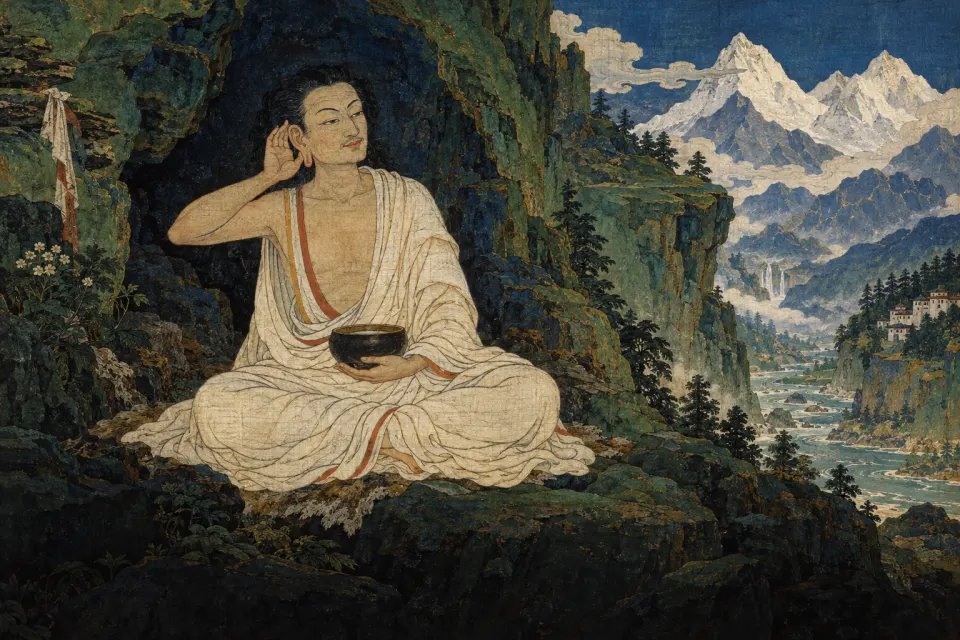
Milarepa · Mi la ras pa
saint · 1040–1123 (traditional)
Tibet's best-loved poet-saint. His biography tells how he used black magic for revenge, repented, and endured years of harsh trials under his teacher Marpa before meditating alone in mountain caves. His songs, collected as the Hundred Thousand Songs, are still sung.[63]

Tsongkhapa Lobsang Drakpa
founder · 1357–1419
A philosopher and reformer who stressed monastic discipline and rigorous study alongside tantric practice. He founded Ganden monastery and Lhasa's Great Prayer Festival in 1409. His Great Treatise on the Stages of the Path (1402), built on Atiśa's Lamp, remains central to the Geluk school that grew from his followers.[64]

Kūkai (Kōbō Daishi) · 空海
founder · 774–835
Founder of Japanese Shingon, also celebrated as a poet, calligrapher and scholar. His Ten Stages of Mind (Jūjū shinron) ranked the religions and schools of his day, with esoteric Buddhism at the summit. Many believers hold he remains in meditation on Mount Kōya, awaiting the Buddha Maitreya.[65]

Tenzin Gyatso, the 14th Dalai Lama
teacher · born 1935
Born in Amdo (now Qinghai), recognised in 1937 and enthroned in 1940, he fled to India in 1959, won the Nobel Peace Prize in 1989 and gave up his political role in 2011. In 2025 he said a 15th Dalai Lama will follow, to be recognised by his own trust alone; China insists its government must approve the choice.[66–67]
Scripture
The tantras · rgyud
Esoteric scriptures, presented as the Buddha's word, that set out rituals, maṇḍalas, mantras and yogas. Among the most influential are the Guhyasamāja; the Hevajra, at the heart of the Sakya school; and the Kālacakra, the "Wheel of Time", known for its astronomy. Their meaning is traditionally passed on only with initiation.[4, 68]
Mahāvairocana Sūtra · 大日経 Dainichi-kyō
Chinese translation, 8th century
The principal scripture of Shingon, translated into Chinese by Śubhākarasiṃha; no Sanskrit original survives. It presents the universe as the body of the Buddha Mahāvairocana and is the source of the Womb maṇḍala, while its partner text, the Tattvasaṃgraha, underlies the Diamond maṇḍala.[69]
Kangyur and Tengyur · bka' 'gyur, bstan 'gyur
compiled by the 14th century
The Tibetan canon in two parts: the Kangyur, translated works held to be the Buddha's word, tantras included, and the Tengyur, translated Indian commentaries and treatises. Edited by scholars such as Butön, it preserves many works lost in India.[5, 70]
Bardo Thödol ("Tibetan Book of the Dead") · bar do thos grol
revealed 14th century
"Liberation through hearing in the intermediate state" is a treasure text revealed in the 14th century. Read to the dying and the dead, it guides consciousness through the bardo, the passage of about 49 days between death and rebirth, toward liberation or a good rebirth.[71]
Places
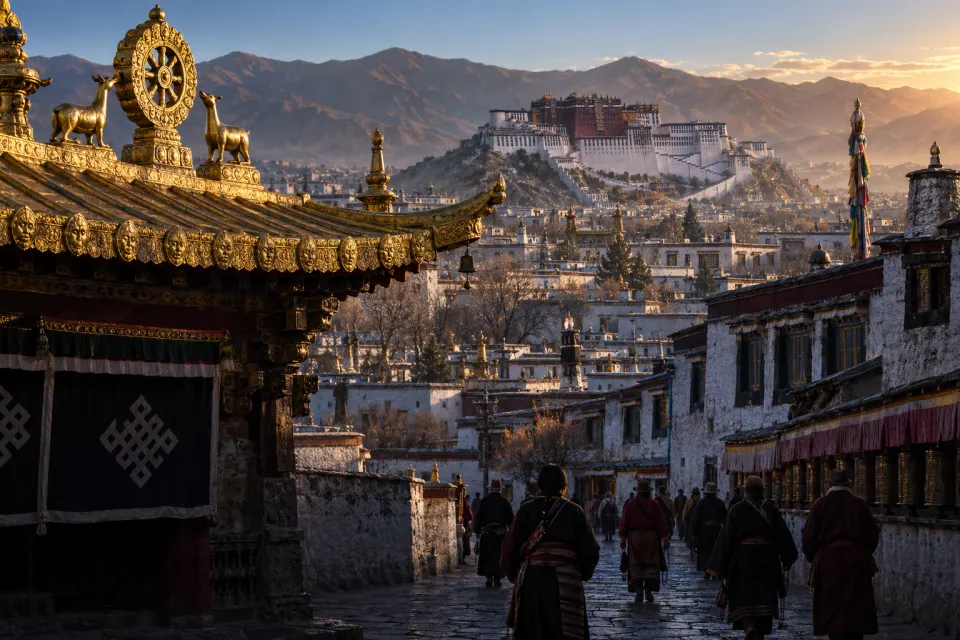
Potala Palace and Jokhang, Lhasa
CHN · UNESCO World Heritage, 1994
The Fifth Dalai Lama began the Potala in 1645 as palace, seat of government and fortress; its Red Palace holds the tombs of eight Dalai Lamas. Nearby, the 7th-century Jokhang houses the Jowo, Tibet's most revered Buddha image. Both belong to a World Heritage property inscribed in 1994.[72]
Swayambhu, Kathmandu
NPL · UNESCO World Heritage, 1979
The oldest Buddhist monument of the Kathmandu Valley, part of its World Heritage property. Newar Buddhists, whose married vajrācārya priests keep a Sanskrit-based tantric tradition, tell how the primordial Buddha appeared here as a flame on a lotus in a lake later drained to form the valley.[73]
Mount Kōya (Kōyasan)
JPN · UNESCO World Heritage, 2004
The mountain monastery Kūkai began in 816, now a town of temples centred on Kongōbu-ji and headquarters of Shingon's largest branch. Pilgrims visit his mausoleum in the Okunoin cemetery. It is one of three sacred sites in the Kii Mountains World Heritage property.[74]
Art & objects
Public-domain objects from museum collections. Select one to see it at the museum.
 Tantric Female Enlightened Being (Vajrayogini) Holding a Skull CupTibet, 18th century
 Portrait of the Great Fifth Dalai LamaTibet, 18th century
 Buddhist God MahakalaTibet, 15th century
 Personified Ritual Dagger (Vajrakila) in Ritual Embrace (Yab-yum)Tibet, 16th century
 Vajradhara Seated Holding a Thunderbolt (Vajra) and Bell (Ghanta)Tibet, 15th century
 Guru Rinpoche (Padmasambhava) in Multiple Forms, with Peaceful and Wrathful Meditational Deities and ProtectorsTibet, 18th century
 Ritual Drum (damaru)Tibet, c. 1800
 Sadaksari-Lokesvara MandalaTibet, Ming dynasty (1368-1644), c. 1475–1525
 Hevajra MandalaTibet, 16th century
 Yamantaka, Destroyer of the God of DeathTibet, early 18th century
 Ritual Dagger (Phurba) and StandTibet, late 14th–early 15th century
 The Spiritual Master PadmasambhavaWestern Tibet or Ladakh, 14th century
 Chakrasamvara and VajravarahiTibet, late 15th–16th century
Numbers
- Followers of Tibetan-tradition Buddhism
- c. 18–20 million (estimates, c. 2006–2010)[11]
Most censuses omit Buddhist branches. Low end: Harvey's c. 2010 figure for 'Northern' Buddhism. High end: a Gale reference estimate. No source gives a central figure. Excludes Shingon and other East Asian esoteric schools.
National censuses
| Country | Year | Count | Share |
|---|---|---|---|
| New Zealand Vajrayana Buddhism | 2018 | 327 | 0.0% |
Source: Stats NZ, 2018 Census, licensed by Stats NZ for re-use under the Creative Commons Attribution 4.0 International licence.
How we know
How old is Buddhist tantra?
No one knows exactly when Buddhist tantra began. Spells and ritual formulas appear in Mahāyāna sūtras of the early centuries CE, but the first firm dates come from China, where Indian tantric masters arrived in 716 and 720. Scholars debate how far tantra grew among wandering yogis before the monasteries absorbed it. Tibetan tradition, by contrast, presents the tantras as the Buddha's own teaching.[75]
Padmasambhava between history and legend
Contemporary sources for Tibet's conversion are thin; the richest early documents are manuscripts sealed in a cave at Dunhuang and opened in the early 20th century. Padmasambhava's fame grew mainly through "treasure" texts revealed from the 11th and 12th centuries onward, which made him the Precious Guru of all Tibetans, and his close link with Dzogchen dates only from the 14th century.[76]
Common misconceptions
Myth Tibetan Buddhism is "Lamaism", a religion distinct from Buddhism.
Fact "Lamaism" was a Western label, now considered mistaken, drawn from the central role of the lama, or teacher. Tibetan Buddhism is a branch of the Vajrayāna built on Indian Mahāyāna philosophy, Indian monastic law and translated Indian scriptures, and its schools see themselves as heirs of the Indian Buddhist universities.[77]
Myth The Dalai Lama is the head of all Tibetan Buddhism, a kind of god-king.
Fact Each school has its own leaders, such as the Sakya Trizin and the Karmapa, and the Geluk school's formal head is the Ganden Throne-holder, chosen for learning rather than by rebirth. Tibetans revere the Dalai Lama as an emanation of a bodhisattva, not as a god, and since 2011 he has held no political office.[78]
Myth Tantra is essentially about sex.
Fact Sexual imagery in tantric art chiefly symbolises the union of wisdom and method, and such images were reserved for initiates. Most practice is ritual, mantra, visualisation and meditation within vows, and most forms of Buddhist tantra were, in one scholar's phrase, antinomian only in principle.[79]
Glossary
- Vajra · rdo rje (dorje)
- Sanskrit for "thunderbolt" or "diamond": a ritual sceptre symbolising the indestructible nature of awakened mind; held in the right hand, with a bell in the left.[9]
- Tantra · rgyud
- Literally "thread" or "weft": a class of esoteric scriptures giving rituals, maṇḍalas, mantras and yogas, and by extension the tradition built on them.[80]
- Abhiṣeka · dbang (wang)
- "Sprinkling", or empowerment: the initiation by which a master authorises a student to practise a particular deity's meditation and mantra.[6]
- Lama · bla ma
- The Tibetan equivalent of guru: a religious teacher, especially one who guides a student's practice. Outsiders often use it loosely for any Tibetan monk.[81]
- Tulku · sprul sku
- "Emanation body": a lama recognised as the rebirth of a predecessor, whose lineage and authority he or she inherits.[50]
- Maṇḍala · dkyil 'khor
- "Circle": a sacred diagram of a deity's palace and retinue, used in initiation and meditation as a model of the universe.[55]
- Mahāsiddha · grub chen
- "Great adept": an Indian tantric master held to have reached full awakening, often outside monastic life; tradition lists eighty-four.[2]
- Dzogchen · rdzogs chen
- "Great Perfection": the Nyingma and Bon teaching on the mind's primordially pure nature, also called Atiyoga, the highest of the Nyingma's nine vehicles.[48]
Sources
Each statement above was checked against published sources; the verdict says whether it stood as written, was corrected or was hedged.
- HedgedBritannica, Vajrayana; EoR India; EoB, Vajrayāna.
- VerifiedEoR, Mahāsiddhas; Rubin Museum, Vajradhara and the Great Adepts; Britannica BTM.
- VerifiedBritannica, Vajrayana; CODWR, Mikkyō; EoB, Vajrayāna.
- VerifiedEoR Tibet; Worldmark, Tibetan Buddhism; Britannica, Tibetan Buddhism; Britannica, yab-yum.
- VerifiedBritannica, Tibetan Buddhism; Britannica BTM; EoR Tibet.
- VerifiedEoR Tibet; CODWR, Abhiṣek(a); Britannica, Dalai Lama.
- VerifiedEoR Tibet; Worldmark, Tibetan Buddhism; Britannica, Milarepa.
- VerifiedWorldmark, Tibetan Buddhism; Britannica, Dalai Lama; Britannica, Shingon; EoB, Newari, Buddhist Literature in.
- VerifiedBritannica, vajra; EoR Tibet; Encyclopedia.com, Buddhism tibetan buddhism.
- VerifiedWorldmark, Tibetan Buddhism; Pew Research Center, Buddhists; Britannica BTM.
- CorrectedPeter Harvey, An Introduction to Buddhism, 2nd ed., Cambridge University Press 2013, ISBN 9780521676748, ch. 1; Worldmark, Tibetan Buddhism; Pew Research Center, Buddhists.
- VerifiedEoB, Vajrayāna; Britannica, Vajrayana; Encyclopedia.com, Buddhism tibetan buddhism.
- VerifiedBritannica BVS; Britannica BTM; EoR, Buddhism: Buddhism in Mongolia.
- VerifiedBritannica, Tibetan Buddhism; EoR Tibet.
- VerifiedBritannica, Tibetan Buddhism; Britannica BTM; EoR, Buddhism: Buddhism in the West; EoB, Sa skya.
- HedgedEoR India; Britannica, Vajrayana; EoB, Vajrayāna.
- VerifiedEoR India; Britannica BVS; EoB, Vajrayāna.
- VerifiedEoR India; UNESCO WHC, Archaeological Site of Nalanda Mahavihara.
- HedgedEoR India; UNESCO WHC 1502; EoB, Newari literature; Britannica BTM.
- VerifiedBritannica BVS; EoR, Zhenyan.
- VerifiedBritannica BVS; EoR, Zhenyan.
- VerifiedBritannica, Mount Kōya; EoR, Shingonshū; Britannica, Kūkai.
- VerifiedEoB, Shingon Buddhism, Japan; Britannica BVS; Britannica, Shingon.
- VerifiedEoR Tibet; Britannica BTM; Encyclopedia.com, Buddhism tibetan buddhism.
- HedgedEoR Tibet; Britannica BTM; Britannica, Rnying-ma-pa.
- VerifiedEoR Tibet; Britannica BTM; Britannica, Padmasambhava.
- VerifiedBritannica BTM; EoR Tibet.
- HedgedEoR Tibet; EoB, Rnying ma; Britannica BTM.
- VerifiedEoR Tibet; EoR, Atīśa; Britannica, Atīśa; Britannica BTM.
- VerifiedBritannica, Sa-skya-pa; EoR Tibet.
- VerifiedBritannica, Bka'-brgyud-pa; EoB, Bka' brgyud.
- VerifiedEoB, Rnying ma; Britannica BVS; EoR Tibet.
- VerifiedEoR, Bon; Britannica, Bon.
- VerifiedBritannica, Sa-skya-pa; Britannica, Tibet: Disunity, 9th–14th century; EoR Tibet.
- VerifiedBritannica, Dge-lugs-pa; EoR Tibet; CODWR, Geluk.
- VerifiedEoR, Dalai Lama; Britannica, Dalai Lama; EoR Mongolia; Britannica BTM.
- VerifiedEoR, Dalai Lama; Britannica, Dge-lugs-pa; Britannica, Potala Palace.
- VerifiedEoR Mongolia; Britannica, Zanabazar.
- VerifiedTreasury of Lives, Zhabdrung Ngawang Namgyel; Britannica BTM; Britannica, Bka'-brgyud-pa.
- VerifiedBritannica, Tibet: 14th to 19th century; Britannica, Tibet since 1900; EoR, Dalai Lama.
- VerifiedEoR Mongolia; Britannica BTM.
- VerifiedBritannica, Tibet since 1900; EoR, Dalai Lama; Britannica, Dalai Lama.
- VerifiedEoR Tibet; Britannica BTM; Britannica, Tibet summary.
- VerifiedEoR Tibet; Britannica, Tibet since 1900; Britannica BTM.
- HedgedBritannica, Tibet since 1900; origins.osu.edu, Seventeen point agreement seventy years china s occupation tibet; Embassy of the PRC, Tibet has been 'inseparable part of China' since ancient times: white paper (supporting).
- VerifiedEoB, Vajrayāna; Britannica, Shingon; Encyclopedia.com, Buddhism tibetan buddhism.
- VerifiedBritannica, Vajrayana; Britannica, yab-yum; EoR India.
- VerifiedEoR Tibet; EoB, Rnying ma; Britannica BVS.
- VerifiedStanford Encyclopedia of Philosophy, Tsongkhapa; Britannica BVS.
- HedgedBritannica, Dalai Lama; EoR, Dalai Lama; EoR Tibet.
- VerifiedBritannica, Dalai Lama; EoR, Dalai Lama.
- VerifiedBritannica BVS; EoB, Shingon.
- VerifiedEoB, Vajrayāna; Britannica BVS; Britannica, Shingon.
- VerifiedBritannica, mantra; Encyclopedia.com, Buddhism tibetan buddhism; EoR, Dalai Lama; EoR Tibet.
- VerifiedBritannica, mandala; EoR, Maṇḍalas: Buddhist Maṇḍalas; EoR Tibet.
- VerifiedBritannica, mandala; EoR, Maṇḍalas; Encyclopedia.com, Buddhism tibetan buddhism; Britannica, Shingon.
- VerifiedEoB, Vajrayāna; EoR Tibet; Britannica BVS.
- VerifiedBritannica, Tibet: Food and drink / Festivals; Britannica, New Year festival; EoR Tibet.
- VerifiedBritannica, Smon-lam chen-mo; Britannica, Tibet: Festivals; Encyclopedia.com, Buddhism tibetan buddhism; EoR Tibet.
- VerifiedBritannica, Tibet: Festivals; EoR Tibet; Britannica, Buddhism: Popular religious practices.
- VerifiedEoR Tibet; Britannica, Buddhism: Popular religious practices; Encyclopedia.com, Buddhism tibetan buddhism; UNESCO Intangible Cultural Heritage, Mask dance of the drums from Drametse.
- VerifiedBritannica, Padmasambhava; EoB, Rnying ma; Britannica BVS; EoR Tibet.
- VerifiedBritannica, Milarepa; EoB, Bka' brgyud; EoR Tibet.
- VerifiedSEP, Tsongkhapa; Britannica, Tsong-kha-pa; Britannica, Smon-lam chen-mo; Britannica BVS; EoR, Atīśa.
- VerifiedBritannica BVS; Britannica, Mount Kōya; EoR, Shingonshū.
- VerifiedBritannica, Dalai Lama; EoR, Dalai Lama.
- VerifiedBritannica, Dalai Lama; CNN, Dalai Lama vows he won't be the last leader of Tibetan Buddhism; ABC News.
- VerifiedEoR India; Britannica BVS; Britannica, Dalai Lama.
- VerifiedBritannica, Shingon; Britannica BVS; EoR, Shingonshū.
- VerifiedBritannica, Tibetan Buddhism; EoR Tibet; EoR Mongolia; SEP, Tsongkhapa.
- VerifiedEoR Tibet; Encyclopedia.com, Buddhism tibetan buddhism; Britannica, Tibet: Government and society.
- VerifiedBritannica, Potala Palace; UNESCO WHC, Historic Ensemble of the Potala Palace, Lhasa; EoR Tibet.
- VerifiedUNESCO WHC, Kathmandu Valley; EoB, Newari literature; Britannica BTM.
- VerifiedBritannica, Mount Kōya; UNESCO WHC, Sacred Sites and Pilgrimage Routes in the Kii Mountain Range; EoB, Shingon; EoR, Shingonshū.
- VerifiedEoR India; Britannica, Vajrayana; EoB, Bka' brgyud.
- HedgedEoR Tibet; EoB, Rnying ma; Britannica, Padmasambhava.
- VerifiedEncyclopedia.com, Buddhism tibetan buddhism; Britannica, Tibetan Buddhism; UNESCO WHC 1502.
- VerifiedCODWR, Geluk; Encyclopedia.com, Buddhism tibetan buddhism; EoR, Dalai Lama; Britannica, Dalai Lama.
- VerifiedEoR India; Britannica, yab-yum; Britannica, Vajrayana.
- VerifiedEoR India; Britannica BVS; EoR Tibet.
- VerifiedEoR Tibet; Britannica, Dalai Lama.
Last fact-checked 3 October 2026.