
Overview
Neo-Confucianism is the Western name for a reworking of Confucian thought that began in Song-dynasty China (960–1279) and dominated East Asian thought for roughly eight centuries. Its thinkers wanted to win back ground Confucianism had lost to Buddhism and Daoism, giving the old texts a systematic metaphysics and a method of self-cultivation to rival them. They organized the cosmos around two linked ideas: li, an ordering pattern, and qi, the vital stuff that takes shape according to it. Zhu Xi (1130–1200) became its most influential voice, and his commentaries on four short classics were made the basis of China's civil service exams, shaping education until 1905 there and, through the same channel, in Korea, Japan and Vietnam. A later rival school, built on Wang Yangming's teaching, argued moral knowledge is already complete in everyone's mind and needs recovering, not studying.[1–6]
History

Northern Song founders 11th century
In the Northern Song period, Zhou Dunyi, Zhang Zai, and the brothers Cheng Hao and Cheng Yi built, out of older Confucian texts, a metaphysics able to compete with Buddhist and Daoist philosophy. The Cheng brothers were the most influential, and later Neo-Confucians traced their own teaching back to the brothers' circle, a movement they called Daoxue, the Learning of the Way.[7]
Zhu Xi's synthesis 1130–1200
Zhu Xi studied Daoism and Chan Buddhism before committing to Confucianism, then spent his career as an official, teacher and writer drawing the Northern Song thinkers into one system. In 1175 he debated the philosopher Lu Jiuyuan over whether moral truth is reached through study or through inward intuition, a dispute later generations kept refighting. He also revived the ruined White Deer Grotto Academy as a teaching base. His commentaries on the Analects, Mencius, Great Learning and Doctrine of the Mean, finished between 1177 and 1189, became known as the Four Books.[2, 8–9]
State orthodoxy 1313–1905
Under the Mongol Yuan dynasty, Zhu Xi's reading of the Confucian canon became the set text for the civil service examinations in 1313, a position his commentaries kept, with interruptions, until the exams were abolished in 1905. Korea's Joseon dynasty adopted his school as state ideology, and Tokugawa Japan gave it official backing as well.[3, 5]
The rival Learning of the Heartmind 1472–1529
Wang Yangming, the second most influential figure in the tradition, broke with Zhu Xi's orthodoxy by teaching that moral knowledge, liangzhi, is innate and inseparable from the will to act on it, so that it is recovered through lived experience rather than through book study. His followers and Zhu Xi's continued to argue over this split into the Ming dynasty and beyond.[6]
Key moments
- c. 1190 CEZhu Xi and the Four Books · Fujian, China
Beliefs
li · 理
principle, pattern
Li is the ordering pattern behind every created thing, including human nature, which Zhu Xi held to be essentially good. Defects arise only because li is expressed through qi, the vital stuff of the physical world, unevenly.[4]
Daoxue · 道學
Learning of the Way
The name Song and later thinkers gave their own movement, signalling a shift of education away from literary polish and toward recovering the moral Way they believed the classical sages had taught.[7]
Practice

Investigation of things
Zhu Xi's followers pursued self-cultivation mainly through study: close, reverential reading of the Confucian classics and careful ethical reflection, meant to correct the unreliable intuitions of untrained minds.[8]
People
Zhu Xi · 朱熹
scholar · 1130–1200
A Song-dynasty official and teacher whose commentaries and synthesis of earlier thinkers made him the tradition's central authority for over seven centuries.[2]
Wang Yangming · 王陽明
scholar · 1472–1529
A Ming-dynasty official, general and teacher who argued moral knowledge was innate, founding the rival Learning of the Heartmind school.[6]
Scripture
Reflections on Things at Hand · 近思錄
1175
An anthology Zhu Xi compiled with his friend Lu Ziqian from the writings of four Northern Song founders, long used as an introduction to the school.[7]
Places
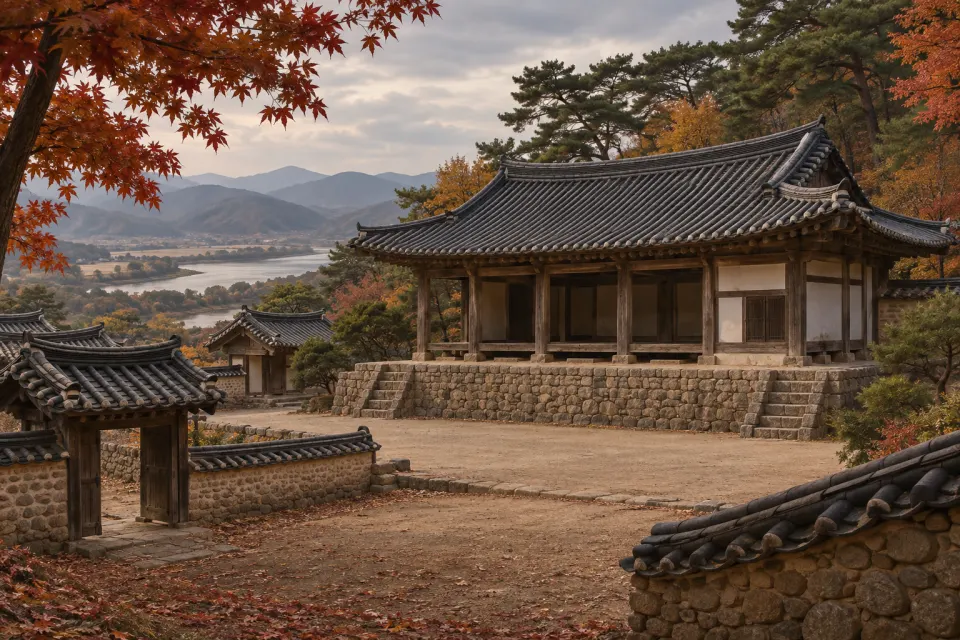
Seowon, Korean Neo-Confucian academies
KOR · UNESCO World Heritage, 2019
Private academies such as Dosan Seowon, built for Confucian teaching and ancestral rites, where Joseon scholars studied Zhu Xi's school; nine of them were inscribed together as a UNESCO World Heritage property in 2019.[10]
Art & objects
Public-domain objects from museum collections. Select one to see it at the museum.
 Brush Holder with Bamboo and Landscape DesignKorea, Joseon dynasty (1392–1910), 1800s
 Poem on PlumKorea, Joseon dynasty (1392–1910), 1700s–1800s
 Gathering among the Members of Office Censor-GeneralKorea, Joseon dynasty (1392–1910), 1700s
 Books and Scholars’ AccoutrementsKorea, Joseon dynasty (1392–1910), late 1800s
 Epitaph tablets (myoji)Korea, Joseon dynasty (1392–1910), dated 1736
 Twenty-five bust portraits of famous scholarsChina, Ming Dynasty (1368–1644), 16th or 17th century
 Portrait of Yun Dongseom (1710–1795)Korea, Joseon dynasty (1392–1910), ca. 1790–1805
 Portrait of Zhu XiJapan, Edo period (1615–1868), 1796
How we know
How we know
Modern knowledge of Neo-Confucian thought rests on an unusually large written record: the philosophers' own commentaries, formal writings, and surviving correspondence with scholars who shared or disputed their views, rather than on independent archaeological evidence.[11]
Common misconceptions
Myth The Four Books are an ancient, fixed core of Confucian scripture.
Fact They are a set Zhu Xi himself assembled and elevated in the 12th century from older, separately transmitted texts. Only in 1313, under the Mongol Yuan dynasty, did his commentaries on them become the set text for the civil service examinations, a position they kept, with interruptions, until the exams were abolished in 1905.[3]
Glossary
- li · 理
- Principle or pattern; the ordering structure Neo-Confucians held to underlie all things, including human moral nature.[4]
- qi · 氣
- Vital force or psychophysical stuff; the material through which li takes shape, with uneven qi explained as the source of human moral failing.[4]
- Daoxue · 道學
- "Learning of the Way": the name the Song founders' school used for itself.[7]
- Lixue · 理學
- "Learning of Principle": the lineage associated with Cheng Yi and Zhu Xi, later contrasted with Xinxue.[2]
- Xinxue · 心學
- "Learning of the Heartmind": the rival school associated with Lu Jiuyuan and, later, Wang Yangming.[6]
- liangzhi · 良知
- "Innate moral knowledge": Wang Yangming's term for the inborn capacity to know and act rightly.[6]
Sources
Each statement above was checked against published sources; the verdict says whether it stood as written, was corrected or was hedged.
- VerifiedBritannica, Zhu Xi; Stanford Encyclopedia of Philosophy, Song-Ming Confucianism.
- VerifiedBritannica, Zhu Xi; Stanford Encyclopedia of Philosophy, Song-Ming Confucianism.
- VerifiedStanford Encyclopedia of Philosophy, Song-Ming Confucianism; Britannica, Zhu Xi.
- VerifiedBritannica, Zhu Xi; Stanford Encyclopedia of Philosophy, Song-Ming Confucianism.
- VerifiedBritannica, Zhu Xi; Stanford Encyclopedia of Philosophy, Song-Ming Confucianism.
- VerifiedStanford Encyclopedia of Philosophy, Song-Ming Confucianism; Britannica AI aggregation, Neo-Confucianism.
- VerifiedStanford Encyclopedia of Philosophy, Song-Ming Confucianism; Britannica AI aggregation, Neo-Confucianism.
- VerifiedBritannica, Zhu Xi; Stanford Encyclopedia of Philosophy, Song-Ming Confucianism.
- VerifiedBritannica, Zhu Xi; Stanford Encyclopedia of Philosophy, Song-Ming Confucianism.
- CorrectedUNESCO World Heritage Centre, Seowon, Korean Neo-Confucian Academies; Britannica, Seowon.
- VerifiedBritannica, Zhu Xi; Stanford Encyclopedia of Philosophy, Song-Ming Confucianism.
Last fact-checked 6 October 2026.