
The story behind the day
The Jade Emperor, Yuhuang, is the most supreme god of the Chinese popular pantheon, and Daoism also counts him among its deities. Tradition holds that he was born on the ninth day of the lunar year's first month, within the New Year season. In Taiwan it is called Tiangong sheng, the birthday of Master Heaven. The rites begin at midnight, when the head of a household leads the family in offering incense.[1–8]
Origins
In Chinese popular religion the Jade Emperor is the highest god, a standing his cult had already reached by the tenth century. Ordinary speech calls him Master Heaven (Tiangong), and the day of his birthday was anciently called the celebration of Heaven's birth. Daoism counts him among its own deities, but its writers place him differently: one account makes him the executor of orders that come from the highest triad, the Three Pure Ones, while another counts him among the gods who may rank beside them as a highest Daoist deity.[1–2, 5, 8]
What it marks
Chinese religion pictures the heavens as a bureaucracy with the Jade Emperor at its head. Each household's Kitchen God is said to travel to heaven and report to him on the family's conduct.[10–11]
How it came to be
Tradition and legend, in the words of Taiwanese sources, hold that the Jade Emperor's birthday is the ninth day of the lunar year's first month. The day falls within the New Year season, which runs on until the first month's full moon and closes with the Lantern Festival. His standing as the supreme popular god is old, going back at least to the tenth century.[2–4]
How it is kept
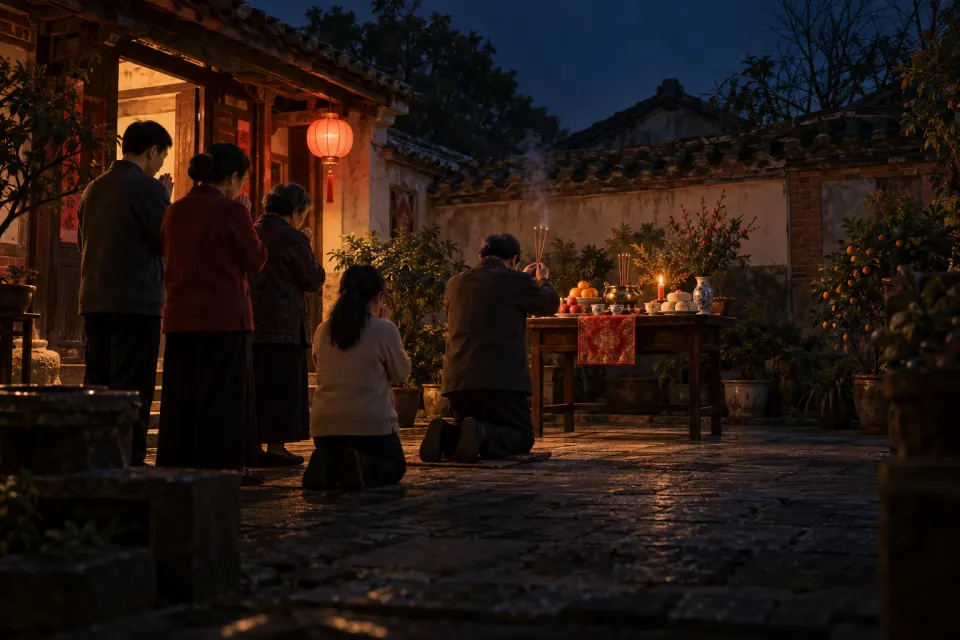
Worship begins at midnight, as the ninth day starts; Thompson's survey of the religious year describes the household fasting through the evening of the eighth and then, led by its head, kneeling and presenting incense. In Taiwan the rite falls in the zi hour and runs from midnight until about four in the morning, with the family's head offering incense at a table set where it faces the sky, in a temple forecourt or the family's own courtyard.[6–7]
Across traditions
Chinese popular religion and Daoism place the Jade Emperor differently: popular worship treats him as supreme, while Daoist writers differ on how his rank stands beside that of the Three Pure Ones. The day is kept well beyond Taiwan. In Singapore, the Jade Emperor Temple on Havelock Road keeps his birthday on the ninth day of Chinese New Year, and the Singapore Mandarin Council's database gives the same day, the ninth of the first lunar month.[1, 8–9]
Sources
Each statement above was checked against published sources; the verdict says whether it stood as written, was corrected or was hedged.
- VerifiedNational Heritage Board; Encyclopedia of Religion.
- CorrectedStanford Encyclopedia of Philosophy, Daoism as a religion; Encyclopedia of Religion.
- VerifiedMinistry of Education; Hakka Affairs Council; Encyclopedia of Religion.
- VerifiedEncyclopedia of Religion; Columbia University, Asia for Educators, The Lunar New Year: Rituals and Legends.
- VerifiedEncyclopedia of Religion; Executive Yuan.
- CorrectedEncyclopedia of Religion; Taiwan government.
- CorrectedEncyclopedia of Religion; Taiwan government.
- CorrectedEncyclopedia of Religion; Stanford Encyclopedia of Philosophy, Daoism as a religion.
- CorrectedNational Heritage Board; Singapore Mandarin Council, Singaporean Mandarin Database, Jade Emperor.
- VerifiedColumbia University, Asia for Educators, The Jade Emperor & Other Gods of the Earthly Domain; Encyclopedia of Religion.
- CorrectedColumbia University, Asia for Educators, The Kitchen God & the Earthly Domain; Encyclopedia of Religion.