
Overview
Chinese folk religion is the oldest and most widely practised religious life in China: honouring ancestors, nature spirits and a vast company of gods at local temples, household altars and graves, rather than through one creed or clergy. It grew out of the ancestor cult and divination of the Shang dynasty, long before Confucianism, Daoism or Buddhism existed, and has borrowed from all three since, so that most Chinese move among them without contradiction. Its gods include deified mortals, such as the sea goddess Mazu and the war god Guandi, approached for their power to answer prayers rather than as objects of exclusive belief. Chinese governments have usually dismissed it as "superstition" and never granted it the status of the state's five recognised religions, yet its incense, festivals and fortune-telling remain part of everyday life for hundreds of millions of people.[1–3, 8–9]
History

Oracle bones and the ancestor cult c. 1600–1046 BCE
The earliest documented Chinese religion is the ancestor cult of the Shang dynasty. From the reign of Wuding (c. 1250–1192 BCE), diviners heated cattle bones and turtle shells and read the cracks to put questions to royal ancestors about sacrifices, harvests, war and the weather, in what is also the earliest known Chinese writing. The Shang kings offered regular sacrifices to a hierarchy of ancestral spirits and, above them, to a more remote high god, Shangdi, who controlled drought, flood and plague but was rarely addressed directly; lesser spirits carried prayers to him instead. This pattern, of gods and ancestors organised like a government, still runs through Chinese folk religion today.[1, 10–11]
A shared religion beneath Three Teachings 500 BCE – 13th century CE
As Confucianism, Daoism and, from the 1st century CE, Buddhism took shape, they did not displace the older cult of gods, ancestors and ghosts but tried, with limited success, to absorb and reform it. From the Tang dynasty, walled cities kept a temple to a Cheng Huang, or City God, who watched over the community of the dead as well as the living, and from the Song dynasty, local guardian earth gods were given individual names and histories and worshipped as local saints. Mortals who had served their communities were deified in the same way, among them the general Guan Yu, later worshipped nationwide as the war god Guandi.[12–14]
Branded as superstition 1898–1976
Chinese reformers and governments repeatedly singled out local cults as backward. Edicts of 1898 and 1901 called for temples to be seized and turned into schools, and from 1912 both the Republic and, from 1949, the People's Republic recognised only five organised religions while actively suppressing local temples and festivals as "superstition". During the Cultural Revolution (1966–76) Red Guards attacked and destroyed many temples and shrines, ancestral tablets were destroyed, and religious personnel were persecuted; because folk religion had no official body of its own, it had nothing to shelter it.[8, 15–16]
Revival since 1979 1979–present
Controls eased after 1979, and local cults have revived on a scale most scholars did not expect: temples have reopened and been rebuilt, lineages again sponsor ancestral rites, and pilgrimage to popular gods such as Mazu draws crowds at thousands of temples in China and overseas. Chinese authorities still draw a line between tolerated "custom" and discouraged "superstition", so practices such as fortune-telling and spirit mediums remain in an uncertain legal position even as incense-burning and temple festivals have become everyday again.[17–18]
Key moments
- 1966 CEThe Cultural Revolution closes China's temples · China
Beliefs
Shangdi and Tian · 上帝 · 天
the High God; Heaven
Behind the many gods of folk religion stands a more remote high power, called Shangdi by the Shang and Tian ("Heaven") by the Zhou who succeeded them. This high power rarely receives direct worship; people instead approach it through ancestors, local gods and other intermediaries, who are thought to carry requests upward and report back on human conduct.[10–11]
Efficacy · 靈驗 língyàn
a god's or ritual's proven power to answer prayers
Chinese folk religion is organised less around belief in a creed than around efficacy (ling, lingyan): whether a particular god, temple or ritual is known to answer prayers for health, wealth or good fortune. Worshippers move between gods and temples as the need arises, giving offerings and making wishes rather than professing exclusive faith in any one of them.[19]
Gods, ghosts and ancestors · 神 · 鬼 · 祖先
shen, gui, zuxian
Folk religion divides the dead into ancestors, who are honoured and asked for protection, and ghosts, unrelated or neglected spirits who may bring misfortune if not placated. Gods are usually former humans, promoted after death for their virtue or power, and organised, like the Shang high god and his subordinates, into a hierarchy that mirrors an imperial bureaucracy.[3, 20]
Fengshui and fate · 風水 · 命
wind-water; fate
Alongside gods and ancestors, folk religion holds that unseen forces such as fengshui, the flow of qi through landscape and buildings, and an individual's fixed fate (ming) shape a person's fortune. Choosing auspicious days, orienting graves and houses correctly, and consulting diviners are ordinary ways of working with these forces.[21]
Practice

Incense and wishes · 燒香 · 許願
The basic act of folk worship is burning incense before a god, ancestor or ghost and making a wish, at a home altar, a lineage hall or a temple. About a quarter of mainland adults say they burn incense to a deity several times a year; incense, once used mainly as a purifying fumigant, is now the single most common offering across Chinese religious life.[22]
Ghost Month · 鬼節 Guǐ Jié
In the seventh lunar month, the gate of the underworld is believed to open and let ghosts, including neglected ancestors, wander among the living. Families and temples make food offerings and burn "spirit money" to appease them, a rite kept alongside, but distinct from, the Buddhist and Daoist festivals held on the same date.[23]
Territorial cults and festivals
Everyone living within a locality is traditionally expected to support the cult of its earth god or city god, often by a household contribution, and the temple serves as the community's religious and social centre. On a god's festival day, residents suspend ordinary business for processions, opera and shared offerings, affirming the community's bond with its patron deity.[14, 24]
Spirit-writing and mediums · 扶乩 fújī
Since at least the Song dynasty, specialists and sometimes ordinary worshippers have received messages from gods or ancestors through spirit-writing or trance possession, producing "morality books" of shared ethical teaching. Hiring a medium, a fortune-teller or a Daoist priest for such services remains common, since folk religion has no clergy of its own.[5, 25]
Holy days
The year ahead
| Date | Holy day | Reckoned |
|---|---|---|
| 22 December 2026 | Dongzhi (Winter Solstice) 冬至 | the December solstice |
| 6 February 2027 – 20 February 2027 | Chinese New Year 春節 | 1st day of the first lunar month, Chinese lunar calendar |
| 20 February 2027 | Lantern Festival 元宵節 | 15th day of the first lunar month, Chinese lunar calendar |
| 5 April 2027 | Qingming (Tomb-Sweeping Day) 清明 | the Sun at 15° (solar term) |
| 9 June 2027 | Dragon Boat Festival 端午節 | 5th day of the fifth lunar month, Chinese lunar calendar |
| 16 August 2027 | Ghost Festival 鬼節 | 15th day of the undefined lunar month, Chinese lunar calendar |
| 15 September 2027 | Mid-Autumn Festival 中秋節 | 15th day of the undefined lunar month, Chinese lunar calendar |
Chinese New Year · 春節
First day of the lunar calendar (late January–February)
The year's biggest festival combines thanks and requests to household and temple gods with family reunion and one of the three customary annual visits to ancestors' graves, along with firecrackers and other noise traditionally meant to drive off evil spirits.[26]
Ghost Festival · 鬼節 Guǐ Jié
15th day of the 7th lunar month (July–August)
Marking the height of Ghost Month, this is folk religion's own observance of the day the dead are believed to walk among the living, kept with food offerings and burning paper money, alongside the related but distinct Buddhist Ullambana and Daoist Zhongyuan festivals held on the same date.[23]
People

Shangdi · 上帝
deity
The Shang dynasty's high god, Shangdi controlled drought, flood and plague from a remote position above the ancestral spirits that Shang kings worshipped directly; oracle bones show he was rarely consulted or addressed in person.[10–11]
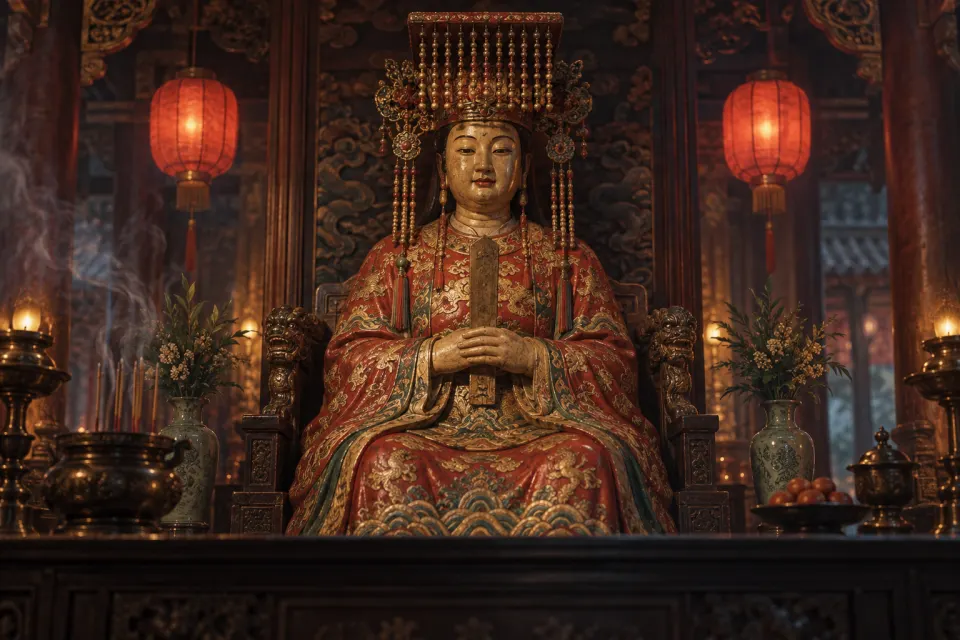
Mazu · 媽祖
deity
By tradition a woman who lived on Meizhou Island and died in the 10th century trying to save shipwrecked sailors, Mazu is worshipped as goddess of the sea at thousands of temples in China and Chinese communities abroad, especially along the southeastern coast and in Taiwan.[27]

Guandi (Guan Yu) · 關帝 · 關羽
deity · d. 219 CE
Guan Yu, a general of the Three Kingdoms era executed in 219 CE, was deified after death and given ever-greater titles until a Ming emperor canonised him in 1594 as Guandi, god of war; he is also honoured as a patron of trades and a protector of households and businesses.[13]
Places

Mount Taishan
CHN · UNESCO World Heritage, 1987
China's most sacred mountain was the site of imperial sacrifices to heaven and earth for some two thousand years and is still visited by pilgrims seeking the blessing of its mountain god; it was already a cult centre before 219 BCE, when the First Emperor of Qin made sacrifices there to mark his unification of China.[28]
Meizhou Island
CHN
The small Fujian island where Mazu is said to have lived and died holds her first and most important temple; twice a year residents, farmers and fisherfolk suspend work for temple fairs in her honour, a practice also kept at thousands of Mazu temples around the world.[27]
Art & objects
Public-domain objects from museum collections. Select one to see it at the museum.
 Pair of Tomb Chamber DoorsChina, Western Han dynasty (206 B.C.–A.D. 9), 1st century B.C.
 Zhong Kui Supported by GhostsChina, Qing dynasty (1644–1911), 1700s
 Tripod Cauldron (Ding)China, Shang dynasty (c. 1600–c. 1046 BCE), 1200–1100 BCE
 The Lantern Night Excursion of Zhong KuiChina, Yuan dynasty (1271–1368), late 1200s–early 1300s
 Food Container (Gui)China, Eastern Zhou dynasty (770–256 BCE), Spring and Autumn period (770–476 BCE), 600–500 BCE
 Bell (Lai Zhong)China, Shaanxi province, Meixian, Western Zhou dynasty (c. 1046–771 BCE), c. 800–700 BCE
 Mirror with Deities, Chariot, and the White TigerChina, Eastern Han dynasty (25–220 CE), 100–200 CE
 Ancestor Group PortraitChina, Qing dynasty (1644-1911), Jiaqing period (1796-1820), 1796–1820
 Zhong KuiChina, Qing dynasty (1644–1911), dated 1883
 The Demon Queller Zhong Kui Giving His Sister Away in MarriageChina, Yuan dynasty (1271–1368)
 Guan YuChina, Qing dynasty (1644–1911), ca. 1700
 Rubbing of Guandi (War God) from a Ming dynasty stone carvingChina, 20th century
 Demon queller Zhong Kui with demonsChina, Qing dynasty (1644–1911), late 17th–early 18th century
 Phrase about the female deity MazuJapan, ca. 1665–71
Numbers
- Mainland adults who name folk religion as their religion
- c. 3% (2018)[7]
From the 2018 Chinese General Social Survey; far more take part in folk practices without calling themselves adherents, and no reliable worldwide total exists.
How we know
A religion without a name
"Chinese folk religion" and "popular religion" are terms scholars use, not names practitioners give themselves; there is no single Chinese word for the whole complex, and the boundary with Confucian, Daoist and Buddhist practice is porous rather than fixed. Specialists now generally describe one broad "Chinese religion" shared by all Chinese, inside which the three organised traditions and countless local cults each offer their own services without excluding the others.[2, 9]
Common misconceptions
Myth Chinese folk religion is mere superstition, not a real religion.
Fact Chinese governments have long used the label "superstition" to justify suppressing local cults, but scholars treat folk religion as a coherent system with its own gods, rites, ethics and communities, one that most Chinese take part in whether or not they call it a religion at all.[8–9]
Myth Because so many Chinese take part in its rites, most Chinese identify as followers of folk religion.
Fact Practice and identity are different things in Chinese religious life. Burning incense, visiting graves and consulting fortune-tellers are common even among people with no religious affiliation, while only a small share of mainland adults name folk religion as their religion in surveys.[7]
Myth Chinese folk religion is just a popular form of Daoism.
Fact Daoism has its own clergy, ordination and canon of scripture, which folk religion lacks. Folk temples and festivals are organised by local communities themselves, who may hire Daoist priests, Buddhist monks or mediums for particular rites without belonging to either religion.[5, 29]
Glossary
- Minjian xinyang · 民間信仰
- "Folk belief": the common Chinese term for the diffuse complex of gods, ancestors, ghosts and divination now usually called Chinese folk or popular religion.[2]
- Shangdi · 上帝
- "High God": the Shang dynasty's supreme deity, later identified with the Zhou dynasty's Tian, or Heaven.[10]
- Lingyan · 靈驗
- Efficacy: a god's or ritual's proven power to answer prayers, the main measure by which folk worshippers judge where to direct their devotion.[19]
- Tudi Gong · 土地公
- An earth god with authority over a single small locality, such as a street or field, subordinate to the city god of the walled town.[14]
- Chenghuang · 城隍
- The City God: a walled city's guardian deity and spiritual magistrate, usually a deified former official, worshipped since the Tang dynasty.[12]
- Fengshui · 風水
- "Wind and water": the practice of orienting graves, buildings and objects to harmonise with the flow of qi through the landscape.[21]
- Fuji · 扶乩
- Spirit-writing: a technique for receiving messages from gods or ancestors, historically a major source of the "morality books" that spread shared ethical teaching.[25]
- Shanshu · 善書
- "Morality books": popular texts of ethical teaching, many originating in spirit-writing revelations, that circulated widely from the Song dynasty onward.[25]
Sources
Each statement above was checked against published sources; the verdict says whether it stood as written, was corrected or was hedged.
- VerifiedPew Research Center, Confucianism, Taoism and Chinese folk religions; Britannica, China: Late Shang divination and religion.
- VerifiedPew Research Center, Confucianism, Taoism and Chinese folk religions; Encyclopedia of Religion, 2nd ed., Chinese Religion: An Overview.
- VerifiedPew Research Center, Confucianism, Taoism and Chinese folk religions; Britannica, Guandi.
- CorrectedPew Research Center, Confucianism, Taoism and Chinese folk religions; Encyclopedia of Religion, 2nd ed., Chinese Religion: Popular Religion.
- VerifiedPew Research Center, Confucianism, Taoism and Chinese folk religions; Encyclopedia of Religion, 2nd ed., Chinese Religion: Popular Religion.
- VerifiedPew Research Center, Confucianism, Taoism and Chinese folk religions; Britannica, feng shui.
- VerifiedPew Research Center, Confucianism, Taoism and Chinese folk religions; Encyclopedia of Religion, 2nd ed., Chinese Religion: Popular Religion.
- VerifiedPew Research Center, Confucianism, Taoism and Chinese folk religions; State Council Information Office of the PRC, White paper China's Policies and Practices on Protecting Freedom of Religious Belief.
- VerifiedEncyclopedia of Religion, 2nd ed., Chinese Religion: An Overview; Pew Research Center, Confucianism, Taoism and Chinese folk religions.
- VerifiedEncyclopedia of Religion, 2nd ed., Shangdi, via Encyclopedia.com; Britannica, China: Late Shang divination and religion.
- VerifiedEncyclopedia of Religion, 2nd ed., Shangdi, via Encyclopedia.com; Britannica, China: Late Shang divination and religion.
- VerifiedEncyclopedia of Religion, 2nd ed., Chinese Religion: Popular Religion; Britannica, Cheng Huang.
- VerifiedBritannica, Guandi; Pew Research Center, Confucianism, Taoism and Chinese folk religions.
- VerifiedEncyclopedia of Religion, 2nd ed., Chinese Religion: Popular Religion; Britannica, Tudi Gong.
- VerifiedEncyclopedia of Religion, 2nd ed., Chinese Religion: Popular Religion; Pew Research Center, Government policy toward religion in the PRC – a brief history.
- CorrectedPew Research Center, Government policy toward religion in the PRC – a brief history; Columbia University Asia for Educators, 20th Century: Communism & Internal Challenges.
- VerifiedEncyclopedia of Religion, 2nd ed., Chinese Religion: Popular Religion; Pew Research Center, Government policy toward religion in the PRC – a brief history.
- VerifiedPew Research Center, Confucianism, Taoism and Chinese folk religions; Encyclopedia of Religion, 2nd ed., Chinese Religion: Popular Religion.
- VerifiedPew Research Center, Confucianism, Taoism and Chinese folk religions; Meng Cao, Remaking Local Knowledge: The Reinterpretation of Morality Through Religious Teachings and Folklore, Religions 15(11):1354.
- VerifiedPew Research Center, Confucianism, Taoism and Chinese folk religions; Britannica, China: Late Shang divination and religion.
- VerifiedBritannica, feng shui; Pew Research Center, Confucianism, Taoism and Chinese folk religions.
- VerifiedPew Research Center, Confucianism, Taoism and Chinese folk religions; Encyclopedia of Religion, 2nd ed., Chinese Religion: Popular Religion.
- VerifiedBritannica, Hungry Ghost Festival; Pew Research Center, Confucianism, Taoism and Chinese folk religions.
- VerifiedEncyclopedia of Religion, 2nd ed., Chinese Religion: Popular Religion; Britannica, Cheng Huang.
- VerifiedEncyclopedia of Religion, 2nd ed., Chinese Religion: Popular Religion; Ichiko Shiga, The production and distribution of spirit-written texts attributed to female deities..., Studies in Chinese Religions 12(1).
- VerifiedBritannica, Chinese New Year; Pew Research Center, Confucianism, Taoism and Chinese folk religions.
- VerifiedUNESCO Intangible Cultural Heritage, Mazu belief and customs; Pew Research Center, Confucianism, Taoism and Chinese folk religions.
- VerifiedUNESCO World Heritage Centre, Mount Taishan; Britannica, Mount Tai.
- VerifiedEncyclopedia of Religion, 2nd ed., Chinese Religion: Popular Religion; Pew Research Center, Confucianism, Taoism and Chinese folk religions.
Last fact-checked 3 October 2026.