The story behind the day
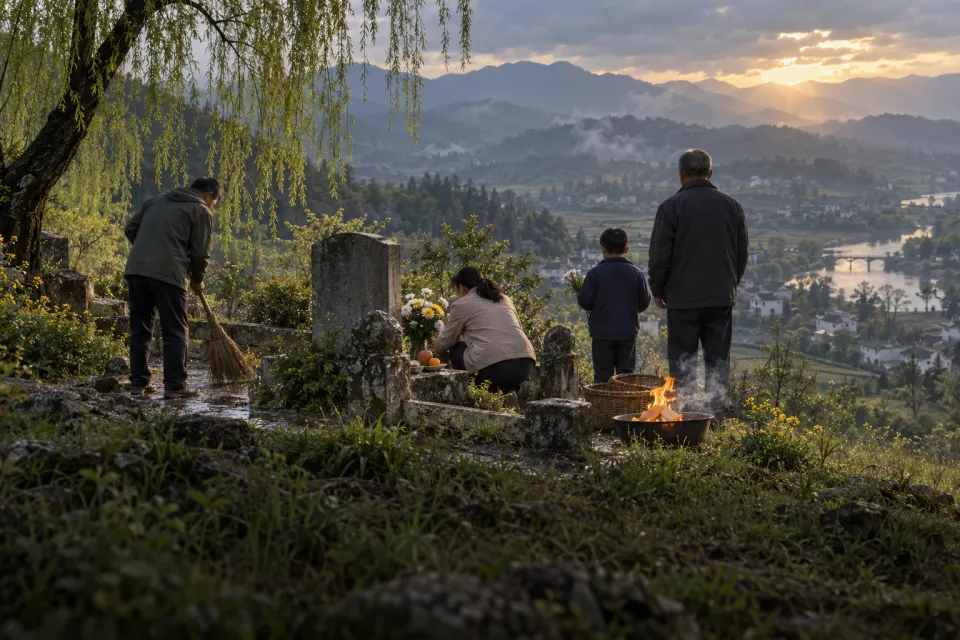
Qingming, often called Tomb-Sweeping Day, is a solar term of the Chinese year, arriving fifteen days after the spring equinox, usually on 4 or 5 April. Families visit the graves of their ancestors, tidy them and lay out food. Chinese folk religion sees this as feeding the dead, while Confucian tradition understands it as an act of filial reverence. Korea has a kindred spring holiday of the graves, Hansik.[1–7]
Origins

Qingming is a festival of the solar calendar, set by the sun and not by the moon: it is a solar term of the Chinese calendar, which divides the sun's yearly course into twenty-four such terms, and it comes fifteen days after the spring equinox, in the first days of April. The Encyclopedia of Religion calls it the second major festival of the year and dedicates it to the ancestors, and Taiwan's Executive Yuan describes it as the festival of going up into the hills to honour the ancestors and sweep their graves.[1, 8]
What it marks
The tradition reports that Confucius did not count honouring ancestors as a religious act; he saw it as meeting a child's duty, and the Confucian tradition counts ancestral sacrifice as a way of showing reverence for forebears. Chinese folk religion adds a further reason. Ancestors are the dead whom their descendants feed, while the dead whose descendants neglect them turn into wandering ghosts. Both views make the visit to the grave a duty, and the Confucian one makes it a matter of filial reverence more than of belief in spirits. The family keeps its side of the bargain by coming.[4–5]
How it is kept

Families go to the ancestral graves and put them in order, sweeping and cleaning the ground around them. They lay out food offerings, and people pray at the graves. The food is meant for the ancestors, who in folk belief are the dead their descendants feed.[2–3, 5]
Across traditions
Korea keeps its own spring holiday of the graves. Hansik, the cold-food day, is reckoned 105 days after the winter solstice, and its heart is the honouring of ancestors: a rite at home, care for the graves, and a rite performed at the grave. People trim the weeds around the graves and hold memorial services, and the National Folk Museum of Korea lists Hansik among the days on which the gravesite rite, myoje, is held. In Korea, going to the graves on traditional holidays to hold a memorial service is described as custom.[6, 9–10]
Sources
Each statement above was checked against published sources; the verdict says whether it stood as written, was corrected or was hedged.
- CorrectedExecutive Yuan; Smithsonian National Museum of Asian Art, Qing Ming Festival.
- CorrectedEncyclopedia of Religion; Spencer Museum of Art, University of Kansas, Qingming Festival on the River; Smithsonian National Museum of Asian Art, Qing Ming Festival.
- CorrectedSmithsonian National Museum of Asian Art, Qing Ming Festival; Spencer Museum of Art, University of Kansas, Qingming Festival on the River.
- VerifiedPew Research Center, Confucianism, Taoism and Chinese folk religions; Stanford Encyclopedia of Philosophy, Confucius.
- VerifiedEncyclopedia of Religion, 2nd ed.; Pew Research Center.
- CorrectedCultural Heritage Administration; National Folk Museum of Korea, Myoje.
- VerifiedSmithsonian Folklife Festival; Pew Research Center.
- CorrectedEncyclopedia of Religion; Executive Yuan.
- CorrectedCultural Heritage Administration; National Folk Museum of Korea, Myoje.
- CorrectedCultural Heritage Administration; National Folk Museum of Korea, Myoje.