
The story behind the day
The Mid-Autumn Festival is held on the eighth lunar month's fifteenth day, at the midpoint of autumn, under a full moon. For Chinese families it is a night of reunion: the round moon, and the moon cakes cut and shared among the family, both stand for a family gathered whole. People worship the moon, offer it cakes and fruit, and sit out to watch it rise. The festival belongs to the close of the harvest. Korea keeps a sister festival as Chuseok.[1–6]
Origins
The festival belongs to the season of harvest. Chinese reckoning took the middle of autumn as a propitious time of fruitfulness, though the Encyclopedia of Religion adds that the harvest link, once specific, is no longer apparent. In older Chinese religious life people worshipped the full moon on this date, and the goddess Chang E gives the night its best-known story: in the Smithsonian's telling she drinks an elixir of immortality, rises into the heavens and turns into a goddess of the moon, and a reference work places her in a silver palace on the moon. Folk religion adds its own observances: on the fifteenth, offerings go to the earth god Tudigong and to the ancestors, and moon cakes are also offered for the birthday of Yin Niangniang. Taiwan's gazetteers record that the earth god was honoured after the harvest as an expression of thanks, answering the prayers of spring.[4–5, 7–8]
What it marks
Chinese tradition, the Smithsonian says, celebrates a bountiful harvest at this time. Because the moon is round and full on this night, the day is regarded as a festival of reunion, and the Smithsonian describes relatives and friends gathering to look up at the full moon. A Taiwanese government account explains the reunion theme simply: autumn is cool, the moon is round, and the round moon becomes the image of a family gathered.[3, 5]
How it is kept
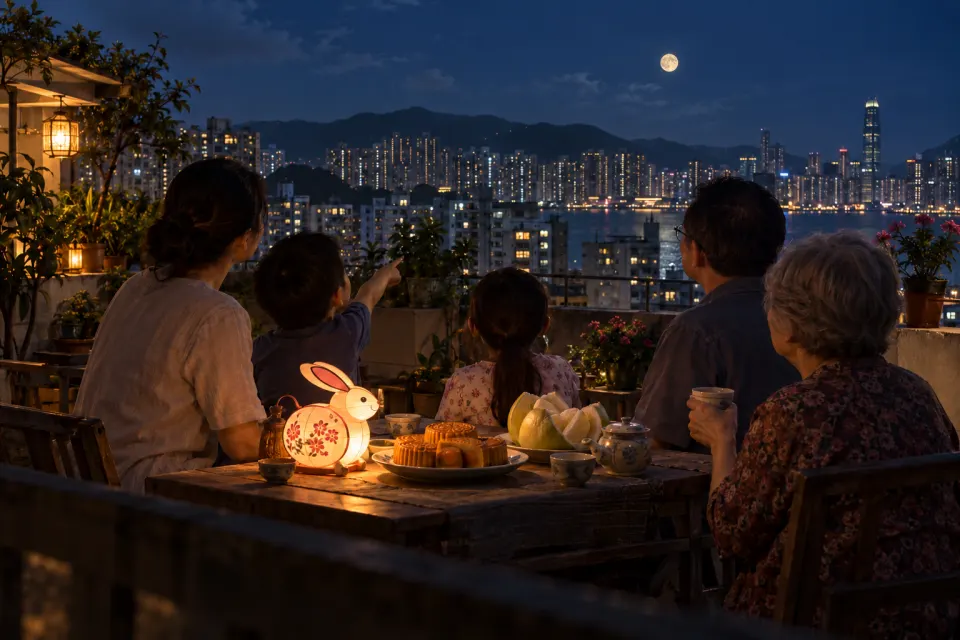
Families eat moon cakes under the moon as an offering to it; the cakes are always shaped like the moon. In early Taiwan people worshipped the Moon Lady, with moon cakes and pomelos on the altar, and the cakes were cut and shared, which is why they are called reunion cakes. Thompson's survey of the Chinese religious year finds this full moon among the pleasantest festivals of the year, when good weather adds to the moon-viewing parties.[4, 9–10]
Across traditions
The same date is Chuseok in Korea, a harvest holiday that the National Folk Museum of Korea calls Korean Thanksgiving Day. Moon, harvest and family are the common themes.[6]
Sources
Each statement above was checked against published sources; the verdict says whether it stood as written, was corrected or was hedged.
- CorrectedExecutive Yuan; Popular Festivals, World Eras; Smithsonian National Museum of Asian Art, Moon Festival.
- CorrectedExecutive Yuan; Popular Festivals, World Eras.
- CorrectedExecutive Yuan; Smithsonian National Museum of Asian Art, Moon Festival.
- VerifiedPopular Festivals, World Eras; Executive Yuan.
- CorrectedPopular Festivals, World Eras; Encyclopedia of Religion; Smithsonian National Museum of Asian Art, Moon Festival.
- CorrectedCultural Heritage Administration; National Folk Museum of Korea, Korean Seasonal Customs, Twelve Months of the Lunar Calendar.
- CorrectedSmithsonian National Museum of Asian Art, Moon Festival; Popular Festivals, World Eras.
- VerifiedEncyclopedia of Religion; Executive Yuan.
- CorrectedPopular Festivals, World Eras; Executive Yuan.
- CorrectedEncyclopedia of Religion; Smithsonian National Museum of Asian Art, Moon Festival.