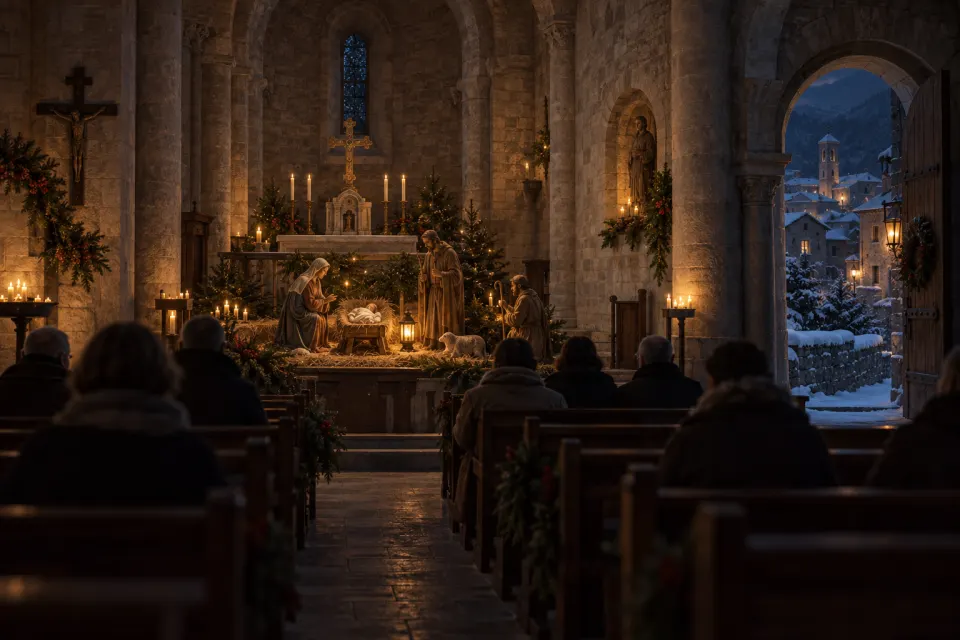
The story behind the day
Christmas celebrates the birth of Jesus, which Christians understand as God coming to live among humanity. The feast has no single date. Western churches keep it on 25 December, while churches that still follow the Julian calendar for fixed feasts, among them the Russian, Coptic and Ethiopian, keep their own 25 December, which falls on 7 January. The Armenian Church keeps one feast of birth and baptism on 6 January.[1–5]
Origins

The Christmas story comes from the Gospels. Luke tells of a child laid in a manger and of shepherds as the first to see him, and Christian tradition adds the visit of the Magi. The exact day of the birth, however, is not recorded, and the New Catholic Encyclopedia states plainly that the true date is unknown.[6–8]
What it marks
For Christians the feast marks the Incarnation. The Church of England speaks of God coming to share human life in the person of Jesus, and the Catechism of the Catholic Church calls Christmas the mystery of a "marvellous exchange". The Catechism also dwells on the humility of the scene: a stable, a poor family, and heaven's glory shown in poverty.[1, 6]
How it came to be
The oldest record of a 25 December Nativity is a Roman almanac, the Chronograph of 354. Why that day was chosen remains disputed. One school, the History of Religions theory, points to the Roman sun festival at the winter solstice; the other, the Calculation theory, ties the date to 25 March, a day with its own Christian weight. In much of the East the birth was first kept on 6 January, together with the Epiphany in a single feast. The Armenian Church still keeps the birth and the baptism together on that day.[2–3, 9–10]
How it is kept

Preparation is part of the feast. Orthodox Christians keep a fast of forty days before Christmas, and the Ethiopian church does so too. The crib has a known beginning: in 1223 at Greccio, Saint Francis staged a living scene with a manger, and Mass was celebrated over it. Armenian parishes bless water on 6 January in memory of Christ's baptism in the Jordan.[11–13]
Across traditions

The date differs by calendar, not by doctrine. The Julian calendar now runs 13 days behind the Gregorian, so 25 December by Julian reckoning falls on 7 January. By the leap-year rules, 2100 is a leap year in the Julian calendar but not in the Gregorian, so the gap widens to 14 days after that year and the date moves to 8 January. The Russian Orthodox Church keeps Christmas on 7 January, as do the Coptic and Ethiopian churches; for the Copts it is 29 Kiahk. The Armenian Patriarchate of Jerusalem keeps the Nativity at midnight on 18 and 19 January. Other Orthodox churches took up a modified calendar in 1923, the Church of Greece among them, though they still reckon Easter by the Julian method.[4–5, 14–17]
Sources
Each statement above was checked against published sources; the verdict says whether it stood as written, was corrected or was hedged.
- VerifiedThe Church of England, Advent and Christmas; Libreria Editrice Vaticana, Catechism of the Catholic Church §526.
- CorrectedEncyclopedia.com; Cambridge University Press, C. P. E. Nothaft, Church History 81(4), 2012.
- CorrectedMother See of Holy Etchmiadzin; Armenian Diocese of Canada, Feast of the Holy Nativity and Theophany of Our Lord Jesus Christ.
- CorrectedVatican News, Orient news: Syria, Julian Christmas, 10 Jan 2025; Orthodox Church in America, Fr Lawrence Farley, A Papal Calendar?; Moscow Patriarchate.
- CorrectedCoptic Orthodox Church; Orthodox Church in America, Farley.
- CorrectedThe National Gallery, London, The Adoration of the Shepherds; Libreria Editrice Vaticana, Catechism §525.
- VerifiedLibreria Editrice Vaticana, Catechism §486; The Church of England, Advent and Christmas.
- CorrectedEncyclopedia.com; BYU Studies, Jeffrey R. Chadwick, Dating the Birth of Christ, BYU Studies 49:4.
- VerifiedCambridge University Press, Nothaft, Church History 81(4), 2012; Encyclopedia.com.
- CorrectedCambridge University Press, Nothaft, Church History 81(4), 2012; Orthodox Church in America, Nativity of Christ; Encyclopedia.com.
- CorrectedOrthodox Church in America, Nativity of Christ; Ethiopian Orthodox Tewahedo Church, Calendar.
- VerifiedHoly See, Pope Francis, Apostolic Letter Admirabile signum; Encyclopedia.com.
- VerifiedMother See of Holy Etchmiadzin; Armenian Diocese of Canada.
- CorrectedU.S. Naval Observatory, Leap Years; NASA Goddard.
- CorrectedCoptic Orthodox Church; Coptic Orthodox Diocese of Los Angeles, Fr Moses Samaan, Calculations of the Date of the Glorious Feast of Nativity.
- VerifiedThe Armenian Church; Custodia Terrae Sanctae, The Custody's greetings for the Armenian Christmas.
- CorrectedU.S. Naval Observatory, The Date of Easter; Orthodox Church in America, The Church in Greece.