
Overview
The Oriental Orthodox churches are the ancient communions of Egypt, Ethiopia, Eritrea, Armenia, Syria and India that did not accept the Council of Chalcedon's ruling of 451 CE on Christ's nature. Where Chalcedon spoke of Christ in two natures, divine and human, these churches followed Cyril of Alexandria's language of one united incarnate nature, a position called miaphysite; opponents labelled them Monophysite, tied to a more extreme teaching they reject. Like Eastern Orthodoxy, a separate communion, they have no single head: the Coptic pope, the Ethiopian and Eritrean patriarchs, the Armenian catholicoi, the Syriac patriarch and the Malankara catholicos each govern their own church. Centuries under Byzantine, Muslim and other rulers shaped these churches as resilient minorities, and several, in Egypt, Syria, Armenia and Eritrea, have suffered severe persecution today.[1–3, 7–12]
History
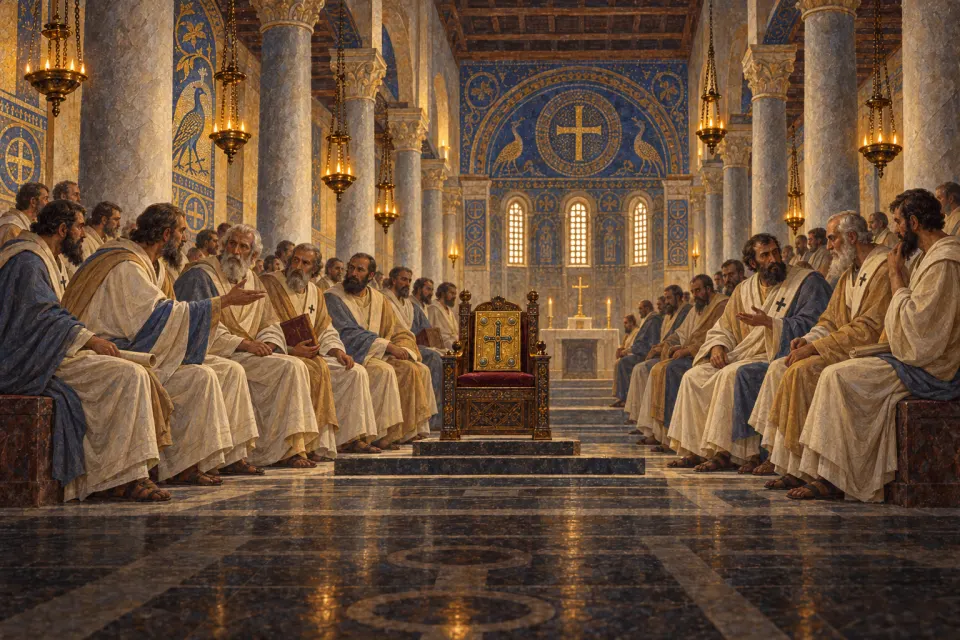
Chalcedon and the parting of ways 431–518
After the Council of Ephesus in 431 condemned Nestorius for dividing Christ into two separate persons, the Council of Chalcedon in 451 defined him instead as one person in two natures, divine and human, 'without confusion' but also without mixture. Patriarch Dioscorus of Alexandria and other bishops rejected this wording as a betrayal of Cyril of Alexandria's teaching that there is 'one nature of God the Word incarnate,' and Chalcedon deposed Dioscorus. Over the following decades the churches of Egypt, Syria and Armenia broke communion with Constantinople and Rome over this question, a split that hardened rather than healed as Byzantine emperors tried and failed to impose Chalcedon by force.[7, 13–17]
Survival under new rulers 518–642
Byzantine emperor Justin I's persecution of miaphysite bishops from 518 scattered many into hiding, but the Syrian monk Jacob Baradaeus, consecrated bishop of Edessa around 542, travelled in disguise ordaining a new generation of miaphysite clergy across Syria and Mesopotamia, work that let the movement survive and later gave the Syriac church its old Western name, Jacobite. The Arab conquests of the 630s–640s took Egypt and Syria out of Byzantine hands entirely; freed from imperial pressure to conform, but now a minority under Muslim rule, the Coptic and Syriac churches paid special taxes and faced recurring restrictions, while keeping their own patriarchs and liturgies.[18–22]
Ancient state churches: Armenia and Aksum 301–451
Armenia became the first state to adopt Christianity officially, traditionally dated to 301, when Gregory the Illuminator converted King Tiridates III; the Armenian church, with its seat afterward at Etchmiadzin, rejected Chalcedon's council at the 506 Council of Dvin and has remained Oriental Orthodox ever since. In the Ethiopian kingdom of Aksum, King Ezana adopted Christianity in the fourth century after Frumentius, a shipwrecked Syrian, won the royal court's confidence; in the late fifth century nine monks from Syria brought monasticism and translated scripture into the liturgical language Ge'ez.[23–27]
Modern autocephaly and persecution 1959–today
The Ethiopian church, long under the honorary oversight of the Coptic patriarch, gained its own patriarch in 1959; Eritrea's church followed in 1994, three years after Eritrean independence, when the Coptic pope Shenouda III ordained its first bishops. The 20th century brought catastrophe and recovery in turn: the Ottoman destruction of Armenians from 1915, remembered as the Armenian genocide, killed vast numbers of Armenian Apostolic Christians and scattered survivors worldwide, while Egypt's Copts and Syria's and Iraq's Syriac Christians have faced renewed violence and displacement in the 21st century, even as diaspora communities have grown in Europe and North America.[28–31]
Key moments
- c. 270 CEAntony and the desert monks · Egypt, east of the Nile
- c. 301 CEArmenia becomes Christian · Vagharshapat, Armenia
- c. 340 CEAksum turns to Christ · Aksum, Ethiopia
- 431 CECouncil of Ephesus · Ephesus (Selçuk, Türkiye)
- 451 CECouncil of Chalcedon · Chalcedon (Istanbul)
- c. 1200 CERock churches of Lalibela · Lalibela, Ethiopia
Beliefs
Miaphysitism
Oriental Orthodox Christians confess Christ as one person with one united nature, fully divine and fully human, joined 'without confusion, change, division or separation.' They see this as Cyril of Alexandria's own teaching and reject the charge that it denies Christ's humanity, a separate error called Eutychianism that their churches also condemn.[2, 32]
Tewahedo · ተዋሕዶ
being made one
The Ethiopian and Eritrean churches add this word, meaning the union of Christ's divine and human natures, to their own names, making their miaphysite confession part of their church's title.[33]
No Chalcedon, no Fourth Council
Oriental Orthodox churches accept the first three ecumenical councils (Nicaea, Constantinople, Ephesus) but not Chalcedon or the later councils Eastern Orthodoxy and Catholicism recognise, which is why they are sometimes called 'the Old Oriental churches' or non-Chalcedonian.[34]
Practice

Fasting
These churches keep some of Christianity's longest fasting calendars; the Ethiopian and Eritrean churches alone observe up to 180 fast days a year, including a 55-day Lent, during which observant members avoid animal products until a set hour.[35]
Liturgical languages
Worship is kept in ancient languages tied to each church's identity: Coptic in Egypt, Ge'ez in Ethiopia and Eritrea, Classical Armenian, Syriac in the Antiochian and Malankara traditions, alongside the local spoken languages of each congregation.[4]
Monastic foundations
Egyptian monasticism, begun by Anthony and organised into communities by Pachomius in the fourth century, shaped Christian monastic life worldwide; Coptic, Ethiopian and Syriac monasteries remain active centres of learning and pilgrimage today.[36–37]
Holy days
The year ahead
| Date | Holy day | Reckoned |
|---|---|---|
| 6 January 2027 | Armenian Christmas and Epiphany Սուրբ Ծնունդ | 6 January |
| 7 January 2027 | Coptic Christmas ⲡⲓⲛⲁⲩ ⲛ̀ⲧⲉ ⲡⲓⲙⲓⲥⲓ | 25 December in the Julian calendar |
| 7 January 2027 | Genna (Ethiopian Christmas) ገና | 25 December in the Julian calendar |
| 19 January 2027 | Timkat ጥምቀት | 11 Ṭərr, Ethiopian calendar |
| 2 May 2027 | Easter (Julian computus) | Pascha (Julian reckoning) |
| 12 September 2027 | Enkutatash (Ethiopian New Year) እንቁጣጣሽ | 1 Mäskäräm, Ethiopian calendar |
| 28 September 2027 | Meskel (Finding of the True Cross) መስቀል | 17 Mäskäräm, Ethiopian calendar |
Timkat · ጥምቀት
19 January (11 Terr, Ethiopian calendar)
The Ethiopian and Eritrean celebration of Christ's baptism, marked by processions carrying each church's tabot (a model of the Ark of the Covenant) and ceremonial blessing of water.[38]
Armenian Christmas and Epiphany
6 January
The Armenian Apostolic Church, uniquely among major churches, keeps Christ's birth and baptism together on a single feast rather than splitting them as most other traditions do.[39]
People
Dioscorus of Alexandria
saint · d. 454
Patriarch of Alexandria deposed by the Council of Chalcedon in 451 for upholding Cyril of Alexandria's one-nature formula, Dioscorus died in exile; Oriental Orthodox churches honour him as a defender of true doctrine rather than the heretic Chalcedonian sources called him.[15, 40]
Jacob Baradaeus
saint · c. 500–578
Consecrated bishop of Edessa around 542 during Byzantine persecution of miaphysite Christians, Jacob travelled Syria and Mesopotamia in disguise ordaining clergy, work that preserved the Syriac church and gave it the old name Jacobite.[19–20]
Scripture
The Bible
Each church reads scripture in its own ancient translation. Egypt's liturgy still reads the Bible in Coptic alongside Arabic. Ethiopia's Ge'ez Bible includes some books, among them the Book of Enoch, outside other Christian canons. Armenia's Bible was translated using Mesrop Mashtots's new fifth-century alphabet. The Syriac Peshitta, meanwhile, excludes five New Testament books that most other canons include.[43–46]
The Nicene Creed (without Chalcedon)
These churches confess the creeds of Nicaea (325) and Constantinople (381) and the teaching of Ephesus (431), but not the Chalcedonian definition of 451 or the councils that followed it in Eastern and Western Christianity.[34]
Places
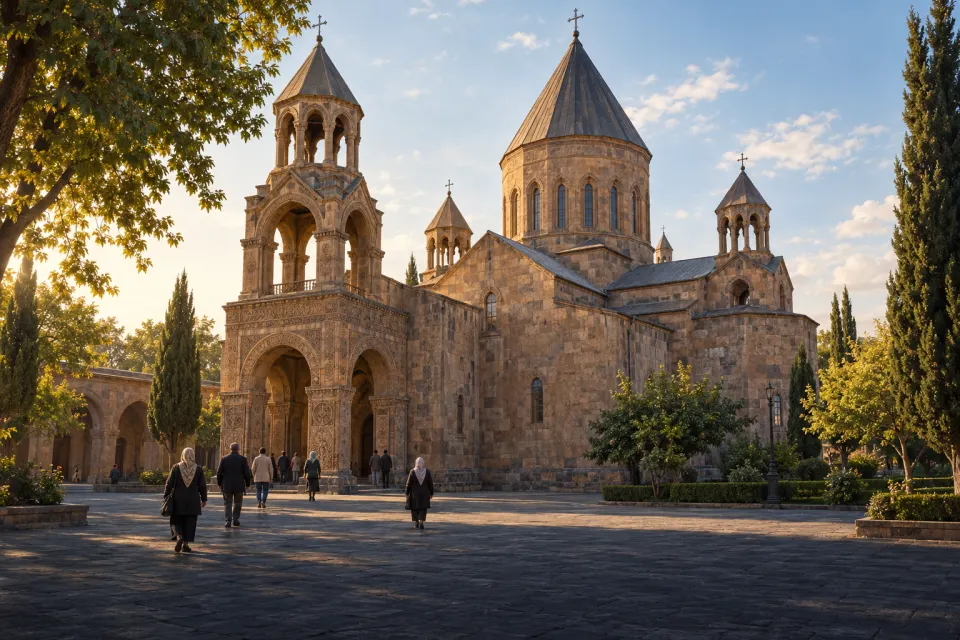
Mother Cathedral of Etchmiadzin
ARM · UNESCO World Heritage, 2000
Traditionally founded by Gregory the Illuminator around 301–303, it is the seat of the Catholicos of All Armenians and, with nearby churches and the archaeological site of Zvartnots, a World Heritage property.[41]
Saint Anthony's Monastery, Red Sea coast
EGY
Founded near the cave where Anthony the Great lived as a hermit in the fourth century, it is among the oldest continuously inhabited Christian monasteries in the world and remains an active Coptic Orthodox community.[36]
Rock-hewn churches, Lalibela
ETH · UNESCO World Heritage, 1978
Eleven monolithic churches carved downward into volcanic rock, traditionally linked to the 12th–13th-century king Lalibela, that remain active Ethiopian Orthodox pilgrimage sites and a World Heritage property.[47]
Art & objects
Public-domain objects from museum collections. Select one to see it at the museum.
 CrossEthiopia, Mid–/late 15th century
 Resist-Dyed Hanging with Biblical ScenesEgypt, Byzantine period, 500–550
 Icon of the Virgin and ChildEgypt, Byzantine period, 500s CE
 Hanging with Christian ImagesEgypt, Byzantine period, 500s
 Armenian Gospel with Silver Covermanuscript: 13th century; cover: dated 1691
 Leaf from a Gospel Book with Four Standing EvangelistsArmenian, 1290–1330
 Four Gospels in ArmenianArmenian, 1434/35
 Processional CrossEthiopian, 13th–early 14th century
 Processional CrossEthiopia, Lasta region, early 15th century
 Four miniatures of the life of Christ from a gospel book of 1311 (Presentation, Baptism, Transfiguration, Entry into Jerusalem)Armenian, 1311
Numbers
- Oriental Orthodox Christians worldwide
- c. 60–70 million (estimates vary by church)[6]
No census covers every Oriental Orthodox church. Ethiopia's Tewahedo church alone is estimated over 40 million; the Coptic Church self-reports 18 million; other churches are each in the low millions.
National censuses
| Country | Year | Count | Share |
|---|---|---|---|
| Canada Oriental Orthodox | 2021 | 65,310 | 0.2% |
| Australia Oriental Orthodox | 2021 | 60,779 | 0.2% |
| New Zealand Coptic Orthodox | 2018 | 546 | 0.0% |
Source: Australian Bureau of Statistics, Census of Population and Housing 2021, 'Religious affiliation in Australia' (Table 4), CC BY 4.0. Adapted from Statistics Canada, Table 98-10-0342-01 Religion by visible minority and generation status: Canada, provinces and territories, census metropolitan areas and census agglomerations with parts, released 2022-10-26. This does not constitute an endorsement by Statistics Canada of this product. Source: Stats NZ, 2018 Census, licensed by Stats NZ for re-use under the Creative Commons Attribution 4.0 International licence.
Common misconceptions
Myth Oriental Orthodox churches are 'Monophysite,' meaning they deny Christ's human nature.
Fact That extreme view, taught by the monk Eutyches, was itself condemned by these churches. They hold the miaphysite position associated with Cyril of Alexandria: Christ is one person with one nature that is fully divine and fully human at once. Many theologians today judge the dispute with Chalcedonian churches to be largely a difference of wording.[8, 32, 48]
Myth Oriental Orthodoxy and Eastern Orthodoxy are the same communion.
Fact They are separate churches that parted after Chalcedon in 451. Eastern Orthodoxy accepts Chalcedon and the later ecumenical councils; the Oriental Orthodox churches, among them the Coptic, Ethiopian, Eritrean, Armenian, Syriac and Malankara churches, do not, though dialogue since the mid-20th century has found much common ground.[9, 34, 48]
Myth These are all essentially one Egyptian or Middle Eastern church.
Fact They are six distinct, self-governing communions with separate histories, languages and patriarchs, from the Ethiopian Tewahedo church, the largest, with tens of millions of members, to the Malankara church of India, which traces its own roots to the apostle Thomas.[3, 6, 49]
Glossary
- Miaphysite
- The Christological position that Christ has one united nature, fully divine and fully human, following Cyril of Alexandria's formula; the term Oriental Orthodox churches prefer to 'Monophysite.'[2]
- Monophysite
- A label, often used by outsiders, for the belief that Christ has only one (effectively divine) nature; Oriental Orthodox churches reject this as a description of their own teaching.[8]
- Chalcedonian
- Describing churches, including Catholic and Eastern Orthodox, that accept the Council of Chalcedon's 451 definition of Christ in two natures.[7]
- Catholicos
- The title of the head of the Armenian and Malankara churches, equivalent in authority to a patriarch.[3]
- Tewahedo · ተዋሕዶ
- Ge'ez for 'being made one,' describing the united nature of Christ and forming part of the Ethiopian and Eritrean churches' own names.[33]
- Jacobite
- An older name for the Syriac Orthodox Church, from Jacob Baradaeus, the sixth-century bishop who rebuilt its clergy under persecution.[20]
- Tabot
- A consecrated model of the Ark of the Covenant kept in every Ethiopian and Eritrean church, central to its consecration and to festivals such as Timkat.[38]
- Abuna
- The traditional title of the head bishop of the Ethiopian or Eritrean church.[28]
Sources
Each statement above was checked against published sources; the verdict says whether it stood as written, was corrected or was hedged.
- VerifiedBritannica, Oriental Orthodox church; Encyclopedia.com, reprint of the Encyclopedia of Religion, art. W. H. C. Frend, Monophysitism.
- VerifiedEncyclopedia.com, Monophysitism; Britannica, Coptic Orthodox Church of Alexandria.
- VerifiedBritannica, Armenian Apostolic Church; Encyclopedia.com, Coptic Church; World Council of Churches (supporting).
- VerifiedBritannica, Ethiopian Orthodox Tewahedo Church; Encyclopedia.com, Coptic Church.
- VerifiedEncyclopedia.com, Coptic Church; Britannica, Coptic Orthodox Church of Alexandria.
- VerifiedBritannica, Oriental Orthodox church; Coptic Orthodox Church.
- VerifiedEncyclopedia.com, Monophysitism; Britannica, Coptic Orthodox Church of Alexandria.
- VerifiedEncyclopedia.com, Monophysitism; Britannica, Coptic Orthodox Church of Alexandria.
- VerifiedBritannica, Oriental Orthodox church; Encyclopedia.com, Coptic Church; World Council of Churches, Orthodox churches (supporting).
- VerifiedBritannica, Oriental Orthodox church; Encyclopedia.com, Coptic Church; World Council of Churches (supporting).
- VerifiedEncyclopedia.com, Coptic Church; Britannica, Jacob Baradaeus; World Council of Churches (supporting).
- VerifiedEncyclopedia.com, Coptic Church; US Commission on International Religious Freedom; World Council of Churches (supporting).
- VerifiedEncyclopedia.com, Monophysitism; Britannica, Council of Chalcedon.
- VerifiedEncyclopedia.com, Coptic Church; Britannica, Dioscorus.
- VerifiedBritannica, Dioscorus; Encyclopedia.com, Coptic Church.
- VerifiedEncyclopedia.com, Monophysitism; Britannica, Oriental Orthodox church.
- VerifiedEncyclopedia.com, Monophysitism; Britannica, Jacob Baradaeus.
- VerifiedBritannica, Jacob Baradaeus; syriaca.org.
- VerifiedBritannica, Jacob Baradaeus; syriaca.org, Jacob Baradaeus.
- VerifiedBritannica, Jacob Baradaeus; Encyclopedia.com, Monophysitism.
- VerifiedEncyclopedia.com, Coptic Church; Britannica, Egypt.
- VerifiedEncyclopedia.com, Coptic Church; Britannica, Coptic Orthodox Church of Alexandria; World Council of Churches (supporting).
- VerifiedBritannica, Armenian Apostolic Church; Encyclopaedia Iranica, Armenia and Iran ii. The Pre-Islamic Period.
- VerifiedBritannica, Armenian Apostolic Church; Encyclopedia.com, Monophysitism.
- VerifiedBritannica, Ethiopian Orthodox Tewahedo Church; Encyclopedia.com, Coptic Church.
- VerifiedBritannica, Ethiopian Orthodox Tewahedo Church; Encyclopedia.com, Coptic Church.
- VerifiedBritannica, Ethiopian Orthodox Tewahedo Church; Encyclopedia.com, Monophysitism.
- VerifiedBritannica, Ethiopian Orthodox Tewahedo Church; Catholic Near East Welfare Association.
- VerifiedBritannica, Armenian Genocide; United States Holocaust Memorial Museum, Holocaust Encyclopedia, The Armenian Genocide.
- VerifiedEncyclopedia.com, Coptic Church; US Commission on International Religious Freedom.
- VerifiedUS Commission on International Religious Freedom; syriaca.org.
- VerifiedEncyclopedia.com, Eutyches; Britannica, Coptic Orthodox Church of Alexandria.
- VerifiedBritannica, Ethiopian Orthodox Tewahedo Church; Encyclopedia.com, Monophysitism.
- VerifiedBritannica, Oriental Orthodox church; Encyclopedia.com, Monophysitism.
- VerifiedEline D'Haene, Senne Vandevelde & Bart Minten, Fasting, food and farming: Value chains and food taboos in Ethiopia, PLOS ONE 16(12): e025998; Britannica, Ethiopian Orthodox Tewahedo Church.
- VerifiedEncyclopedia.com, Coptic Church; Britannica, St. Anthony of Egypt.
- VerifiedEncyclopedia.com, Coptic Church; Britannica, St. Anthony of Egypt.
- VerifiedUNESCO, Intangible Cultural Heritage, Ethiopian epiphany; Britannica, Ethiopian Orthodox Tewahedo Church.
- VerifiedEncyclopedia.com, reprint of the Encyclopedia of Russian History, Armenian Apostolic Church; Britannica, Oriental Orthodox church.
- VerifiedBritannica, Dioscorus; Encyclopedia.com, Coptic Church.
- VerifiedBritannica, Tiridates III, king of Armenia; Encyclopaedia Iranica, Armenia and Iran ii.
- VerifiedBritannica, Saint Frumentius; Encyclopedia.com, Ethiopian.
- VerifiedBritannica, Coptic Orthodox Church of Alexandria; Encyclopedia.com, Coptic Church.
- VerifiedBritannica, Ethiopian Orthodox Tewahedo Church; Leslie Baynes, Enoch and Jubilees in the Canon of the Ethiopian Orthodox Church, in A Teacher for All Generations.
- VerifiedBritannica, Armenian Apostolic Church; Encyclopedia.com, reprint of the Encyclopedia of Russian History, Armenian Apostolic Church.
- VerifiedBritannica, Peshitta; Encyclopedia.com, reprint of the New Catholic Encyclopedia, Peshitta.
- VerifiedUNESCO World Heritage Centre, Rock-Hewn Churches, Lalibela; Britannica, Ethiopian Orthodox Tewahedo Church.
- VerifiedEncyclopedia.com, Monophysitism; Second Agreed Statement of the Joint Commission of the Theological Dialogue Between the Orthodox Church and the Oriental Orthodox Churches, .
- CorrectedBritannica, Thomas Christians; New Catholic Encyclopedia; Catholic Encyclopedia (supporting).
Last fact-checked 3 October 2026.