
The story behind the day
Timkat is the Ethiopian Orthodox celebration of Epiphany. Its name is the Ge'ez word for the feast, and it commemorates the baptism of Jesus by John in the Jordan. It falls on 11 Ṭərr in the Ethiopian calendar, which is 19 January, and it begins the evening before, with a night of prayer. Each church carries its tabot, which Ethiopian Christians hold to be a copy of the Ark of the Covenant, in procession to water that is blessed and sprinkled on the faithful. Hundreds of thousands take part in the largest gatherings.[1–6]
Origins

Timkat belongs to a church with deep roots. The Ethiopian church's own history dates the conversion of King Ezana of Aksum to about 330, and Christianity became the kingdom's religion in the fourth century. Frumentius was consecrated its first bishop by Athanasius of Alexandria, in about 347 by one scholarly account. For most of its history the church was led by a Copt sent from Egypt. Its autonomy came by stages in the twentieth century, and in 1959 the Coptic Pope Cyril VI raised Abuna Basilios to Patriarch-Catholicos of Ethiopia.[7–8]
What it marks
Timkat commemorates the baptism of Jesus Christ by John the Baptist at the River Jordan. The water is central to its meaning: it is gathered, blessed by the priests, and sprinkled over the congregation, so that the whole community shares in the memory of the baptism.[1, 5]
How it came to be
The date follows the church's own calendar. It has twelve months of thirty days and a short extra month at the year's end, it runs seven or eight years behind the western system, and in method and dates it matches the Coptic church's calendar. In this reckoning Epiphany stands on 11 Ṭərr, which corresponds to 19 January, and the commemoration opens on the evening of 18 January.[2, 9]
How it is kept
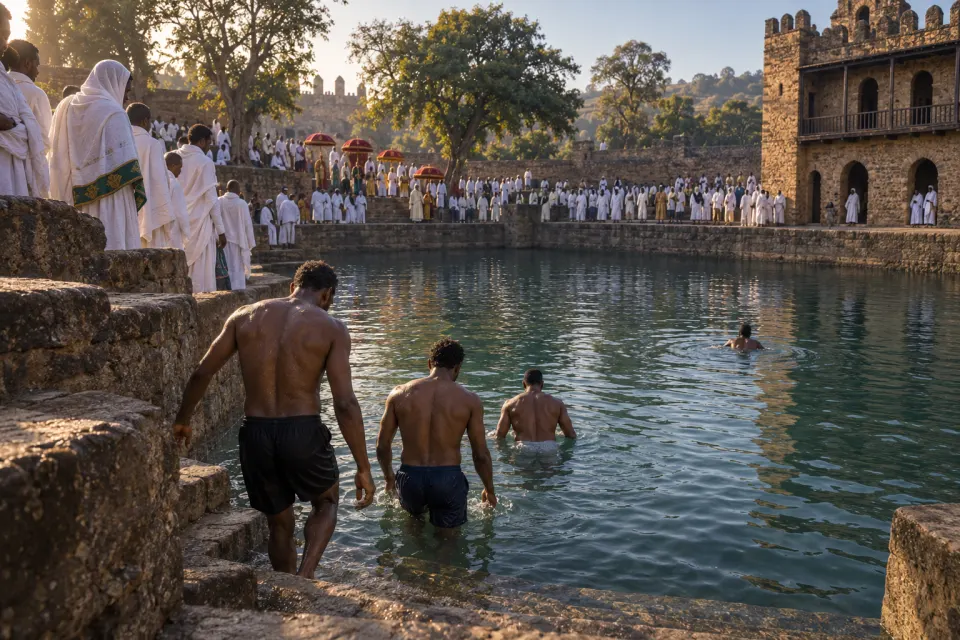
The eve is called Ketera, a word for damming the water ahead of its blessing, and the night is given to prayer and hymns. In every church stands the tabot, a wooden slab that Ethiopian Christians hold to be a copy of the Ark of the Covenant. On the eve each parish escorts its tabot to a pool, river or reservoir, where it stays overnight; in the morning the water is blessed and sprinkled on the congregation, and around ten o'clock each tabot is carried in procession back to its church. Priests lead the processions in colourful vestments, and worshippers wear their finest traditional dress. Hundreds of thousands take part on the main day, and in the large cities main streets are shut for hours as the processions pass.[3–6, 10–11]
Across traditions
Timkat comes twelve days after Genna, the Ethiopian Christmas, which the church keeps on 7 January. The birth and the baptism of Jesus are therefore kept on two separate feasts, in contrast with the Armenian Church, which celebrates them together on 6 January. For Ethiopian Christians, the baptism of Jesus has a feast of its own.[12–13]
Sources
Each statement above was checked against published sources; the verdict says whether it stood as written, was corrected or was hedged.
- VerifiedLibrary of Congress, Fentahun Tiruneh, Epiphany and Timkat in Ethiopia, 4 Corners of the World blog, 19 Jan 2022; Vatican News, News from the Orient, 2026.
- VerifiedEthiopian Orthodox Tewahedo Church, Calendar; UNESCO Intangible Cultural Heritage, Ethiopian epiphany.
- VerifiedUNESCO Intangible Cultural Heritage; Library of Congress, Tiruneh.
- VerifiedLibrary of Congress, Tiruneh; Ethiopian Orthodox Tewahedo Church, Worship in the Ethiopian Orthodox Church.
- VerifiedUNESCO Intangible Cultural Heritage; Vatican News.
- VerifiedUNESCO Intangible Cultural Heritage; Cambridge University Press, Terje Østebø, African Studies Review 66(3), 2023.
- CorrectedEthiopian Orthodox Tewahedo Church, The Ethiopian Orthodox Tewahedo Church; Cambridge University Press, The Cambridge History of Christianity, ch. 19 summary; Encyclopedia.com.
- CorrectedEthiopian Orthodox Tewahedo Church, Hierarchy; Coptic Orthodox Church, Coptic History; Encyclopedia.com.
- CorrectedEthiopian Orthodox Tewahedo Church, Calendar; The Coptic Encyclopedia.
- VerifiedUNESCO Intangible Cultural Heritage; Cambridge University Press, Østebø.
- VerifiedVatican News; Library of Congress, Tiruneh.
- CorrectedEthiopian Orthodox Tewahedo Church, Calendar; Vatican News, Orient news, 10 Jan 2025.
- VerifiedArmenian Diocese of Canada; Mother See of Holy Etchmiadzin.