
Overview
Rastafari is a religious and political movement that arose among poor Black Jamaicans in the early 1930s, after Ras Tafari Makonnen was crowned Emperor Haile Selassie I of Ethiopia. The movement takes its name from his title before the coronation. Many Rastafari regard him as Jah, God made flesh, and as the returned messiah; others honour him as a prophet or a great king. Drawing on the Bible and on older Black nationalist hopes, Rastafari teach that people of African descent live in exile in 'Babylon', an unjust world order, and look to Africa, especially Ethiopia, as Zion. Followers speak of a 'livity', a natural and disciplined way of life marked for many by dreadlocks, ital food and the sacramental use of ganja. Rastafari has no central church. Reggae music carried it far beyond Jamaica.[1, 3, 6, 10–14]
History
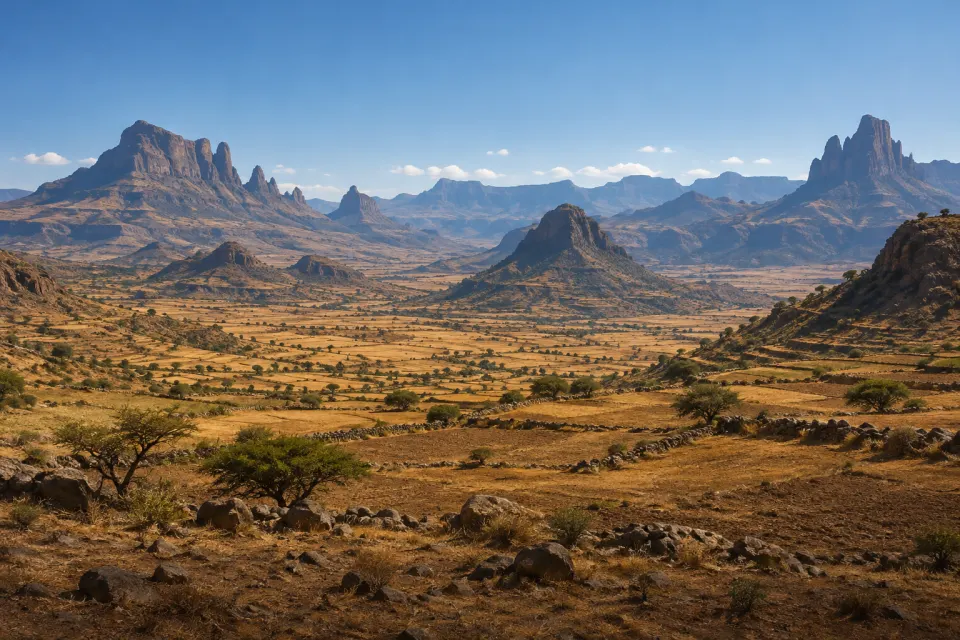
Ethiopia and Garvey 18th century–1920s
Long before Rastafari, Black Christians in the Americas read Psalm 68:31, 'Ethiopia shall soon stretch out her hands unto God', as a promise of freedom. Ethiopia, an ancient Christian kingdom that defeated an Italian army at Adwa in 1896, became a symbol of African dignity. The Jamaican-born Marcus Garvey founded the Universal Negro Improvement Association in 1914 and built a mass movement for Black pride and an independent Black nation in Africa. Rastafari remember Garvey as a prophet and credit him with telling followers to look to Africa for the crowning of a Black king, though his links with the first Rastafari preachers remain obscure.[15–17]
A king crowned, a faith preached 1930–1940
On 2 November 1930 Ras Tafari was crowned in Addis Ababa as Haile Selassie I, 'Might of the Trinity', with the titles King of Kings and Conquering Lion of the Tribe of Judah, and a claimed descent from Solomon and the Queen of Sheba. In Jamaica, then a British colony, several street preachers, among them Leonard Howell, Joseph Hibbert, Archibald Dunkley and Robert Hinds, reached the conclusion independently that the new emperor was divine, reading biblical texts such as Revelation 5. Howell, back from New York in 1932, drew large crowds in St Thomas. The colonial courts convicted him of sedition in 1934 and sent him to prison for two years.[18–20]
Pinnacle and the Dreadlocks 1940–1959
In 1940 Howell bought Pinnacle, a disused estate in the hills of St Catherine, and settled hundreds of followers there as a self-supporting commune that grew food and ganja. Police raided it in 1941 and broke it up in 1954. Meanwhile, younger radicals of the House of Youth Black Faith, active from the late 1940s, made ganja smoking a ritual, grew their hair into locks and developed a defiant speech of their own; 'locksmen' were noticed in Kingston from about 1947. Rastafari faced frequent arrests and public scorn, and in 1959, after a clash at Kingston's Coronation Market, police arrested dozens of Rastafari and forcibly shaved many locksmen.[21–24]
Repression, study and an emperor's visit 1960–1966
In 1960, at the request of Rastafari leaders, three scholars of the University College of the West Indies studied the movement. Their report rejected common slurs and urged a government mission to Africa, which went in 1961. Hostility persisted. Over Easter 1963 a clash at Coral Gardens, near Montego Bay, left eight people dead, including two policemen and three Rastafari; police then rounded up more than 150 bearded men, many of whom were beaten. On 21 April 1966 Haile Selassie arrived at Kingston's Palisadoes airport for a three-day state visit and was met by an enormous crowd. The visit lent the movement a new respectability, and 'liberation before repatriation' became a watchword.[25–28]
Reggae, revolution and a world faith 1967–1990s
Reggae grew out of ska and rock steady in late-1960s Kingston, and by the 1970s artists such as Bob Marley had carried Rastafari themes worldwide; in 2018 UNESCO inscribed the reggae music of Jamaica as intangible cultural heritage of humanity. Jamaican migrants and their children took the faith to Britain and North America, and it reached the wider Caribbean, Africa and beyond. In 1974 Ethiopian soldiers deposed Haile Selassie, and in August 1975 the military government announced his death in custody. Many Rastafari refused to accept that God could die; others came to honour him without calling him God. In the years after the Second World War Selassie had granted land at Shashamane, Ethiopia, to Black supporters abroad, and a few Rastafari settlers arrived there from the 1960s.[29–34]
Recognition and continuing struggles 2000s–today
Jamaica's 2011 census counted 29,026 Rastafari. Since 15 April 2015, an amended Dangerous Drugs Act has allowed Rastafari to use ganja as a sacrament. In 2017 Prime Minister Andrew Holness apologised for Coral Gardens and set up a trust fund for survivors. Locs remain a flashpoint: Jamaica's education ministry told schools as early as 1978 not to turn away Rastafari children over their hair, yet Rastafari still report discrimination in schools and at work. They also report growing acceptance, and Rastafari communities are now found on almost every continent.[35–40]
Key moments
- 1930 CERastafari · Jamaica
Beliefs
Jah and His Majesty
Rastafari call God Jah. Most hold that Haile Selassie was Jah in human form, the messiah returned as king. Beliefs vary by house: the Bobo Shanti speak of a trinity of Selassie, their founder Prince Emmanuel and Marcus Garvey, while many in the Twelve Tribes of Israel look to Jesus Christ and revere Selassie without calling him God.[3–4, 41]
I-and-I
Rastafari often say 'I-and-I' where others say 'we' or 'me'. The phrase expresses the conviction that Jah lives within every person, joining speaker, listener and God in one. It is the heart of a wider way of speaking in which 'I' replaces other sounds in words.[42–43]
Babylon
Babylon names the oppressive order that holds Africa's descendants captive: once the slave plantation and colonial Jamaica, now any unjust system of government, wealth or policing. The image comes from Israel's exile in Babylon, and Rastafari read their own history as a new captivity.[11, 44]
Zion and repatriation
Zion is Ethiopia, and by extension Africa, the true home and seat of Jah. Return to Africa has been a hope since the 1930s. Over time many Rastafari have also come to speak of Zion as a just world to be built wherever they live, and some seek to find Africa in Jamaica itself.[12, 45]
Livity
Livity is the Rastafari way of life: a balanced, natural existence in keeping with Jah. For many it means ital food, uncut hair, simple living and reverence for the herb, but no single code binds everyone, and individuals choose which practices to follow.[13, 46]
Practice

Reasoning
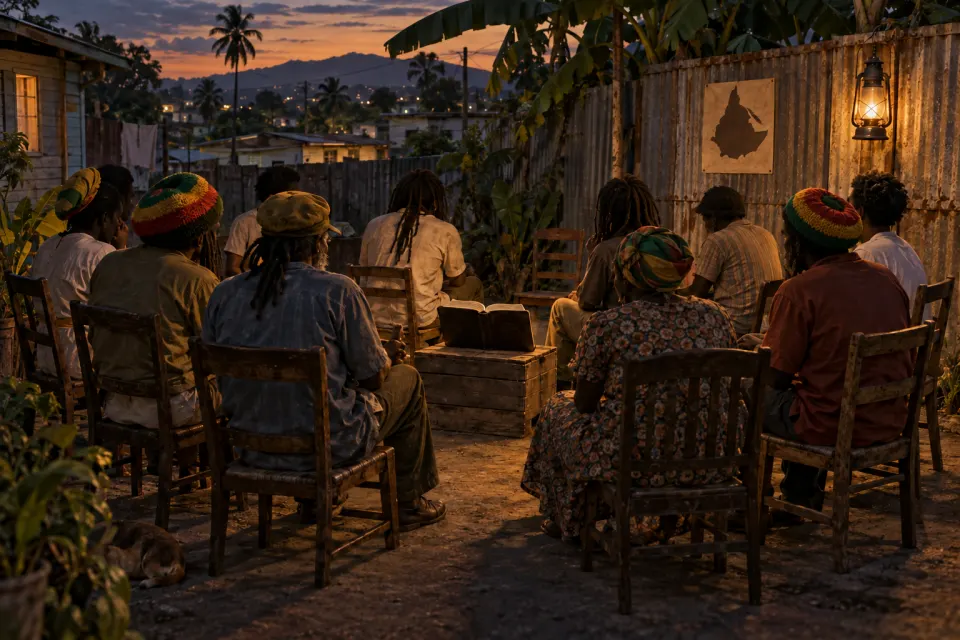
In a reasoning, a small circle gathers to discuss scripture, history, politics and daily life, with no preacher in charge. A chalice or pipe of ganja is usually blessed and passed around. Rastafari see these open exchanges as the way insight into Jah's truth is reached together.[47]
Nyabinghi gatherings · binghi
The Nyabinghi, or binghi, is the great communal ceremony: days and nights of drumming, chanting and prayer that mark the holy dates of the year. Its drumming blends older Afro-Jamaican styles with Christian hymn singing, and it is often held in a round tabernacle on a dedicated ground.[48–49]
Ital food
Ital means vital, natural food. Many Rastafari avoid pork, salt, additives and processed food, and many are vegetarian or vegan, guided by Old Testament food laws and a desire to keep the body pure.[50]
Dreadlocks and the herb
Many Rastafari grow their hair into dreadlocks as a vow, citing the Nazirite law of Numbers 6, and as a mark of African identity and separation from Babylon. Ganja, 'the herb', is smoked as a sacrament that opens the mind to meditation on Jah; Rastafari cite biblical verses about herbs in its support.[51–52]
Women in Rastafari
Early Rastafari was strongly patriarchal. Women were held to Levitical rules on menstruation, kept at the edge of reasonings, and honoured as queens or empresses through their husbands. From the 1970s Rastafari women pushed back, in print and in practice, and some houses now let women elders speak and reason.[53]
Holy days
The year ahead
| Date | Holy day | Reckoned |
|---|---|---|
| 2 November 2026 | Coronation Day | 2 November |
| 7 January 2027 | Ethiopian Christmas | 7 January |
| 21 April 2027 | Groundation Day | 21 April |
| 23 July 2027 | His Majesty's Earthday | 23 July |
| 12 September 2027 | Ethiopian New Year | 1 Mäskäräm, Ethiopian calendar |
Groundation Day
21 April
Marks Haile Selassie's arrival in Jamaica on 21 April 1966, when crowds of Rastafari filled the airport with drums and chanting. It is kept with gatherings and Nyabinghi celebrations.[54]
His Majesty's Earthday
23 July
Haile Selassie's birthday, which Rastafari call his earthday. It is one of the largest celebrations of the year, drawing thousands in Jamaica and crowds at Shashamane in Ethiopia.[55]
Ethiopian Christmas
7 January
Many Rastafari keep Christmas on the Ethiopian Orthodox date rather than 25 December, with Nyabinghi gatherings; one source gives 6 January instead.[56]
People


Leonard Howell
founder · 1898–1981
Often called the first Rasta, Howell preached Selassie's divinity from 1932, wrote The Promised Key and founded Pinnacle. Jailed repeatedly and later confined to a mental hospital, he spent his last years out of the public eye.[59–60]

Prince Emmanuel Charles Edwards
founder
Leader of a 1958 Rastafari convention in Kingston that drew some 3,000 people expecting to sail for Africa. He founded the Ethiopia Africa Black International Congress, the Bobo Shanti, whose members live apart in a commune.[61]
Vernon Carrington (Prophet Gad)
founder · 1935–2005
A Kingston man who began gathering members in 1968 into what became the Twelve Tribes of Israel. Its focus on return to Ethiopia, its middle-class members and its many reggae musicians made it the most international of the mansions.[62]

Bob Marley
other · 1945–1981
The reggae singer from St Ann whose albums with the Wailers made Rastafari known around the world, and who became its best-known voice. He died in 1981, aged 36.[63]
Scripture
The Bible
Rastafari read the King James Bible closely but selectively, holding that slaveholders and translators corrupted parts of it. Favourite books include Psalms, the prophets and Revelation, where they find Selassie's titles foretold.[64]
The Holy Piby
1924
Robert Athlyi Rogers's 'Black Man's Bible', published in Newark, New Jersey. It circulated through the African diaspora, was banned in Jamaica in the 1920s and fed into the teaching of the first Rastafari preachers.[65]
Kebra Nagast · ክብረ ነገሥት
An Ethiopic work that celebrates the Queen of Sheba as an African queen. Rastafari read it alongside the Bible and link it to the descent from Solomon and Sheba claimed by Ethiopia's emperors.[66]
The Promised Key
c. 1935
Leonard Howell's short pamphlet, written as G. G. Maragh, proclaiming Haile Selassie the supreme God. It borrowed from the Holy Piby and other Black nationalist writings of the 1920s.[60]
Places

Pinnacle, St Catherine
JAM
Howell's hilltop commune near Sligoville, between Spanish Town and the hills of St Catherine. Hundreds of early Rastafari lived and farmed there from 1940 until police broke it up in 1954. The coordinates are approximate, from present-day streets built on part of the old estate, not a survey of Howell's house.[21–22]
Palisadoes airport (Norman Manley International), Kingston
JAM
Where Haile Selassie landed on 21 April 1966 to a vast crowd of Rastafari, an arrival remembered every year on Groundation Day.[27, 54]
Shashamane
ETH
A market town south of Addis Ababa, near land the emperor granted to Black supporters abroad. The grant was nationalised in 1975, but a few hundred Rastafari from many countries (estimates range from about 250 to 800, depending on who is asked) still live on the town's edge.[34, 67]
Where it spread
| Region | From | How |
|---|---|---|
| Jamaica | 1932 CE | Arose after Haile Selassie's 1930 coronation; Leonard Howell and others preached in Kingston |
| United Kingdom | 1955 CE | JAM. Caribbean migrants of the Windrush era |
| Ethiopia | 1964 CE | JAM. Shashamane, on land granted by Haile Selassie; settlers from the mid-1960s |
| United States | 1965 CE | JAM. Jamaican migrants, notably in New York |
| Canada | 1970 CE | JAM. Jamaican migrants, mainly in Toronto |
| Ghana | 1970 CE | JAM. Caribbean repatriates, then Ghanaian adherents |
| Trinidad and Tobago | 1970 CE | JAM |
| New Zealand | 1975 CE | Adopted by some Māori, notably at Ruatoria |
| South Africa | 1980 CE | Small groups under apartheid; formally organized in 1997 |
Numbers
- Rastafari worldwide
- c. 700,000 to over 1 million (estimates)[9]
Rough estimates only; there is no worldwide count. One scholar gives 700,000–1,000,000; a Smithsonian curator says more than one million.
- Rastafari in Jamaica, 2011 census
- 29,026 (1.1% of the population)[35, 68]
Up from 24,020 in 2001. About 87% were men. Older scholarly estimates were far higher, at 3–4% of Jamaicans.
- Census counts elsewhere
- E&W 5,948; NZ 1,707; Australia 921[69]
England and Wales 2021, New Zealand 2018, Australia 2021 censuses. Self-identification only; people who also give another religion or none may be missed.
National censuses
| Country | Year | Count | Share |
|---|---|---|---|
| United Kingdom (England and Wales) Other religion: Rastafarian | 2021 | 5,948 | 0.0% |
| Canada Rastafarian | 2021 | 2,110 | 0.0% |
| New Zealand Rastafarianism | 2018 | 1,707 | 0.0% |
| Australia Rastafari | 2021 | 921 | 0.0% |
Source: Australian Bureau of Statistics, Census of Population and Housing 2021, 'Religious affiliation in Australia' (Table 4), CC BY 4.0. Source: Office for National Statistics licensed under the Open Government Licence v.3.0 Adapted from Statistics Canada, Table 98-10-0342-01 Religion by visible minority and generation status: Canada, provinces and territories, census metropolitan areas and census agglomerations with parts, released 2022-10-26. This does not constitute an endorsement by Statistics Canada of this product. Source: Stats NZ, 2018 Census, licensed by Stats NZ for re-use under the Creative Commons Attribution 4.0 International licence.
Common misconceptions
Myth Rastafari is basically reggae music and Bob Marley.
Fact Reggae grew out of Jamaica's music scene in the late 1960s and spread Rastafari ideas around the world, but the faith is older. For three decades before reggae, Rastafari had been building their own drumming, rituals, calendar and theology, and Rastafari elders stress that the faith is not about singing reggae.[70]
Myth Being Rasta means smoking ganja and wearing dreadlocks.
Fact Ganja is a sacrament used in prayer and reasoning, not the point of the faith, and Rastafari themselves complain of this stereotype. Not all Rastafari smoke or wear locks, while locks are now worn by many people who are not Rastafari at all.[46, 71]
Myth Its proper name is 'Rastafarianism'.
Fact Adherents usually say Rastafari, or simply Rasta. 'Rastafarianism' is an outsiders' label, and many adherents also resist calling Rastafari a religion at all, preferring to describe it as a way of life.[72]
Glossary
- Jah
- The Rastafari name for God, often applied to Haile Selassie.[4]
- I-and-I
- 'We' or 'I', expressing the oneness of people with each other and with God within them.[42]
- Livity
- The Rastafari way of life: natural, balanced living in harmony with Jah.[13]
- Ital
- Natural, unprocessed food, usually without pork or salt and often vegetarian.[50]
- Babylon
- The oppressive Western and colonial order that keeps Africa's descendants in exile.[11]
- Zion
- Ethiopia or Africa as the promised homeland; for some, a just world anywhere.[12, 45]
- Mansion
- One of the independent houses or orders of Rastafari, such as the Nyabinghi or Twelve Tribes.[6]
- Nyabinghi
- The mansion led by elders, and its drumming ceremonies. The name reached Jamaica in 1935 through press stories of an African order said to fight white rule.[73–74]
- Reasoning
- A group discussion of scripture and life, usually with a shared chalice.[47]
- Chalice
- The pipe in which ganja is smoked ritually.[75]
- Groundation
- A Rastafari gathering for worship, drumming and reasoning; also spelled grounation.[76]
- Overstand
- Rastafari word for 'understand', one of many reworkings of English, such as 'downpression' for oppression.[43]
- Empress
- A respectful title for a Rastafari woman, especially a wife or mother; men may be called kings.[77]
Sources
Each statement above was checked against published sources; the verdict says whether it stood as written, was corrected or was hedged.
- VerifiedBritannica, Rastafari; Price, The Conversation; Bowker, in Encyclopedia.com; Britannica, Jamaica: Religion.
- VerifiedSmithsonian Ed, Dread History; CAR, in Encyclopedia.com; Chawane NC.
- VerifiedBritannica, Rastafari; Price, The Conversation; Chevannes WC, Encyclopedia.com.
- VerifiedBritannica, Rastafari; Chevannes WC, Encyclopedia.com; Price, The Conversation.
- VerifiedBritannica, Rastafari; Coltri, Postcolonial Interpretation: The Bible in Rastafari, Black Theology; Chawane NC.
- VerifiedBarnett, The many faces of Rasta, Caribbean Quarterly 51; UWI report; Littman WRSP; nybooks.com, The true story of rastafari.
- VerifiedBarnett, Caribbean Quarterly, abstract; Chevannes WC, Encyclopedia.com; Bonacci NWIG.
- VerifiedBritannica, Rastafari; Edmonds, Encyclopedia.com; Bean, I-And-I Vibration, University of Maryland.
- HedgedPrice, The Conversation; Smithsonian Magazine, Rasta Revealed; Littman WRSP.
- VerifiedBritannica, Rastafari; Smithsonian Magazine; Chawane JSR.
- VerifiedBritannica, Rastafari; Edmonds, Encyclopedia.com; Chawane JSR.
- VerifiedBritannica, Rastafari; CAR, Encyclopedia.com; UWI report.
- VerifiedBritannica, Rastafari; Bean, University of Maryland, abstract; nybooks.com, The true story of rastafari (supporting).
- VerifiedBritannica, Rastafari; Edmonds, Encyclopedia.com; Smithsonian Ed.
- VerifiedBritannica, Ethiopianism; Smithsonian Ed.
- VerifiedBritannica, Marcus Garvey; Smithsonian Ed; UWI report.
- HedgedUWI report; Smithsonian Magazine; Britannica Kids, Rastafarianism.
- VerifiedBritannica, Haile Selassie I; Smithsonian Magazine; UWI report.
- VerifiedUWI report; CAR, Encyclopedia.com; Dunkley, NWIG.
- VerifiedDunkley, NWIG; UWI report; nybooks.com, The true story of rastafari (supporting).
- VerifiedUWI report; Dunkley, NWIG; nybooks.com, The true story of rastafari (supporting).
- VerifiedUWI report; Dunkley, NWIG; Edmonds, Encyclopedia.com.
- VerifiedEdmonds, Encyclopedia.com; UWI report; Chevannes AA, Encyclopedia.com.
- VerifiedUWI report; ACIJ / Jamaica Memory Bank; Edmonds, Encyclopedia.com.
- VerifiedUWI report; Edmonds, Encyclopedia.com.
- VerifiedJIS, Statement – PM Holness Apologises for 1963 Coral Gardens Incident; acij-ioj.org.jm, International day commemorating the victims of acts of violence based on religion or belief; US State Dept, IRF Report 2023: Jamaica; Encyclopedia.com, Rastafarianism.
- VerifiedEdmonds, Encyclopedia.com; JIS, Minister Grange Celebrates Rastafari Groundation Day; Price, The Conversation.
- VerifiedEdmonds, Encyclopedia.com; Van Dijk, Jahmaica, Utrecht University dissertation, pp. 3, 128; Littman WRSP (supporting).
- VerifiedBritannica, reggae; UNESCO, Reggae music of Jamaica; Edmonds, Encyclopedia.com.
- Verifiedich.unesco.org; JIS, Minister Grange Leads Successful Inscription of Reggae....
- VerifiedEdmonds, Encyclopedia.com; Price, The Conversation; Smithsonian Ed.
- VerifiedBritannica, Haile Selassie I; Price, The Conversation; Smithsonian Magazine.
- VerifiedPrice, The Conversation; Smithsonian Magazine; Chevannes WC, Encyclopedia.com.
- HedgedBonacci WRSP; Bowker, Encyclopedia.com; Bonacci NWIG.
- VerifiedSTATIN, Population and Housing Census 2011, General Report Vol. 1; US State Dept, IRF Report 2023: Jamaica; Jamaica Gleaner, Religion and the 2011 census.
- VerifiedJIS, Dangerous Drugs; Oxford Human Rights Hub, Dionne Jackson Miller; nybooks.com, The true story of rastafari (supporting).
- VerifiedJIS 2017; acij-ioj.org.jm, International day commemorating the victims of acts of violence based on religion or belief; US State Dept 2023.
- VerifiedJamaica MoEY, Student Dress and Grooming Policy, final draft; US State Dept 2023.
- VerifiedUS State Dept 2023; JIS 2021.
- VerifiedPrice, The Conversation; Edmonds, Encyclopedia.com.
- VerifiedChevannes AA, Encyclopedia.com; Bonacci NWIG; Price, The Conversation.
- VerifiedBritannica, Rastafari; Chevannes WC, Encyclopedia.com; Chawane JSR.
- VerifiedBritannica, Rastafari; Edmonds, Encyclopedia.com.
- VerifiedBritannica, Rastafari; Chevannes AA, Encyclopedia.com; Chawane JSR.
- VerifiedCAR and Bowker, Encyclopedia.com; Van Dijk, Jahmaica, Utrecht University dissertation, pp. 19-20, 119; Chevannes NWIG90, pp. 136-137 of the PDF; Littman WRSP (supporting).
- VerifiedWaldstein, Studying the Body in Rastafari Rituals, Journal for the Study of Religious Experience; UWI report; nybooks.com, The true story of rastafari.
- VerifiedChevannes WC, Encyclopedia.com; Chawane JSR; Bean, abstract.
- VerifiedBritannica, Rastafari; Chevannes WC, Encyclopedia.com; Bean, abstract; Smithsonian Ed.
- VerifiedChawane JSR; Smithsonian Ed, Nyabinghi Tabernacle, Jamaica; nybooks.com, The true story of rastafari.
- VerifiedBritannica, Rastafari; Chevannes WC and Oxford Dictionary of Nursing, Encyclopedia.com; Smithsonian Ed.
- VerifiedUWI report; Smithsonian Ed; Edmonds, Encyclopedia.com; Britannica, Rastafari.
- VerifiedBritannica, Rastafari; Chawane JSR; Oxford Human Rights Hub; UWI report.
- VerifiedChevannes AA, Encyclopedia.com; Middleton, review of Christensen, Religious Studies Review; Britannica, Rastafari.
- CorrectedJIS 2021; Chevannes AA, Encyclopedia.com; Littman WRSP.
- VerifiedBonacci WRSP; Price, The Conversation; Smithsonian Ed; Britannica, Haile Selassie I.
- CorrectedBonacci WRSP; Chevannes AA, Encyclopedia.com; Smithsonian Ed.
- VerifiedBritannica, Haile Selassie I; Smithsonian Magazine.
- VerifiedUWI report; Chawane JSR; Smithsonian Ed.
- VerifiedDunkley, NWIG; UWI report; Edmonds, Encyclopedia.com; nybooks.com, The true story of rastafari.
- HedgedDunkley, NWIG; UWI report; Coltri, Black Theology, abstract.
- VerifiedUWI report; Chevannes WC, Encyclopedia.com.
- VerifiedBonacci NWIG; Chevannes WC, Encyclopedia.com.
- VerifiedBritannica, Bob Marley; Edmonds, Encyclopedia.com.
- VerifiedBritannica, Rastafari; Chawane JSR; UWI report.
- VerifiedSmithsonian Magazine; Dunkley, NWIG; Chawane NC; Schlager, Milestone Documents, abstract.
- VerifiedStinchcomb, Race, Racism, and the Hebrew Bible, Religions 12; Coltri, Black Theology, abstract; Chawane JSR; Smithsonian Ed.
- CorrectedBonacci WRSP; MacLeod, Visions of Zion; Bonacci NWIG; Uhlig, Appleyard & Bausi.
- VerifiedSTATIN 2011 General Report; Chevannes WC, Encyclopedia.com.
- VerifiedONS Census 2021 TS031 via Nomis; Stats NZ 2018 Census totals by topic; ABS, Religious affiliation in Australia, 2021 tables.
- VerifiedSmithsonian Ed; Britannica, reggae; Smithsonian Magazine (supporting).
- VerifiedSmithsonian Magazine; Oxford Human Rights Hub; Britannica, dreadlocks.
- HedgedChawane JSR; Britannica, Rastafari; Smithsonian Ed.
- VerifiedChevannes WC, Encyclopedia.com; Barnett, abstract; Littman WRSP.
- VerifiedUWI report; Smithsonian Ed.
- VerifiedChevannes AA, Encyclopedia.com; JIS 2021; nybooks.com, The true story of rastafari.
- VerifiedChawane JSR; Mitchell, Crucial Issues in Caribbean Religions; Chawane NC (supporting); Littman WRSP.
- VerifiedSmithsonian Magazine; Chevannes AA, Encyclopedia.com.
Last fact-checked 3 October 2026.