
The story behind the day
Groundation Day, 21 April, is a holy day of Rastafari that remembers the state visit of Emperor Haile Selassie I of Ethiopia to Jamaica in April 1966. Rastafari, who regard Haile Selassie as God, gathered in great numbers to meet him at Kingston airport, and the visit is seen as a turning point for a movement that Jamaican society had long shunned. Rastafari have kept the day every year since, and the name is spelled both Groundation and Grounation.[1–5]
Origins
Haile Selassie arrived in Kingston on 21 April 1966 for a three-day state visit. A huge crowd met his plane at Palisadoes Airport; the Jamaican government puts the number at over 100,000, and a scholarly dictionary says that thousands surrounded the aircraft, so that he could not disembark. Rastafari elders, among them Ras Mortimo Planno, were called to help, and they accompanied the emperor from the plane. Some elders were later granted a private audience with him, and they report that he told them to work first for the liberation of Jamaica rather than hurry to Ethiopia.[3, 7–10]
What it marks
Rastafari hold that Haile Selassie is God, whom they name Jah, and for them the visit was a meeting with the one they worship. It also changed the movement's position in Jamaica. Scholars and the Jamaican government both say that the emperor's attention gave Rastafari a degree of recognition and respectability that they had lacked. The visit is called an important moment in the growth of the religion, and one encyclopedia calls it a watershed that opened a new cycle of greater organisation. Afterwards the phrase liberation before repatriation passed into Rastafari speech, and interest in emigrating to Ethiopia seems to have declined.[2, 5, 10–11]
How it came to be and is kept
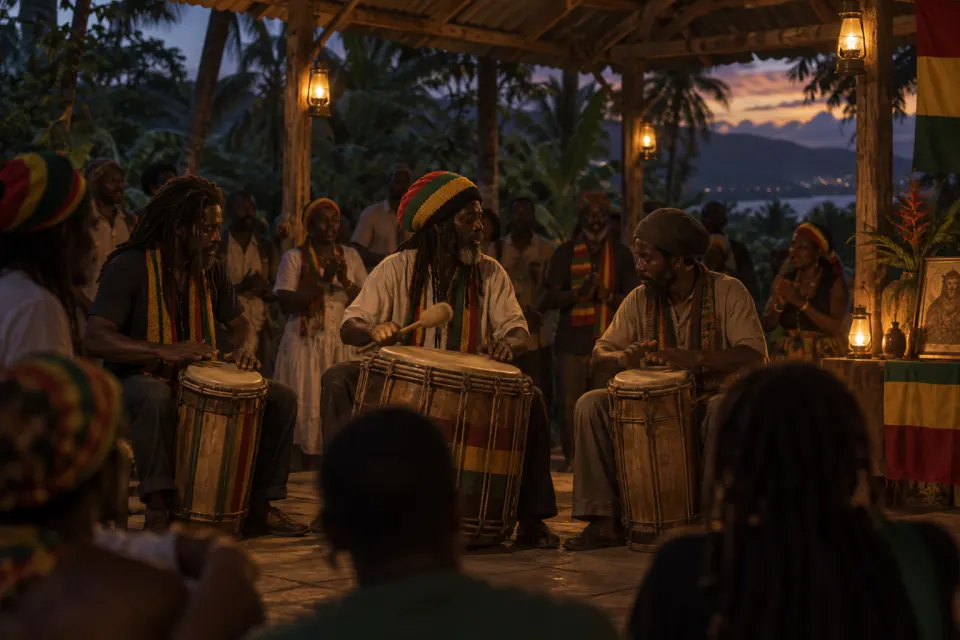
Rastafari have celebrated 21 April every year since 1966, and the day has become a holy day known as Groundation or Grounation Day. It is kept with nyabinghi, a worship ceremony built around music, dance, prayer and prophecy, which is the larger of the two Rastafari drumming rituals. In Rastafari speech the word groundation also names the gathering for worship. The larger celebration, the binghi, lasts several days; its sessions include praise in song, drumming and dance, and reasoning, an informal discussion among a small group.[4, 6, 12–13]
Sources
Each statement above was checked against published sources; the verdict says whether it stood as written, was corrected or was hedged.
- VerifiedJIS 2021; Chevannes, Encyclopedia.com.
- Verifiedscielo.org.za, Scielo; Allen Williams, Encyclopedia.com.
- VerifiedJIS 2021; Chevannes, Encyclopedia.com.
- VerifiedJIS 2021; JIS reggae; scielo.org.za, Scielo.
- VerifiedEncyclopedia.com; JIS 2021.
- CorrectedSalter, Encyclopedia.com; cdamm.org, Rastafari.
- VerifiedEncyclopedia.com, Rastafarianism; JIS reggae.
- CorrectedJIS reggae; CDAMM, Crockford.
- Verifiedcdamm.org, Rastafari; JIS reggae; Edmonds, Encyclopedia.com.
- Verifiedcdamm.org, Rastafari; Encyclopedia.com, Rastafarianism; Allen Williams.
- VerifiedEncyclopedia.com, Rastafarianism; JIS 2021.
- VerifiedJIS reggae; Encyclopedia.com, Rastafarianism.
- Correctedscielo.org.za, Scielo; Chevannes, Rastafarians, Encyclopedia of World Cultures, on the Encyclopedia.com page.