
Overview
Gnosticism is the modern scholarly name for a cluster of Greco-Roman religious movements, most prominent in the 2nd century CE, offering salvation through gnosis, a revealed knowledge of one's own hidden divine origin. Many taught that the visible world was made not by the supreme, transcendent God but by a flawed or hostile lesser power, a demiurge, often identified with the biblical creator; humanity carries a trapped spark of true divine light needing awakening. Most gnostic teachers worked within, or just outside, early Christianity, provoking controversies that helped sharpen orthodox doctrine, covered in a separate profile; its relation to Manichaeism and Mandaeism, also profiled separately, is close but debated. Scholars increasingly question whether "Gnosticism" names one real ancient movement or a modern umbrella over a far more diverse set of teachers and texts.[1–2, 5, 7]
History
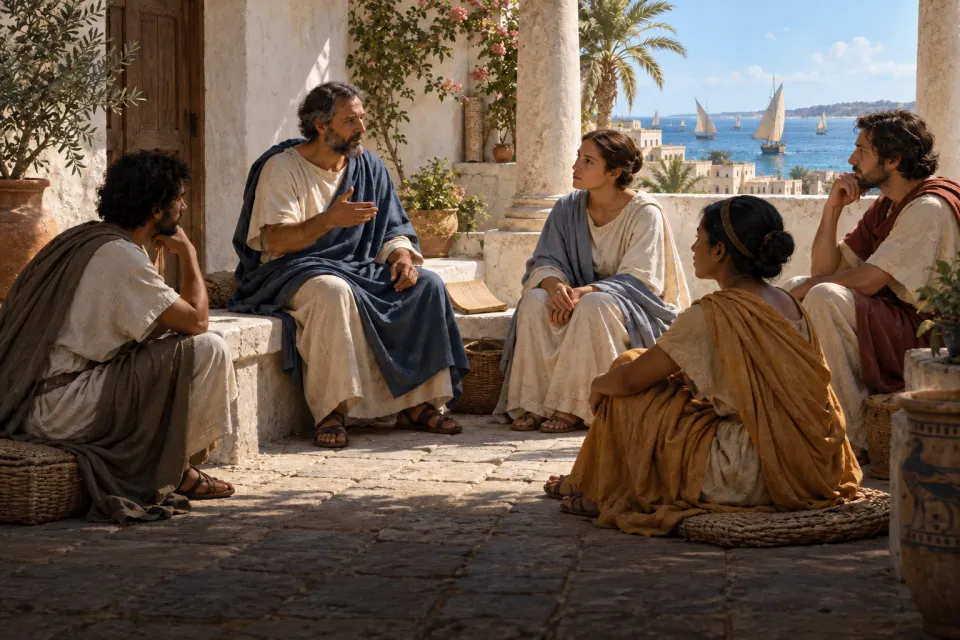
Teachers and sects of the 2nd century c. 100–180 CE
Named gnostic teachers emerge in the historical record from the early 2nd century: the Samaritan Simon Magus and his successors Menander and Saturninus; the Alexandrians Basilides and, above all, Valentinus, whose school produced the era's most intellectually ambitious mythology; and the Pontian Marcion, who rejected the Hebrew Bible's God as distinct from and inferior to the God of Jesus. Alongside named teachers stood sects identified only by name, such as the Sethians, whose mythology centred on the biblical figure Seth.[4, 8–9]
Irenaeus and the heresiologists c. 180–400 CE
The bishop Irenaeus of Lyon's Adversus haereses (c. 180 CE) became the classic hostile source on these teachers, cataloguing and refuting their doctrines; it was studied and expanded for two centuries by other orthodox Christian writers, including Clement of Alexandria, Hippolytus and Epiphanius, whose reports, however polemical, remained virtually the only window onto gnostic teaching until the 20th century.[10–11]
Rediscovered scriptures found 1945; written c. 2nd–4th c. CE
In 1945, twelve codices and part of a thirteenth, containing more than four dozen Coptic translations of mostly 2nd- to 4th-century texts, were discovered near Nag Hammadi in Egypt, including several copies of the Apocryphon of John and the Gospel of Thomas; this find, together with smaller earlier discoveries such as the Berlin Codex, let scholars read gnostic teaching in its own words for the first time, confirming much of what the heresiologists had reported while revealing far greater internal diversity than their hostile summaries suggested.[3, 12]
Decline and legacy 3rd–4th centuries CE and after
Gnostic movements likely remained a minority within early Christianity and faded as an organized Christian-era phenomenon by the 4th and 5th centuries, pressured by an increasingly organized and creedal church; scholars often treat Valentinian teaching and the rise of Manichaeism in the 3rd century as the two most fully developed, independently influential elaborations of gnostic dualism, and some scholars trace the myths and baptismal rites of the modern Mandaean community, which survives today in diaspora, to a continuous late-antique gnostic tradition.[6, 13–14]
Key moments
- 1945 CEThe Nag Hammadi library · Nag Hammadi, Egypt
Beliefs
gnosis · γνῶσις
knowledge
Gnosis was not ordinary factual knowledge but a revealed, saving insight into one's own true origin in the divine realm and the cosmos's hidden structure; in most gnostic teaching, receiving this knowledge, not ethical conduct or ritual alone, was what freed the inner spiritual self from its entrapment in matter.[2]
demiurge
the flawed creator
Many gnostic myths distinguish a supreme, unknowable transcendent God from a lesser creator-god, the demiurge, who fashioned the material world in ignorance or pride; in some versions, such as the Apocryphon of John's Ialdabaoth, he is a dark caricature of the biblical God, while Valentinian teaching presents him as merely misguided rather than evil.[15–16]
pleroma · πλήρωμα
fullness
The pleroma was the hierarchical fullness of the divine realm, populated by aeons, personified aspects of God's nature such as Thought, Wisdom and Life, whose unfolding from unity into plurality, and whose disruption by the fall of the aeon Wisdom (Sophia), set the mythic stage for the material world's flawed creation.[17]
People
Valentinus
teacher · fl. 2nd century CE
A Christian mystic working from a Platonic reading of scripture, Valentinus inspired the most elaborate and widely attested gnostic school; his own followers taught that a demiurge, not malevolent but limited, shaped humanity from soul and matter, while a divine "seed" placed secretly within could mature, through instruction, toward reunion with the pleroma after death.[4, 18]
Marcion of Sinope
teacher · b. c. 110 CE
Marcion taught that the father of Jesus Christ was wholly distinct from, and superior to, the stern creator-God of the Hebrew Bible, offering salvation as an act of pure grace; because he lacked any myth of a divine race descended into matter, scholars often treat his teaching as only a relative of gnosticism proper rather than a central example of it.[9, 19]
Irenaeus of Lyon
scholar · c. 130–202 CE
A Christian bishop whose five-volume Adversus haereses catalogued and refuted the teachers later grouped as gnostic, Irenaeus is the single most influential ancient source on the movement, even though his accounts are openly polemical and sometimes blur distinct sects together under one hostile label.[10–11]
Scripture
Apocryphon of John
2nd century CE (copies 4th century)
Surviving in three Nag Hammadi copies and a fourth in the Berlin Codex, this text presents itself as a secret revelation from Jesus to the apostle John, describing the divine pleroma's emergence, the fall of the aeon Wisdom, and the flawed creator Ialdabaoth's fashioning of the material world and of Adam; it closely matches a myth Irenaeus had already summarized a century before its rediscovery.[12, 15]
Adversus haereses
c. 180 CE
Irenaeus of Lyon's refutation of rival Christian teachers remained, until the 20th century, the principal source on gnostic doctrine for most scholars, since so little original gnostic writing had survived independently of its hostile summaries.[10]
Places

Nag Hammadi
EGY
A cache of thirteen 4th-century Coptic codices, containing more than four dozen texts including multiple gnostic scriptures, was found near this Upper Egyptian town in 1945, transforming scholarly access to gnostic teaching from hostile summary to original text.[3]
Common misconceptions
Myth "Gnosticism" was a single, unified ancient religion with one doctrine.
Fact The groups modern scholars call gnostic varied enormously: Valentinian teaching made its demiurge merely limited rather than evil, Marcion had no myth of a divine race at all, and some popularly "gnostic" texts, such as the Gospel of Thomas, contain no creation myth whatsoever; even whether some of these groups ever called themselves "gnostic" is uncertain, and many scholars now treat the category as a useful but imperfect modern label rather than a description of one ancient movement.[5, 19]
Myth Everything known about gnostic belief comes from the Nag Hammadi scriptures found in 1945.
Fact Before 1945, scholars already possessed a detailed, if hostile, picture of many gnostic teachings through Irenaeus and later heresiologists, whose reports the Nag Hammadi texts have mostly confirmed and enriched rather than overturned; the 1945 find is transformative chiefly because it lets these movements speak for themselves for the first time, not because nothing was known beforehand.[10, 12]
Glossary
- gnosis
- Revealed, saving knowledge of one's own true origin in the divine realm, central to most teachings modern scholars call gnostic.[2]
- demiurge
- A lesser, flawed or ignorant creator-god distinguished from the supreme, transcendent God in most gnostic myths.[15]
- pleroma
- The 'fullness' of the divine realm, populated by personified aeons emanating from the transcendent God.[17]
- aeon
- A personified aspect or faculty of the divine (such as Wisdom or Life) inhabiting the pleroma.[17]
- Sophia
- The aeon whose unauthorized striving outside the pleroma, in most gnostic myths, triggers the creation of the flawed material world.[15]
- Sethian
- A modern label for a cluster of gnostic texts and myths centred on the biblical figure Seth as ancestor of a spiritually enlightened race.[8]
- Nag Hammadi library
- A cache of 4th-century Coptic codices discovered in Egypt in 1945, containing the largest surviving collection of original gnostic texts.[3]
- heresiologist
- An orthodox Christian writer, such as Irenaeus, who catalogued and refuted teachings judged heretical, including those later called gnostic.[10]
Sources
Each statement above was checked against published sources; the verdict says whether it stood as written, was corrected or was hedged.
- VerifiedBritannica, gnosticism; Encyclopedia of Religion.
- VerifiedBritannica, gnosticism; Encyclopedia of Religion.
- VerifiedBritannica, gnosticism; Encyclopedia of Religion.
- VerifiedBritannica, gnosticism; Encyclopedia of Religion.
- CorrectedBritannica, gnosticism; Encyclopedia of Religion.
- VerifiedBritannica, gnosticism; Encyclopedia of Religion.
- VerifiedBritannica, gnosticism; Encyclopedia of Religion.
- CorrectedBritannica, gnosticism; Encyclopedia of Religion.
- VerifiedBritannica, gnosticism; Encyclopedia of Religion.
- VerifiedBritannica, gnosticism; Encyclopedia of Religion.
- VerifiedBritannica, gnosticism; Encyclopedia of Religion.
- VerifiedBritannica, gnosticism; Encyclopedia of Religion.
- VerifiedBritannica, gnosticism; Encyclopedia of Religion.
- VerifiedEncyclopedia of Religion; Britannica, gnosticism.
- VerifiedBritannica, gnosticism; Encyclopedia of Religion.
- VerifiedBritannica, gnosticism; Encyclopedia of Religion.
- VerifiedBritannica, gnosticism; Encyclopedia of Religion.
- VerifiedBritannica, gnosticism; Encyclopedia of Religion.
- VerifiedBritannica, gnosticism; Encyclopedia of Religion.
Last fact-checked 4 October 2026.