
Overview
Ancient Greek religion was the worship of the gods among Greek-speaking peoples from the Bronze Age until Christian emperors outlawed public pagan cult in the 390s CE. It had no founder, creed or holy book, and Greek had no single word for religion; piety meant giving the right gods their due in the right way. Every city honoured Zeus, Athena, Apollo and many other gods, with heroes and local spirits, chiefly through animal sacrifice at outdoor altars, libations, prayer and gifts. Priests and priestesses were usually ordinary citizens caring for one shrine. Poets such as Homer and Hesiod shaped how Greeks pictured the gods, but never as binding doctrine. Great sanctuaries such as Delphi and Olympia drew worshippers from the whole Greek world.[1–7, 10–12]
History
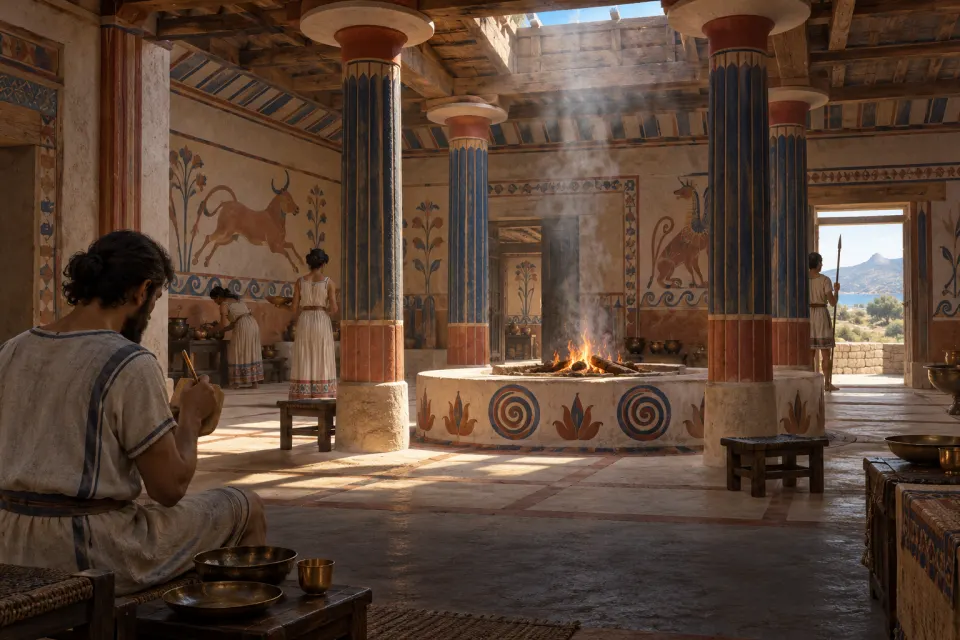
Gods of the Mycenaean palaces c. 1400 – 1100 BCE
The oldest written names of Greek gods are on Linear B clay tablets, kept by palace scribes at Knossos, Pylos and elsewhere between about 1400 and 1200 BCE and shown in 1952 to record early Greek; most survive because the fires that destroyed the palaces baked them. These accounts list offerings, not beliefs: one Pylos tablet assigns gold vessels to Zeus, Hera, Hermes, a goddess called Potnia ("Lady") and others. Dionysos appears too, though scholars had long thought him a later arrival. Some sacred places outlived the palaces, but whether their cults continued is debated.[13–16]
Cities, sanctuaries and poets c. 900 – 500 BCE
As independent city-states (poleis) took shape, each organised the worship of its own gods and kept its own festivals. Apollo's oracle at Delphi grew up between the late 9th and 8th centuries BCE, and Olympia, a centre of Zeus's cult from as early as the 11th–10th century BCE, traditionally held its first games in 776 BCE. From the 8th century Greeks honoured heroes at old Bronze Age tombs, and by about 600 BCE temples of wood and mud brick were being rebuilt in stone. Homer's epics and Hesiod's Theogony gave the gods shared personalities, a home on Olympus and a family tree.[17–22]
Classical Athens and its critics c. 500 – 323 BCE
Athens is the best-documented city. After defeating Persia it rebuilt the Acropolis, raising the Parthenon for Athena in 447–432 BCE, and staged its tragedies and comedies at festivals of Dionysos. Meanwhile thinkers questioned the poets' gods. Xenophanes, active in the 6th century BCE, objected that Homer and Hesiod credited the gods with theft and adultery, and joked that oxen able to draw would draw ox-shaped gods. In 399 BCE an Athenian jury condemned Socrates for impiety, charged with rejecting the city's gods, introducing new divinities and corrupting the young; he died by drinking hemlock.[23–26]
Kings, mysteries and Rome 323 BCE – 312 CE
After Alexander's conquests Greek cults spread from Spain to the Indus, and Delphi's influence reached Bactria. Mystery cults offering a personal bond with a god flourished, and Egypt's Isis and Serapis spread widely in Greek form. Rome matched its gods to the Greek ones, Jupiter to Zeus and Juno to Hera. Roman rule brought plunder and patronage alike: Nero carried off statues from Delphi, while emperors such as Augustus and Hadrian funded building in Greek sanctuaries.[27–30]
A slow ending 361 – c. 600 CE
The emperor Julian (361–363) turned from Christianity back to the old gods, and the last recorded consultation of the Delphic oracle came in his reign, but his revival died with him. In 391–392 Theodosius I banned sacrifice, closed the temples and forbade even household cult; Goths under Alaric destroyed Eleusis in 395. The Olympic festival traditionally ended in 393 but may have lasted into the 5th century. Many temples, the Parthenon among them, became churches. Country cult held on longer: in the 540s John of Ephesus claimed over 70,000 baptisms of pagans in Asia Minor.[31–36]
Ruins and revival 19th century – today
Excavations over the past 150 years, beginning at Delos in 1872 and Delphi in 1892, uncovered the great sanctuaries, now the main evidence for how Greeks worshipped. A separate modern movement reveres the ancient Hellenic gods; scholars describe it as a revitalisation claiming indigenous roots, not an unbroken survival. In 2017 the Greek state licensed its first house of prayer in Athens, for the Supreme Council of Ethnikoi Hellenes (YSEE), giving Hellenic Ethnic Religion the legal standing of a known religion.[37–38]
Key moments
- 776 BCEGames for Zeus at Olympia · Olympia, Greece
- 447 BCEThe Parthenon · Acropolis, Athens
- 399 BCESocrates tried for impiety · Athens
Beliefs
Theoi · θεοί
gods
Greeks pictured their gods as deathless beings in human form, each with a character and a sphere such as the sea, war or the harvest. Twelve chief gods were said to live on Olympus, but a city might honour hundreds, and one god had many titles: on the Acropolis Athena was revered as city-guardian, warrior, bringer of victory and patron of crafts.[39–40]
Timē · τιμή
honour
Worship was an exchange. People honoured the gods with sacrifice, gifts and festivals, hoping in return for fertile fields and herds, wealth, health and safety in war and at sea. The gods wanted respect rather than love, rather as a good king might from his subjects.[41]
Eusebeia · εὐσέβεια
piety
Piety lay in correct practice more than correct belief. There was no creed and no authority enforcing orthodoxy, and myths were told in many versions. Yet openly denying the gods was risky: Athens could prosecute impiety (asebeia), as Socrates' trial showed.[42]
Hērōs · ἥρως
hero
Heroes were the powerful dead, between gods and humans, often legendary warriors or city founders. Each was usually honoured at a tomb, real or supposed, and his power was bound to that spot, so colonists could take their gods abroad but not their heroes.[43]
Purity and pollution
Sex, birth, death and killing left a person ritually unclean for a time, a physical rather than moral stain. The polluted stayed out of sanctuaries until cleansed by washing, time or rites, and worshippers sprinkled themselves from a basin at the gate.[44]
Practice
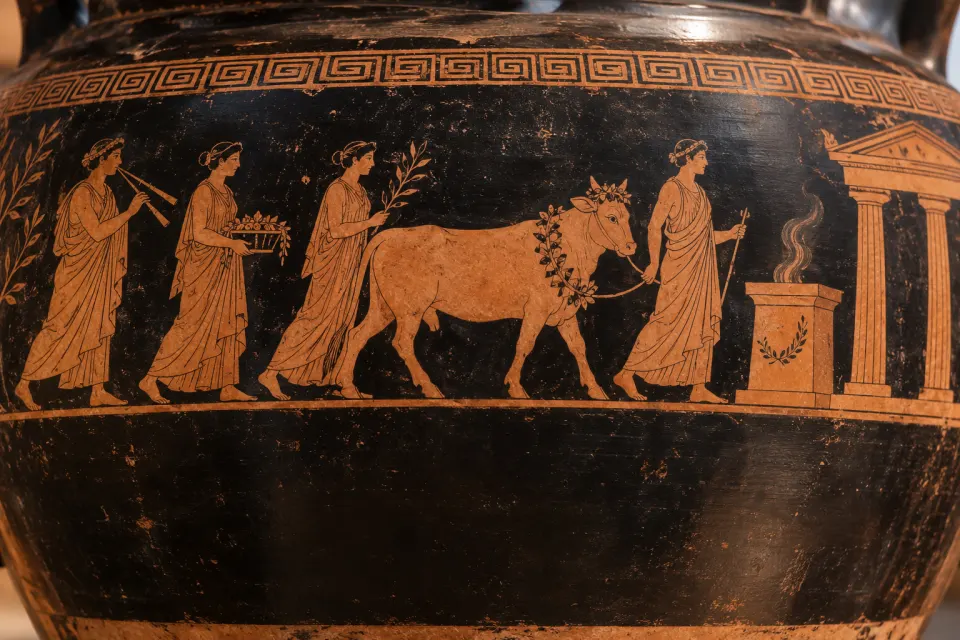
Sacrifice
Animal sacrifice was the central rite. A procession led cattle, sheep, goats or pigs to the altar; after washing, a hymn and a prayer, the victim was killed, the thigh bones wrapped in fat were burnt so the smoke rose to the god, and the meat was cooked for a shared feast. Cakes and other bloodless gifts were offered too. Human sacrifice belongs to myth and scandal, not regular practice.[45–46]
Libation, prayer and hymn
Wine, oil, water, milk or honey were poured out for the gods on altars, into the ground or at meals. Prayers were spoken aloud, often by the priest for all present, standing with arms raised and palms up, and choirs sang hymns as gifts in themselves.[47]
Votive offerings
Anyone could vow a god a gift in return for help and pay it once the prayer was answered. Sanctuaries filled with offerings, from clay figurines by the thousand to bronze tripods, statues and treasuries built by cities. Given gifts belonged to the god, so broken ones were buried in the sanctuary, where archaeologists find them.[48]
Oracles and divination
Cities and individuals asked the gods about war, pollution, release from misfortune, colonies and, above all, cult. At Delphi an enquirer paid a fee and sacrificed, and attendants shaped the prophetess's words into Apollo's reply. At Zeus's oracle at Dodona questions were scratched on lead, and seers read birds, dreams and entrails.[49–50]
Mysteries · μυστήρια
Some cults admitted only initiates sworn to secrecy. At Eleusis, Demeter's Mysteries began with purification and ended in a night-long rite, after which initiates hoped for a better lot after death. Bacchic mysteries of Dionysos drew on poems credited to Orpheus, and some initiates were buried with gold leaves instructing them for the underworld (Orphism has its own entry).[51–52]
Holy days
Panathenaia · Παναθήναια
Midsummer in Athens (c. August); grander every fourth year
Athens' festival for its patron goddess. A great procession climbed to the Acropolis, her old wooden image received a newly woven robe, many animals were sacrificed, and contests in athletics, music and reciting Homer followed.[53]
City Dionysia · Διονύσια
Elaphebolion (around March)
Athens' spring festival of Dionysos: a procession brought animals for sacrifice, the god's image was escorted to his theatre, and the city watched competitions in tragedy and comedy.[54]
Thesmophoria · Θεσμοφόρια
Pyanopsion (autumn, c. October), before sowing
A women-only festival of Demeter kept across the Greek world. For three days women, apparently married citizens, met apart from men, fasting on the middle day; rotted remains of piglets thrown into pits were mixed with seed corn to help the crop.[55]
Eleusinian Mysteries
Boedromion (September – October)
The Greater Mysteries opened in Athens with a bath in the sea and a fast; initiates then walked the Sacred Way, some 21 km, to Eleusis for the secret night rites.[56]
People
Zeus · Ζεύς
deity
God of the sky and weather and father of the gods; the oak and the ox were sacred to him. His name comes from an Indo-European sky god, matching Sanskrit Dyaus and Latin Jupiter, and is already on Linear B tablets. His greatest sanctuary was Olympia.[57–58]
Athena · Ἀθηνᾶ
deity
Armed patron goddess of Athens and protector of weaving and carpentry, whose emblems were the owl and the olive. At the Panathenaia her ancient wooden image received a new robe; even after Phidias made a gold-and-ivory statue for the Parthenon, most worship still went to the old figure.[59–60]
Apollo · Ἀπόλλων
deity
God of music, prophecy and healing, often shown with a lyre. By myth he was born on Delos and killed the serpent Python at Delphi to take over its oracle, the most important in Greece.[61]
Demeter · Δημήτηρ
deity
Goddess of grain and the fertile earth. The Homeric Hymn to Demeter tells how Hades seized her daughter Kore (Persephone) and how Demeter withheld the crops until Zeus let Kore return for part of each year, a story behind the Eleusinian Mysteries and the Thesmophoria.[62]
The Pythia · Πυθία
other
Apollo's prophetess at Delphi, an ordinary Delphian woman who served for life and stayed chaste. Purified at the Castalian spring, she sat on a tripod in the inner shrine and spoke as the god possessed her. Whether vapours from the ground played a part is still argued.[64–65]
Scripture
The Homeric Hymns
mostly 7th – 6th century BCE
Thirty-three poems in epic metre honouring gods, credited in antiquity to Homer but of varied date and authorship. The longer ones narrate myths, such as Demeter's search for her daughter and the founding of Apollo's shrines at Delos and Delphi.[66]
Theogony
c. 700 BCE
Hesiod's poem on the birth of the world and the generations of the gods, from Chaos to the reign of Zeus. It also tells how Prometheus tricked Zeus into taking the bones and fat of sacrifice, explaining why humans keep the meat.[67]
Iliad and Odyssey
c. 8th century BCE
Homer's epics, probably composed around the 8th century BCE, became the backbone of Greek education. They show gods taking sides in human affairs and describe prayer and sacrifice, but they are poetry, not a rulebook for cult.[68]
Places
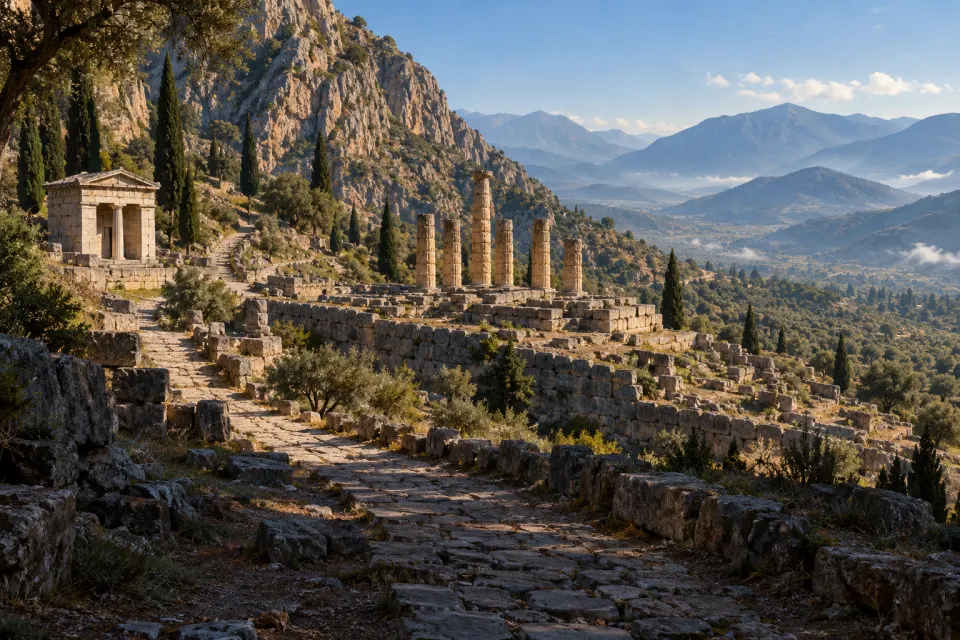
Delphi
GRC · UNESCO World Heritage, 1987
Apollo's sanctuary on Mount Parnassus, seat of the foremost oracle and the Pythian Games. Greeks saw it as the centre of the world, marked by the omphalos stone; cities lined its Sacred Way with treasuries.[69]
Olympia
GRC · UNESCO World Heritage, 1989
Zeus's sanctuary, the Altis, beside the Alpheios in the western Peloponnese and home of the Olympic Games; a major cult centre from as early as the 11th–10th century BCE to the 4th century CE.[70]
Acropolis of Athens
GRC · UNESCO World Heritage, 1987
Athens' citadel, sacred to Athena from the 8th century BCE, crowned in the 5th century BCE by the Parthenon, the Erechtheion and the temple of Athena Nike.[71]
Eleusis
GRC
Demeter's sanctuary about 22 km west of Athens, home of the Mysteries. Its hall of initiation, the Telesterion, was rebuilt in the 5th century BCE to hold thousands of initiates.[72]
Delos
GRC · UNESCO World Heritage, 1990
Cycladic island held to be the birthplace of Apollo and Artemis. To keep it pure, Athens removed all graves in 426/5 BCE and ruled that no one might be born or die there.[73]
Epidauros
GRC · UNESCO World Heritage, 1988
Chief sanctuary of the healing god Asclepius, where the sick slept in a special hall hoping the god would cure them or prescribe a remedy in a dream.[74]
Where it spread
| Region | From | How |
|---|---|---|
| Cyprus | 800 BCE – 400 CE | Greek city-kingdoms such as Paphos and Salamis |
| Greece | 800 BCE – 400 CE | Olympian cults, Delphi and Delos; public pagan worship was banned by Theodosius I in 391–392 |
| Turkey | 800 BCE – 400 CE | Ionian cities such as Miletus and Ephesus; later Sinope |
| Italy | 750 BCE – 400 CE | GRC. Cumae and Syracuse, then the cities of Magna Graecia |
| Libya | 630 BCE – 400 CE | GRC. Cyrene, founded from Thera, with its sanctuary of Apollo |
| Albania | 625 BCE – 400 CE | GRC. Epidamnus (Durrës) |
| Egypt | 620 BCE – 400 CE | Naukratis in the Delta, then Ptolemaic Alexandria |
| France | 600 BCE – 400 CE | TUR. Massalia (Marseille), founded by Phocaeans |
| Romania | 600 BCE – 400 CE | TUR. Tomis (Constanța) and other Black Sea colonies |
| Spain | 575 BCE – 400 CE | FRA. Emporion (Empúries) |
| Bulgaria | 550 BCE – 400 CE | Mesembria (Nesebar) on the Black Sea |
| Ukraine | 550 BCE – 400 CE | TUR. Olbia; Chersonesus and Panticapaeum in Crimea |
| Afghanistan | 300 BCE – 130 BCE | GRC. Ai Khanoum on the Oxus, a Greco-Bactrian city |
| Iraq | 300 BCE – 170 CE | GRC. Seleucia on the Tigris, until its destruction in 165 |
| Syria | 300 BCE – 400 CE | GRC. Seleucid cities such as Dura-Europos |
Art & objects
Public-domain objects from museum collections. Select one to see it at the museum.
 Figure of a Youth from a Funerary Stele (Monument)Greece, about 380 BCE
 Head of a KoreGreece, Amorgos, c. 480–460 BCE
 Black-Gloss Mesomphalic Phiale (Libation Bowl): Apotheosis of HeraklesSouth Italian, Campanian (Calenian), 200s BCE
 Head of a SphinxGreece, Archaic period, 540–520 BCE
 The Cleveland Apollo: Apollo Sauroktonos (Lizard-Slayer) or Apollo the Python-SlayerGreece, Athens, c. 350–200 BCE
 Votive Plaque (Pinax) with Persephone Making her Bridal BedWest Greek / South Italian, Locri Epizephirii, c. 490–450 BCE
 Bronze statuette of ApolloGreek, Classical, ca. 500 BCE
 Bronze statuette of Zeus or PoseidonGreek, Archaic, early 5th century BCE
 Two gutti from a group of fragments from the Temple of Apollo at Phigaleia (Bassae)Greek, Arcadian, Classical, 5th century BCE
 Lead figure of a goddess with an aegis, probably AthenaGreek, Laconian, Archaic, 6th–5th century BCE
 Marble column from the Temple of Artemis at SardisGreek, Hellenistic, ca. 300 BCE
 Bronze statuette of Athena flying her owlGreek, Classical, ca. 460 BCE
 Marble votive relief dedicated to a heroGreek, Attic, Late Classical, late 4th century BCE
 Marble fragment of a votive relief with AthenaGreek, Attic, Classical, ca. 405–390 BCE
How we know
Sanctuaries and inscriptions
Most of what we know comes from excavated sanctuaries such as Delphi, Olympia and Delos, and from inscriptions: sacred laws on priesthoods and sacrifice, festival calendars, temple accounts and dedications naming giver and god. Masses of cheap figurines suggest worship reached far beyond the wealthy. Objects rarely reveal belief, though, and Linear B tablets are terse lists of offerings.[13, 75–76]
Images and literature
Vase paintings, reliefs and statues show sacrifices, processions and gods; the Parthenon frieze depicts Athena's festival procession. Literature, from Homer to the travel writer Pausanias, is rich but partial: poets reshaped myths, many oracles quoted by ancient authors look composed after the event, and most details of the secret mysteries come from hostile Christian writers.[77–78]
Myth and cult
Scholars separate stories told about gods from worship actually paid to them. A useful test is the altar: a deity with altars and offerings belonged to practised religion, while a figure known only from poems or folktales may never have been worshipped.[79]
Common misconceptions
Myth Greek myths were the Greek Bible, a sacred scripture that believers had to accept.
Fact The Greeks had no scripture, creed or church authority. Myths existed in many versions, poets and playwrights changed them, and philosophers attacked them. What mattered was ritual: honouring the gods with sacrifice, gifts and festivals, not affirming a text.[80]
Myth Greek temples were halls where congregations gathered to worship, like churches or mosques.
Fact The heart of a sanctuary was its altar, outdoors in front of the temple, where sacrifice and communal prayer took place. The temple housed the god's statue and precious offerings, more shrine and treasury than meeting hall, and many sanctuaries had no temple at all.[81]
Myth Greek religion ended at once when the Roman Empire became Christian.
Fact The change took centuries. The decisive bans on sacrifice and temples came only in 391–392, and old practice still lingered: the Olympic festival may have outlived them, and in the 540s a missionary bishop found tens of thousands of pagans to baptise in Asia Minor.[82]
Glossary
- Temenos · τέμενος
- A sacred precinct set apart as a god's property, marked by boundary stones or a wall and containing at least an altar.[83]
- Asebeia · ἀσέβεια
- Impiety, an offence Athens could prosecute; Socrates was condemned for it. Its opposite, eusebeia, is piety.[84]
- Perirrhanterion · περιρραντήριον
- A basin of water at a sanctuary entrance, from which worshippers sprinkled themselves before approaching the gods.[44]
- Mystēs · μύστης
- An initiate of a mystery cult (plural mystai). At Eleusis an initiate could return a year later for the higher grade of epoptēs, a watcher.[85]
- Telesterion · τελεστήριον
- The hall of initiation at Eleusis, where the secret central rites of the Mysteries took place.[86]
- Panhellenic
- Shared by all Greeks: used of the great sanctuaries and four-yearly festivals at Olympia, Delphi, Isthmia and Nemea.[87]
- Omphalos · ὀμφαλός
- The navel stone at Delphi marking the centre of the world, where by myth two eagles released by Zeus met.[88]
- Incubation
- Sleeping in a sanctuary in hope of a healing or revealing dream, above all at sanctuaries of Asclepius.[89]
Sources
Each statement above was checked against published sources; the verdict says whether it stood as written, was corrected or was hedged.
- VerifiedT. G. Palaima, Linear B Sources, in Trzaskoma et al., Anthology of Classical Myth; Britannica, Linear B; OCD Miles; New Catholic Encyclopedia, Theodosius I via Encyclopedia.com.
- VerifiedThe Met; Brit GR; catalogimages.wiley.com.
- VerifiedThe Met; UNESCO, Archaeological Site of Olympia; Brit GR-hist; OCD, E. Kearns, hero-cult.
- VerifiedThe Met; Brit GR-prac; Brit GR; OCD, J. S. Clay, Hesiod.
- VerifiedThe Met; catalogimages.wiley.com; OCD Miles.
- VerifiedBrit GR-hist; catalogimages.wiley.com; OCD Miles.
- VerifiedThe Met; OCD Miles.
- VerifiedOCD Miles; Brit GR; Brit GR-hist.
- VerifiedUS Department of State, 2017 Report on International Religious Freedom: Greece; E. Fotiou, Transreligiosity and Religious Revitalization in Modern Greece, Religions 14.
- VerifiedBrit GR; OCD, E. Kearns, religion, Greek.
- VerifiedBrit GR; OCD Kearns, religion, Greek; The Met.
- VerifiedThe Met; UNESCO, Archaeological Site of Delphi; OCD Miles.
- Verifiedsites.utexas.edu; Britannica, Linear B; Met, Mycenaean Civilization.
- VerifiedR. D. Woodard, Further Thoughts on Linear B po-re-na…, Center for Hellenic Studies, Harvard; sites.utexas.edu.
- Verifiedsites.utexas.edu; Brit GR-hist.
- VerifiedOCD Miles; catalogimages.wiley.com; Graf ER.
- VerifiedBrit GR; OCD Miles.
- VerifiedOCD Scott; UNESCO, Delphi; Britannica, Delphi.
- CorrectedUNESCO, Olympia; Britannica, Olympic Games; Oxford University Press academic reference; Penn Museum (supporting).
- VerifiedOCD Kearns, hero-cult; Arts and Humanities Through the Eras.
- VerifiedBrit GR-prac; OCD Miles.
- VerifiedBrit GR; OCD Clay, Hesiod; The Met.
- VerifiedUNESCO, Acropolis, Athens; Britannica, Parthenon.
- VerifiedOCD, R. Seaford, Dionysia; Brit GR-prac.
- VerifiedStanford Encyclopedia of Philosophy, Xenophanes; Internet Encyclopedia of Philosophy, Xenophanes.
- VerifiedStanford Encyclopedia of Philosophy, Socrates; Internet Encyclopedia of Philosophy, Socrates.
- VerifiedBrit GR; UNESCO, Delphi; OCD Miles.
- VerifiedBrit GR-hist; Oxford Dictionary of Phrase and Fable, Serapis, via Encyclopedia.com; Graf ER.
- VerifiedBrit GR; Myths and Legends of the World.
- VerifiedOCD Miles; Britannica, Delphi; UNESCO, Delphi.
- VerifiedBritannica, Julian; OCD Scott; New Catholic Encyclopedia, Delphi, Oracle of, via Encyclopedia.com.
- VerifiedNew Catholic Encyclopedia, Theodosius I; OCD Miles; Britannica, Delphi.
- VerifiedBritannica, Eleusis; Graf ER.
- HedgedUNESCO, Olympia; Penn Museum; BMCR 2016.04.11, review of S. Remijsen, The End of Greek Athletics in Late Antiquity.
- VerifiedOCD Miles; Britannica, Parthenon.
- VerifiedBritannica, John of Ephesus; New Catholic Encyclopedia, John of Ephesus, via Encyclopedia.com.
- VerifiedOCD Miles; UNESCO, Delos; Britannica, Delphi.
- VerifiedUS State Dept 2017 report; mdpi.com.
- VerifiedBrit GR; The Met; catalogimages.wiley.com.
- VerifiedThe Met; catalogimages.wiley.com; UNESCO, Acropolis.
- Verifiedcatalogimages.wiley.com; The Met; Brit GR.
- VerifiedBrit GR; OCD Kearns, religion, Greek; Stanford Encyclopedia, Socrates.
- VerifiedOCD Kearns, hero-cult; Brit GR-hist; Gale, Heroes and Demigods.
- Verifiedcatalogimages.wiley.com; OCD Miles.
- VerifiedThe Met; OCD Miles; catalogimages.wiley.com.
- Verifiedcatalogimages.wiley.com; Brit GR-prac.
- VerifiedOCD Miles; catalogimages.wiley.com; Brit GR-prac; The Met.
- Verifiedcatalogimages.wiley.com; OCD Miles; The Met.
- CorrectedOCD Scott; Britannica, Delphi; New Catholic Encyclopedia, Delphi, Oracle of.
- VerifiedOCD Scott; New Catholic Encyclopedia, Delphi, Oracle of; Brit GR-prac; UNESCO, The lead tablets of the Dodona Oracle, Memory of the World register.
- VerifiedBritannica, Eleusinian Mysteries; Graf ER; OCD Miles.
- VerifiedOCD, F. Graf, Gold Tablets; Brit GR-prac.
- VerifiedBritannica, Panathenaea; Brit GR-prac; OCD Miles.
- HedgedBrit GR-prac; catalogimages.wiley.com.
- VerifiedOCD, Nilsson, Jameson and Clinton, Thesmophoria; Britannica, Thesmophoria.
- VerifiedGraf ER; Britannica, Eleusinian Mysteries; OCD Miles.
- VerifiedThe Met; UNESCO, Olympia; catalogimages.wiley.com.
- VerifiedBrit GR; chs.harvard.edu, Roger d woodard further thoughts on linear b po re na po re si and po re no; UNESCO, Olympia.
- VerifiedThe Met; UNESCO, Acropolis.
- VerifiedBrit GR-prac; Brit GR-hist; National Archaeological Museum, Athens, A peplos for Athena.
- VerifiedThe Met; Britannica, Asclepius; UNESCO, Delos; Britannica, Apollo; Britannica, Delphi.
- VerifiedGraf ER; Britannica, Eleusinian Mysteries; Britannica, Thesmophoria.
- VerifiedThe Met; OCD Seaford, Dionysia; Brit GR-hist.
- VerifiedOCD Scott; New Catholic Encyclopedia, Delphi, Oracle of; Britannica, Pythia.
- HedgedOCD Scott; New Catholic Encyclopedia, Delphi, Oracle of; Brit GR-prac.
- VerifiedOxford Bibliographies, A. Faulkner, Homeric Hymns; Brit GR-prac; OCD Miles.
- VerifiedBritannica, Theogony; OCD Clay, Hesiod; Britannica, Prometheus.
- VerifiedThe Met; Britannica, Homer; Brit GR-prac.
- VerifiedUNESCO, Delphi; Britannica, Delphi; OCD Miles.
- CorrectedUNESCO, Olympia; Brit GR-prac; Oxford University Press academic reference.
- VerifiedUNESCO, Acropolis; catalogimages.wiley.com; Britannica, Parthenon.
- VerifiedBritannica, Eleusis; Graf ER.
- VerifiedUNESCO, Delos; Thucydides 3.104; catalogimages.wiley.com.
- VerifiedUNESCO, Sanctuary of Asklepios at Epidaurus; Brit GR-prac; Britannica, Asclepius; OCD Miles.
- VerifiedOCD Miles; catalogimages.wiley.com; The Met.
- VerifiedOCD Miles; catalogimages.wiley.com.
- VerifiedOCD Miles; Britannica, Panathenaea; National Archaeological Museum, Athens.
- VerifiedBrit GR; Brit GR-prac; Britannica, Eleusinian Mysteries; Graf ER; OCD Miles.
- Verifiedcatalogimages.wiley.com; Brit GR.
- VerifiedThe Met; Brit GR; OCD Kearns, religion, Greek.
- Verifiedcatalogimages.wiley.com; OCD Miles; Britannica, Parthenon.
- VerifiedNew Catholic Encyclopedia, Theodosius I; BMCR 2016.04.11; Britannica, John of Ephesus; OCD Miles.
- Verifiedcatalogimages.wiley.com; OCD Miles; The Met.
- VerifiedStanford Encyclopedia, Socrates; Internet Encyclopedia of Philosophy, Socrates; Brit GR.
- VerifiedBritannica, Eleusinian Mysteries; Brit GR-prac; Graf ER.
- VerifiedBritannica, Eleusinian Mysteries; Graf ER; OCD Miles.
- VerifiedThe Met; OCD Miles.
- VerifiedUNESCO, Delphi; Britannica, Delphi; OCD Scott.
- VerifiedBrit GR-prac; OCD Miles; UNESCO, Epidaurus.
Last fact-checked 3 October 2026.