Overview
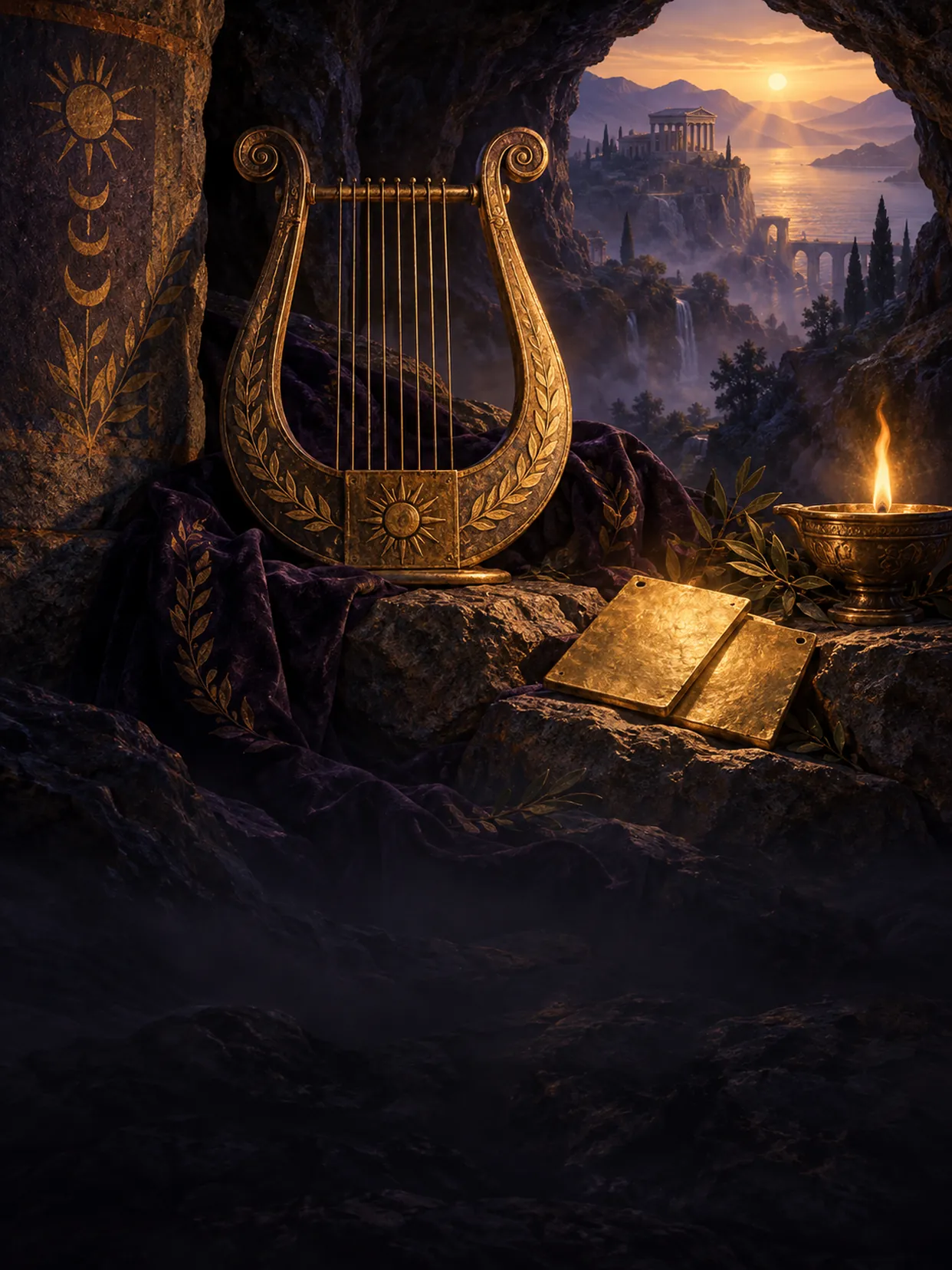
Orphism is the modern name for a Greek religious current, attested from the 6th century BCE, built around teachings attributed to the singer Orpheus. Whether it was one organized religion is debated: by the 5th century BCE there was at least a loose movement, with travelling priest-initiators rather than a fixed temple or priesthood, sharing features with Dionysiac and Eleusinian mystery cult. Orphics accepted the standard Greek gods but held that a soul could reach divine status, a hope grounded in a myth where the Titans killed and devoured Dionysos before Zeus destroyed them and humanity arose from their remains, carrying both Titanic guilt and a divine spark. Because ancient evidence is scattered, 20th-century finds, including buried gold tablets and a 1962 papyrus find near Thessaloniki, proved a real Orphic current existed well before the age scholars once confined it to.[2–5, 7–8]
History
A movement without a temple c. 600–400 BCE
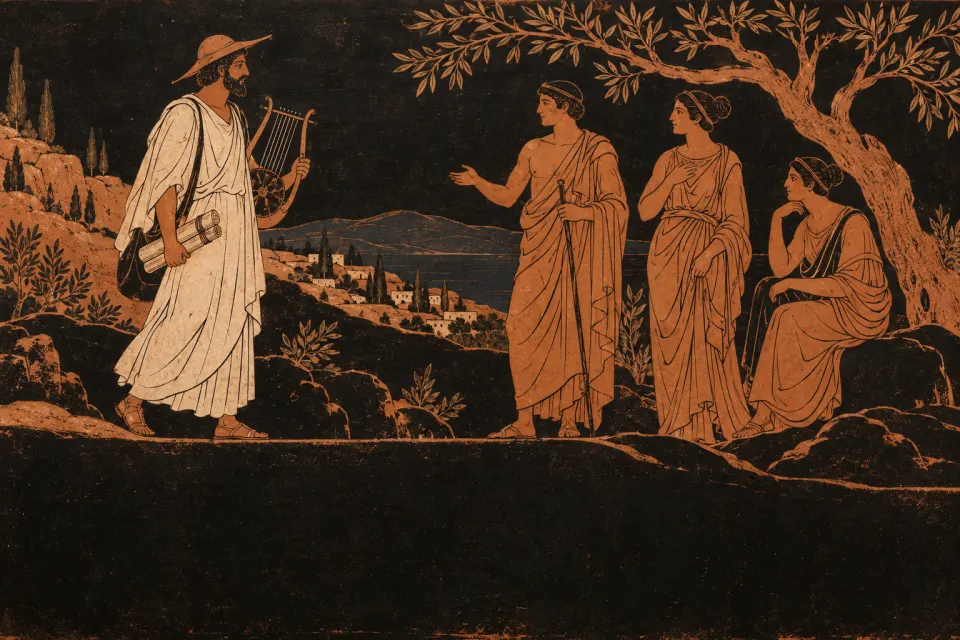
By the 6th century BCE, Greek tradition already credited Orpheus with songs and teachings about the gods, the soul and the afterlife, and by the following century a recognizable Orphic movement existed: travelling priest-initiators taught Orphic doctrine and performed initiations (teletai) for anyone willing to take part. Unlike the cult at Eleusis, which was tied to a single sanctuary and controlled by particular families, Orphism had no fixed temple, central authority or settled priesthood, which let its teachings vary considerably between different followers and transmitters even as its core concerns, about guilt, rebirth and the soul's fate, remained recognizable for centuries.[2–3]
A myth of the torn god attested by the 5th–4th centuries BCE
Central to Orphic teaching was a myth in which Zeus intended his son Dionysos to succeed him, only for the Titans to lure the child away, kill him and tear his body apart; Zeus then destroyed the Titans with a thunderbolt, and humanity was said to have been born from their ashes. Because of this origin, Orphics taught that every human soul carries both an inherited Titanic guilt and a divine spark from Dionysos, and that only repeated reincarnation could let the soul shed its Titanic nature and recover its original divine state. Orphic initiation ritual is thought to have dramatized the god's death and rebirth through a mimed, or sometimes real, dismemberment of a representative figure.[5, 8]
From ancient doubt to modern proof 19th century CE to 1974
Because so little direct evidence of Orphism survived from antiquity, 19th-century scholars disagreed sharply about whether it had ever existed as a distinct movement: Christian Lobeck's skeptical 1829 study opposed Georg Creuzer's claims for its importance, and a later "hypercritical" school led by Ulrich von Wilamowitz-Moellendorff denied any organized Orphic religion before the Hellenistic period. Twentieth-century finds overturned the most doubtful view: a philosophical commentary on an Orphic poem, the Derveni papyrus, found in a tomb near Thessaloniki in 1962 and written close to 400 BCE, and inscribed gold tablets buried with initiates from the 4th to 2nd centuries BCE and unearthed at sites across Italy, Greece and Crete, together showed that Orphic teaching about the soul's fate after death had real roots in the Classical period.[7, 9]
Places

Petelia (Orphic gold tablet findspot)
ITA
Near this town in southern Italy a 3rd–2nd century BCE gold tablet was found, inscribed with Orphic instructions warning the soul not to drink from one spring in the underworld but to seek out the Lake of Memory instead; it is now in the British Museum.[6]
Art & objects
Public-domain objects from museum collections. Select one to see it at the museum.
 Pendant with a Cameo of Orpheus Charming the AnimalsEurope, c. 1550-c. 1600 (cameo); 19th or 20th century (mount)
 Needlework Picture Depicting Orpheus Charming the AnimalsEngland, first half of the 17th century
 Orpheus Charming the AnimalsItaly, 1490/1510
 Orpheus Playing the Lyre to Hades and Persephone, from Orpheus and Eurydice or The MetamorphosesAntwerp, c. 1685
 The Death of OrpheusFrance, c. 1870
 Orpheus and CerberusGermany, near Bamberg, 18th century, c. 1765
 Orpheus and Eurydicemodeled ca. 1887, carved 1893
 Orpheus1600–1601
 Orpheus Playing to the Animalsearly 16th century
 The Orpheus Cup1641–42, the jeweled elements on the lid in the form of animals, amorini holding bow and quiver, and the statuettes of O
How we know
Proof from graves, not temples
Orphism left no central archive of scripture, so its reality as a distinct movement was long argued over purely from later, often hostile or philosophical, references to Orpheus. "Orphism" is itself a modern label: ancient and, much later, Florentine Neoplatonist writers already treated Orpheus as a theologian behind Greek mystery cult generally, and Neoplatonic commentary on Orphic verse continued as late as the 6th century CE. The strongest direct evidence instead comes from burials: small gold tablets placed on or near the bodies of initiates, inscribed with instructions for the soul's journey after death, have been found from Italy to Crete, and a unique papyrus commentary on Orphic verse was recovered from a tomb near Thessaloniki in 1962.[1, 6–7]
Common misconceptions
Myth Orphism was an organized church, with its own temples and clergy, somewhat like an ancient precursor to Christianity.
Fact Orphism had no central sanctuary, settled priesthood or fixed doctrine; it was spread instead by independent travelling priest-initiators, which let real variation develop between different Orphic teachers and communities even as certain core concerns persisted across centuries.[3]
Myth The Orphic story of Dionysos torn apart by the Titans is just a gruesome myth with no deeper point.
Fact The myth explained, in Orphic teaching, why every human soul is divided: it carries both the guilt of the Titans, from whose ashes humanity was said to spring, and a spark of the murdered god, and it grounded the hope that repeated reincarnation could free that divine spark for good.[5, 8]
Glossary
- Telete
- An Orphic rite of initiation, performed by travelling priests for anyone willing to take part, offering comfort and hope for a better fate after death.[3]
- Orphic gold tablets
- Thin inscribed gold sheets buried with initiates from the 4th to 2nd centuries BCE across Italy, Greece and Crete, giving the soul instructions and passwords for the afterlife.[6]
- Derveni papyrus
- A philosophical commentary on an Orphic poem, found in a tomb near Thessaloniki in 1962 and written close to 400 BCE; the oldest substantial evidence for organized Orphic teaching.[7]
- Titanic nature
- In Orphic teaching, the share of guilt every human soul inherits from the Titans, from whose destroyed bodies humanity was said to have arisen.[5]
Sources
Each statement above was checked against published sources; the verdict says whether it stood as written, was corrected or was hedged.
- VerifiedOxford Classical Dictionary; Encyclopedia.com, Orpheus.
- VerifiedBritannica, Orphic religion; Encyclopedia.com, Orpheus.
- VerifiedBritannica, Orphic religion; Encyclopedia.com, Orpheus.
- VerifiedEncyclopedia.com, Orpheus; Britannica, Orphic religion.
- VerifiedEncyclopedia.com, Orpheus; Britannica, Orphic religion.
- VerifiedEncyclopedia.com, Orpheus; British Museum, tablet/pendant/case.
- VerifiedEncyclopedia.com, Orpheus; British Museum, tablet/pendant/case.
- VerifiedBritannica, Orphic religion; Encyclopedia.com, Orpheus.
- VerifiedEncyclopedia.com, Orpheus; Oxford Classical Dictionary.
Last fact-checked 6 October 2026.