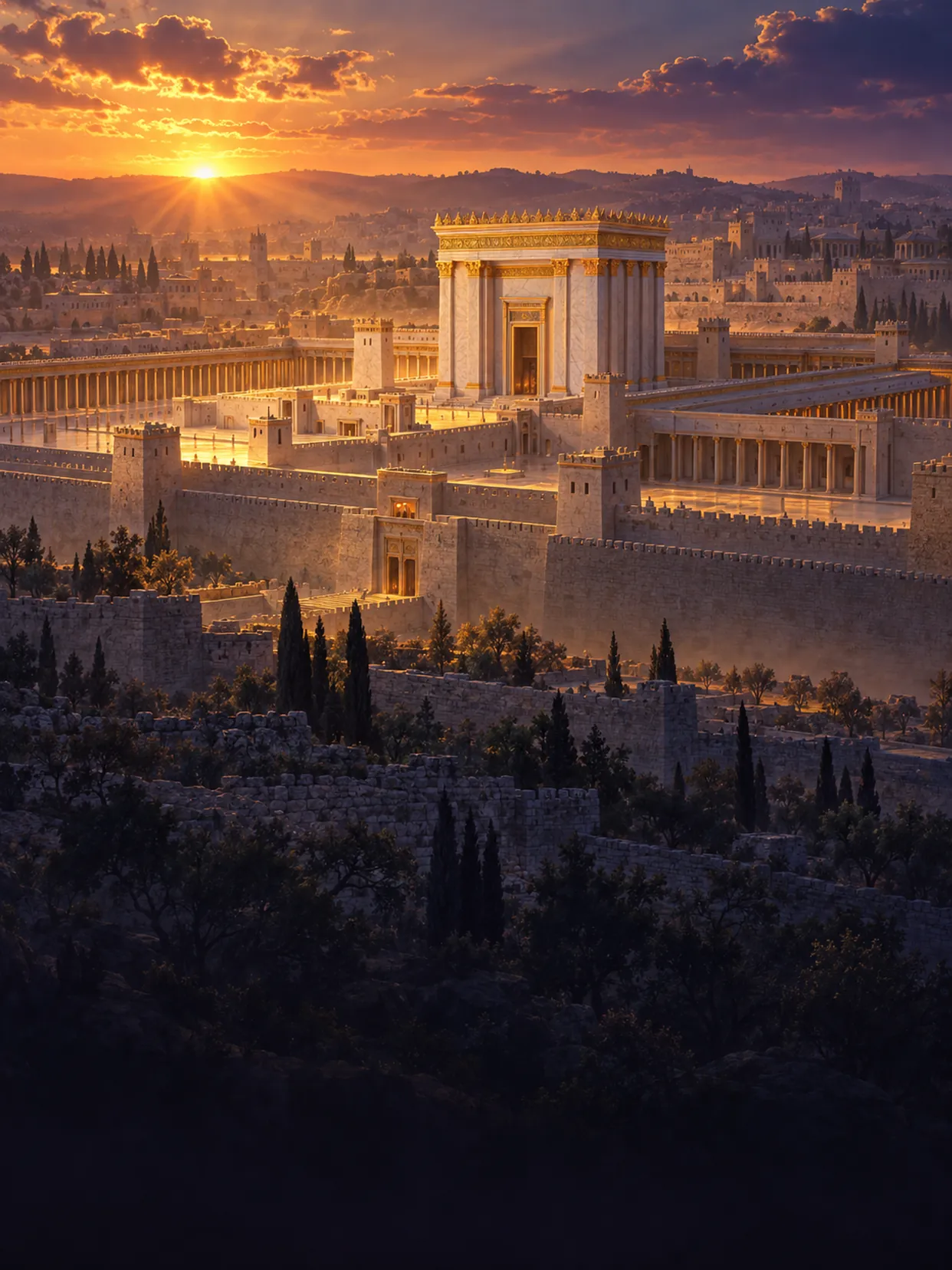
Overview
Second Temple Judaism covers the religion of Judea from the rebuilding of Jerusalem's Temple after the Babylonian exile down to that Temple's destruction by Rome in 70 CE, during which Judean religious life diversified into competing groups, chiefly the Pharisees, Sadducees and Essenes. A Jewish revolt against the Hellenistic Seleucid empire in the 2nd century BCE, still marked by the festival of Hanukkah, briefly won Judea independence.[1–4, 7]
History

Return, rebuilding and revolt c. 539–141 BCE
After Persia's Cyrus the Great took Babylon in 539 BCE, Judean exiles were permitted to return and rebuild their Temple in Jerusalem; when the Seleucid king Antiochus IV later restricted Jewish practice, the Maccabees led a successful revolt (168–164 BCE) and rededicated the Temple, an event commemorated each year at Hanukkah.[1, 7]
Sects under Roman rule, and the Temple's fall 63 BCE–70 CE
Under Roman rule, Jewish religious life was organized around the Pharisees, the Sadducees and the Essenes, until Rome crushed a second revolt and destroyed the Temple in 70 CE, ending the Sadducees as a group while synagogue- and school-based practice rooted in Pharisaic teaching carried Jewish religious life forward.[2–4, 8]
Key moments
- c. 587 BCEJerusalem falls; the Exile · Jerusalem and Babylon
- c. 516 BCEThe Second Temple · Jerusalem
- c. 450 BCEThe Torah takes shape · Persian Yehud (Judea)
- 410 BCEA Jewish temple on the Nile · Elephantine (Yeb), near Aswan, Egypt
- c. 250 BCEThe Septuagint · Alexandria, Egypt
- 164 BCEThe Maccabees rededicate the Temple · Jerusalem
- c. 150 BCEThe Dead Sea Scrolls are written · Qumran, near the Dead Sea
- 70 CEFall of the Second Temple · Jerusalem
Beliefs
Written and Oral Torah
Pharisees held both the Written and Oral Torah authoritative and believed in resurrection; Sadducees accepted only the written Torah and denied it.[2–3]
Essenes and Qumran
Essenes were an ascetic, communal movement that held property in common and largely avoided the Temple; most scholars identify them with the Qumran community, though the word "Essene" never appears in the scrolls themselves.[4, 9]
Scripture
The Septuagint · LXX
3rd c. BCE – 2nd c. CE
The earliest Greek translation of Hebrew scripture, begun under Ptolemaic rule in Alexandria and completed gradually over about four centuries.[10]
Art & objects
Public-domain objects from museum collections. Select one to see it at the museum.


Glossary
- Pharisees
- A Second Temple Jewish group holding both Written and Oral Torah authoritative, believing in resurrection, and generally willing to accept foreign rule if Jewish practice continued.[2]
- Sadducees
- A priestly, aristocratic Second Temple group accepting only the written Torah, denying resurrection, and dominant in the Temple until its destruction in 70 CE.[3]
- Essenes
- An ascetic, communal Second Temple Jewish movement generally identified with the Qumran community behind the Dead Sea Scrolls.[4]
- Dead Sea Scrolls
- Roughly 900 manuscripts found near Qumran from 1947, dating c. 150 BCE–68 CE.[6]
Sources
Each statement above was checked against published sources; the verdict says whether it stood as written, was corrected or was hedged.
- VerifiedBritannica, Judaism; Encyclopedia.com.
- VerifiedEncyclopedia.com; Britannica, Flavius Josephus.
- VerifiedBritannica, Sadducee; Encyclopedia.com.
- VerifiedBritannica, Essene; Encyclopedia.com.
- VerifiedBritannica, Flavius Josephus; Encyclopedia.com.
- VerifiedEncyclopedia.com; Britannica, Essene.
- VerifiedBritannica, Maccabees; Encyclopedia.com.
- VerifiedBritannica, Sadducee; Encyclopedia.com.
- VerifiedEncyclopedia.com; Britannica, Essene.
- VerifiedBritannica, Septuagint; Encyclopedia.com.
Last fact-checked 5 October 2026.