
The story behind the day
Good Friday is the Friday before Easter, on which Christians commemorate the crucifixion of Jesus. The Church of England calls it the most sombre day in the Christian year. In Catholic practice there is no Mass: the afternoon Celebration of the Lord's Passion centres on the reading of John's Passion and the adoration of the cross, and Catholics fast and abstain from meat. The Orthodox Church keeps the same day as Great and Holy Friday, with the burial of Christ at Vespers.[1–7]
Origins
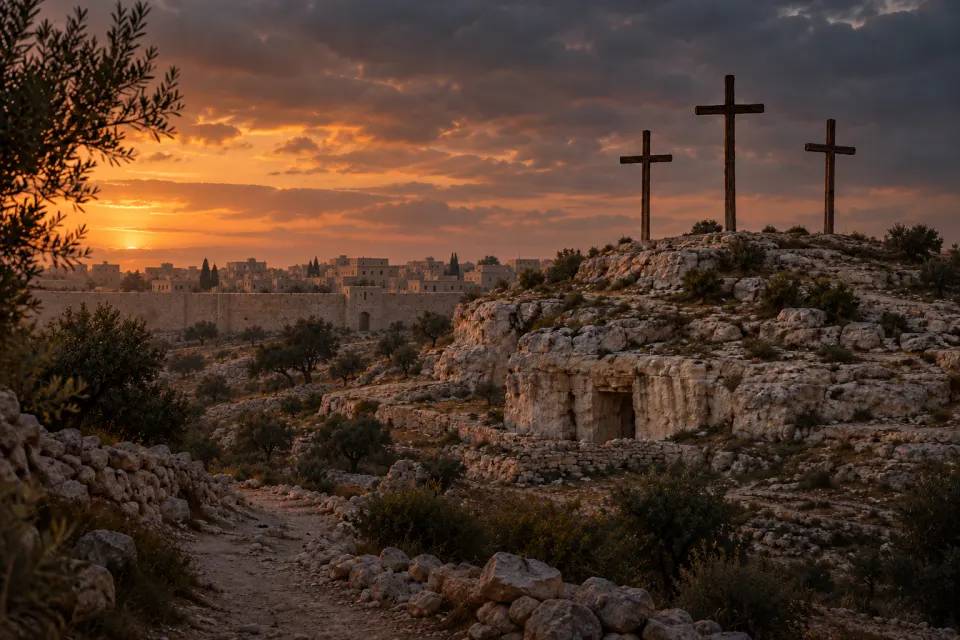
According to the Gospels, Jesus was condemned and handed over to be crucified. In John's account he carried the cross himself to a place called Golgotha, the Place of the Skull, where he was crucified between two others. The Orthodox Church in America places this outside Jerusalem, and reference works name the Roman governor Pontius Pilate as the one who authorised the execution.[8–9]
What it marks
The day commemorates the suffering and death of Jesus on the cross. Its mood is grave: the Church of England describes it as the most sombre day in the Christian year.[1]
How it came to be
Much of the order of Holy Week came out of Jerusalem. The pilgrim Egeria, who visited in the early 380s, kept a diary in which she described the rites in great detail, and the fourth century saw a tremendous development in the ritual of Holy Week. Visitors carried what they had seen back to their own lands.[10]
How it is kept

In the Catholic Church the central celebration is the Celebration of the Lord's Passion, held in the afternoon, normally at about three o'clock. The Liturgy of the Word includes the Passion according to John, and the rite includes the showing and adoration of the holy cross. No Mass is celebrated, and the only sacraments given on Good Friday are Penance and the Anointing of the Sick. Catholics are bound to fast and to abstain from meat on Good Friday, as they are on Ash Wednesday. Many churches also observe the Stations of the Cross, and the Church of England notes that services may begin or end at three in the afternoon.[2–6, 11]
Across traditions
In the Orthodox Church the day is Great and Holy Friday. The Vespers of Good Friday, which recalls the final events of Christ's life, is served in the afternoon, and the epitaphios, an icon of Christ lying in the tomb painted on cloth, is carried in procession to a tomb that stands in the middle of the church. Orthodox Vespers of burial thus belongs both to Friday and, in the church's reckoning, to the opening of Holy Saturday.[7]
Sources
Each statement above was checked against published sources; the verdict says whether it stood as written, was corrected or was hedged.
- VerifiedEncyclopedia.com; The Church of England, Fact File: What is Good Friday?.
- CorrectedUnited States Conference of Catholic Bishops, Questions on the Sacred Paschal Triduum; The Church of England; Holy See Press Office, 3 April 2026.
- CorrectedUnited States Conference of Catholic Bishops; Holy See Press Office.
- VerifiedUnited States Conference of Catholic Bishops; Catholic Bishops' Conference of England and Wales, Good Friday.
- VerifiedUnited States Conference of Catholic Bishops; Holy See Press Office.
- CorrectedUnited States Conference of Catholic Bishops, Fast & Abstinence; Holy See, Code of Canon Law can. 1251.
- VerifiedOrthodox Church in America, Great and Holy Friday; Orthodox Christian Laity, The Historical Development of Holy Week Services in Orthodoxy.
- CorrectedHoly See, New American Bible, John 19:16-18; Orthodox Church in America, Great and Holy Friday.
- CorrectedEncyclopedia.com; Orthodox Church in America.
- CorrectedOrthodox Christian Laity; Cambridge University Press, Rachel Moriarty, Studies in Church History.
- VerifiedThe Church of England; Catholic Bishops' Conference of England and Wales.