
Overview
Vodou is a Haitian religion formed among enslaved Dahomean (Fon), Kongo, Yorùbá and other peoples in French colonial Saint-Domingue, blending West African Vodun with Roman Catholicism. Its name is the Fon word for "spirit"; the Western spelling "Voodoo" is a pejorative invention whose stereotypes do not reflect how Haitians actually practise the religion. Vodou is fundamentally monotheistic: one supreme God stands behind the lwa, spirits who act as intermediaries, served through prayer, offering, music and dance. Because its lwa draw on Fon, Kongo and Yorùbá traditions together, Vodou is not simply a transplanted Yorùbá religion. It has no central authority: local priests (oungan) and priestesses (manbo) each lead their own congregation. Long treated as backward superstition, Vodou gained growing recognition over the 1900s, and most Haitian Catholics today also take part in it.[1–4, 7–10]
History
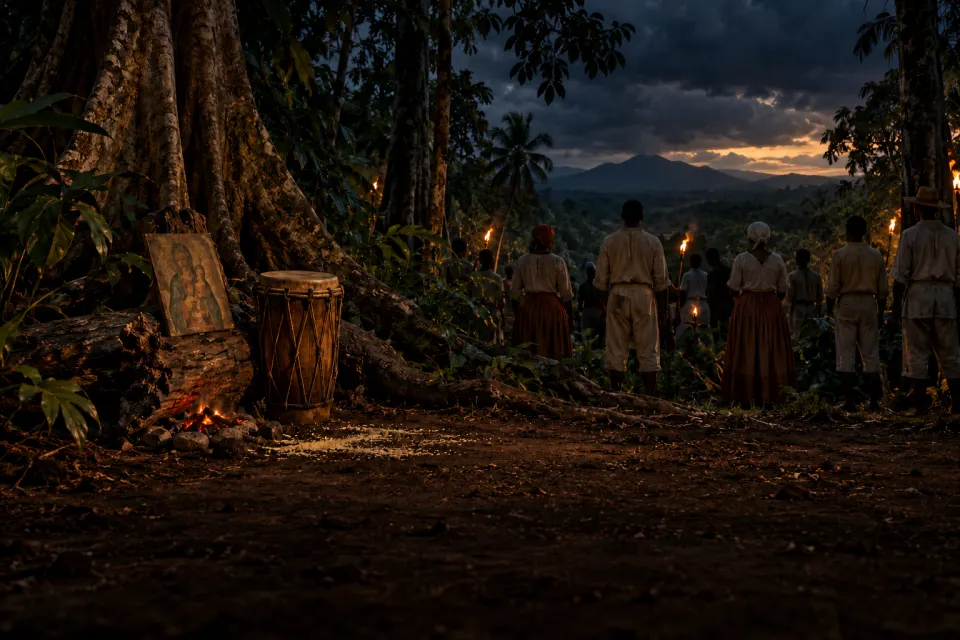
Formation under slavery 1700s–1804
French Saint-Domingue imported enormous numbers of enslaved Africans, chiefly Fon, Kongo and Yorùbá, who were baptized Catholic but kept and recombined their own spirits, forming Vodou's lwa and its Rada and Petwo "nations". Tradition holds that a Vodou ceremony at Bois-Caïman in August 1791, with the priestess Cécile Fatiman and remembered as led by Dutty Boukman, sanctified the uprising that grew into the Haitian Revolution; Haiti declared independence on 1 January 1804. Historians debate the ceremony's exact details.[2, 11]
Suppression and survival 1800s–1950s
After independence, Haiti's elite and the Catholic Church treated Vodou as backward superstition, and it was periodically suppressed. In the early 1940s the Church's "Anti-Superstition Campaign", backed by government forces that destroyed temples, drums and sacred objects, sought to wipe it out; after 1957 the ruling Duvalier family instead courted Vodou for political support. Even so, Vodou remained the lived religion of the rural and urban poor, and many Catholics continued to practise it alongside the Church without seeing a contradiction.[7, 12]
Toward recognition 1930s–2003
From the 1930s, Haitian intellectuals began defending Vodou as a national tradition rather than a backward one, and Haiti's 1987 constitution went further, recognizing Vodou as a national religion.[10]
A living, decentralized religion 20th century–today
Vodou has no central hierarchy or single leader; authority rests locally with each oungan or manbo and their congregation. Haitian immigrants carried Vodou abroad, especially to the United States, where manbo and oungan continue to serve their communities.[9, 13]
Key moments
- c. 1750 CEAfrican religions cross the Atlantic · West and Central Africa to the Americas
- 1791 CEThe Bois Caïman ceremony · Saint-Domingue (Haiti)
Beliefs
Lwa · lwa
spirits
Below one supreme God, the lwa are spirits, along with ancestors, who act as intermediaries with humanity; both are believed to belong to a mythic, ancestral "Africa" called Ginen, and their power lies partly in their ability to help or afflict their descendants.[3–4]
Sèvi Lwa · sèvi lwa
to serve the spirits
Vodou's central religious activity is serving the lwa: offering prayer, food and devotion in return for health, protection and favour, in rituals meant to foster reciprocity among the living, the ancestors and the spirits.[14]
Rada and Petwo
the two main "nations" of lwa
Lwa are grouped into "nations" by origin. The Rada, from Dahomey in West Africa, are regarded as cool, calm and benevolent; the Petwo, said to be named for a legendary slave leader called Don Pedro, formed under slavery itself and are regarded as hot and volatile.[6]
Practice

Priesthood and possession · oungan, manbo
A priest (oungan) or priestess (manbo) is consulted especially in times of illness or discord, communicating with the lwa through divination or ceremonies that call on a lwa to "mount", or possess, a devotee, who may then give advice or perform a healing through the trance.[5, 15]
Congregation and calendar · sosyete
Each oungan or manbo leads a congregation, a sosyete, with no authority above the local level. Many lwa are honoured on the feast day of the Catholic saint paired with them, so Vodou's ritual year runs alongside the Catholic calendar.[13, 16]
Drawing the vèvè · vèvè
Before a ceremony, an oungan or manbo draws a vèvè, a geometric emblem in cornmeal or ashes on the temple floor, to call a particular lwa: a heart for Ezili Freda, a cross for Papa Legba, a boat for Agwe. Offerings to that lwa are placed on its vèvè, a practice tracing to similar ground drawings in Dahomey and Central Africa.[17]
People
Dutty Boukman
other · d. 1791
Remembered by tradition as the Vodou priest, or oungan, who presided over the Bois-Caïman ceremony that preceded the start of the Haitian Revolution; historians question the exact wording of his remembered prayer, though his symbolic role endures in Haitian art and memory.[11]
Cécile Fatiman
other · c. 1750s–1860s
A manbo, or Vodou priestess, remembered as officiating at the Bois-Caïman ceremony, including the sacrifice whose blood participants are said to have shared to seal their commitment to revolt.[11]
Places

Bois-Caïman
HTI
A forest clearing near Cap-Français (now Cap-Haïtien) where tradition places the August 1791 Vodou ceremony that preceded the uprising leading to Haiti's independence.[11]
Numbers
- Self-identified Vodouists, Haiti
- 2% (2017 government survey)[7]
Many practitioners see Vodou as a spirituality practised alongside another faith rather than a separate religion, and most of Haiti's Catholic majority also take part in it.
How we know
Counting followers
Vodou is hard to count because most practitioners also identify as Catholic or Protestant and many do not consider Vodou a separate religion at all. Haiti's 2017 government survey found just 2% of the population self-identifying as Vodouists, yet Britannica notes that most of the country's Catholic majority also practise Vodou, and the gap between the two findings reflects this definitional problem rather than a real change in practice.[7]
Common misconceptions
Myth Vodou ("Voodoo") is sorcery centred on curses, zombies and dolls with pins.
Fact These images come from Western film and tabloid media, not from the religion. Scholars note that the stereotype of "voodoo" does not represent the religion of ordinary Haitians, which is fundamentally monotheistic and organized around serving ancestral spirits through offering, prayer, music and dance, aimed at health and reciprocity rather than harming others.[1, 14]
Myth Vodou is simply Yorùbá religion carried to Haiti.
Fact Vodou's lwa draw on Fon, Kongo, Yorùbá and other African traditions together, reshaped further by Haiti's own history under slavery and since. It is a distinct religion from West African Vodun and from Santería and Candomblé, which took shape the same way in Cuba and Brazil.[8]
Glossary
- Lwa · lwa
- A Vodou spirit who acts as an intermediary with the one supreme God, honoured through its own rites and able to possess a devotee.[3]
- Oungan · oungan
- A Vodou priest, who leads a congregation and communicates with the lwa through divination or possession ceremonies.[5]
- Manbo · manbo
- A Vodou priestess, who holds the same role and standing as an oungan.[5]
- Ginen · Ginen
- The mythic, ancestral "Africa" where the lwa and the dead are believed to dwell.[4]
- Sosyete · sosyete
- A local Vodou congregation gathered around an oungan or manbo.[13]
- Rada · Rada
- The "nation" of lwa tracing to West Africa (Dahomey), regarded as cool, calm and benevolent.[6]
- Petwo · Petwo
- The "nation" of lwa said to have formed under slavery itself, regarded as hot and volatile.[6]
- Vèvè · vèvè
- A geometric emblem drawn on the temple floor for a particular lwa, on which offerings to it are placed.[17]
Sources
Each statement above was checked against published sources; the verdict says whether it stood as written, was corrected or was hedged.
- VerifiedBritannica, Vodou; Wiley Online Library, The International Encyclopedia of Anthropology, Voodoo/Vodou by Karen Richman.
- VerifiedBritannica, Vodou by Elizabeth A. McAlister; Encyclopedia.com, Encyclopedia of Religion, Vodun.
- VerifiedSmithsonian Folklife Festival, Vodou by Gerdes Fleurant; Britannica, Vodou.
- VerifiedBritannica, Vodou; Wiley Online Library, Voodoo/Vodou.
- VerifiedOxford Reference, Trees in Haitian Vodou, The Encyclopedia of Religion and Nature; Britannica, Vodou.
- VerifiedOxford Reference, Vodou, The Oxford Encyclopedia of African Thought; Britannica, Vodou.
- VerifiedU.S. Department of State, 2023 Report on International Religious Freedom: Haiti; Britannica, Haiti.
- VerifiedBritannica, Vodou; Encyclopedia.com, Vodun.
- VerifiedBritannica, Vodou; Wiley Online Library, Voodoo/Vodou.
- VerifiedOxford Reference, Vodou, The Concise Oxford Dictionary of World Religions; Encyclopedia.com, Vodun.
- VerifiedSmithsonian Folklife Festival, Vodou; Oxford Reference, Boukman Dutty.
- VerifiedOxford Reference, Vodou, The Concise Oxford Dictionary of World Religions; Encyclopedia.com, Encyclopedia of Latin American History and Culture, Vodun, Voodoo, Vaudun by Melvin B. Rahming.
- VerifiedBritannica, Vodou; Oxford Reference, Haitian Americans, Encyclopedia of Social Work.
- VerifiedBritannica, Vodou; Wiley Online Library, Voodoo/Vodou.
- VerifiedBritannica, Vodou; Encyclopedia.com, Vodun.
- VerifiedBritannica, Vodou; Encyclopedia.com, Vodun.
- VerifiedBritannica, Vèvè by Ama Mazama; Oxford Reference, Vodou, The Concise Oxford Dictionary of World Religions, preview on.
Last fact-checked 3 October 2026.