
Overview
Vodun, often spelled Vodou or, by outsiders, "Voodoo", is the traditional religion of the Fon, Ewe, Aja and related peoples of Benin, Togo and Ghana. Its name is the Fon word for "spirit" or "deity". Many ethnic groups have shaped Vodun, which has no single founder. A remote creator, Mawu, called Nana Buluku by the Fon, stands behind a crowd of vodun: spirits of nature, communities and ancestors, each served by its own priesthood through offering and, at times, possession. Ancestors are held to watch over, and sometimes punish, their descendants. From the 1600s Dahomey built its power partly on the slave trade, and enslaved Vodun-practicing people carried their religion to the Americas, forming the root of Haitian Vodou and shaping Santería and Candomblé. Vodun remains a living religion in West Africa, practiced openly alongside Christianity and Islam.[1–6, 8, 11–14]
History

The kingdom of Dahomey c. 1625–1890s
Wegbaja built the small state of Abomey into the core of the kingdom of Dahomey; a line of twelve kings ruled Dahomey from 1625 to 1900 and governed as absolute monarchs. The king's household guard included the Agojie, an elite corps of several thousand female soldiers whom European visitors called "Amazons". Dahomean kingship was bound up with royal ancestors, echoing the wider Fon belief that the dead continue to help or harm their living descendants.[6–7, 15]
Slaving and the Atlantic 1724–1860s
King Agaja's conquest of Allada in 1724 and of the coastal port of Whydah (Ouidah) in 1727 gave Dahomey direct access to European slave traders on the Gulf of Guinea coast. The kingdom prospered for over a century by selling captives in exchange for European weapons. Enslaved Fon, Ewe and other Vodun-practicing people shipped out through ports such as Ouidah rebuilt their worship under new names once in the Americas, forming the root of Haitian Vodou and feeding into Cuban Santería and Brazilian Candomblé.[8, 13, 16]
Colonial conquest 1892–1960
A French military expedition defeated Dahomey's last independent king in 1892, and France established a protectorate that it later absorbed into colonial French Dahomey. Vodun lost royal patronage with the fall of the kingdom, though worship continued in villages and family compounds, and the former royal palaces at Abomey came, under colonial and later Beninese rule, to stand as a monument to resistance to that occupation.[17]
Recognition since independence 1960–today
After Benin's 1960 independence, Vodun continued alongside Christianity and Islam, and the government lifted earlier restrictions on it, officially recognizing it from 1996. Benin's 2013 census recorded 11.6% of the population as Vodun practitioners and a further 2.6% following other indigenous religions, although many Christians and Muslims also take part in Vodun rites. Across the border in Togo, traditional animist believers, including followers of Vodun, are estimated at roughly a third of the population.[9–10, 14]
Beliefs
Mawu · Mawu
the supreme, remote creator
Vodun tradition holds Mawu, called Nana Buluku among the Fon, as the creator god standing behind a crowd of lesser vodun. Mawu is immutable and unapproachable, and worshippers turn instead to the vodun for help in daily affairs such as farming, trade and war.[4]
Vodun · vodun
spirit, deity
The vodun are spirits of nature, communities and ancestors, each honoured by its own priesthood and shrine, understood as intermediaries between worshippers and the unapproachable Mawu. During ceremony a vodun may "possess" a devotee, who then speaks and acts as its presence among the living.[5, 12]
Legba · Legba
the trickster-messenger
Among the Fon, Legba is a trickster vodun who disrupts order and stirs confusion but is revered rather than feared. Known as the "linguist", Legba translates Mawu's otherwise cryptic messages for humans and presides over divination; the name survives among the lwa of Haitian Vodou as Atibon Legba.[18–19]
Ancestors
the lineage dead
Belief in the power of ancestral spirits to help or harm their descendants runs through Fon and Ewe religion alike, reinforcing the authority of lineage heads, who serve as priests linking the living to the dead.[6]
Practice

Priesthood and possession
Each vodun has its own priests and priestesses, who tend its shrine, lead its rites, and may be entered by the spirit in ritual trance. Initiation and training can take years, and priestly office often passes within particular families or lineages.[5, 12]
Offering and ceremony
Worshippers honour and consult the vodun in carefully structured ceremonies, bringing food and drink whose essence the spirit is understood to consume during possession. Such offerings are brought in exchange for protection, healing and favour in daily life.[20]
Ancestor rites
Lineage heads preside over rites for the family dead, whose goodwill is sought through offering and whose anger is thought to bring misfortune on descendants who neglect them.[6]
Fa divination · Fa
Fa, the Dahomean counterpart of Yorùbá Ifá divination, grew in influence at the royal court from the reign of King Tegbesu (1732–1774), alongside the new cult of the tohosu, royal spirit-children; by the mid-1800s Fa diviners had become intimate advisers to the king.[21]
People
Mawu · Mawu
deity
The creator god of Fon and Ewe tradition, also called Nana Buluku, who set the vodun over the visible world and is not worshipped through a daily cult of his own.[4]
Legba · Legba
deity
A trickster vodun who guards communication between humans and Mawu and presides over divination; disruptive but not regarded as evil.[18–19]
Wegbaja
ruler · r. c. 1645–1685
Founder-king who built Abomey into the core of the Dahomey kingdom, beginning the line of twelve kings who ruled it until 1900.[15]
Hwanjile
other · d. 1770s
A royal wife and religious reformer at the Dahomean court who promoted the cult of the tohosu and Fa divination; she died late in King Tegbesu's reign, and a successor later took on her name and role.[21]
Places

Royal Palaces of Abomey
BEN · UNESCO World Heritage, 1985
The walled palace complex of Dahomey's twelve kings, built up from the 1620s to 1900. Today the palaces of kings Ghézo and Glélé house the Historical Museum of Abomey; the site was inscribed as a World Heritage Site in 1985.[15]
Ouidah
BEN
A port city on Benin's coast, taken by Dahomey in 1727, through which enslaved Vodun-practicing captives were shipped across the Atlantic. Its "Gate of No Return" monument now commemorates them.[13]
Art & objects
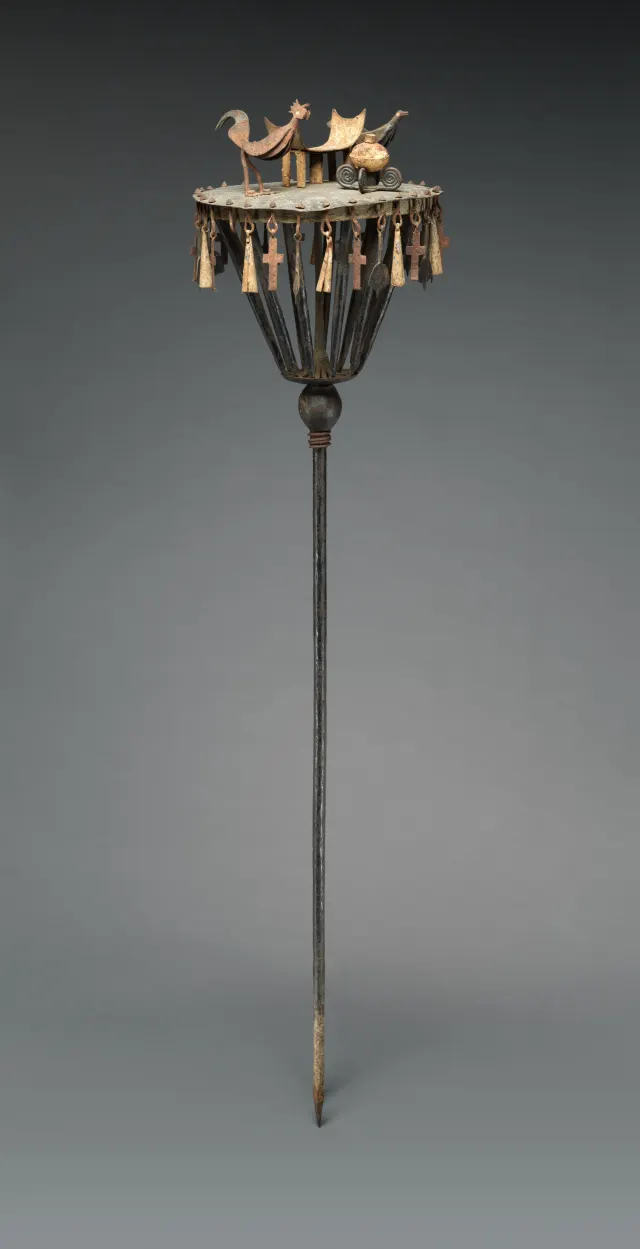
Public-domain objects from museum collections. Select one to see it at the museum.

Numbers
- Vodun and traditional believers, Benin and Togo
- 11.6% of Benin; roughly a third of Togo[9–10]
Benin's 2013 census also counted 2.6% in other indigenous religions; Britannica's broader Benin estimate runs to about one-fourth. Togo's two estimates (36.9%; "about one-third") agree only when rounded.
National censuses
| Country | Year | Count | Share |
|---|---|---|---|
| United Kingdom (England and Wales) Other religion: Vodun | 2021 | 257 | 0.0% |
Source: Office for National Statistics licensed under the Open Government Licence v.3.0
Common misconceptions
Myth Vodun ("Voodoo") is sorcery built around curses, zombies and pins stuck in dolls.
Fact These images come largely from Western film and fiction. Labelling Vodun as "witchcraft" and "magic" has been a habit of European colonial writers, sustained by Hollywood and tabloid media, but the religion itself centres on a supreme God, lesser spirits, ancestor veneration, offering and divination, directed at health, protection and the wellbeing of the community.[1, 22]
Myth Vodun is simply the Haitian religion, imported back into Africa.
Fact Vodun is the older, West African religion of the Fon, Ewe and related peoples, and it is the root of Haitian Vodou, which also drew on Kongo, Yorùbá and other traditions among enslaved Africans in Saint-Domingue. Vodun has continued in Benin, Togo and Ghana throughout, independent of developments in Haiti.[3, 8]
Glossary
- Vodun · vodun
- "Spirit" or "deity" in the Fon language; both the name of the religion and of its many individual spirits.[1]
- Mawu · Mawu
- The remote creator god of Fon and Ewe tradition, called Nana Buluku by the Fon, who stands behind the vodun.[4]
- Legba · Legba
- The trickster vodun and "linguist" who carries messages between humans and Mawu, and who presides over divination.[18]
- Dahomey
- The Fon kingdom centred on Abomey, powerful from the 17th to 19th centuries, conquered by France in 1892; now part of Benin.[15, 17]
- Agojie
- An elite corps of several thousand female soldiers who guarded the Dahomean king, nicknamed "Amazons" by European visitors.[7]
- Ouidah
- A port city in Benin, a major Atlantic slave-trading point under Dahomey and now a place of memory for that history.[13]
- Fa · Fa
- The Dahomean system of divination, closely related to Yorùbá Ifá, consulted by both ordinary people and, from the 1700s, the royal court.[21]
Sources
Each statement above was checked against published sources; the verdict says whether it stood as written, was corrected or was hedged.
- VerifiedEncyclopedia.com, Encyclopedia of Latin American History and Culture, Vodun, Voodoo, Vaudun by Melvin B. Rahming; Oxford Reference, Vodou, The Concise Oxford Dictionary of World Religions.
- VerifiedOxford Reference, Vodou, The Oxford Encyclopedia of African Thought; Encyclopedia.com, Vodun, Voodoo, Vaudun.
- VerifiedEncyclopedia.com, Vodun, Voodoo, Vaudun; Oxford Reference, Vodou, The Oxford Encyclopedia of African Thought, preview on.
- VerifiedBritannica, Mawu; Encyclopedia.com, Vodun, Voodoo, Vaudun.
- VerifiedEncyclopedia.com, Vodun, Voodoo, Vaudun; Britannica, Vodun.
- VerifiedBritannica, Fon; Encyclopedia.com, Vodun, Voodoo, Vaudun.
- VerifiedBritannica, Dahomey; Smithsonian Magazine, The Real History Behind 'The Woman King' by Meilan Solly, 15 Sept. 2022.
- VerifiedBritannica, Vodun; Encyclopedia.com, Vodun, Voodoo, Vaudun.
- VerifiedU.S. Department of State, 2023 Report on International Religious Freedom: Benin; Britannica, Benin.
- CorrectedU.S. Department of State, 2023 Report on International Religious Freedom: Togo; Britannica, Ewe.
- CorrectedEncyclopedia.com, Vodun, Voodoo, Vaudun; Oxford Reference, Vodou, The Oxford Encyclopedia of African Thought, preview on.
- VerifiedEncyclopedia.com, Vodun, Voodoo, Vaudun; Britannica, Vodun.
- VerifiedBritannica, Dahomey; Encyclopedia.com, Vodun, Voodoo, Vaudun.
- VerifiedOxford Reference, Vodou, The Concise Oxford Dictionary of World Religions, preview on; Encyclopedia.com, Vodun, Voodoo, Vaudun.
- CorrectedUNESCO World Heritage Centre, Royal Palaces of Abomey; Britannica, Dahomey.
- VerifiedBritannica, Dahomey; Encyclopedia.com, Vodun, Voodoo, Vaudun.
- VerifiedBritannica, Dahomey; UNESCO World Heritage Centre, Royal Palaces of Abomey.
- VerifiedBritannica, African religions; Encyclopedia.com, Encyclopedia of Religion, Vodun.
- VerifiedEncyclopedia.com, Encyclopedia of Religion, Vodun; Britannica, Vodun.
- VerifiedEncyclopedia.com, Vodun, Voodoo, Vaudun; Britannica, Vodun.
- VerifiedOxford Reference, Hwanjile; Britannica, Dahomey.
- VerifiedEncyclopedia.com, Vodun, Voodoo, Vaudun; Smithsonian Folklife Festival, Vodou by Gerdes Fleurant.
Last fact-checked 3 October 2026.