
The story behind the day
Every year on 15 August, Catholics keep the solemnity of the Assumption and Orthodox Christians keep the Dormition: a feast of Mary, the mother of Jesus, at the close of her life. Catholics teach that she was taken, body and soul, into heavenly glory. The Eastern churches speak of her "falling asleep" and of her glorification. The feast is some fifteen centuries old, yet the Catholic teaching was defined as dogma only in 1950, and the New Testament does not tell how her life ended.[1–6]
Origins
The New Testament says nothing of Mary's death, and a writer as early as Epiphanius, who died in 403, admitted he knew nothing certain about it. Later narratives, grouped as the Transitus Mariae or "passing of Mary", are dated by scholars between the fourth century and the early sixth, and several of them end with her body taken into paradise. Orthodox tradition tells how the apostles carried her to burial; when the tomb was opened it held only its wrappings, and they understood that her body had been taken up.[5, 8–9]
What it marks
In Orthodox understanding the feast commemorates the death of Christ's mother, her resurrection and her glorification, and its name, Dormition, recalls the Virgin falling asleep. The Catholic Church holds that she was carried up in body and soul to the glory of heaven when her earthly life was complete.[2–3]
How it came to be
The feast began in Jerusalem and was kept in Palestine before the year 500. A report in the Liber Pontificalis, which is not certain, credits the Byzantine emperor Maurice (582 to 602) with ordering 15 August as the date across his empire. Rome received it in the seventh century, where it was called the Assumption, and under Pope Sergius I, around 700, it ranked among the city's principal festivals. In the West the feast came to centre on Mary's bodily glorification, and its liturgical books name it either the dormition or the Assumption of the Virgin. On 1 November 1950 Pope Pius XII defined the Assumption as a divinely revealed dogma in Munificentissimus Deus.[4, 6, 10–12]
How it is kept
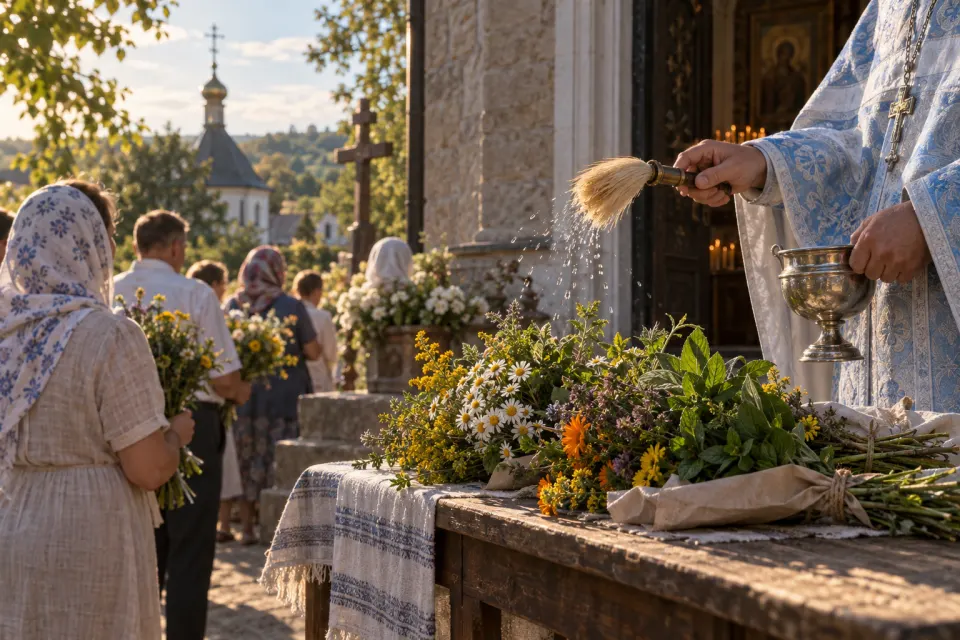
Orthodox Christians prepare with a fast of two weeks that begins on 1 August.[7]
Across traditions
The Armenian Church keeps the Assumption of the Holy Mother of God on the Sunday nearest 15 August. On the feast it blesses grapes, a custom with a special place in Armenian culture.[13–14]
Sources
Each statement above was checked against published sources; the verdict says whether it stood as written, was corrected or was hedged.
- VerifiedOrthodox Church in America, Dormition of the Theotokos, The Orthodox Faith vol. II; NCE-Marian, Encyclopedia.com.
- VerifiedPius XII, Munificentissimus Deus; NCE-Dormition, Encyclopedia.com.
- VerifiedOrthodox Church in America, Dormition of the Theotokos, The Orthodox Faith; NCE-Dormition, Encyclopedia.com.
- VerifiedPius XII, Munificentissimus Deus, Vatican; NCE-Marian, Encyclopedia.com.
- VerifiedNCE-Dormition, Encyclopedia.com; CE 1907; Orthodox Church in America.
- VerifiedNCE-Marian, Encyclopedia.com; CE 1907.
- VerifiedOrthodox Church in America, Dormition of the Theotokos, The Orthodox Faith; Greek Orthodox Metropolis of San Francisco, Reflection for the Dormition Fast 2026.
- CorrectedAdam Becker; CE 1907; NCE-Dormition, Encyclopedia.com.
- CorrectedOrthodox Church in America, The Dormition of our Most Holy Lady…; Antiochian Orthodox Christian Archdiocese of Los Angeles and the West, Synaxarion for the Dormition.
- VerifiedNCE-Dormition, Encyclopedia.com; CE 1907.
- VerifiedNCE-Marian, Encyclopedia.com; CE 1907; Pius XII, Munificentissimus Deus, Vatican.
- CorrectedNCE-Dormition, Encyclopedia.com; Pius XII, Munificentissimus Deus, Vatican.
- CorrectedEastern Prelacy of the Armenian Apostolic Church, Feast Days; Hrant Dink Foundation, History Program, From the Oral History: Grape and Asdvadzadzin.
- CorrectedMother See of Holy Etchmiadzin; Hrant Dink Foundation.