Overview
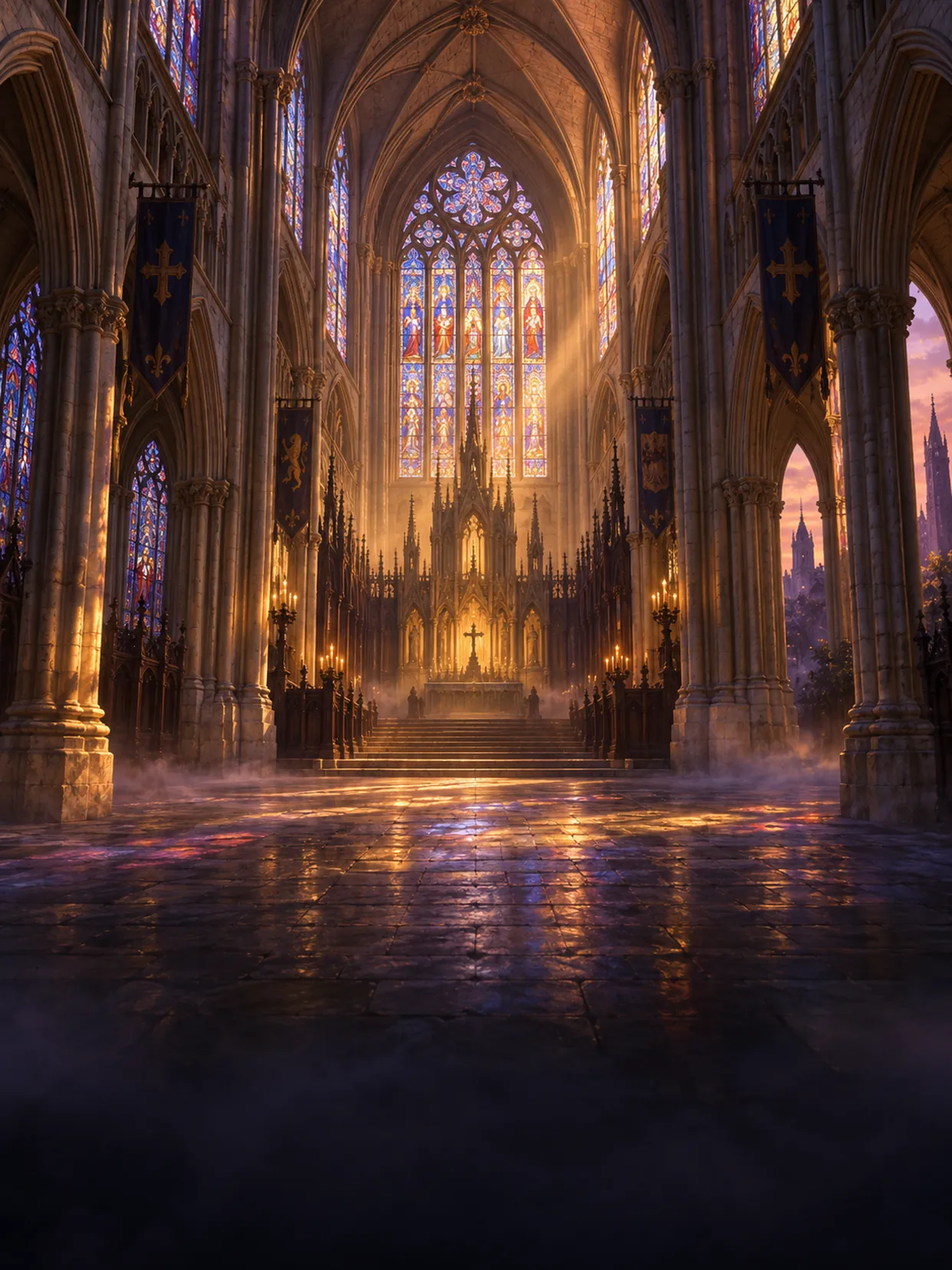
Anglicanism grew out of the Church of England after its 16th-century break with Rome, keeping bishops ordained in a line traced back to the pre-Reformation English church. Anglicans often describe their faith as a via media, a middle way joining Protestant convictions about scripture and grace to Catholic worship, bishops and sacraments; in practice it runs from Anglo-Catholics, close to Rome in ceremony, to Evangelicals closer to other Protestants. There is no pope: the worldwide Anglican Communion, some 42 provinces, recognises the Archbishop of Canterbury as first in honour, not a ruler. Carried abroad by British trade, empire and mission, it now has far more members in Africa, especially Nigeria and Uganda, than in England. Member churches disagree sharply over ordaining women and gay or partnered clergy, straining the Communion since the 1990s.[1, 4–5, 9–11]
History

Break with Rome and settlement 1534–1571
Henry VIII's Act of Supremacy of 1534 made the English crown, not the pope, head of the church, after Rome refused to annul his marriage to Catherine of Aragon. After a brief Catholic restoration under Mary I, Elizabeth I's own Act of Supremacy of 1559 made her Supreme Governor and required the Book of Common Prayer as the church's only legal liturgy. A final Convocation text of 1571, the Thirty-Nine Articles, deliberately left room for Calvinist, Lutheran and Catholic-leaning readings so the national church could hold together competing views.[1–4, 12]
A worldwide communion 1662–1930
The 1662 Book of Common Prayer, issued after the monarchy's restoration, remained the Church of England's standard liturgy for centuries. Anglicanism travelled with British settlement and missions: in the United States, cut off from Canterbury by independence, Samuel Seabury was consecrated bishop by Scottish Episcopal bishops in Aberdeen in 1784, and a 1789 convention in Philadelphia united American Anglicans as the Episcopal Church with its own prayer book. As colonial and missionary churches multiplied, archbishops of Canterbury began summoning their bishops to the Lambeth Conference from 1867, and the 1930 conference defined the Anglican Communion as this fellowship of churches in communion with Canterbury.[13–17]
Catholic revival and modern divisions 1833–today
In 1833 John Keble's Oxford sermon against 'national apostasy' opened the Oxford Movement; Keble, John Henry Newman and Edward Pusey wrote Tracts for the Times urging Anglicans to recover Catholic doctrine and ceremony, and Tractarian clergy became known as Anglo-Catholics. In 1944, with ordinary ministry disrupted by war, Bishop Ronald Hall of Hong Kong ordained Florence Li Tim-Oi the Communion's first woman priest; provinces have since reached different conclusions, and some still ordain only men. Disagreement over ordaining women, and over same-sex relationships, led conservative provinces to found the rival GAFCON movement in 2008, straining the Communion's unity.[18–22]
Key moments
- 1534 CEThe Church of England · London
- 1611 CEThe King James Bible · England
- 1859 CEDarwin's Origin of Species · London and Oxford, England
- 1944 CELi Tim-Oi and the ordination of women · Zhaoqing, Guangdong, China
Beliefs
Via media
middle way
Anglicans have long described their church as a middle way between Reformation Protestantism and Roman Catholicism, keeping bishops, set liturgy and sacraments while holding scripture as the final authority in doctrine. The balance is not fixed: Anglo-Catholics stress continuity with pre-Reformation Catholicism, Evangelicals stress the Reformation's emphasis on grace through faith, and both claim the same church.[4, 23]
Scripture, tradition and reason
Richard Hooker's defence of the Elizabethan church argued that scripture is the primary source of doctrine but is read through the church's tradition and tested by reason, an approach later called the three-legged stool. It lets Anglican provinces reach different conclusions on some disputed questions while sharing a common core.[24–25]
The historic episcopate
Anglicans hold that bishops, consecrated in unbroken succession, are necessary to a church's full order; the 1888 Lambeth Quadrilateral named it, with scripture, the creeds and the two sacraments of the gospel, as one of four essentials for reunion with other churches.[26–27]
Practice

Common prayer
Anglican worship centres on set, printed liturgies rather than free prayer, descended from Cranmer's Book of Common Prayer, which reduced the old monastic round of services to the two daily offices of Morning and Evening Prayer. Most provinces now also authorise modern-language rites alongside the older ones.[3, 28]
The two sacraments and more
Anglicans count baptism and the Eucharist as sacraments instituted by Christ himself, while treating confirmation, ordination, marriage, confession and anointing of the sick as lesser rites; how the Eucharist is understood and celebrated ranges from near-Catholic Mass to a simple Protestant communion service.[29]
Ordained ministry
Since Li Tim-Oi's wartime ordination, women's ordination has spread unevenly: some provinces ordain women as deacons, priests and bishops, others stop short of consecrating women bishops, and some, especially in parts of the Global South, ordain men only.[20–21]
People
Thomas Cranmer
founder · 1489–1556
Archbishop of Canterbury under Henry VIII and Edward VI, Cranmer compiled the first Book of Common Prayer in 1549 and its revised 1552 edition, shaping Anglican worship's language for centuries. Under the Catholic Mary I he was burned at the stake in Oxford in 1556 for heresy.[30–31]
John Keble
teacher · 1792–1866
An Oxford clergyman and poet whose 1833 sermon on 'national apostasy' is usually dated as the start of the Oxford Movement, which called Anglicans back to the church's Catholic inheritance.[18]
Desmond Tutu
other · 1931–2021
Archbishop of Cape Town from 1986 and a leading voice against apartheid in South Africa, Tutu later chaired the Truth and Reconciliation Commission and became one of the Communion's best-known modern figures.[32]
Scripture
The Book of Common Prayer
1549; revised 1552, 1559, 1662
Cranmer's compilation of services for daily prayer, the Eucharist, baptism and other rites, in English rather than Latin; the 1662 edition, issued after the Restoration, remained the Church of England's standard liturgy for more than three centuries.[14, 30]
The Thirty-Nine Articles
1571
The Church of England's doctrinal statement, finalised by Convocation in 1571 after earlier drafts, deliberately phrased to let Calvinist, Lutheran and Catholic-leaning clergy all subscribe to it.[4, 12]
Places

Canterbury Cathedral
GBR · UNESCO World Heritage, 1988
Seat of the Archbishop of Canterbury since the 6th century and the symbolic mother church of the Anglican Communion, it forms part of a World Heritage property with St Augustine's Abbey and St Martin's Church.[33]
Lambeth Palace, London
GBR
The Archbishop of Canterbury's London residence since the 13th century, and host to the Lambeth Conference of bishops from around the Communion, held roughly every ten years since 1867.[16, 34]
Art & objects
Public-domain objects from museum collections. Select one to see it at the museum.
 Church of EnglandFrance, c. 1875
 Canterbury CathedralEngland, 20th century, c. 1930
 Bible and Book of Common Prayerca. 1607
 The Bible, The Book of Common Prayer, The Book of Psalms with Royal Stuart armsca. 1624
 The New Testament, The Book of Common Prayerca. 1636
 Palatium Archiepiscopi Cantuariensis propae Londinum vulgo Lambeth House (Lambeth House: Palace of the Archbishop of Canterbury, London)1647
 William Laud, Archbishop of Canterbury1640
 Northeast Transept of Canterbury Cathedral (recto); Architectural Details (verso)ca. 1800
 The Most Reverend Thomas Herring, Archbishop of Canterbury1750
 Book of Common Prayer, Bible, and Book of PsalmsBritish, 1715–28
Numbers
- Anglicans worldwide
- c. 70–85 million[8–9]
Estimates vary with method: a Gale/New Catholic Encyclopedia count put the Communion at some 70 million in the early 2000s; Britannica's recent figure is more than 85 million. No single census covers all 42 provinces.
National censuses
| Country | Year | Count | Share |
|---|---|---|---|
| Australia Anglican | 2021 | 2,496,283 | 9.8% |
| Canada Anglican | 2021 | 1,134,310 | 3.1% |
| New Zealand Anglican | 2018 | 314,913 | 6.7% |
Source: Australian Bureau of Statistics, Census of Population and Housing 2021, 'Religious affiliation in Australia' (Table 4), CC BY 4.0. Adapted from Statistics Canada, Table 98-10-0342-01 Religion by visible minority and generation status: Canada, provinces and territories, census metropolitan areas and census agglomerations with parts, released 2022-10-26. This does not constitute an endorsement by Statistics Canada of this product. Source: Stats NZ, 2018 Census, licensed by Stats NZ for re-use under the Creative Commons Attribution 4.0 International licence.
Common misconceptions
Myth Anglicanism is just the Church of England.
Fact The Church of England is one of 42 provinces in the worldwide Anglican Communion, which now has more members in Nigeria and Uganda than in England itself. The Archbishop of Canterbury has a primacy of honour over the whole Communion but no authority inside other provinces, which govern themselves.[5, 9]
Myth Anglicans are Catholics who reject the pope and nothing else.
Fact Anglicanism spans Anglo-Catholics, whose worship can look close to Rome's, and Evangelicals, whose simpler services and stress on personal faith resemble other Protestant churches. Both read the same Thirty-Nine Articles and claim the same via media.[4, 23]
Myth All Anglican churches ordain women as priests and bishops.
Fact Practice varies by province: some ordain women to all three orders of deacon, priest and bishop, some ordain women as priests but not bishops, and some, particularly in parts of the Global South, ordain men only. The disagreement has strained the Communion's unity.[21–22]
Glossary
- Via media
- The 'middle way' Anglicans often claim between Reformation Protestantism and Roman Catholicism in doctrine and worship.[23]
- Province
- A self-governing national or regional Anglican church, such as the Church of England or the Episcopal Church (USA); the Communion has 42 of them.[5]
- Primate
- The senior archbishop or presiding bishop who heads a province, and who takes part in the Communion's Primates' Meetings.[35]
- Lambeth Conference
- The roughly decennial meeting of Anglican bishops from around the world, convened by the Archbishop of Canterbury since 1867, with advisory rather than binding authority.[16]
- Anglo-Catholic
- An Anglican tradition, descended from the Oxford Movement, that stresses continuity with pre-Reformation Catholic doctrine, ceremony and sacramental practice.[18]
- Evangelical (Anglican)
- An Anglican tradition stressing personal conversion, the authority of scripture and simpler worship, closer in style to other Protestant churches.[23]
- GAFCON
- The Global Anglican Future Conference, a movement of conservative provinces and groups founded in 2008 that rejects the ordination of women in some member churches and of partnered gay clergy, and functions outside the official Communion structures.[22]
- Act of Supremacy
- English legislation of 1534, renewed in 1559, making the monarch rather than the pope the head (or Supreme Governor) of the Church of England.[1–2]
Sources
Each statement above was checked against published sources; the verdict says whether it stood as written, was corrected or was hedged.
- VerifiedBritannica, United Kingdom: The break with Rome; Encyclopedia.com, reprint of The Oxford Companion to British History, Acts of Supremacy.
- VerifiedOxford Reference, The Oxford Dictionary of the Christian Church, Act of Supremacy; Encyclopedia.com, reprint of The Oxford Companion to British History, Acts of Supremacy.
- VerifiedBritannica, Thirty-nine Articles; Encyclopedia.com, reprint of the Encyclopedia of Religion.
- VerifiedBritannica, Thirty-nine Articles; Encyclopedia.com, Anglicanism.
- VerifiedBritannica, Anglican Communion; Encyclopedia.com, reprint of New Catholic Encyclopedia/World Encyclopedia, Anglican Communion.
- VerifiedBritannica, Lambeth Quadrilateral; Oxford Reference, The Oxford Dictionary of the Christian Church, Ordination of women.
- VerifiedBritannica, Broad Church; St Andrews Encyclopaedia of Theology, Anglican Theology.
- VerifiedBritannica, Anglican Communion; Encyclopedia.com, Anglican Communion.
- VerifiedBritannica, Which Country Has the Most Anglicans?; Pew Research Center, Religious Affiliation ch., Tolerance and Tension: Islam and Christianity in Sub-Saharan Africa.
- VerifiedBritannica, Anglican Communion; Encyclopedia.com, Anglican Communion.
- VerifiedScienceDirect; Wiley-Blackwell Companion to the Anglican Communion, ch. 65, The Global Anglican Future Conference.
- VerifiedOxford Reference, The Oxford Dictionary of the Christian Church, Act of Supremacy; Encyclopedia.com, Acts of Supremacy.
- VerifiedEncyclopedia.com, Thomas Cranmer; Britannica, Thirty-nine Articles.
- VerifiedEncyclopædia Britannica, 11th edition; Encyclopedia.com, Episcopal Church, U.S..
- VerifiedEncyclopedia.com, Episcopal Church, U.S.; Encyclopedia of Greater Philadelphia.
- VerifiedBritannica, Lambeth Conference; Encyclopedia.com, Anglican Communion.
- VerifiedEncyclopedia.com, Anglican Communion; Britannica, Lambeth Conference.
- VerifiedBritannica, Tracts for the Times; Encyclopedia.com, reprint of New Catholic Encyclopedia, Oxford Movement.
- VerifiedBritannica, Tracts for the Times; Encyclopedia.com, Oxford Movement.
- VerifiedEncyclopedia.com, Contemporary American Religion, Ordination of Women; Oxford Reference, The Oxford Dictionary of the Christian Church, Ordination of women; Dictionary of Christian Biography in Asia, Florence Tim Oi Li (supporting).
- VerifiedOxford Reference, The Oxford Dictionary of the Christian Church, Ordination of women; Encyclopedia.com, Contemporary American Religion, Ordination of Women.
- VerifiedScienceDirect; Wiley-Blackwell Companion to the Anglican Communion, ch. 65.
- VerifiedBritannica, Broad Church; St Andrews Encyclopaedia of Theology, Anglican Theology.
- VerifiedBritannica, Richard Hooker; Encyclopedia.com, Richard Hooker.
- VerifiedEncyclopedia.com, Richard Hooker; St Andrews Encyclopaedia of Theology, Anglican Theology.
- VerifiedBritannica, Lambeth Quadrilateral; Encyclopedia.com, Lambeth Quadrilateral.
- VerifiedBritannica, Lambeth Quadrilateral; Encyclopedia.com, Lambeth Quadrilateral.
- VerifiedEncyclopedia.com, Thomas Cranmer; Oxford Reference, The Oxford Encyclopedia of the Reformation, Book of Common Prayer.
- VerifiedEncyclopedia.com, Anglicanism; Britannica, Thirty-nine Articles.
- VerifiedBritannica, Thomas Cranmer; Encyclopedia.com, Thomas Cranmer.
- VerifiedBritannica, Thomas Cranmer; Encyclopedia.com, Thomas Cranmer.
- VerifiedBritannica, Desmond Tutu; Nobel Prize.
- VerifiedBritannica, St. Thomas Becket; British Museum, A timeline of Thomas Becket's life and legacy.
- VerifiedBritannica, Lambeth Palace; Encyclopedia.com, Anglican Communion.
- VerifiedBritannica, Anglican Communion; Encyclopedia.com, Anglican Communion.
Last fact-checked 3 October 2026.