
Overview
Theravāda, the "teaching of the elders", is the branch of Buddhism that has shaped Sri Lanka, Myanmar, Thailand, Cambodia and Laos for about a thousand years. Its followers hold the Pāli Tipiṭaka to be the most faithful record of the Buddha's teaching. They honour Gotama as a perfected human teacher, not a god, and take as their ideal the arahant, who has ended craving and will not be reborn. Daily religion is an exchange: monks keep strict discipline and teach; lay people feed and support them and make merit. Reformers and meditation teachers have reshaped the tradition since the 19th century, and its insight meditation has spread worldwide. Theravādins see themselves as keepers of the original teaching; historians add that, like every school, it has changed over time.[1, 7–8, 10–15]
History
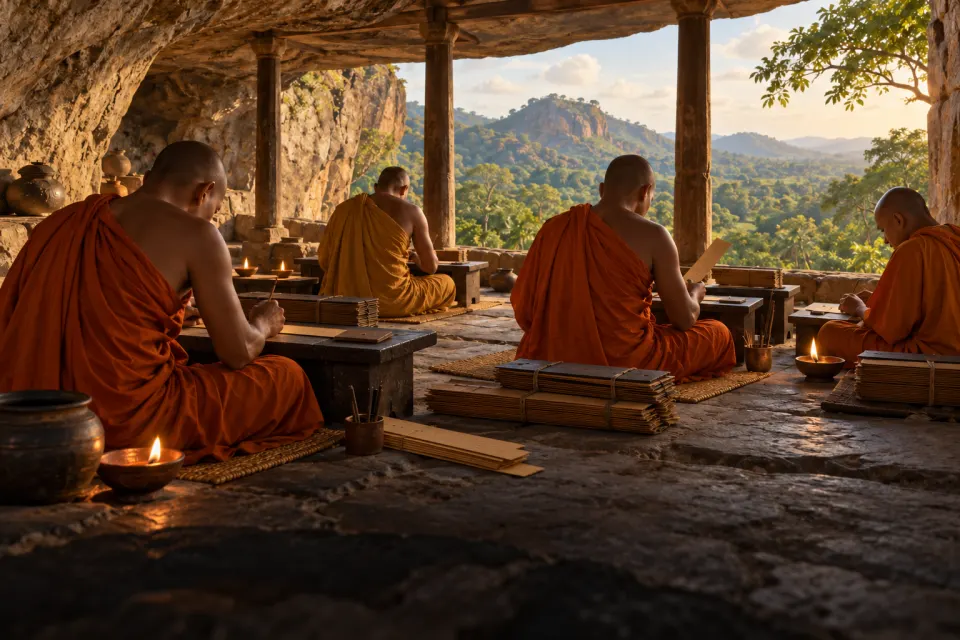
The Elders and the island c. 4th – 1st century BCE
Theravādins trace their line to the Sthaviras, or Elders, the stricter party in Buddhism's first split, set by their tradition at a council about a century after the Buddha's death. Sri Lankan chronicles add that Ashoka backed a third council upholding the Elders' views, though no other school remembers it. By the same chronicles, Ashoka's son Mahinda converted King Devānampiya Tissa, who gave the monks the park at Anurādhapura that became the Mahāvihāra, and his sister Saṅghamittā founded an order of nuns and brought a cutting of the Bodhi tree. In the 1st century BCE monks wrote down the canon, until then carried in memory.[16–19]
Rival monasteries and the great commentator 1st century BCE – 10th century CE
Sri Lanka's monks soon split into fraternities named after their monasteries: the Mahāvihāra; the Abhayagiri, which also housed Mahāyāna and later tantric monks; and the smaller Jetavana. In the 5th century the scholar Buddhaghosa, probably from India, recast the Mahāvihāra's Sinhala commentaries in Pāli, and his works became the standard reading of the canon. On the mainland, Pāli inscriptions show Theravāda among the Pyu of Burma by the 5th or 6th century, and it was strong among the Mon of Dvāravatī in today's Thailand, alongside other Buddhist schools and Hindu cults.[20–22]
Reform and a mainland realm 11th – 16th century
From the 11th century Theravāda won royal favour across the region. Anawrahta of Pagan, the first king of all Burma (r. 1044–1077), adopted it under the Mon monk Shin Arahan. In 12th-century Sri Lanka, Parākramabāhu I expelled lax monks and united the fraternities under Mahāvihāra leadership. Mainland monks went to the island for reordination in this reformed line, and Sinhala-lineage monks carried it to the Thai kingdoms of Sukhothai, Ayutthaya and Lan Na, to Cambodia, and to the Lao kingdom of Lan Xang, founded in 1353. By about 1500 it led from Burma to the Mekong.[23–26]
Colonial pressure and reform 18th – early 20th century
Under Portuguese and Dutch rule Sri Lanka's higher ordination lapsed; in the mid-18th century the king of Kandy brought monks from Siam to restore it, founding the Siam Nikāya, and 19th-century lineages from Burma created the Amarapura and Rāmañña fraternities. In Siam the monk-prince Mongkut founded the stricter Thammayut order before becoming king in 1851. In British Ceylon and Burma, Buddhists answered Christian missions with schools, tracts and lay societies, and reformers presented a rational, ethical Buddhism. Burmese monks such as Ledi Sayadaw began teaching meditation to ordinary lay people.[27–30]
Nations, wars and a world path 1948 – today
After independence Buddhism became bound up with national life. Burma hosted a Sixth Council in Rangoon in 1954–56, where monks from across the Theravāda world recited the whole canon to mark 2,500 years since the Buddha died. Sri Lanka's constitution gives Buddhism "the foremost place" while guaranteeing other religions' rights. In Cambodia the Khmer Rouge shattered the monastic order in the late 1970s; Buddhism has recovered and is again the state religion. Monks led Myanmar's 2007 protests for democracy, while in the 2010s monk-led nationalist groups there and in Sri Lanka campaigned against Muslim minorities, opposed by other Buddhists. Teachers and migrants have carried the tradition west.[31–35]
Key moments
- c. 250 BCEBuddhism reaches Sri Lanka · Anurādhapura, Sri Lanka
- c. 29 BCEThe Pāli Canon written down · Sri Lanka
- c. 1044 CEPagan turns to Theravāda · Bagan (Pagan), Myanmar
- c. 1150 CEAngkor Wat · Angkor, Cambodia
- c. 1165 CEParākramabāhu unifies the saṅgha · Polonnaruwa, Sri Lanka
- c. 1292 CESukhothai's Buddhist kingdom · Sukhothai, Thailand
- 1979 CEInsight meditation goes global · Burma to Massachusetts
Beliefs
Arahant
"worthy one" (Sanskrit arhat)
The tradition's model of perfection is the arahant, a disciple who has uprooted greed, hatred and delusion, reached nibbāna and will not be reborn. Pāli texts mark four stages on the way, beginning with the "stream-enterer". Many Theravādins now think full awakening out of reach, yet some revered meditation masters are widely held to have attained it.[8, 36–37]
The Buddha, past and future
Gotama, the buddha of this age
Theravādins revere Gotama as a human being who perfected virtues such as generosity over many lives before finding the way out of suffering. Though he has passed into final nibbāna, his relics and images are believed to keep something of his power. Earlier buddhas preceded him and Metteyya is still to come; Mahāyāna's bodhisattva cults play little part.[12, 38–39]
The word of the Buddha
the Pāli canon as final authority
Theravādins regard the Pāli Tipiṭaka as the Buddha's own teaching and the last word on doctrine and monastic law. They read it through commentaries written down in the 5th century, and they reject the Mahāyāna sūtras as later works. Historians see the canon as built up in layers, from the Buddha's time to Ashoka's and after.[11, 40–41]
Abhidhamma
"higher teaching"
The third basket of the canon breaks experience into brief events of mind and matter (dhammas) and maps how they condition one another, in 24 kinds of relation. Tradition holds that the Buddha first taught it to his mother in a heaven; scholars see later scholastic work. Myanmar studies it with special devotion.[42–43]
Sīla, samādhi, paññā
ethics, concentration, wisdom
Theravāda teachers commonly group the steps of the Noble Eightfold Path into three trainings: ethical conduct, a steady and concentrated mind, and liberating insight. Buddhaghosa built his Path of Purification on this pattern, and it still frames how monks and lay people describe spiritual progress.[44]
Kamma and merit
kamma, "action"; puñña, "merit"
Intentional deeds bear fruit in this life and later ones. Most lay Buddhists aim less at escaping rebirth soon than at making merit for a good rebirth, for themselves and their families. Feeding monks, keeping precepts, building shrines and sponsoring a son's ordination all make merit, which can be shared.[45–46]
Practice

Alms and giving · piṇḍapāta, dāna
In the early morning monks walk through towns and villages with alms bowls, and householders fill them with cooked food; monks eat no solid food from noon until the next morning. Lay donors also give robes and other necessities. The gift is an exchange: material support flows to the monks, while teaching, blessing and merit flow back.[13, 47]
Ordination, short and long · pabbajjā, upasampadā
A boy or man first becomes a novice (sāmaṇera), keeping ten precepts, and may later take full ordination as a monk. In Myanmar, Thailand, Laos and Cambodia many men ordain for a few weeks or one rains retreat, often in youth: a coming-of-age rite believed to earn merit for their parents, especially their mothers.[48–49]
Meditation · bhāvanā
Teachers distinguish calm (samatha), which steadies the mind into deep absorption, from insight (vipassanā), which watches body and mind to see impermanence, unsatisfactoriness and lack of self. Meditation was long the work of forest and specialist monks; since the 20th century, centres in Myanmar, Thailand and Sri Lanka, using simplified methods such as Mahāsi Sayadaw's, have trained great numbers of laypeople.[50–51]
Holy days and precepts · uposatha
On four days of each lunar month, devout lay people visit the monastery, offer flowers, hear a sermon and may keep eight precepts for the day, including fasting after noon; many wear white. At new and full moon the monks confess faults and recite their 227-rule code, the Pāṭimokkha.[52–53]
Protective rites · paritta
Monks chant paritta, protective texts from the canon, at blessings, in sickness and in times of public danger, and water sanctified by the chanting is sprinkled for protection. These rites sit alongside amulets blessed by famous monks, offerings to local spirits and guardian deities, and astrology.[54–55]
Holy days
The year ahead
| Date | Holy day | Reckoned |
|---|---|---|
| 26 October 2026 | Pavāraṇā (end of Vassa) | Āśvina śukla pūrṇimā, the tithi at sunrise |
| 27 October 2026 – 24 November 2026 | Kaṭhina season | 1 day after Āśvina śukla pūrṇimā, the tithi at sunrise |
| 21 February 2027 | Makha Bucha (Thailand) | from published calendars |
| 21 February 2027 | Māgha Pūjā (Navam Poya) | Māgha śukla pūrṇimā, the tithi at sunrise |
| 20 May 2027 | Vesak Visākha Pūjā | Vaiśākha śukla pūrṇimā, the tithi at sunrise |
| 20 May 2027 | Visakha Bucha (Thailand) | from published calendars |
| 18 July 2027 | Asahna Bucha (Thailand) | from published calendars |
| 18 July 2027 | Āsāḷha Pūjā (Esala Poya) | Āṣāḍha śukla pūrṇimā, the tithi at sunrise |
| 19 July 2027 | Khao Phansa, Vassa begins (Thailand) | from published calendars |
| 19 July 2027 | Vassa begins | 1 day after Āṣāḍha śukla pūrṇimā, the tithi at sunrise |
Vesak · Visākha Pūjā
Full moon of Vesākha (April–May, sometimes June)
Theravādins hold that the Buddha's birth, awakening and final passing all fell on this full moon. People keep precepts, hear sermons, light lamps and make offerings. Its modern public form, with lights, cards and processions, grew out of Sri Lanka's 19th-century Buddhist revival.[56]
Vassa (rains retreat)
About July to October, 8th to 11th lunar month
For three months monks stay in one monastery to study and meditate, and a monk's seniority is counted in rains retreats. Many young men ordain just for this season. Its start and end are among the year's biggest festivals in Myanmar, Thailand, Cambodia and Laos.[57]
Kaṭhina
The month after the rains retreat (October–November)
Lay communities present new robes and other gifts to a monastery, often in processions with a "wishing tree" hung with presents. It is among the most meritorious giving of the year.[58]
People
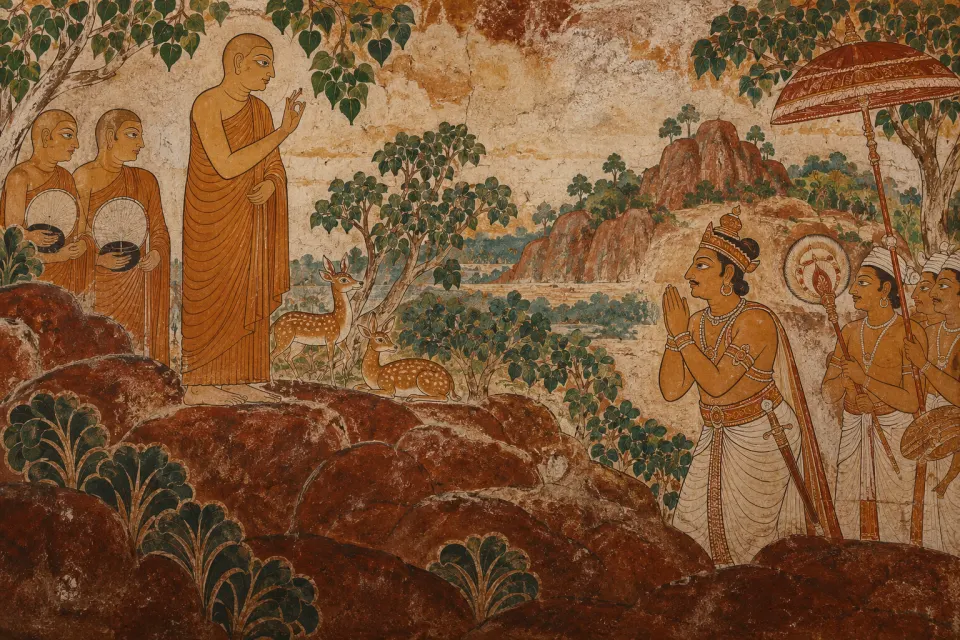
Mahinda
saint · 3rd century BCE
The monk whom Sri Lankan tradition calls Ashoka's son and credits with bringing Buddhism to the island. He is said to have met King Devānampiya Tissa on the hill of Mihintale, converted him, and settled his monks in the royal park that became the Mahāvihāra.[59]

Buddhaghosa
scholar · fl. 5th century CE
The most influential Theravāda commentator. Probably from India, though his birthplace is disputed, he worked at the Mahāvihāra, put its Sinhala commentaries into Pāli and wrote the Visuddhimagga. A Southeast Asian tradition, with no supporting evidence, says he went to Burma late in life.[60]

Mongkut (Rama IV)
ruler · 1804–1868
Thai prince who spent more than 25 years as a monk. Convinced by a Mon monk that Mon practice was more faithful to the Vinaya, he was reordained and began the Thammayut order. As king from 1851 he opened Siam to Western trade and learning.[61]

Anagārika Dharmapāla
other · 1864–1933
Sinhala lay reformer, born David Hewavitarne, who lived celibate as an anagārika, "homeless one", without becoming a monk. He founded the Maha Bodhi Society in 1891 to restore Buddhist control of Bodh Gayā, spoke at Chicago's 1893 World's Parliament of Religions, and championed a modernist Sinhala Buddhist revival.[62]

Ledi Sayadaw
teacher · 1846–1923
Burmese scholar-monk who, after the British took the whole of Burma in 1885, popularised the study of Abhidhamma and simplified meditation for lay people. Historians regard him as a chief founder of the mass lay insight-meditation movement.[63]

Ajahn Mun Bhūridatta
teacher · early–mid 20th century
Wandering meditation monk of northeast Thailand who, with Ajahn Sao, founded the forest meditation tradition, stressing strict monastic discipline and methods drawn from the Pāli canon. Many Thais regard him as an arahant, and the movement has since spread beyond Thailand, including to the West.[64]
Scripture
Vinaya Piṭaka
compiled c. 5th–3rd century BCE
The "Basket of Discipline": the rules for monks and nuns, each with a story of why the Buddha laid it down, and the procedures for ordination, ceremonies and disputes. Its core list of rules, the Pāṭimokkha, is recited at the fortnightly assembly.[65]
Sutta Piṭaka
The Buddha's discourses, arranged in five collections (nikāyas): long, middle-length, thematically grouped and numerically ordered sermons, plus a fifth, "minor" collection. Much of it has parallels in the canons of other early Indian schools.[66]
Abhidhamma Piṭaka
Seven books, unique to Theravāda, that classify mental and physical phenomena and their relations. One of them, the Kathāvatthu ("Points of Controversy"), ascribed to Moggaliputta Tissa, defends more than 200 Theravāda positions against other schools.[67]
Jātaka
Some 550 tales of the Buddha's former lives as king, outcast, god or animal, each modelling a virtue, gathered with a commentary in Sri Lanka around the 5th century. Scenes from the tales are painted and carved on temple walls throughout the Theravāda world.[68]
Milindapañha
c. 1st–2nd century CE
"The Questions of King Milinda": dialogues in which the monk Nāgasena answers the Indo-Greek king Menander on puzzles such as rebirth without a soul. Usually treated as outside the canon, it was nonetheless quoted as an authority by Buddhaghosa.[69]
Visuddhimagga
5th century CE
"The Path of Purification", Buddhaghosa's summary of Mahāvihāra doctrine, arranged under ethics, concentration and wisdom. It describes meditation methods in detail and contains much of Theravāda Abhidhamma; it remains the classic handbook of the tradition.[70]
Places
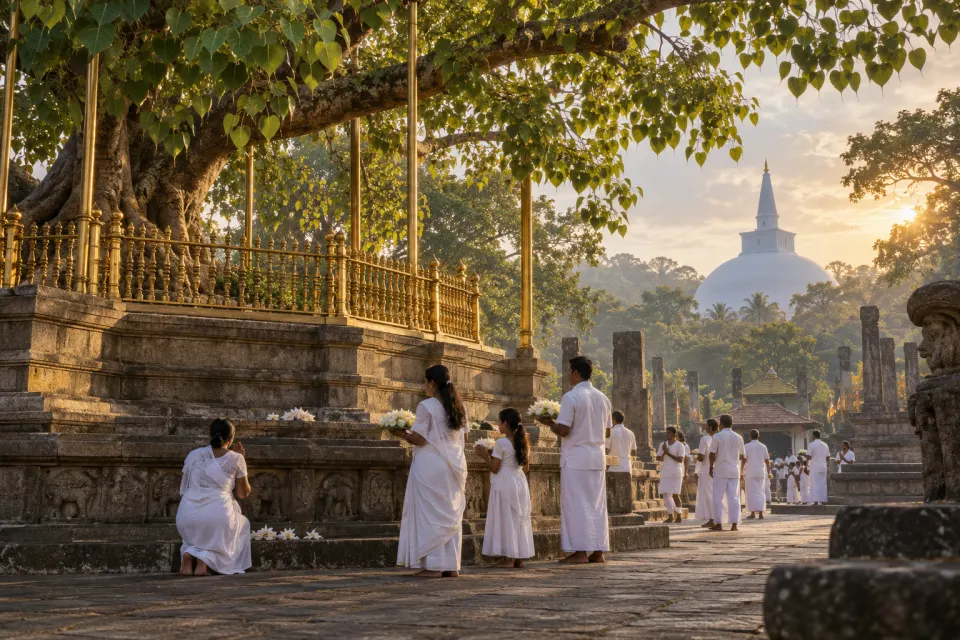
Sri Mahā Bodhi and the Mahāvihāra, Anurādhapura
LKA · UNESCO World Heritage, 1982
The ancient Sinhala capital, where a fig tree held to grow from Saṅghamittā's cutting of the Bodhi tree stands near the ruins of the Mahāvihāra, Abhayagiri and Jetavana. Rediscovered in the 19th century, it is a pilgrimage centre and UNESCO World Heritage site.[71]
Temple of the Tooth, Kandy
LKA · UNESCO World Heritage, 1988
Sri Lanka's most important shrine, beside the old royal palace, said to hold a tooth of the Buddha. The relic long symbolised the right to rule. The temple is part of the Sacred City of Kandy, a UNESCO World Heritage site.[72]
Shwedagon Pagoda, Yangon
MMR
A gilded brick stūpa about 99 metres high on a hill above Yangon, Myanmar's most sacred shrine. Tradition says it enshrines hairs of the Buddha and objects of three earlier buddhas.[73]
Bagan
MMR · UNESCO World Heritage, 2019
Capital of the Pagan kingdom from the 11th to the late 13th century, where donors led by the kings built thousands of temples and stūpas to make merit; 3,595 monuments are recorded. It became a UNESCO World Heritage site in 2019.[74]
Luang Prabang
LAO · UNESCO World Heritage, 1995
Royal and religious centre of Laos, named after the Prabang, a revered Buddha image said to have come from Sri Lanka by way of Cambodia. Its many monasteries and the monks' morning alms round make it a living Theravāda town and a UNESCO World Heritage site.[75]
Art & objects
Public-domain objects from museum collections. Select one to see it at the museum.
 Buddha Standing with Hand in the Gesture of Reassurance (Abhayamudra) with Radiating NimbusSri Lanka, Kandyan period (1480–1815)
 Buddha Seated in Meditation (Dhyanamudra)Sri Lanka, Kandyan period, 18th century
 Jeweled and Crowned Buddha (Jambupati)Myanmar, c. 17th century
 Plaque with Buddha Triumphing over MaraThailand, Ayutthaya period, 15th–16th century
 Head of BuddhaThailand, Ayutthaya, 14th-15th century, 1350–1425
 Seated BuddhaThailand, Chiang Mai, Chiengsen Period, 15th Century, c. 1400s
 The Paranirvana of Buddha, Gal Vihara, Polonnaruva, CeylonEngland, 19th century, 1870–71
 Standing Crowned and Jeweled BuddhaBurma, Pagan period, 12th–13th century
 Seated BuddhaCambodia, 19th century
 Seated BuddhaThailand, ca. 19th century
 Seated BuddhaSri Lanka, Anuradhapura period, ca. late 7th century
 Buddha Expounding the DharmaSri Lanka (Anuradhapura), late Anuradhapura period (750–850), late 8th century
 Scenes from Life of the BuddhaMyanmar (Burma), Mandalay, 1880s
Numbers
- Theravāda Buddhists worldwide
- c. 150 million (estimate)[9]
Censuses do not count Buddhist branches. Pew (2020) finds 68 million Buddhists in Thailand and Buddhist majorities in Cambodia, Myanmar, Sri Lanka and Laos; a reference work gives "more than 150 million".
- Rules in the monks' code (Pāṭimokkha)
- 227[53]
National censuses
| Country | Year | Count | Share |
|---|---|---|---|
| New Zealand Theravada Buddhism | 2018 | 4,851 | 0.1% |
Source: Stats NZ, 2018 Census, licensed by Stats NZ for re-use under the Creative Commons Attribution 4.0 International licence.
How we know
The chronicles and their limits
Much of the early story comes from Pāli chronicles written by monks: the Dīpavaṃsa (4th century) and the Mahāvaṃsa (5th or 6th century), continued by the Cūlavaṃsa. They tell sacred history from the Mahāvihāra's viewpoint and mix legend with record. Ashoka's own inscriptions confirm a mission to Sri Lanka, but archaeology suggests Buddhism reached the mainland piecemeal, through several schools.[76]
What "Theravāda" means
Before the 20th century, theravāda named a monastic lineage defined by its rules of ordination and discipline, not a separate religion. Only in the 20th century did "Theravāda Buddhism" become the name of a whole type of Buddhism, often imagined as the original one. Historians stress that premodern Theravāda monks also used Mahāyāna and tantric texts and practices, later pushed to the margins by reform.[77]
Common misconceptions
Myth Theravāda is the same thing as "Hīnayāna".
Fact Hīnayāna, "lesser vehicle", is a disparaging label that Mahāyāna authors gave to the older schools, which never used it of themselves. Theravāda is the only one of those early schools to survive, and its followers do not accept the name.[78]
Myth Theravāda is original Buddhism, unchanged since the Buddha.
Fact Theravādins regard their tradition as the faithful keeper of the Buddha's teaching, but historians find no school that has preserved early Buddhism unaltered. Theravāda's canon grew in layers, its orthodoxy was defined by medieval royal reforms, and its modern self-image took shape in the 19th and 20th centuries.[15]
Myth Theravāda Buddhists mainly meditate and have little ritual.
Fact For most of its history meditation was a specialist pursuit of some monks. Lay religion has centred on giving to monks, keeping precepts, honouring images and relics, festivals and protective chanting. Meditation for large numbers of lay people is largely a 20th-century development.[79]
Glossary
- Bhikkhu
- A fully ordained Buddhist monk, bound by the Pāṭimokkha and traditionally living on alms; the word comes from a root meaning "to beg".[80]
- Sāmaṇera
- A novice who has "gone forth" (pabbajjā), shaving the head, taking the robes and ten precepts; in some Theravāda countries boys are ordained as novices around puberty.[48]
- Bhikkhunī
- A fully ordained nun. The Theravāda nuns' order died out in the medieval period; ordinations since the late 1990s are not recognised by most monks, and many women live instead as renunciants keeping eight or ten precepts.[81]
- Nikāya
- An ordination lineage or monastic fraternity, such as Thailand's Mahānikāya and Thammayut or Sri Lanka's Siam, Amarapura and Rāmañña; also one of the five collections of the Sutta Piṭaka.[82]
- Pāṭimokkha
- The core code of monastic rules in the Vinaya, 227 for monks in the Pāli version, recited at the fortnightly uposatha assembly.[53]
- Vipassanā
- "Insight": meditation that uses mindfulness to see impermanence, unsatisfactoriness and not-self in body and mind; the basis of the modern insight-meditation movement.[50–51]
- Paritta
- "Protection": canonical texts chanted by monks to ward off danger and illness and to bless people and places.[54]
- Aṭṭhakathā
- Commentary on the canon. The standard Pāli commentaries were written mostly in the 5th century, by Buddhaghosa and others, from older Sinhala ones.[40]
- Cetiya
- A stūpa or relic mound, called dāgaba in Sri Lanka; devotees walk around it with flowers, incense and lamps.[83]
Sources
Each statement above was checked against published sources; the verdict says whether it stood as written, was corrected or was hedged.
- VerifiedBritannica, Pali canon; Encyclopedia of Religion; Encyclopedia of Global Religion.
- VerifiedBritannica, Theravada; Encyclopedia of Religion; Encyclopedia of Global Religion.
- VerifiedBritannica, Pali canon; Harvard Pluralism Project, Theravada: The Way of the Elders; Encyclopedia of Buddhism.
- VerifiedBritannica, Pāli language; Encyclopedia of Religion.
- VerifiedBritannica, bhikku; Encyclopedia of Buddhism; Encyclopedia of Religion.
- VerifiedEncyclopedia of Buddhism; UNESCO WHC, Town of Luang Prabang; Britannica, Anuradhapura.
- VerifiedBritannica, Theravada; Encyclopedia of Religion; Pew Research Center, Buddhist population change.
- VerifiedBritannica, Theravada; Britannica, arhat; Encyclopedia of Religion; Harvard Pluralism Project, Theravada: The Way of the Elders (supporting).
- HedgedEncyclopedia of Global Religion; Pew Research Center, Buddhist population change; Worldmark Encyclopedia of Religious Practices (supporting).
- VerifiedEncyclopedia of Religion; Britannica, Theravada.
- VerifiedHarvard Pluralism Project, Theravada: The Way of the Elders; Britannica, Theravada; Encyclopedia of Buddhism.
- VerifiedWorldmark Encyclopedia of Religious Practices; Harvard Pluralism Project, Theravada: The Way of the Elders; Britannica, Theravada; Britannica, Jataka.
- VerifiedBritannica, Buddhism: Popular religious practices; Britannica, bhikku; Encyclopedia of Buddhism.
- VerifiedBritannica, Buddhism in the contemporary world; Encyclopedia of Global Religion; Encyclopedia of Religion.
- VerifiedEncyclopedia of Religion; Sven Bretfeld, Theravāda Buddhism, Oxford Research Encyclopedia of Religion.
- VerifiedBritannica, Buddhist council; Britannica, Theravada; Encyclopedia of Religion.
- VerifiedEncyclopedia of Religion; Britannica, Buddhist council.
- VerifiedBritannica, Sri Lanka: Conversion to Buddhism; Encyclopedia of Religion; UNESCO WHC, Sacred City of Anuradhapura.
- VerifiedEncyclopedia of Religion; Britannica, Pali canon; Britannica, Buddhism: Historical development.
- VerifiedEncyclopedia of Religion; Britannica, Theravada; Britannica, Buddhism: Historical development; UNESCO WHC, Sacred City of Anuradhapura.
- VerifiedBritannica, Buddhaghosa; Encyclopedia of Religion; Encyclopedia of Global Religion.
- VerifiedEncyclopedia of Religion, Buddhism: Buddhism in Southeast Asia, Encyclopedia.com; Encyclopedia of Religion; Britannica, Buddhism: Southeast Asia; Encyclopedia of Global Religion.
- VerifiedBritannica, Buddhism: Southeast Asia; Encyclopedia of Religion; Sven Bretfeld, Theravāda Buddhism, Oxford Research Encyclopedia of Religion.
- VerifiedBritannica, Anawrahta; Encyclopedia of Religion.
- VerifiedBritannica, Parākramabāhu I; Encyclopedia of Religion; Britannica, Buddhism: Historical development.
- VerifiedEncyclopedia of Religion; Encyclopedia of Religion, Buddhism: Buddhism in Southeast Asia, Encyclopedia.com; Britannica, Fa Ngum; Britannica, Buddhism: Southeast Asia.
- VerifiedBritannica, Buddhism: Historical development; Encyclopedia of Religion.
- VerifiedBritannica, Mongkut; Encyclopedia of Religion, Mongkut, Encyclopedia.com; Britannica, Buddhism: Southeast Asia.
- VerifiedBritannica, Buddhism in the contemporary world; Encyclopedia of Religion; World Religions Reference Library.
- VerifiedEncyclopedia of Religion, Buddhism: Buddhism in Southeast Asia, Encyclopedia.com; University of Chicago Press, Erik Braun, The Birth of Insight: Meditation, Modern Buddhism, and the Burmese Monk Ledi Sayadaw; H-Net Reviews.
- VerifiedBritannica, Buddhist council; Encyclopedia of Religion.
- VerifiedParliament of Sri Lanka, The Constitution of the Democratic Socialist Republic of Sri Lanka; Law and Politics Book Review.
- VerifiedEncyclopedia of Religion; Britannica, Buddhism: Southeast Asia; Britannica, Buddhism in the contemporary world.
- VerifiedBritannica, Buddhism in the contemporary world; B. Schonthal and M. Walton, The; Camilla Orjuela, Countering Buddhist radicalisation: emerging peace movements in Myanmar and Sri Lanka, Third World Quarterly 41.
- VerifiedEncyclopedia of Buddhism, Vipassanā, Encyclopedia.com; Harvard Pluralism Project, Theravada: The Way of the Elders; Britannica, Buddhism in the contemporary world.
- VerifiedBritannica, arhat; Worldmark Encyclopedia of Religious Practices.
- VerifiedEncyclopedia of Buddhism; S. J. Tambiah, The Buddhist Saints of the Forest and the Cult of Amulets; Encyclopedia of Religion.
- VerifiedEncyclopedia of Buddhism; Britannica, Buddhism: Popular religious practices.
- VerifiedEncyclopedia of Buddhism; Britannica, Theravada; Worldmark Encyclopedia of Religious Practices.
- VerifiedBritannica, Visuddhimagga; Encyclopedia of Religion; Encyclopedia of Global Religion; Britannica, Pali canon.
- VerifiedEncyclopedia of Religion; Britannica, Abhidhamma Pitaka.
- VerifiedNoa Ronkin, Abhidharma, Stanford Encyclopedia of Philosophy; Britannica, Abhidhamma Pitaka; Encyclopedia of Religion.
- VerifiedEncyclopedia of Buddhism; Encyclopedia of Religion, Buddhist Religious Year, Encyclopedia.com; Britannica, Abhidhamma Pitaka; Encyclopedia of Religion.
- VerifiedWorldmark Encyclopedia of Religious Practices; Britannica, Visuddhimagga.
- VerifiedEncyclopedia of Buddhism; Worldmark Encyclopedia of Religious Practices; Britannica, Vesak.
- VerifiedUNESCO WHC, Bagan; Encyclopedia of Buddhism; Britannica, Vesak; Worldmark Encyclopedia of Religious Practices.
- VerifiedBritannica, bhikku; UNESCO WHC, Town of Luang Prabang; Worldmark Encyclopedia of Religious Practices.
- VerifiedBritannica, pabbajjā; Encyclopedia of Buddhism.
- VerifiedEncyclopedia of Buddhism; Encyclopedia of Religion; Britannica, vassa.
- VerifiedEncyclopedia of Buddhism, Vipassanā, Encyclopedia.com; Britannica, Buddhist meditation.
- VerifiedEncyclopedia of Religion, Buddhism: Buddhism in Southeast Asia, Encyclopedia.com; Encyclopedia of Religion; H-Net Reviews; Ohio University Press, Ingrid Jordt, Burma's Mass Lay Meditation Movement; Melton's Encyclopedia of American Religions.
- VerifiedBritannica, Buddhism: Popular religious practices; Britannica, uposatha; Worldmark Encyclopedia of Religious Practices.
- VerifiedBritannica, uposatha; Encyclopedia of Buddhism; Britannica, Vinaya Piṭaka.
- VerifiedBritannica, Buddhism: Popular religious practices; Encyclopedia of Religion, Buddhist Religious Year, Encyclopedia.com.
- VerifiedEncyclopedia of Religion; Encyclopedia of Buddhism; Britannica, Pagan; S. J. Tambiah, The Buddhist Saints of the Forest and the Cult of Amulets.
- VerifiedBritannica, Vesak; Encyclopedia of Religion, Buddhist Religious Year, Encyclopedia.com; Britannica, Buddhism: Popular religious practices.
- VerifiedBritannica, vassa; Britannica, Buddhism: Popular religious practices; Encyclopedia of Religion, Buddhist Religious Year, Encyclopedia.com.
- VerifiedBritannica, vassa; Britannica, Buddhism: Popular religious practices; Encyclopedia of Religion, Buddhist Religious Year, Encyclopedia.com.
- VerifiedBritannica, Sri Lanka: Conversion to Buddhism; Encyclopedia of Religion.
- VerifiedBritannica, Buddhaghosa; Encyclopedia of Religion.
- VerifiedEncyclopedia of Religion, Mongkut, Encyclopedia.com; Britannica, Mongkut.
- VerifiedWorld Religions Reference Library; Bhadrajee Hewage, Anagarika Dharmapala; Britannica, Maha Bodhi Society; Harvard Pluralism Project, At the 1893 World's Parliament of Religions; Encyclopedia of Religion.
- VerifiedDouglas Ober, review of Braun, The Birth of Insight, Journal of Buddhist Ethics 22; University of Chicago Press, Erik Braun, The Birth of Insight: Meditation, Modern Buddhism, and the Burmese Monk Ledi Sayadaw; H-Net Reviews.
- HedgedS. J. Tambiah, The Buddhist Saints of the Forest and the Cult of Amulets; Encyclopedia of Buddhism, Wilderness Monks, Encyclopedia.com; Encyclopedia of Religion, Buddhism: Buddhism in Southeast Asia, Encyclopedia.com.
- VerifiedBritannica, Vinaya Piṭaka; Encyclopedia of Religion; Britannica, uposatha.
- VerifiedBritannica, Sutta Pitaka; Encyclopedia of Religion.
- VerifiedBritannica, Abhidhamma Pitaka; Encyclopedia of Religion.
- VerifiedBritannica, Jataka; Encyclopedia of Buddhism.
- VerifiedBritannica, Milinda-panha; Encyclopedia of Buddhism, Milindapañha, Encyclopedia.com.
- VerifiedBritannica, Visuddhimagga; Encyclopedia of Religion; Noa Ronkin, Abhidharma, Stanford Encyclopedia of Philosophy.
- VerifiedBritannica, Anuradhapura; Britannica, Sri Lanka: Conversion to Buddhism; Encyclopedia of Religion; UNESCO WHC, Sacred City of Anuradhapura.
- VerifiedBritannica, Temple of the Tooth; John Bowker; UNESCO WHC, Sacred City of Kandy.
- VerifiedBritannica, Yangon; UNESCO WHC Tentative List, Shwedagon Pagoda on Singuttara Hill.
- VerifiedUNESCO WHC, Bagan; Britannica, Pagan.
- VerifiedBritannica, Louangphrabang; UNESCO WHC, Town of Luang Prabang; Britannica, Fa Ngum.
- VerifiedBritannica, Mahāvaṃsa; Encyclopedia of Religion; Encyclopedia of Buddhism; Encyclopedia of Global Religion.
- VerifiedSven Bretfeld, Theravāda Buddhism, Oxford Research Encyclopedia of Religion; Encyclopedia of Buddhism; Encyclopedia of Religion.
- VerifiedBritannica, Hīnayāna; Encyclopedia of Religion; Worldmark Encyclopedia of Religious Practices.
- VerifiedEncyclopedia of Buddhism; Encyclopedia of Religion, Buddhism: Buddhism in Southeast Asia, Encyclopedia.com; Britannica, Buddhism in the contemporary world.
- VerifiedBritannica, bhikku; Encyclopedia of Buddhism.
- VerifiedEncyclopedia of Buddhism; Encyclopedia of Religion; Britannica, Buddhism in the contemporary world; Worldmark Encyclopedia of Religious Practices.
- VerifiedEncyclopedia of Buddhism; Encyclopedia of Religion; Britannica, Sutta Pitaka.
- VerifiedBritannica, Anuradhapura; Encyclopedia of Religion, Buddhist Religious Year, Encyclopedia.com; Britannica, Buddhism: Popular religious practices; UNESCO WHC Tentative List, Shwedagon Pagoda on Singuttara Hill.
Last fact-checked 3 October 2026.