
The story behind the day
Māgha Pūjā is a Theravāda holy day kept on the full moon of the third lunar month, which brings it to February or March. By tradition it recalls a gathering at Veluvana, where 1,250 enlightened disciples came to the Buddha without being summoned and he taught them the Ovāda Pātimokkha. In Thailand it is Makha Bucha, marked with candlelit ceremonies. In Sri Lanka, Navam Poya, on the February full moon, also recalls the Ovāda Pātimokkha, along with the naming of the Buddha's two chief disciples.[1–6]
Origins
Thai Buddhists call the event the Fourfold Assembly, and describe it by four features: it fell on the full moon of the third lunar month; about 1,250 monks, all of them arahants, came without prior arrangement; the Buddha had ordained each of them himself; and he delivered the Ovāda Pātimokkha. A standard reference work on the Buddhist year describes the gathering as the founding of the saṃgha at Veluvana. The teaching is summed up as refraining from evil, cultivating good and purifying the mind.[7–9]
How it came to be
The observance took different forms in different countries. Thailand had no such ceremony until King Mongkut (Rama IV) came to the throne, and he designated Makha Bucha an important Buddhist holy day within his wider reform of the monastic order. In Sri Lanka and Thailand alike the day is tied to the preaching of the Ovāda Pātimokkha, though Sri Lankan accounts also place on this full moon the naming of Sāriputta and Moggallāna as chief disciples. They add a graver note: at the Chapala shrine in Vesālī the Buddha is said to have set aside his will to live, announcing that his final passing would come in three months.[4–5, 10–11]
How it is kept
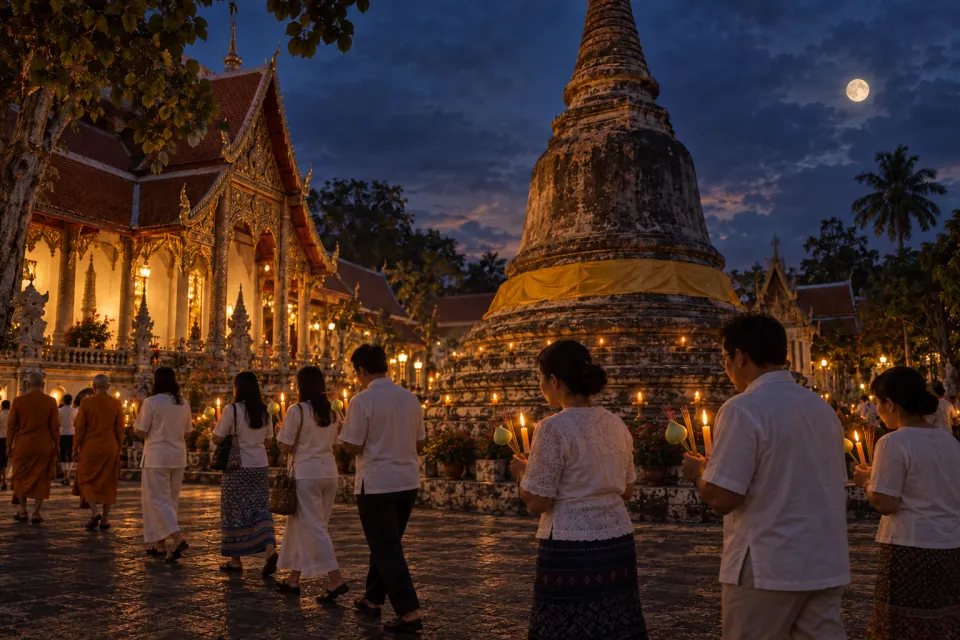
In Thailand crowds gather at temples at dusk to walk around the cetiya, then hear chanting and a sermon, and Buddhists join candlelit processions and make merit. Like every full-moon day in the Theravāda year, it is also an uposatha, a day when lay followers take extra precepts and gather at a monastery for teaching, while monks recite the monastic code. In Sri Lanka the full moons are called poya, a word derived from uposatha.[3, 12]
Across traditions
The two observances need not fall together. In 2026 Sri Lanka kept Navam Poya on 1 February, while Thailand kept Makha Bucha on 3 March.[6]
Sources
Each statement above was checked against published sources; the verdict says whether it stood as written, was corrected or was hedged.
- VerifiedEncyclopedia.com, Donald K. Swearer, Buddhist Religious Year, Encyclopedia of Religion; Suan Sunandha Rajabhat University, Office of Arts and Culture, 6 March Makha Bucha Day.
- VerifiedSuan Sunandha Rajabhat University, Office of Arts and Culture, 6 March Makha Bucha Day; Encyclopedia.com, Donald K. Swearer, Buddhist Religious Year, Encyclopedia of Religion.
- CorrectedEncyclopedia.com, Donald K. Swearer, Buddhist Religious Year, Encyclopedia of Religion; Suan Sunandha Rajabhat University, Office of Arts and Culture, 6 March Makha Bucha Day; Dhammakaya Foundation, Magha Puja Day (supporting).
- CorrectedD. Kariyawasam, Buddhist Ceremonies and Rituals of Sri Lanka; Ministry of Mass Media, Government of Sri Lanka, Today is the Navam Full Moon Poya Day.
- VerifiedMinistry of Mass Media, Government of Sri Lanka, Today is the Navam Full Moon Poya Day; Suan Sunandha Rajabhat University, Office of Arts and Culture, 6 March Makha Bucha Day.
- CorrectedCentral Bank of Sri Lanka, Bank Holidays 2026; Ministry of Mass Media, Government of Sri Lanka, Today is the Navam Full Moon Poya Day; Bank of Thailand, Notification No. 31/2568, Financial institutions' holidays for B.E. 2569; Royal Thai Embassy, Abu Dhabi.
- VerifiedSuan Sunandha Rajabhat University, Office of Arts and Culture, 6 March Makha Bucha Day; Encyclopedia.com, Donald K. Swearer, Buddhist Religious Year, Encyclopedia of Religion; Thai Folk, Magha Puja (supporting).
- CorrectedEncyclopedia.com, Donald K. Swearer, Buddhist Religious Year, Encyclopedia of Religion; Suan Sunandha Rajabhat University, Office of Arts and Culture, 6 March Makha Bucha Day.
- CorrectedSuan Sunandha Rajabhat University, Office of Arts and Culture, 6 March Makha Bucha Day; Encyclopedia.com, Donald K. Swearer, Buddhist Religious Year, Encyclopedia of Religion.
- VerifiedSuan Sunandha Rajabhat University, Office of Arts and Culture, 6 March Makha Bucha Day; King Mongkut's University of Technology Thonburi Library, The Siamese King Who Opened the Door to the Civilized World; Encyclopedia.com, Donald K. Swearer, Buddhist Religious Year, Encyclopedia of Religion.
- VerifiedMinistry of Mass Media, Government of Sri Lanka, Today is the Navam Full Moon Poya Day; D. Kariyawasam, Buddhist Ceremonies and Rituals of Sri Lanka; Access to Insight, Maha-parinibbana Sutta.
- VerifiedEncyclopedia.com, Uposatha, The Concise Oxford Dictionary of World Religions; D. Kariyawasam, Buddhist Ceremonies and Rituals of Sri Lanka.