The story behind the day
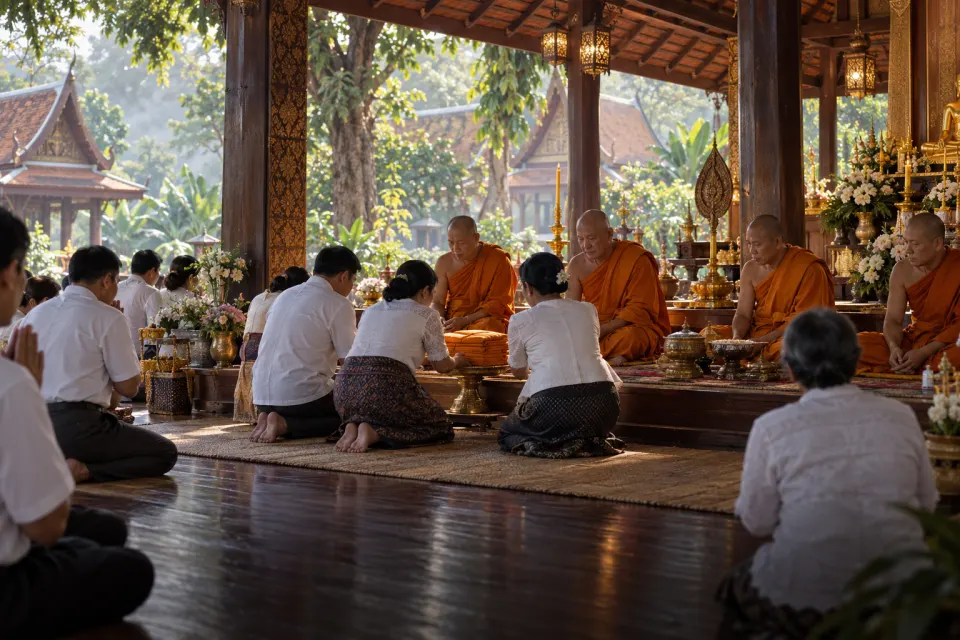
Pavāraṇā and Kaṭhina close the Theravāda rains retreat. Pavāraṇā, the monks' Invitation, falls on the full moon of the eleventh lunar month, in October: each monk invites the others to point out any fault, and the retreat ends. The month that follows is the kaṭhina season, when laypeople offer cloth to the community of monks who have kept the retreat, and the community makes it into a robe within a single day. In Thailand the king, or a royal delegate, presents robes at royal temples, and in some years the king travels in the Royal Barge Procession to Wat Arun.[1–5]
Origins

The Vinaya records how the kaṭhina began. When monks came to pay their respects to the Buddha after the Rains, their robes were soaking wet, and he allowed the kaṭhina transaction. Thai tradition holds that it was monks who had finished the rains retreat who received permission to get new robes. The Invitation that ends the retreat has its own rule: in place of the usual recitation of the monastic code, each monk asks his fellows to tell him of any fault.[1, 9–10]
What it marks
Pavāraṇā is a moment of mutual accountability for the monks, and kaṭhina is the layperson's turn to give: laypeople offer new robes to monks who have completed the retreat. In Thailand the end of Buddhist Lent, Ok Phansa, comes at the full moon of the eleventh lunar month, and the kaṭhina offering follows in the month after the retreat. In Sri Lanka the retreat closes on the October full moon, Vap Poya.[2–3, 6, 8]
How it came to be
In the Vinaya the kaṭhina is a formal act. Donors present a community of at least five monks with cloth, the community bestows it on one monk who has spent the Rains without a break, and he makes it into a robe, which must be finished before the following dawn. In Thailand the kaṭhina period begins on the first waning day of the eleventh month and ends at the full moon of the twelfth, and a monastery receives it only once a year.[7, 11]
How it is kept

Kaṭhina ceremonies are often marked by processions. In Thailand the procession winds through the village and into the monastery hall, carrying robes, money and a wishing tree, and across Myanmar, Thailand, Laos and Cambodia the wishing tree is a familiar feature. The king's presentation of kaṭhina robes is an important annual ceremony in Thailand: by tradition he goes by land or water, and in some years in the Royal Barge Procession, as on 27 October 2024, when the King and Queen travelled to offer robes at Wat Arun. Tak Bat Devo, an alms-giving procession led by a Buddha image, comes at the end of the retreat in Thailand.[5, 12–13]
Sources
Each statement above was checked against published sources; the verdict says whether it stood as written, was corrected or was hedged.
- VerifiedD. Kariyawasam, Buddhist Ceremonies and Rituals of Sri Lanka; Thanissaro Bhikkhu, The Buddhist Monastic Code II, ch. 11 Rains-residence; Thammasat Museum of Anthropology, Ok Phansa; University of Pennsylvania, Thai Digital Monastery, Ritual and Liturgy.
- VerifiedThammasat Museum of Anthropology, Ok Phansa; University of Pennsylvania, Thai Digital Monastery, Ritual and Liturgy; Encyclopedia.com, Donald K. Swearer, Buddhist Religious Year, Encyclopedia of Religion.
- VerifiedD. Kariyawasam, Buddhist Ceremonies and Rituals of Sri Lanka; University of Pennsylvania, Thai Digital Monastery, Ritual and Liturgy; Spurlock Museum, University of Illinois, Clark Cunningham, Thot Kathin: The ceremonial presentation of new robes and gifts to Buddhist monks.
- VerifiedD. Kariyawasam, Buddhist Ceremonies and Rituals of Sri Lanka; Thanissaro Bhikkhu, The Buddhist Monastic Code II, ch. 17 Kaṭhina.
- CorrectedKMUTT Library, Chapter 13: Royal Duties in Literature, Museums, and Culture; Royal Thai Embassy in Dili; Spurlock Museum, University of Illinois, Clark Cunningham, Thot Kathin: The ceremonial presentation of new robes and gifts to Buddhist monks.
- VerifiedD. Kariyawasam, Buddhist Ceremonies and Rituals of Sri Lanka; Central Bank of Sri Lanka, Bank Holidays 2026.
- VerifiedThammasat Museum of Anthropology, Ok Phansa; Walailak Abode of Culture, Walailak University, Kathin ceremony; Spurlock Museum, University of Illinois, Clark Cunningham, Thot Kathin: The ceremonial presentation of new robes and gifts to Buddhist monks; D. Kariyawasam, Buddhist Ceremonies and Rituals of Sri Lanka.
- VerifiedD. Kariyawasam, Buddhist Ceremonies and Rituals of Sri Lanka; Thammasat Museum of Anthropology, Ok Phansa; University of Pennsylvania, Thai Digital Monastery, Ritual and Liturgy.
- VerifiedThanissaro Bhikkhu, The Buddhist Monastic Code II, ch. 17 Kaṭhina; Thammasat Museum of Anthropology, Ok Phansa; KMUTT Library, Chapter 13: Royal Duties in Literature, Museums, and Culture.
- VerifiedThammasat Museum of Anthropology, Ok Phansa; Walailak Abode of Culture, Walailak University, Kathin ceremony.
- VerifiedThanissaro Bhikkhu, The Buddhist Monastic Code II, ch. 17 Kaṭhina; D. Kariyawasam, Buddhist Ceremonies and Rituals of Sri Lanka; Walailak Abode of Culture, Walailak University, Kathin ceremony.
- CorrectedPeaceful Societies, University of North Carolina at Greensboro, Kathina Ceremony of Rural Thailand; Encyclopedia.com, Donald K. Swearer, Buddhist Religious Year, Encyclopedia of Religion; Spurlock Museum, University of Illinois, Clark Cunningham, Thot Kathin: The ceremonial presentation of new robes and gifts to Buddhist monks.
- CorrectedThammasat Museum of Anthropology, Ok Phansa; Royal Thai Embassy in Jeddah; Dhammakaya Foundation, History of the End of Buddhist Lent Day (supporting).