People & places · 3 min read
Religion in Iran: Communities, History and What the Numbers Mean
A sourced guide to religion in Iran, explaining its official faith, diverse communities, demographic estimates, religious heritage and dated rights reporting.
What is Iran’s official religion?
Iran’s constitution designates Islam, specifically the Twelver Ja‘fari school, as the official religion. Article 12 also addresses other Islamic schools, including Hanafi, Shafi‘i, Maliki, Hanbali and Zaydi traditions. This is a statement about the state’s constitutional framework. It does not describe the individual convictions, degree of observance or political views of every person living in Iran. [1]
Article 13 identifies Iranian Zoroastrians, Jews and Christians as recognized religious minorities and sets out provisions for religious rites, religious teaching and personal status within the law. That list has a particular legal purpose. It is not a complete inventory of all religious identities in the country, and constitutional wording alone cannot establish how a community is treated in practice. [1]
Which religious communities live in Iran?
The U.S. Department of State’s report for 2023 describes Shi‘a and Sunni Muslims alongside Bahá’ís, Christians, Jews, Zoroastrians, Yarsanis and Sabean-Mandaeans, as well as Sufi adherents. Its Christian inventory includes Armenian and Assyrian communities, Catholics, Protestants and converts. These categories should not be treated as a precise population table: the report itself notes gaps and competing estimates. [2]
Sunni communities are also geographically and culturally varied. The same report identifies Sunni populations among several groups, including Kurds, Baluch, Turkmen and Arabs in different regions. This does not mean that every member of any of those ethnic groups has the same religion. Ethnicity, language, citizenship and religious affiliation answer different questions about a person or community. [2]
Why religious population figures need context
Pew Research Center’s global composition table, published in June 2025, estimates that Muslims represented 99.8% of Iran’s population in 2020. The estimate’s year matters: it is not a new 2026 measurement. Nor does a broad affiliation category tell us how often people pray, how they interpret their tradition or whether they agree with government policy. [3]
Pew’s methodology explains that Iran’s national census supplies its figures. It also discusses anonymous online surveys by GAMAAN that produce substantially different results. Those surveys use nonprobability sampling and demographic weighting. Pew did not use them for its 2010–2020 comparison, citing the lack of a 2010 baseline and, at publication, the absence of replication by other organizations. [4]
This disagreement is a reason to read the methods alongside the headline number. A census category and an anonymous online response are different forms of evidence, gathered under different conditions. Pew explicitly considers how people may express identity differently. Combining incompatible estimates into a single confident percentage would hide those differences rather than resolve them. [4]
Religious diversity in the built landscape
Yazd makes several strands of religious heritage visible within one city. UNESCO’s account of its historic urban landscape includes mosques, synagogues and Zoroastrian temples alongside earthen homes, markets and water systems. These buildings provide concrete evidence of different community histories. A heritage description, however, is not a nationwide assessment of present-day equality or freedom of worship. [5]
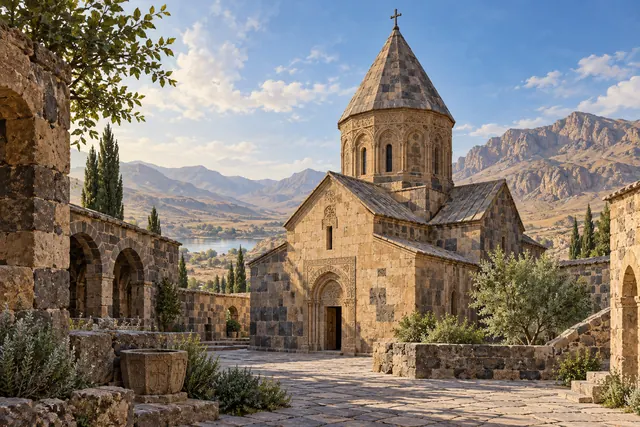
Northwestern Iran’s UNESCO-listed Armenian Monastic Ensembles comprise St Thaddeus, St Stepanos and the Chapel of Dzordzor. Their buildings and continuing religious significance connect Iran with Armenian Christian history. St Thaddeus is a pilgrimage site. These monuments belong in an account of religion in Iran even when the country is introduced through its official Islamic identity. [6]
Recognition and lived conditions are separate questions
A March 2026 report by the UN Special Rapporteur on Iran, covering January 2025 through February 2026, describes persecution of Bahá’ís, including arrests, property confiscation and exclusion from higher education and employment. It also reports targeting of Christians, particularly converts, while distinguishing Christianity’s constitutional recognition from the position of Bahá’ís. These are attributed findings from a dated report, not a description of every individual experience. They show why legal recognition and actual conditions need separate examination. [7]
Sources & further reading
The numbered links connect claims to the sources below. Sources checked October 14, 2026 by a separate AI fact-checking agent. This is not human or specialist review. Read our editorial approach.
- Constitution of the Islamic Republic of Iran (full text) ↗Guardian Council of the Islamic Republic of Iran · Accessed October 14, 2026
- 2023 Report on International Religious Freedom: Iran ↗U.S. Department of State, Office of International Religious Freedom · Accessed October 14, 2026
- Appendix B: Religious composition table ↗Pew Research Center · Accessed October 14, 2026
- Methodology: How the Global Religious Landscape Changed From 2010 to 2020 ↗Pew Research Center · Accessed October 14, 2026
- Historic City of Yazd ↗UNESCO World Heritage Centre · Accessed October 14, 2026
- Armenian Monastic Ensembles of Iran ↗UNESCO World Heritage Centre · Accessed October 14, 2026
- Situation of human rights in the Islamic Republic of Iran, the nationwide protests and their aftermath: Report of the Special Rapporteur, Mai Sato (A/HRC/61/59) ↗United Nations Human Rights Council · Accessed October 14, 2026
Found a problem? Send a correction with the passage and a supporting source.
Continue your reading
All articles ↗
History · 3 min read
Why Is Iran Shi‘a? The Safavids and a Gradual Religious Transformation
Learn how Safavid state policy, earlier Shi‘a communities, scholars and regional change shaped Iran’s religious history beyond the landmark year 1501.
Beliefs & ideas · 4 min read
Zoroastrianism in Iran: Living Communities, Rituals and Sacred Places
Explore Zoroastrian life in Iran through Yazd, Kerman, pilgrimage, oral histories and ancient sanctuaries, with scholarly and heritage sources.
Holy days · 4 min read
Is Nowruz a Religious Holiday? Its Roots and Traditions in Iran
Understand Nowruz in Iran: Zoroastrian roots, its life in Muslim societies, the evolving haft-sin table and a celebration shared across communities.
People & places · 4 min read
Armenian Churches in Iran: Monasteries, New Julfa and Vank Cathedral
Discover Iran’s Armenian Christian heritage, from its UNESCO-listed monasteries to New Julfa and Vank Cathedral, with carefully dated historical sources.
History · 3 min read
The Bahá’í Faith’s Origins in Iran: Shiraz, Tehran and Exile
Trace the Bahá’í Faith’s Iranian origins through the Báb, Bahá’u’lláh, Shiraz and Tehran, while distinguishing its 1863 declaration in Baghdad.