People & places · 4 min read
Armenian Churches in Iran: Monasteries, New Julfa and Vank Cathedral
Discover Iran’s Armenian Christian heritage, from its UNESCO-listed monasteries to New Julfa and Vank Cathedral, with carefully dated historical sources.
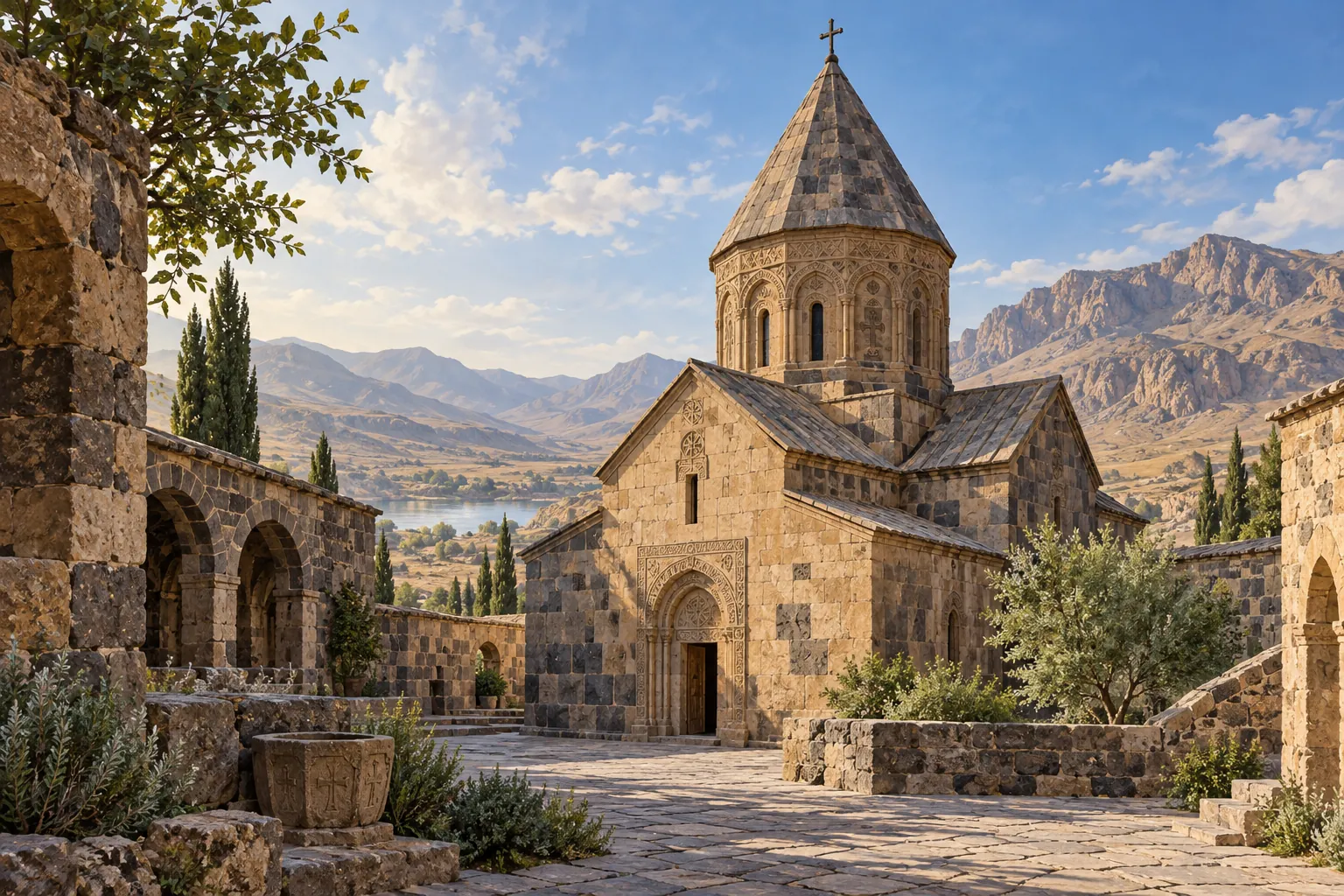
Two settings for Armenian Christian heritage
Iran’s Armenian Monastic Ensembles entered UNESCO’s World Heritage List in 2008. The property consists of St Thaddeus, St Stepanos and the Chapel of Dzordzor in northwestern Iran. UNESCO emphasizes Armenian religious traditions and architectural exchanges with neighboring cultures. These sites also retain pilgrimage significance. They are a different geographical group from the churches of New Julfa, the Armenian district of Isfahan. [1][6]
What the monasteries’ buildings tell us
The monastery of St Thaddeus carries an apostolic founding tradition, but that tradition is not a verified date for its surviving masonry. ICOMOS’s architectural evaluation identifies successive building phases: important reconstruction followed the earthquake of 1319, while the White Church addition belongs to the early nineteenth century. Looking at those layers is more informative than assigning the entire complex a single ancient construction date. [2]
St Stepanos likewise developed through several phases of reconstruction and restoration. Its history also includes manuscript production and illumination. Dzordzor’s chapel belonged to a larger medieval monastic complex and was dismantled and reconstructed in 1987–1988 because of a dam project, with cooperation between government and Armenian church authorities. The chapel’s medieval history and its modern relocation are both part of the site’s story. [2]
New Julfa began with forced displacement
New Julfa’s history begins with the upheavals of the Safavid-Ottoman conflict. In 1604, Shah Abbas I ordered deportations from frontier areas and the destruction of settlements to deny supplies to advancing Ottoman forces. Old Julfa’s Armenian inhabitants were forced across the Aras River. Encyclopaedia Iranica describes hardship and dispersal during this movement; it should not be softened into an account of an entirely voluntary merchant migration. [3]
By early summer 1605, Julfans at Isfahan had begun establishing New Julfa on the southern bank of the Zayandarud. The settlement developed merchant houses and churches, but its population also included artisans, artists, teachers, scribes and illuminators. Some merchants received privileges and favorable treatment. Those later opportunities belong alongside the coercive circumstances of relocation, rather than erasing them. [3]
Vank Cathedral and the architecture of New Julfa
Vank, or All Savior Cathedral, was built in the middle of the seventeenth century and completed in 1664. Iranica’s architectural study describes a combination of Armenian religious traditions with regional building methods and decoration. Its interior includes floral stucco and painted scenes from the Old and New Testaments. Religious function, construction and decoration each reveal a different aspect of the community’s setting in Safavid Isfahan. [4][7]
The district’s architectural history extends beyond its best-known cathedral. The same study identifies early seventeenth-century churches including St James and the Mother of God church. Courtyards and adjoining community rooms helped place church buildings within a wider institutional setting. Individual examples vary, so Vank’s elaborate interior should not be taken as a blueprint for every Armenian church in Iran. [4]
Reading the murals as evidence of exchange
An illustrated study in Platform examines Vank’s murals through comparisons with manuscripts and European prints. It identifies scenes including Christ’s entry into Jerusalem and the washing of Peter’s feet. Printed images reached New Julfa through commercial connections, while Armenian painting traditions and Safavid decoration also shaped the result. Artists selected and adapted visual material rather than merely reproducing an imported style. [5]
The study also connects Vank with manuscript copying, illumination, printing and theological education. These activities make the cathedral meaningful as an intellectual and communal institution as well as a decorated building. The surviving evidence for Armenian wall painting before migration is uneven, however, so the author cautions against presenting New Julfa’s art as a complete and sudden break with everything that preceded it. [5]
Churches within community life
Iranica’s historical account of Armenians in modern Iran describes churches, schools, manuscripts and other institutions as interconnected parts of community life. New Julfa served as a religious and cultural center, while St Thaddeus retained significance for pilgrims. That history helps keep people in view when looking at architecture. Older institutional descriptions and population totals should not be mistaken for a verified account of current services, access arrangements or community size. [6]
Sources & further reading
The numbered links connect claims to the sources below. Sources checked October 14, 2026 by a separate AI fact-checking agent. This is not human or specialist review. Read our editorial approach.
- Armenian Monastic Ensembles of Iran ↗UNESCO World Heritage Centre · Accessed October 14, 2026
- Armenian monastic ensembles (Iran), No 1262: ICOMOS evaluation ↗ICOMOS (hosted by UNESCO) · Accessed October 14, 2026
- JULFA i. SAFAVID PERIOD ↗Encyclopaedia Iranica · Accessed October 14, 2026
- JULFA iv. ARCHITECTURE AND PAINTING ↗Encyclopaedia Iranica · Accessed October 14, 2026
- Artistic Fusion in Isfahan: The Evolution of Armenian Murals in Vank Cathedral ↗Platform · Accessed October 14, 2026
- ARMENIANS OF MODERN IRAN ↗Encyclopaedia Iranica · Accessed October 14, 2026
- New Julfa as a Juncture of Armenian, European, and Persian Art ↗ORIENT / The Society for Near Eastern Studies in Japan · Accessed October 14, 2026
Found a problem? Send a correction with the passage and a supporting source.
Continue your reading
All articles ↗
People & places · 3 min read
Religion in Iran: Communities, History and What the Numbers Mean
A sourced guide to religion in Iran, explaining its official faith, diverse communities, demographic estimates, religious heritage and dated rights reporting.
History · 3 min read
Why Is Iran Shi‘a? The Safavids and a Gradual Religious Transformation
Learn how Safavid state policy, earlier Shi‘a communities, scholars and regional change shaped Iran’s religious history beyond the landmark year 1501.
Beliefs & ideas · 4 min read
Zoroastrianism in Iran: Living Communities, Rituals and Sacred Places
Explore Zoroastrian life in Iran through Yazd, Kerman, pilgrimage, oral histories and ancient sanctuaries, with scholarly and heritage sources.