Holy days · 4 min read
Is Nowruz a Religious Holiday? Its Roots and Traditions in Iran
Understand Nowruz in Iran: Zoroastrian roots, its life in Muslim societies, the evolving haft-sin table and a celebration shared across communities.
Religious roots and a wider celebration
Nowruz has important Zoroastrian religious roots, while its history also includes social and seasonal celebration. In Mary Boyce’s scholarly account, spring renewal connects with Zoroastrian hopes for the eventual restoration of a good creation. That religious interpretation is part of the festival’s history; it does not establish the personal beliefs of everyone who celebrates it. [1]
The surviving evidence also has limits. Boyce notes that the name Nowruz does not appear in the surviving Old or Young Avestan texts, while it does occur in later Pahlavi literature. Claims about a single precise founding year go beyond that evidence. Some early developments remain historical reconstructions. [1]
How Nowruz continued in Muslim Iran
The festival continued after the Islamic conquest, and Muslim courts and communities adopted and reshaped its observance. Encyclopaedia Iranica’s historical survey describes both support and opposition across different periods. Its survival was a long process involving changing political and religious settings. The label “pre-Islamic” describes part of its background without explaining the whole of its subsequent life in Iran. [2]
Household practices give that continuity a practical form. The same survey describes preparations such as cleaning, new clothing and growing sprouts, followed by gathering at the turn of the year, visiting and exchanging gifts. Fish with herbed rice is one festive food example. On the thirteenth day, Sizdah Bedar brings a tradition of outings, meals and recreation in outdoor settings. These are descriptions of customs, not rules that every household follows identically. [2]
What the haft-sin table can—and cannot—tell us
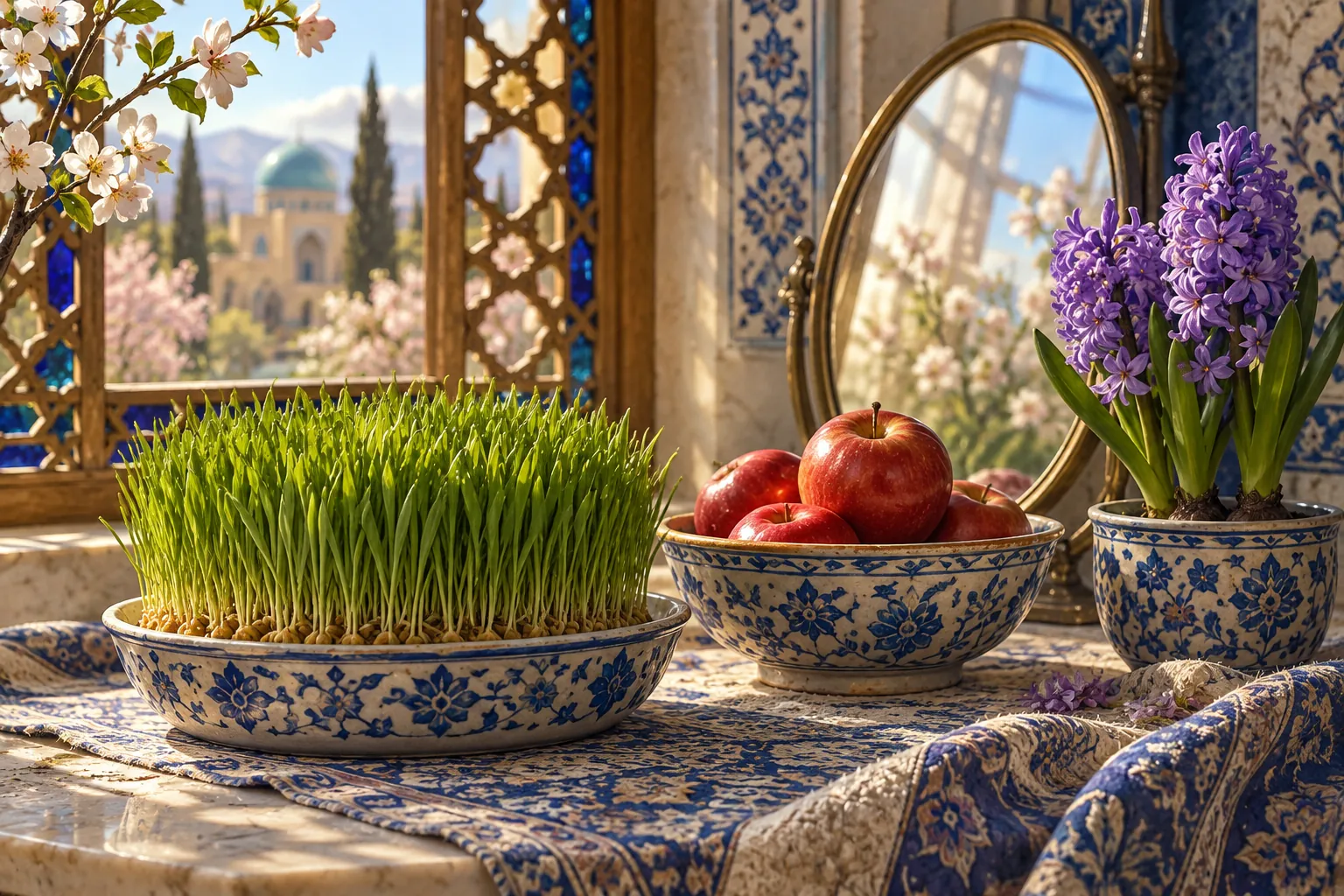
A haft-sin display takes its name from seven items whose Persian names begin with the letter sin. Examples include sabzeh, or sprouts; sib, apples; sir, garlic; serkeh, vinegar; and samanu, a preparation made from wheat. Displays can also contain objects outside that seven-item pattern, such as mirrors, candles, decorated eggs and books. A photograph of a few familiar objects may evoke the festival without showing a complete arrangement. [3]
The history of the named modern arrangement is less certain than popular explanations sometimes suggest. Iranica cautions against treating a proposed ancient predecessor or a supposed earlier “haft-shin” as established fact. Books on a household’s display may include the Quran, the Shahnameh or poetry by Hafez. Some urban Zoroastrian households have adopted the modern form too. The table can express family and religious identity, but it is not evidence of one universal, unchanged ancient ritual. [3]
Why the equinox is a moment rather than a whole day
The March equinox occurs when the Sun crosses the plane of Earth’s equator. It marks the start of astronomical spring in the Northern Hemisphere and autumn in the Southern Hemisphere. This is a single astronomical moment, so its local clock time depends on location. Day and night are close to equal in length, rather than exactly equal everywhere, because atmospheric refraction and the Sun’s apparent size affect sunrise and sunset. [4]
The United Nations recognized 21 March as the International Day of Nowruz in 2010. That international observance provides a shared calendar reference for commemorations and cultural dialogue. It should not be read as a claim that the astronomical equinox always falls at the same local time, or even the same local date, for everyone celebrating. [5][4]
Sources & further reading
The numbered links connect claims to the sources below. Sources checked October 14, 2026 by a separate AI fact-checking agent. This is not human or specialist review. Read our editorial approach.
- Nowruz i. In the Pre-Islamic Period ↗Encyclopaedia Iranica; Mary Boyce · Accessed October 14, 2026
- Nowruz ii. In the Islamic Period ↗Encyclopaedia Iranica; Alireza Shapur Shahbazi · Accessed October 14, 2026
- Haft Sin ↗Encyclopaedia Iranica; Alireza Shapur Shahbazi · Accessed October 14, 2026
- Embracing the Equinox ↗NASA Science / Night Sky Network; Dave Prosper, updated by Kat Troche · Accessed October 14, 2026
- General Assembly Recognizes 21 March as International Day of Nowruz ↗United Nations, Department of Public Information, GA/10916, 23 February 2010 · Accessed October 14, 2026
- Nowruz Traditions ↗Smithsonian Institution, Freer and Sackler Galleries / National Museum of Asian Art archive · Accessed October 14, 2026
- Nawrouz, Novruz, Nowrouz, Nowrouz, Nawrouz, Nauryz, Nooruz, Nowruz, Navruz, Nevruz, Nowruz, Navruz ↗UNESCO Intangible Cultural Heritage · Accessed October 14, 2026
Found a problem? Send a correction with the passage and a supporting source.
Continue your reading
All articles ↗
People & places · 3 min read
Religion in Iran: Communities, History and What the Numbers Mean
A sourced guide to religion in Iran, explaining its official faith, diverse communities, demographic estimates, religious heritage and dated rights reporting.
Beliefs & ideas · 4 min read
Zoroastrianism in Iran: Living Communities, Rituals and Sacred Places
Explore Zoroastrian life in Iran through Yazd, Kerman, pilgrimage, oral histories and ancient sanctuaries, with scholarly and heritage sources.
History · 3 min read
The Bahá’í Faith’s Origins in Iran: Shiraz, Tehran and Exile
Trace the Bahá’í Faith’s Iranian origins through the Báb, Bahá’u’lláh, Shiraz and Tehran, while distinguishing its 1863 declaration in Baghdad.