
Overview
Shinto is the name now given to the worship of kami, the gods and sacred powers of Japan, at some 80,000 shrines. Kami include the deities of the ancient myths, such as the sun goddess Amaterasu, guardians of villages, mountains and great trees, and people honoured as gods after death. Shinto has no founder, no single scripture and little fixed doctrine; it lives mainly in ritual. For over a thousand years kami were worshipped alongside buddhas, until the Meiji government forced the two apart in 1868 and made the shrines a state cult centred on the emperor, dismantled under Allied occupation in 1945. Most Japanese still visit shrines at New Year and for family milestones, yet few call themselves Shinto.[2, 11–14]
History

Kami, clans and the early court c. 300 BCE – 900 CE
Wet-rice farming spread through Japan from about the 3rd century BCE, and the oldest traceable rites follow the farming year: prayers for the crop in spring, thanks for the harvest in autumn. Each clan (uji) honoured its own guardian kami, at first in open-air sacred places. As the Yamato court centralised power in the 7th and 8th centuries it created a Department of Divinities, commissioned the Kojiki (712) and Nihon shoki (720), which traced the imperial line to the sun goddess, and began rebuilding the Ise shrines every twenty years. By the early 10th century nearly 3,000 shrines received state offerings.[15–19]
Kami and buddhas together 6th – 16th century
Buddhism reached the court in the 6th century, and from the 8th century kami and buddhas were steadily combined, a pattern called shinbutsu shūgō. Kami became protectors of the Buddha's teaching, temples rose within shrine grounds, and monks chanted sutras before kami. By the Heian period many kami were seen as local forms of buddhas, and most shrines were run by Buddhist clergy. From the 13th century the priests of Ise, and in the 15th century Yoshida Kanetomo in Kyoto, built theologies that put the kami first, though both still drew on Buddhist and Chinese ideas.[20–22]
Confucian Shinto and National Learning 1603 – 1867
Under the Tokugawa shoguns, scholars such as Yamazaki Ansai recast Shinto in Neo-Confucian terms. The National Learning (kokugaku) movement instead studied the oldest texts to strip away foreign layers. Its greatest scholar, Motoori Norinaga, spent some 35 years on a commentary on the Kojiki, finished in 1798; his successor Hirata Atsutane tied kami worship to reverence for the emperor and inspired the men who later restored imperial rule. Pilgrimage to Ise became a mass practice, and new teachers such as Kurozumi Munetada founded movements later recognised as Sect Shinto.[23–26]
Separation and State Shinto 1868 – 1945
In the spring of 1868 the Meiji government ordered Buddhist priests, images and titles out of the shrines. Local officials and activists went further, wrecking temples and destroying or selling Buddhist treasures, a campaign known as haibutsu kishaku. The state revived the Department of Divinities, sent out preachers of a national 'Great Teaching', and from 1882 classed shrine rites as civic ceremony rather than religion. Although the 1889 constitution granted a limited freedom of belief, reverence at shrines was treated as a patriotic duty. Independent movements were sorted into thirteen recognised sects of Sect Shinto by 1908.[27–31]
Disestablishment and Shinto today 1945 – present
On 15 December 1945 the occupation's Shinto Directive cut the ties between state and shrines, ending public funding and banning Shinto rites and teaching in public institutions. In February 1946 most shrines joined a new private body, the Association of Shinto Shrines, which regards Ise as its spiritual centre, and the 1947 constitution made the separation of religion and state permanent. Shrines now rely on donations and fees. The boundary is still disputed, above all at Yasukuni Shrine for the war dead, where official visits draw protest at home and abroad. In 2013 Ise was rebuilt for the 62nd time.[9, 32–35]
Key moments
- 712 CEThe Kojiki and the sun goddess · Nara, Japan
- 1868 CEMeiji Japan separates kami from buddhas · Japan
Beliefs
Kami · 神
deity, sacred power
Kami are the objects of Shinto worship: the gods of the myths, guardians of places and communities, features of nature, and outstanding people deified after death. The classics speak of 'eight million' kami to say their number has no limit. What marks something as kami is a power that inspires awe. Practitioners hold that a kami is present at its shrine in a sacred object, the shintai.[3, 36–37]
Makoto · 誠
sincerity, a true heart
Shinto ethics rest less on written rules than on a sincere, bright and upright heart. There is no doctrine of original sin: people are regarded as children of the kami whose good nature can be clouded but not corrupted. In practice, Shinto moral teaching has borrowed much from Confucian and Buddhist values.[38–39]
Kegare and harae · 穢れ・祓
pollution and purification
The opposite of purity is kegare, a pollution linked above all with death, blood and disorder, thought to bring misfortune on a person and a community. It is removed by harae, purification by priestly rite, and by misogi, washing in water. The myths trace misogi to the god Izanagi, who bathed after escaping the land of the dead.[40–41]
Honji suijaku · 本地垂迹
original ground and manifest trace
For most of Japanese history kami were understood through Buddhism. Under the theory of honji suijaku, a kami was the local trace of a buddha or bodhisattva, its original ground. Some medieval Shinto thinkers reversed the scheme, making the kami the originals, and the Meiji government banned Buddhist titles for kami in 1868.[27, 42–43]
Practice

Visiting a shrine · 参拝
A shrine visit needs no priest. Worshippers pass under the torii, rinse hands and mouth at the water basin, make a small offering, then bow twice, clap twice and bow again as they pray. Many write a wish on a wooden plaque (ema) or draw a paper fortune. For a formal prayer, a priest purifies the petitioner and recites a norito, and the petitioner offers an evergreen sprig.[44–46]
Festivals · 祭り
Every shrine keeps an annual festival as well as spring rites for the crops and autumn thanksgiving. A formal rite opens with purification, presents rice, sake and other food (never meat) to the kami, and ends with participants sharing the offerings. At big festivals the kami rides through its parish in a portable shrine (mikoshi) shouldered by local people.[47–49]
Rites of passage · 人生儀礼
A baby's first shrine visit, about a month after birth, presents the child to the local kami. Shinto weddings, a form created in the late 19th and early 20th centuries, became the usual ceremony for much of the 20th. Funerals are usually Buddhist, partly because death is treated as polluting. Priests also purify building sites and new ventures.[50–53]
The household altar · 神棚
Many homes keep a kamidana, a small shelf shrine holding paper talismans from shrines, often one from Ise, for daily offerings and prayer. The custom spread from the Edo period. Traditional households often keep a Buddhist altar for the ancestors as well.[54–55]
Holy days
The year ahead
| Date | Holy day | Reckoned |
|---|---|---|
| 15 November 2026 | Shichigosan 七五三 | 15 November |
| 31 December 2026 | Great Purification (year's end) 年越の大祓 | 31 December |
| 1 January 2027 – 3 January 2027 | New Year and first shrine visit 正月・初詣 | 1 January |
| 3 February 2027 | Setsubun 節分 | 3 February |
| 30 June 2027 | Great Purification (summer) 夏越の大祓 | 30 June |
New Year and first shrine visit · 正月・初詣
1–3 January (Gregorian New Year; winter)
The busiest days of the shrine year. Families make their first shrine or temple visit of the year, many setting out at midnight on New Year's Eve, to pray for the months ahead; even people with little other religious practice usually take part.[56]
Great Purification · 大祓
30 June and 31 December (end of each half-year)
Twice-yearly rites to cleanse the pollution and offences gathered unknowingly over six months. In summer many shrines set up a large ring of reeds for worshippers to pass through, and paper figures are rubbed on the body to carry impurity away.[57]
Shichigosan · 七五三
15 November (autumn)
Parents bring children of three, five and seven, dressed in their best, to the shrine to give thanks for their growth and pray for their health; customarily boys come at five and girls at three and seven.[58]
People

Amaterasu · 天照大御神
deity
The sun goddess, born in the myths when the god Izanagi washed his left eye after visiting the land of the dead. Her retreat into a rock cave, which plunged the world into darkness until the other kami lured her out, is the best-known Shinto story. The imperial family claims descent from her, and her chief sanctuary is Ise's Inner Shrine.[59–60]

Sugawara no Michizane · 菅原道真
scholar · 845–903
A court scholar and minister exiled to Kyushu in 901 on a false charge of treason. Disasters after his death were blamed on his angry spirit, so the court restored his honours and he was enshrined as Tenjin. Students still pray at Tenjin shrines before entrance examinations.[61]
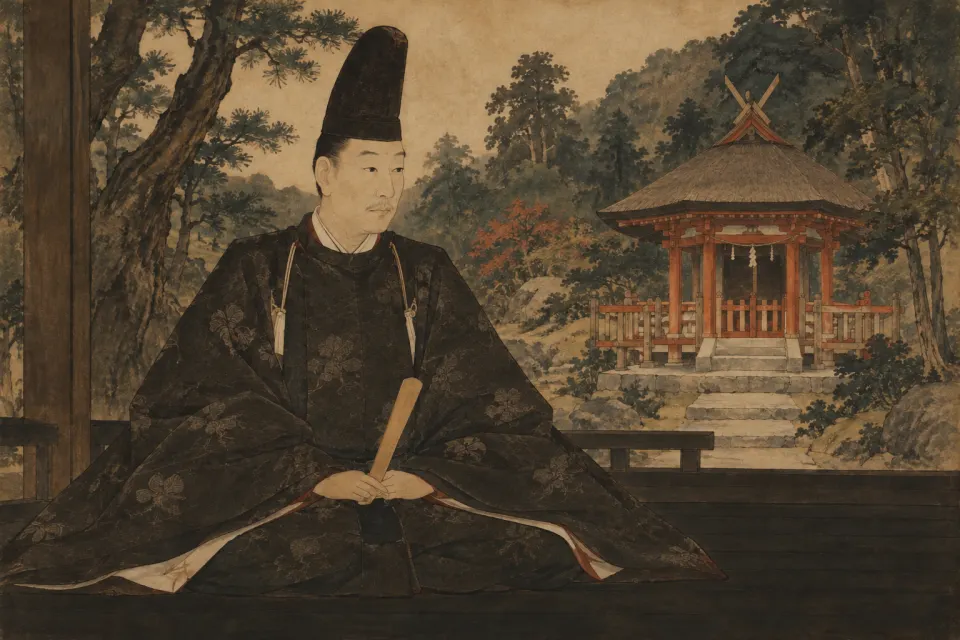
Yoshida Kanetomo · 吉田兼倶
scholar · 1435–1511
A Kyoto priest from a hereditary line of court diviners who founded Yoshida, or Yuiitsu ('one and only'), Shinto. He taught that Shinto was the root from which Buddhism and Confucianism had grown, and his family's power to license priests made the school dominant until 1868.[62]

Motoori Norinaga · 本居宣長
scholar · 1730–1801
A physician of Matsusaka and the leading scholar of National Learning. He read the Kojiki as a record of Japan's true ancient way, free of Chinese influence, and his definition of kami as anything extraordinary that inspires awe is still widely cited.[24, 63]

Kurozumi Munetada · 黒住宗忠
founder · 1780–1850
Son of a shrine priest in Bizen (now Okayama). In 1814, recovering from illness, he had what followers call a direct mission from heaven; his preaching and healing gave rise to Kurozumikyō, in 1876 the first movement recognised as an independent Shinto sect.[64]
Scripture
Kojiki · 古事記
712
'Record of Ancient Matters', compiled for the court from oral tradition and presented in 712. It runs from the creation through the age of the kami to Empress Suiko, and holds the main myths of Amaterasu and the imperial line. It gained near-scriptural standing through Motoori Norinaga.[24, 65]
Nihon shoki · 日本書紀
720
'Chronicles of Japan', completed in 720 in classical Chinese as an official history to stand beside the Chinese annals. It records the myths, often in variant versions, then early history. Like the Kojiki it was shaped to legitimise the court, and historians reject its dating of the first emperor to the 7th century BCE.[66–67]
Norito of the Engishiki · 延喜式祝詞
completed 927
The Engishiki, a code of court procedures completed in 927, preserves 27 norito, ritual prayers to the kami, and a register of 2,861 shrines that received court offerings. Its prayers remain the model for those priests recite today.[68]
Places

Ise Jingū
JPN
Shinto's most revered shrine complex: the Inner Shrine honours Amaterasu and the Outer Shrine the food goddess Toyouke. Their sanctuaries are rebuilt in identical form every twenty years, a custom first performed in 690 and next due in 2033.[35, 69]
Izumo Taisha
JPN
Counted among the oldest shrines, dedicated to Ōkuninushi, the kami who in the myths yields the land to Amaterasu's line. Its sanctuary keeps an archaic style. Tradition holds that all the kami of Japan gather here in the tenth month.[70]
Itsukushima Shrine
JPN · UNESCO World Heritage, 1996
Built over the tidal flats of an island in the Inland Sea, so that at high tide it seems to float. A shrine probably stood here by the 6th century; the present layout follows a 12th-century rebuilding under the Taira clan. A World Heritage site since 1996.[71]
Fushimi Inari Taisha
JPN
Head shrine of Inari, kami of rice and prosperity, whose messengers are foxes. Avenues of vermilion torii, gifts from worshippers, line the paths of its sacred mountain. Inari shrines number more than 30,000.[72]
Kumano Hongū Taisha
JPN · UNESCO World Heritage, 2004
One of the three Kumano shrines in the Kii mountains, where kami and buddhas fused: its kami was revered as a form of the buddha Amida. Retired emperors made the long pilgrimage repeatedly. Part of a World Heritage property inscribed in 2004.[73]
Art & objects
Public-domain objects from museum collections. Select one to see it at the museum.
 Futarasan Shrine at Nikko (Nikko Futarasan jinja)Japan, c. 1930s
 Shinto Deity in the Guise of the Monk HyejaJapan, 11th/early 12th century
 Female Shinto DeityJapan, 12th century
 Susano-o no Mikoto Killing the Eight-headed DragonJapan, 1748
 Shinto priest performing the seaweed-gathering ritualJapan, early 1830s
 Morning Worship of Shinto CeremonyJapan, 19th century
 MirrorJapan, Heian period (794–1185), 794–1185
 Mandala of the Three Shrines at KumanoJapan, Kamakura period (1185–1333) to Nanbokuchō period (1336–92), 1300s
 Pair of Guardian Figures (Zuishin)Japan, Muromachi period (1392–1573) to Edo period (1615–1858), c. 1560–1625
 Mandala of the Sannō Shrine DeitiesJapan, Edo period (1615–1868), 17th century
 Male and Female Shinto DeitiesJapan, Heian period (ca. 900–1185), 10th century
 Guardian Lion-DogsJapan, Kamakura period (1185–1333), mid-13th century
 Luring the Sun Goddess Amaterasu Out of a Cave with Music; Death of the Historical BuddhaJapan, Meiji period (1868–1912), late 19th century
 Sacred Names of Shinto Deities and the "Oracles of the Three Shrines"Japan, Edo period (1615–1868), 1805
Numbers
- Followers (depends on how they are counted)
- c. 4–86 million (2023–24)[10, 74]
86,359,612: adherents reported by Shinto bodies to Japan's Agency for Cultural Affairs, end of 2024. About 4 million: the 4% of adults who named Shinto as their religion in Pew's 2023 survey.
- Shinto religious corporations (mostly shrines)
- 84,014 (end of 2024)[75]
National censuses
| Country | Year | Count | Share |
|---|---|---|---|
| Canada Shinto | 2021 | 1,585 | 0.0% |
| Australia Shinto | 2021 | 1,395 | 0.0% |
| United Kingdom (England and Wales) Other religion: Shintoism | 2021 | 1,375 | 0.0% |
| New Zealand Shinto | 2018 | 387 | 0.0% |
Source: Australian Bureau of Statistics, Census of Population and Housing 2021, 'Religious affiliation in Australia' (Table 4), CC BY 4.0. Source: Office for National Statistics licensed under the Open Government Licence v.3.0 Adapted from Statistics Canada, Table 98-10-0342-01 Religion by visible minority and generation status: Canada, provinces and territories, census metropolitan areas and census agglomerations with parts, released 2022-10-26. This does not constitute an endorsement by Statistics Canada of this product. Source: Stats NZ, 2018 Census, licensed by Stats NZ for re-use under the Creative Commons Attribution 4.0 International licence.
How we know
How old is Shinto?
Shrine organisations and older scholarship present Shinto as Japan's indigenous religion, continuous from prehistory. In 1981 the historian Kuroda Toshio argued instead that before modern times kami worship was a working part of a Buddhist religious system, and that Shinto became a separate religion only through the Meiji separation. Most Western specialists now start from his critique but differ on where Shinto begins: with the court ritual system of the 7th–10th centuries, or with the self-named Shinto schools of the 14th and 15th. Few doubt that kami cults themselves are very old.[76–78]
Counting followers
Japan's official religious statistics add up whatever each religious body reports, and shrines traditionally count everyone living in their parish districts. Shinto bodies reported about 86 million adherents at the end of 2024, and all religions together claim far more members than Japan has people. In surveys, by contrast, only about 4% of adults call Shinto their religion.[10, 74, 79]
Common misconceptions
Myth Shinto is Japan's unchanging ancient religion, untouched by outside influence.
Fact Kami worship is old, but what is now called Shinto has changed greatly. For more than a thousand years it was bound up with Buddhism and shaped by Chinese thought, and its present form, with shrines and clergy kept apart from Buddhist temples, owes much to Meiji government policy after 1868.[80]
Myth Japanese people are either Shinto or Buddhist.
Fact Most Japanese take part in both without any sense of contradiction: shrine visits at New Year and for children's rites, often a Shinto wedding, then Buddhist funerals and memorials. That is why religious bodies' combined membership exceeds Japan's population, while many of the same people tell pollsters they have no religion.[81]
Myth Shinto is simply nature worship.
Fact Mountains, rocks and trees can be revered as kami, but so are the deities of the myths, ancestors, deified people such as Sugawara no Michizane, and the war dead. Nor is all of nature sacred: a kami is marked by power that inspires awe. Some scholars call the 'green religion' image a modern emphasis.[82]
Glossary
- Jinja · 神社
- A Shinto shrine: the sacred precinct and buildings where a kami is worshipped, usually including a sanctuary (honden) and a hall of worship (haiden).[5]
- Torii · 鳥居
- The gateway of two posts joined by crossbeams that marks the entrance to a shrine and the boundary between ordinary and sacred ground.[6]
- Kannushi · 神主
- General term for a Shinto priest; historically one who served the kami on behalf of a community and could convey the kami's will.[83]
- Miko · 巫女
- A woman who assists priests at a shrine and performs sacred dance; in earlier times, a medium who received messages from the kami in trance.[84]
- Norito · 祝詞
- A formal prayer to the kami in archaic Japanese, recited by a priest; the oldest surviving examples are in the Engishiki of 927.[85]
- Shintai · 神体
- The object in which a kami is present at its shrine, often a mirror or sword kept hidden in the sanctuary; a whole mountain can serve as one.[86]
- Ema · 絵馬
- A small wooden votive plaque on which visitors write prayers or thanks; the name, 'horse picture', recalls horses once offered to the kami.[87]
- Jingūji · 神宮寺
- A Buddhist temple attached to a shrine, a product of the combination of kami and buddhas; the first were founded in the early 8th century, and the Meiji separation ended them.[88]
Sources
Each statement above was checked against published sources; the verdict says whether it stood as written, was corrected or was hedged.
- HedgedEOS, Introduction: The History of Shinto; Teeuwen & Scheid, JJRS 29/3-4; Britannica, Shintō.
- VerifiedBritannica, Shintō; The Met, Shinto; Worldmark, Shinto, Encyclopedia.com.
- VerifiedBritannica, kami; EOS, Introduction: Kami.
- VerifiedBritannica, Shintō literature and mythology; Worldmark, Shinto.
- VerifiedEOS, Introduction: Jinja; Britannica, Types of shrines.
- VerifiedEOS, Torii; Britannica, Types of shrines; Worldmark, Shinto.
- VerifiedBritannica, Types of shrines; Worldmark, Shinto; EOS, Jinja Honchō.
- VerifiedBritannica, Shintō; EOS, Introduction: The History of Shinto.
- VerifiedEOS, Jinja Honchō; Britannica, Political and social roles; Worldmark, Shinto.
- VerifiedAgency for Cultural Affairs, 令和7年 宗教統計調査 summary; Pew Research Center, Religion and Spirituality in East Asian Societies.
- VerifiedBritannica, Shrine Shintō; Agency for Cultural Affairs summary; Britannica, kami; EOS, Introduction: Kami.
- VerifiedBritannica, Shintō; The Met, Shinto; Worldmark, Shinto.
- VerifiedBritannica, Shinbutsu shūgō; Britannica, State Shintō; EOS, Shinbutsu Bunri; EOS, Shintō Shirei.
- VerifiedPew 2024 report; Teeuwen & Scheid, JJRS 2002.
- VerifiedBritannica, Shintō; Worldmark, Shinto; EOS, Niiname sai.
- VerifiedBritannica, Shintō; Worldmark, Shinto; The Met, Shinto; EOS, Introduction: Jinja.
- VerifiedEOS, 1. Ancient Shinto; Worldmark, Shinto.
- VerifiedBritannica, Japanese mythology; EOS, 1. Ancient Shinto; EOS, Shikinensengū; Britannica, Ise Shrine.
- VerifiedBritannica, Shintō; EOS, Engishiki.
- VerifiedBritannica, Shintō; EOS, Shinbutsu Bunri; Worldmark, Shinto.
- VerifiedBritannica, Shinbutsu shūgō; EOS, Shinbutsu Bunri.
- VerifiedBritannica, Shintō reaction against Buddhism; Teeuwen & Scheid, JJRS 2002; EOS, Yoshida Shintō.
- VerifiedBritannica, Shintō reaction against Buddhism; Worldmark, Shinto.
- VerifiedBritannica, Motoori Norinaga; EOS, Kojikiden; Worldmark, Shinto.
- VerifiedBritannica, Shintō reaction against Buddhism; Worldmark, Shinto; EOS, Haibutsukishaku.
- VerifiedEOS, Ise Shinkō; EOS, Jingū taima; Worldmark, Shinto; Britannica, Shintō reaction against Buddhism.
- VerifiedEOS, Shinbutsu Bunri; Britannica, Shinbutsu shūgō.
- VerifiedEOS, Haibutsukishaku; EOS, Shinbutsu Bunri; Concise Oxford Dictionary of World Religions, Haibutsu kishaku, Encyclopedia.com.
- VerifiedEOS, The Meiji Jingikan; EOS, Taikyō Senpu; EOS, State Shintō; Britannica, Political and social roles; Britannica, Kyōha Shintō.
- VerifiedNational Diet Library, Constitution of the Empire of Japan; Britannica, State Shintō.
- VerifiedBritannica, Kyōha Shintō; EOS, Tenrikyō; EOS, Kyōha Shintō Rengōkai.
- VerifiedEOS, Shintō Shirei; Britannica, State Shintō; Britannica, Political and social roles.
- VerifiedNational Diet Library, The Constitution of Japan; Britannica, Political and social roles; Britannica, Shrine Shintō; Worldmark, Shinto.
- VerifiedBritannica, Yasukuni Shrine; Worldmark, Shinto.
- VerifiedEOS, Shikinensengū; Britannica, Ise Shrine.
- VerifiedBritannica, kami; EOS, Introduction: Kami; Worldmark, Shinto.
- VerifiedWorldmark, Shinto; Britannica, kami; EOS, Shintai.
- VerifiedBritannica, Shintō literature and mythology; EOS, Makoto.
- VerifiedBritannica, Shintō literature and mythology; Worldmark, Shinto.
- VerifiedEOS, Kegare; Worldmark, Shinto; Britannica, Ritual practices.
- VerifiedEOS, Harae; EOS, Misogi; Britannica, Japanese mythology; Worldmark, Shinto.
- VerifiedEOS, Honjisuijakusetsu; Britannica, Shintō; Worldmark, Shinto.
- VerifiedBritannica, Shinbutsu shūgō; Worldmark, Shinto.
- VerifiedEOS, Paying Respects at a Shinto Shrine; Britannica, Types of shrines; EOS, Sanpai sahō.
- VerifiedEOS, Paying Respects; EOS, Ema; Worldmark, Shinto; Britannica, Types of shrines.
- VerifiedEOS, Paying Respects; Britannica, Ritual practices.
- VerifiedBritannica, Ritual practices; EOS, Niiname sai.
- VerifiedBritannica, Ritual practices; Worldmark, Shinto.
- VerifiedEOS, Shin'yo; Britannica, Ritual practices; Worldmark, Shinto.
- VerifiedEOS, Hatsumiyamōde; Britannica, Ritual practices.
- HedgedEOS, Shinzenkekkon; Worldmark, Shinto; Britannica, Ritual practices.
- VerifiedWorldmark, Shinto; Britannica, Ritual practices; EOS, Shinsōsai.
- VerifiedBritannica, Ritual practices; EOS, Shintō Shirei.
- VerifiedEOS, Kamidana; Britannica, Japanese religion; Worldmark, Shinto.
- VerifiedBritannica, Ritual practices; EOS, Kamidana.
- VerifiedEOS, Hatsumōde; Teeuwen & Scheid, JJRS 2002; EOS, Shōgatsu.
- VerifiedEOS, Ōharae; EOS, Nagoshi no harae; Worldmark, Shinto.
- VerifiedEOS, Shichigosan; Britannica, Ritual practices; Worldmark, Shinto.
- VerifiedEOS, Amaterasu; Britannica, Amaterasu.
- VerifiedBritannica, Amaterasu; EOS, Ise Shinkō; Britannica, Ise Shrine.
- VerifiedBritannica, Sugawara Michizane; Worldmark, Shinto; EOS, Tenjin Shinkō.
- VerifiedEOS, Yoshida Shintō; Britannica, Yoshida Shintō; Worldmark, Shinto.
- VerifiedBritannica, Motoori Norinaga; Worldmark, Shinto; EOS, Kojikiden.
- VerifiedEOS, Kurozumikyō; Britannica, Shintō reaction against Buddhism.
- VerifiedBritannica, Kojiki; Worldmark, Shinto.
- VerifiedBritannica, Nihon shoki; EOS, The Complexity of the Nihon Shoki; Worldmark, Shinto.
- VerifiedBritannica, Japanese mythology; Britannica, Jimmu; Worldmark, Shinto.
- VerifiedEOS, Engishiki; Teeuwen & Scheid, JJRS 2002; Britannica, Ritual practices.
- VerifiedBritannica, Ise Shrine; EOS, Toyoukehime; EOS, Shikinensengū.
- VerifiedBritannica, Grand Shrine of Izumo; Britannica, Types of shrines; EOS, Izumo Shinkō.
- VerifiedUNESCO, Itsukushima Shinto Shrine; Britannica, Itsuku Island; EOS, Itsukushima Shinkō.
- VerifiedBritannica, Inari; EOS, Inari Shinkō; Worldmark, Shinto.
- VerifiedEOS, Kumano Shinkō; UNESCO, Kii Mountain Range; Worldmark, Shinto.
- VerifiedPew 2024 report; Teeuwen & Scheid, JJRS 2002; Britannica, Japanese religion.
- VerifiedAgency for Cultural Affairs summary; Britannica, Shrine Shintō.
- VerifiedTeeuwen & Scheid, JJRS 2002; Worldmark, Shinto; Britannica, Shintō literature and mythology.
- VerifiedKuroda Toshio, Shinto in the History of Japanese Religion, Journal of Japanese Studies 7.1; Teeuwen & Scheid, JJRS 2002; Worldmark, Shinto.
- VerifiedTeeuwen & Scheid, JJRS 2002; EOS, Introduction: The History of Shinto.
- VerifiedAgency for Cultural Affairs summary; EOS, Ujiko; Britannica, Japanese religion.
- VerifiedTeeuwen & Scheid, JJRS 2002; Worldmark, Shinto; EOS, Shinbutsu Bunri.
- VerifiedBritannica, Japanese religion; Pew 2024 report; Worldmark, Shinto.
- VerifiedWorldmark, Shinto; Britannica, kami; Britannica, Yasukuni Shrine.
- VerifiedEOS, Kannushi; Worldmark, Shinto.
- VerifiedEOS, Miko; Worldmark, Shinto.
- VerifiedEOS, Norito; EOS, Engishiki; Britannica, Ritual practices.
- VerifiedEOS, Shintai; EOS, Introduction: Jinja; Britannica, Types of shrines.
- VerifiedEOS, Ema; Worldmark, Shinto; Britannica, Types of shrines.
- VerifiedEOS, Jingūji; EOS, Shinbutsu Bunri; Worldmark, Shinto; Britannica, Shintō.
Last fact-checked 3 October 2026.