
The story behind the day
The Great Purification, Ōharae, is a Shinto rite for cleansing the sins and pollution that people are held to gather. It is performed twice a year, on 30 June and on 31 December, and it descends from a rite of national purification held by the ancient court. In summer, worshippers at many shrines pass through a great ring of woven reeds, and paper figures are passed over the body to carry the defilement away.[1–5]
Origins
In the ancient state the Ōharae was a rite of national purification, held twice a year, at the end of the sixth and twelfth months. Its liturgy, the Ōharae no kotoba, is one of the court prayers, norito, compiled in the Engishiki in 927, and the Nakatomi family took the leading part in reciting it. In myth, Izanagi, back from the land of the dead, performed a rite of purification to rid himself of its pollution.[3, 7–8]
What it marks
The Great Purification marks the accumulation of defilement, kegare, and its purpose is to cast out sins and impurities. Shinto holds that sins and defilement build up and can be washed away by rites of purification, harae. Purification comes before worship, and shrine rites begin with it. It may take the form of washing, misogi, or of rites performed by priests, such as waving a sacred wand.[1, 9–11]
How it came to be
The summer purification, called nagoshi no harae, is held at many shrines and is understood as protection against the epidemics of the hot months. The custom of the reed ring comes from a legend in which Somin Shōrai, a poor man, escaped an epidemic by wearing a ring of grass at his waist; in the version told today, the god Susanoo, lodging with him, promises that a ring worn at the waist would spare his descendants from plague.[6, 12]
How it is kept
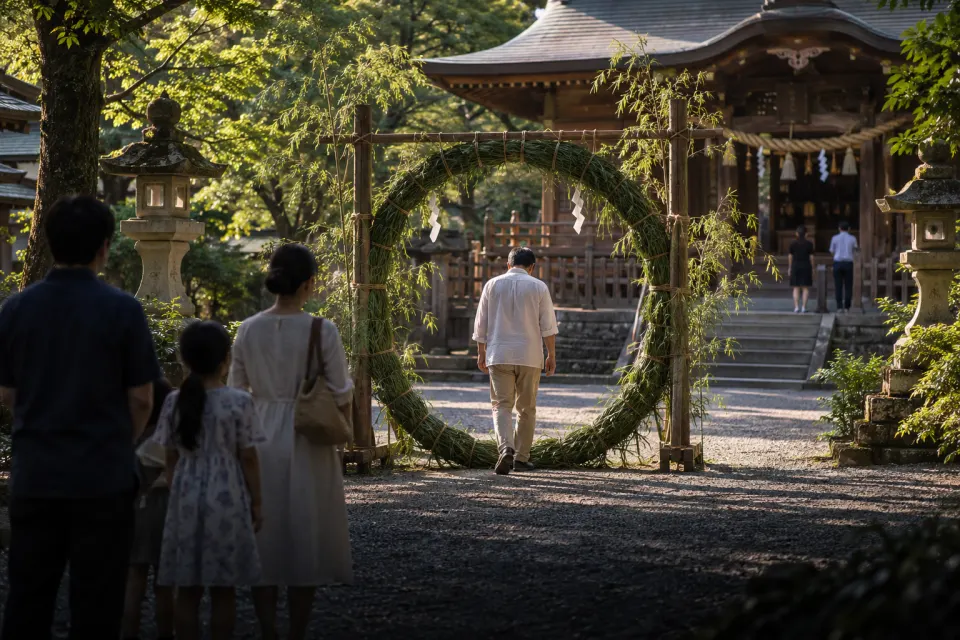
Meiji Jingu in Tokyo holds its Great Purification Ceremony on 30 June and 31 December. At shrines in June, worshippers pass through the chinowa, a large ring of reeds set up at the approach, reciting a verse that promises long life to those who keep the summer purification. At Kamigamo Shrine in Kyoto, as at other shrines, the paper figure called a hitogata, which has been passed over the body, is afterwards set afloat on a stream, believed to bear away each person's impurities.[2, 4–5, 13–14]
Sources
Each statement above was checked against published sources; the verdict says whether it stood as written, was corrected or was hedged.
- CorrectedNamiki Kazuko, Ōharae, Encyclopedia of Shinto; Meiji Jingu, Rites & Events; Shinto, Worldmark Encyclopedia of Religious Practices.
- VerifiedMeiji Jingu, Rites & Events; Imperial Household Agency, List of main ritual ceremonies of the Imperial Palace; Ishii Kenji, Annual Events and the Transformation of Japanese Religious Life.
- CorrectedNamiki Kazuko, Ōharae, Encyclopedia of Shinto; The Concise Oxford Dictionary of World Religions, Jingikan, via Encyclopedia.com; Ueda Kenji, Norito, Encyclopedia of Religion.
- VerifiedMotosawa Masashi, Chinowa, Encyclopedia of Shinto; Kamigamo Shrine, Nagoshi no Oharae; Agency for Cultural Affairs, Japan Heritage Portal.
- VerifiedShinto, Worldmark Encyclopedia of Religious Practices; Kamigamo Shrine, Nagoshi no Oharae; Kyoto National Museum.
- VerifiedIwai Hiroshi, Nagoshi no harae, Encyclopedia of Shinto; Kamigamo Shrine, Nagoshi no Oharae; Agency for Cultural Affairs, Japan Heritage Portal.
- CorrectedMotosawa Masafumi, Norito, Encyclopedia of Shinto; Ueda Kenji, Norito, Encyclopedia of Religion.
- VerifiedNishioka Kazuhiko, Misogi, Encyclopedia of Shinto; Shinto, Worldmark Encyclopedia of Religious Practices.
- CorrectedShinto, Worldmark Encyclopedia of Religious Practices; Nishioka Kazuhiko, Harae, Encyclopedia of Shinto.
- CorrectedJinja Honcho, Matsuri pamphlet; The Concise Oxford Dictionary of World Religions, Harai, via Encyclopedia.com; Nishioka Kazuhiko, Misogi, Encyclopedia of Shinto.
- CorrectedNishioka Kazuhiko, Harae, Encyclopedia of Shinto; The Concise Oxford Dictionary of World Religions, Harai, via Encyclopedia.com.
- CorrectedMotosawa Masashi, Chinowa, Encyclopedia of Shinto; Agency for Cultural Affairs, Japan Heritage Portal.
- VerifiedAgency for Cultural Affairs, Japan Heritage Portal; Motosawa Masashi, Chinowa, Encyclopedia of Shinto.
- CorrectedKamigamo Shrine, Nagoshi no Oharae; Kyoto National Museum; Iwai Hiroshi, Nagoshi no harae, Encyclopedia of Shinto.