The story behind the day
Shōgatsu is the Japanese New Year, a cluster of observances in the first days of the year, kept above all as a family holiday. At home, families welcome the year deity, toshigami, with pine kadomatsu at the entrance and with pounded rice cakes. At shrines, a New Year morning rite is held on 1 January, and hatsumōde, the first shrine visit of the year, draws about four in five people in Japan, by the estimate of the national association of shrines.[1–7]
Origins
Shōgatsu is not one rite but a set of events in the first month, held to greet the new year. Its centre is the household. Families traditionally welcomed a year deity, toshigami, who was venerated chiefly at the New Year and invoked to see the household safely through the coming twelve months. The great three-day celebration of the New Year, as one reference describes it, is essentially a family holiday, while shrines and the Imperial Court keep their own rites alongside it.[1–2, 10]
What it marks
The holiday marks a fresh start shared by family and community. For most households it is above all a family holiday, a time for easygoing relaxation at home. Shrines take up the same moment for thanksgiving and prayer for the year ahead, which is why hatsumōde, the first shrine visit, is so widely kept.[1, 6, 10–11]
How it is kept

The season lasts about a week from 1 January and is prepared for by cleaning homes; in the Encyclopedia of Shinto, preparations begin in mid-December, with mochi pounded and the New Year altar set up on the 28th. Kadomatsu, the pine decorations of the season, stand at the entrance. In many rural areas 15 January is kept as Koshōgatsu, the Little New Year.[3–4, 8–9]
At the shrine
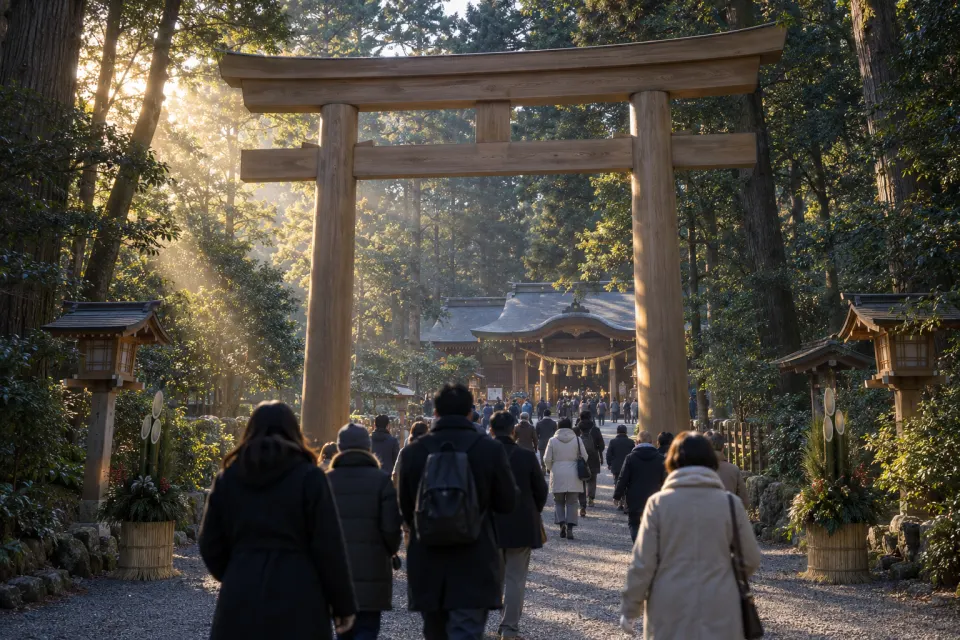
On the morning of 1 January the Imperial Court and shrines across the country hold the New Year rite, saitansai. Hatsumōde, the first visit of the year, follows in the New Year season, and it may be made at a Buddhist temple as well as at a shrine. Jinja Honcho, the association of Shinto shrines, says about 80 per cent of the population of Japan visits a shrine at New Year, and a standard encyclopedia gives the same round figure. Meiji Jingu in Tokyo says that several million people choose it for their first visit of the year.[5–7, 12]
Sources
Each statement above was checked against published sources; the verdict says whether it stood as written, was corrected or was hedged.
- VerifiedIwai Hiroshi, Shōgatsu, Encyclopedia of Shinto; Robert J. Smith, Domestic Observances: Japanese Practices, Encyclopedia of Religion.
- VerifiedIwai Hiroshi, Shōgatsu, Encyclopedia of Shinto; Robert J. Smith, Domestic Observances: Japanese Practices, Encyclopedia of Religion.
- CorrectedIwai Hiroshi, Shōgatsu, Encyclopedia of Shinto; Encyclopedia.com, Shinto.
- CorrectedIwai Hiroshi, Shōgatsu, Encyclopedia of Shinto; Encyclopedia.com, Shinto.
- VerifiedMeiji Jingu, Rites & Events; Imperial Household Agency, List of main ritual ceremonies of the Imperial Palace.
- VerifiedEndō Jun, Hatsumōde, Encyclopedia of Shinto; Meiji Jingu, Rites & Events; Shintō, Encyclopedia of Religion.
- CorrectedJinja Honcho, Q&A; Shintō, Encyclopedia of Religion.
- VerifiedThe Concise Oxford Dictionary of World Religions, Festivals and fasts via Encyclopedia.com; Iwai Hiroshi, Shōgatsu, Encyclopedia of Shinto.
- VerifiedRobert J. Smith, Domestic Observances: Japanese Practices, Encyclopedia of Religion; Iwai Hiroshi, Shōgatsu, Encyclopedia of Shinto.
- CorrectedRobert J. Smith, Domestic Observances: Japanese Practices, Encyclopedia of Religion; Ishii Kenji, Annual Events and the Transformation of Japanese Religious Life.
- VerifiedShinto, World Religions Reference Library; Meiji Jingu, Rites & Events.
- CorrectedMeiji Jingu, Uniqueness; Ishii Kenji, Annual Events and the Transformation of Japanese Religious Life; Shinto, World Religions Reference Library.