People & places · 3 min read
Stupa vs Pagoda: Buddhist Architecture and Overlapping Names
Understand stupas and pagodas through Sanchi, Horyuji, Shwedagon, miniature Japanese pagodas, and Borobudur.
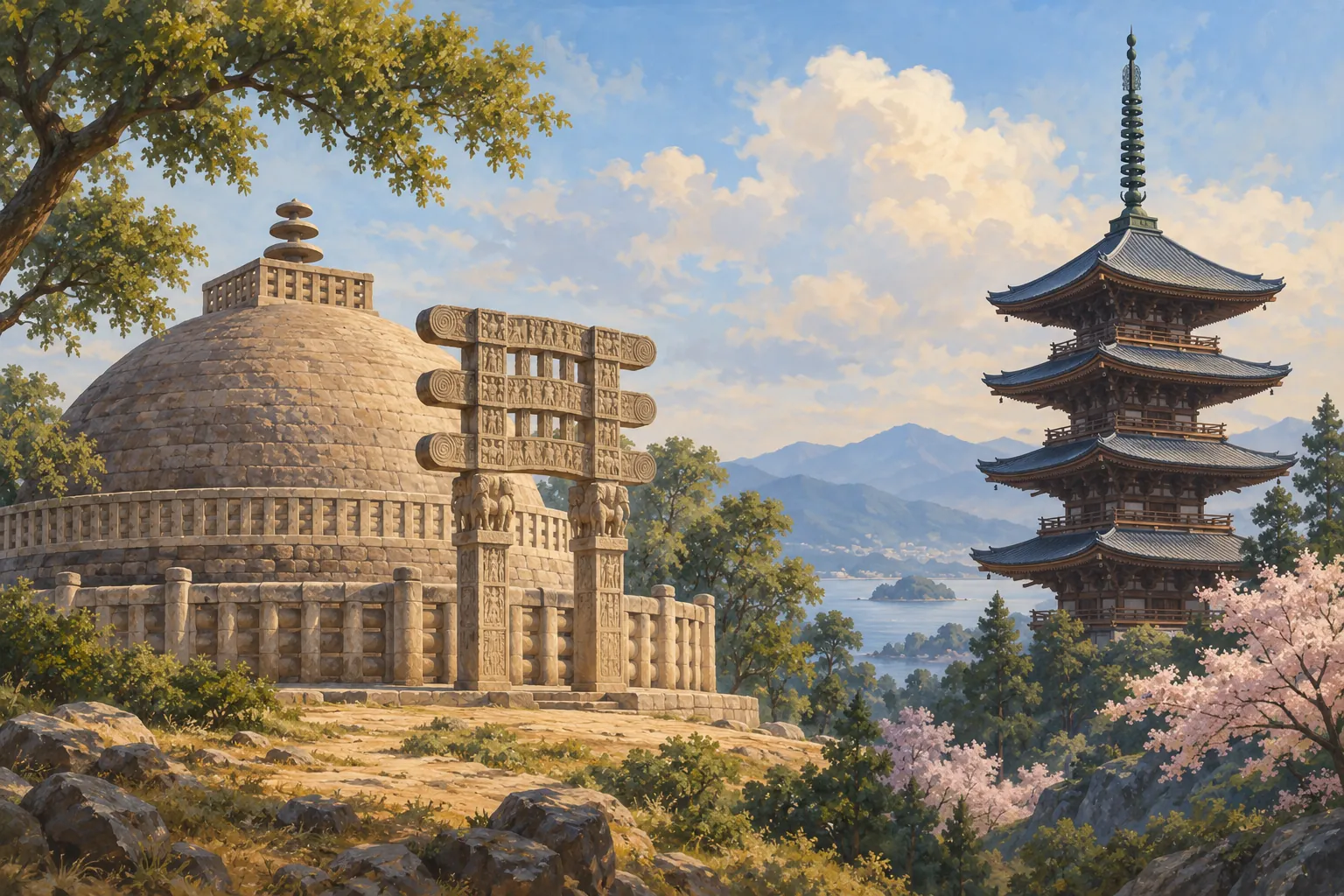
Start with a stupa at Sanchi
Sanchi's Buddhist complex in central India includes stupas, temples, monasteries, and a pillar. UNESCO traces the Great Stupa from an Ashokan brick structure through later enlargement and stone facing. Its rounded form is surrounded by routes for circumambulation, railings, stairs, and gateways. The monument is therefore not just a dome: its architecture organizes movement, viewing, and devotion around it. [1]
The summit has a square enclosure and umbrella-like elements, while carved narratives and symbols contribute to the setting. Sanchi also preserves relic traditions associated with Sariputra and Maudgalyayana. That example cautions against defining every stupa as a container exclusively for the Buddha's bodily remains. A complex can have several monuments, construction phases, and religious associations. [1]
A tiered pagoda at Horyuji
Horyuji in Japan offers the familiar tiered-tower form often suggested by the English word pagoda. The Japan National Tourism Organization identifies a five-storied pagoda in its western precinct, alongside the Kondo hall. The pagoda is one component of a larger temple compound, not the name for every building within it. Its vertical form gives a clear visual contrast with Sanchi's broad rounded monument. [2]
Foundation dates and surviving buildings
UNESCO's account distinguishes Horyuji's early history from the surviving structures. A fire in 670 was followed by rebuilding, and some remaining wooden buildings date to the late seventh and eighth centuries. Their columns, beams, brackets, and bays show architectural transmission from the Asian mainland alongside Japanese development. A temple's foundation date should not automatically be assigned to all the material a visitor sees today. [3]
Shwedagon is called both a pagoda and a stupa
A rigid rule that a pagoda must be a tiered tower fails in Myanmar. The country's UNESCO Tentative List submission calls Yangon’s Shwedagon both a pagoda and a stupa. It describes a gilded principal stupa on a brick plinth, crowned with an ornamental umbrella and surrounded by terraces, shrines, pavilions, and other features. The two English labels overlap in this regional usage. [4]
The same submission associates the monument with relics in religious tradition. That attribution should be distinguished from independent verification of the relics' contents or age. Its listing also needs precision: Shwedagon appears on Myanmar's Tentative List, which is not the same as inscription on the World Heritage List. UNESCO hosts the submitted description, but the State Party is responsible for its claims. [4]
A pagoda small enough to hold
The University of Michigan Museum of Art holds a Japanese wooden Hyakumanto dated 764–770, about 21 centimeters high. Its catalogue title uses both stupa and pagoda. Such miniature monuments contained printed dharani texts. This example complicates another common shortcut: a pagoda is not necessarily a building with rooms that a visitor can enter. [5]
The museum connects these objects with Empress Koken's commission of a million miniature monuments for distribution to major Nara temples, while noting uncertainty about the actual number produced. The commission's name is not a verified count of surviving objects. Here the contents, scale, and devotional purpose are more informative than imposing a strict architectural category based only on height. [5]
Borobudur makes the picture more complex
Borobudur in Central Java, built in the eighth and ninth centuries, combines five square terraces with three circular platforms and a crowning stupa. UNESCO describes seventy-two openwork stupas containing Buddha images on the circular levels. Its stepped design is explained through Buddhist cosmological realms. This is a temple monument incorporating many stupas, rather than a simple choice between one temple and one dome. Named examples show why form, function, and regional vocabulary should be considered together. [6]
Sources & further reading
The numbered links connect claims to the sources below. Sources checked October 14, 2026 by a separate AI fact-checking agent. This is not human or specialist review. Read our editorial approach.
- Buddhist Monuments at Sanchi ↗UNESCO World Heritage Centre · Accessed October 14, 2026
- Horyuji Temple ↗Japan National Tourism Organization · Accessed October 14, 2026
- Buddhist Monuments in the Horyu-ji Area ↗UNESCO World Heritage Centre · Accessed October 14, 2026
- Shwedagon Pagoda on Singuttara Hill ↗Myanmar Ministry of Religious Affairs and Culture, hosted by UNESCO World Heritage Centre · Accessed October 14, 2026
- Stupa: Hyakuman tô (one of one million pagodas) ↗University of Michigan Museum of Art · Accessed October 14, 2026
- Borobudur Temple Compounds ↗UNESCO World Heritage Centre · Accessed October 14, 2026
Found a problem? Send a correction with the passage and a supporting source.
Continue your reading
All articles ↗
People & places · 4 min read
Bodh Gaya and the Mahabodhi Temple: significance and history
Learn why Bodh Gaya matters in Buddhism, how the Mahabodhi Temple developed, and what its tree, monuments and surviving pilgrimage models tell us.
Comparisons · 4 min read
Shinto shrine vs Buddhist temple: how to tell the difference
Compare Japanese shrines and Buddhist temples, their common visual clues and visitor practices, while understanding centuries of shared religious history.
History · 3 min read
How Buddhism spread: routes, texts, patrons and pilgrims
Trace Buddhist transmission through South, Central and East Asia using evidence from monuments, trade routes, texts and artistic exchange.