Comparisons · 4 min read
Shinto shrine vs Buddhist temple: how to tell the difference
Compare Japanese shrines and Buddhist temples, their common visual clues and visitor practices, while understanding centuries of shared religious history.
The basic distinction
In Japan, a Shinto shrine is associated with the veneration of kami, while a Buddhist temple belongs to a Buddhist tradition. The Japan National Tourism Organization uses this distinction as a starting point for visitors. It is more reliable than deciding that every red gate, bell or incense burner must belong exclusively to one tradition. [1][2]
Jinja Honcho, the Association of Shinto Shrines, describes kami as varied, including ancestors and presences associated with nature. A jinja is a sacred place where kami are honored and community relationships are sustained. Translating every kami simply as a ghost or a separate creator god would lose important parts of that description. [2]
Common visual clues
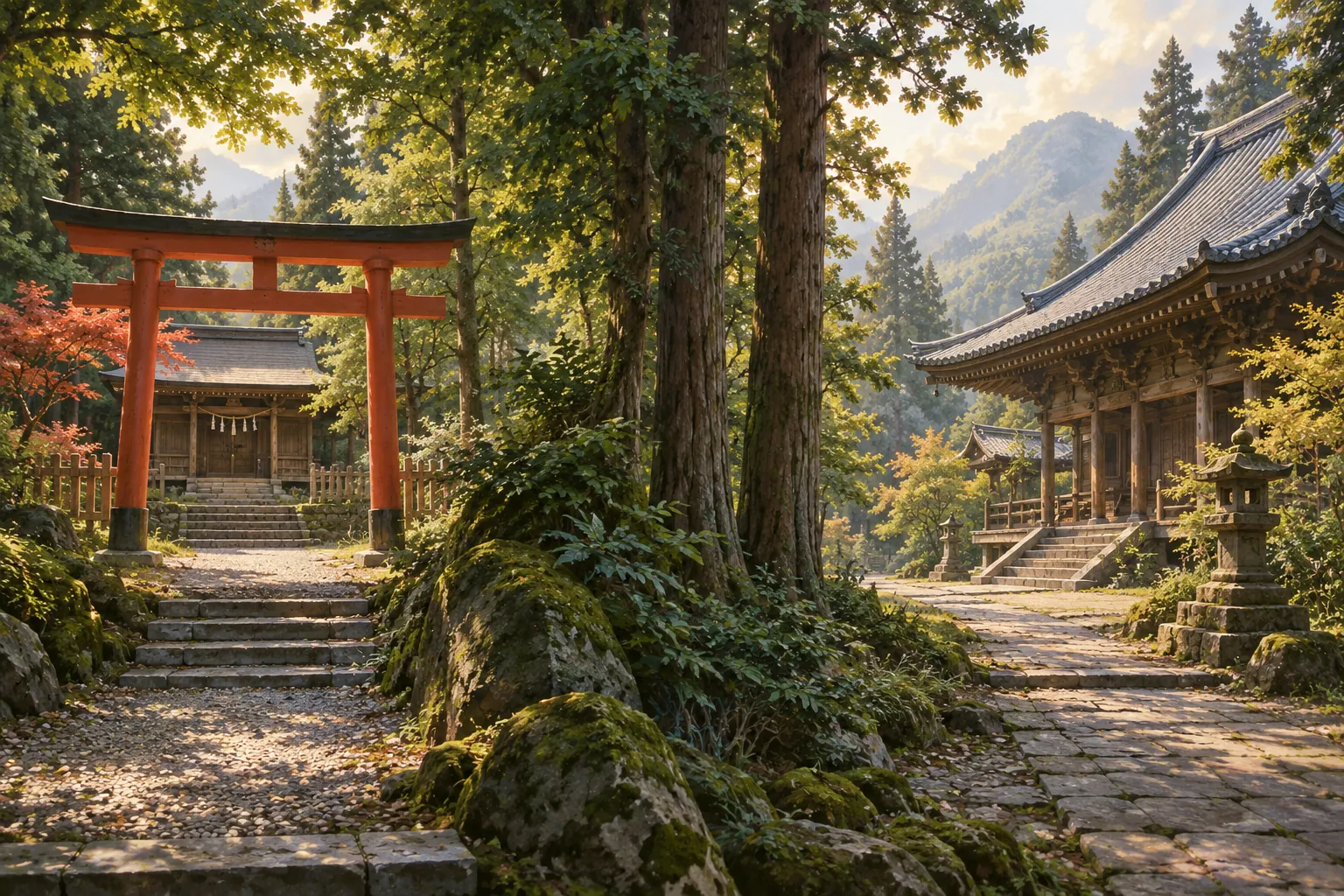
A torii often marks the entrance to a shrine’s sacred precinct. A roofed gate and guardian figures can be clues to a Buddhist temple. JNTO’s visitor guide describes such recognizable features, but they should guide an initial observation rather than become an infallible identification system. Read the official name and description of the place as well. [1]
The sacred space of a shrine includes outdoor areas, not just a building at the end of a path. Jinja Honcho explains that visitors commonly pay their respects from outside the worship hall, with the main sanctuary beyond. Arriving at a shrine does not therefore mean that a visitor is expected to enter its innermost building. [3]
Worship and visitor etiquette
Jinja Honcho gives a standard form of respect involving two deep bows, two claps and a final bow. It also describes purification at a water font. Treat this as introductory guidance and follow instructions at the particular shrine; a general article should not override a local notice, a closed area or directions from shrine staff. [3]
For temples, JNTO describes joining the hands for quiet prayer without the shrine-style clapping. It also notes that a temple may have a purification font, so the presence of water does not itself identify a site as Shinto. Photography permissions and footwear requirements depend on the building and signs. Check them before entering or raising a camera. [1]
A Buddhist example: Senso-ji
Senso-ji in Tokyo identifies its central hall with Kannon, a bodhisattva associated with compassion. Its official description explains that the principal image is hidden and that another image stands before it. This is a useful reminder that a Buddhist temple need not publicly display its central sacred image, or focus only on an image of the historical Buddha. [4]
The same temple page records the destruction of an earlier hall in the 1945 air raid and the completion of the present hall in 1958. A building’s date and the history of the religious institution are different questions. Newer construction does not by itself make a temple newly founded, just as an old architectural feature cannot settle every question about its present community. [4]
Why the distinction is historically complicated
Kokugakuin University’s Encyclopedia of Shinto describes centuries of interaction after Buddhism reached Japan in the sixth century. Shrines and temples could share compounds and practices, and some interpretations connected kami with Buddhist sacred figures. The categories were distinguishable, but they were not always arranged as completely separate institutions with no ritual or intellectual overlap. [5]
The Meiji government began a policy of separating kami and Buddhist institutions in 1868. The encyclopedia distinguishes administrative measures from destructive anti-Buddhist actions pursued in some places. That history helps explain why a clean modern visitor chart should not be projected unchanged backward through all periods of Japanese religious life. [5]
A useful checklist for a first visit
Start with the institution’s own identification: shrine or temple, its name and the tradition it describes. Then look for the place where visitors are invited to stand, pray or observe. Follow posted instructions concerning purification, photographs and access. If you are uncertain, ask a host before copying a ritual you have only seen briefly in a travel video.
Leave room for what makes the individual place distinctive. Jinja Honcho’s account of matsuri includes both solemn ceremonies and celebrations extending into the surrounding community. A shrine or temple is consequently more than a collection of architectural clues. Understanding what its community is doing can be more informative than correctly naming a gate while missing the purpose of the gathering. [2]
Sources & further reading
The numbered links connect claims to the sources below. Sources checked October 14, 2026 by a separate AI fact-checking agent. This is not human or specialist review. Read our editorial approach.
- Shrine and Temple Traditions ↗Japan National Tourism Organization (JNTO) · Accessed October 14, 2026
- What is Shinto? ↗Jinja Honcho (Association of Shinto Shrines) · Accessed October 14, 2026
- Entering a Jinja ↗Jinja Honcho (Association of Shinto Shrines) · Accessed October 14, 2026
- Main Hall (Kannon Hall) / 本堂(観音堂) ↗Senso-ji Temple · Accessed October 14, 2026
- Shinbutsu Bunri ↗Kokugakuin University, Encyclopedia of Shinto · Accessed October 14, 2026
Found a problem? Send a correction with the passage and a supporting source.
Continue your reading
All articles ↗
Comparisons · 3 min read
Hinduism vs Buddhism: shared terms, different teachings
Explore Hindu and Buddhist approaches to the self, karma, rebirth, liberation and sacred texts, with attention to differences within each tradition.

History · 3 min read
How Buddhism spread: routes, texts, patrons and pilgrims
Trace Buddhist transmission through South, Central and East Asia using evidence from monuments, trade routes, texts and artistic exchange.
Comparisons · 3 min read
Theravada vs Mahayana: texts, ideals and practice
Compare Theravada and Mahayana Buddhism without reducing them to selfish versus compassionate paths or treating either as one uniform school.