History · 3 min read
How Buddhism spread: routes, texts, patrons and pilgrims
Trace Buddhist transmission through South, Central and East Asia using evidence from monuments, trade routes, texts and artistic exchange.
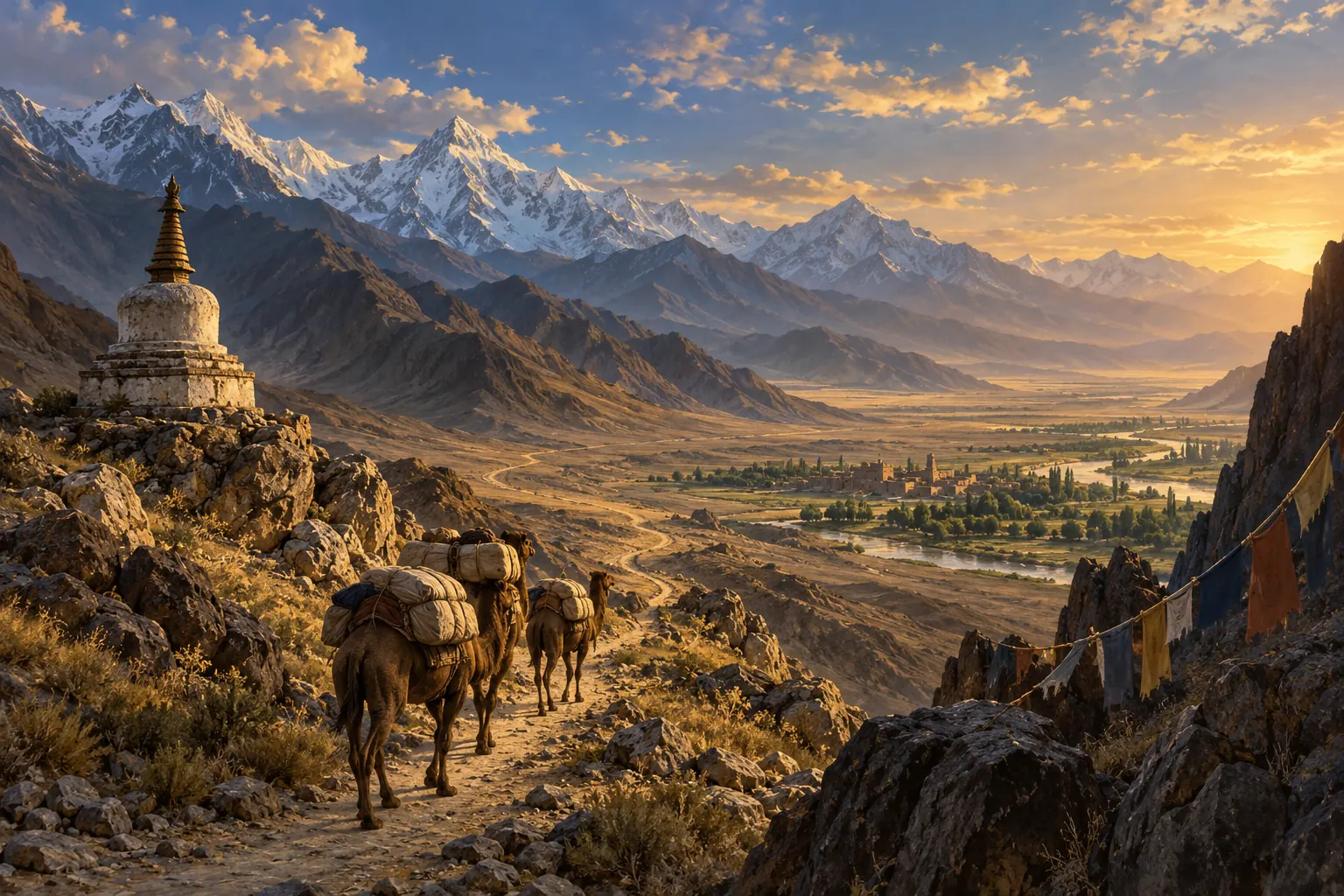
More than one route or cause
Buddhism spread through interacting networks of monastics, merchants, rulers, pilgrims, texts and images. Trade routes created opportunities for contact, while monasteries and patrons helped sustain religious life. A single arrow on a map can show a direction, but it cannot explain all the people and institutions involved. [3][1]
For a useful historical account, distinguish first contact from durable establishment. An object can document exchange, a monastery can show institutional presence and a translation can reveal sustained intellectual work. These kinds of evidence answer different questions.
South Asian foundations and patronage
UNESCO's account of Sanchi connects its beginnings with Ashoka in the third century BCE. It also describes the mission of Mahindra to Sri Lanka as reported in Sri Lankan chronicles. Monumental evidence and a chronicle's account should be identified as different forms of support, rather than presented as one seamless eyewitness record. [4]
Sanchi also shows how a religious centre could develop over many centuries. Its stupas, temples, monasteries and pillars preserve a history extending from the third century BCE into the twelfth century CE. The surviving complex is evidence of repeated construction and support, not just one ruler's original foundation. [4]
Central Asian routes and China
UNESCO's Chang'an–Tianshan corridor description links religious exchange to merchants, rulers, travelling monks and monasteries. Smithsonian educational material describes Buddhism's introduction into China through trade and cultural exchange in the first century CE. These accounts place transmission within networks rather than a single isolated journey. [3][2]
The Metropolitan Museum describes pilgrims carrying Buddhist images along Silk Road routes. Smithsonian's overview follows the religion's further spread through East Asia and dates its introduction and assimilation in Japan to the middle of the sixth century. Movement involved objects and institutions as well as spoken teaching. [1][2]
Tibet and continuing exchange
The Metropolitan Museum's Tibetan art overview places Buddhism's arrival in Tibet by the seventh century and its establishment as a state religion by the late eighth. It also describes later renewal through Tibetan travel to India and Indian scholars teaching in Tibet. Transmission was not complete after a single first arrival. [5]
This is a useful corrective to a simple diffusion map. A region can participate in several periods of introduction, translation, debate and revival. Include those stages when the evidence supports them instead of treating a religion's presence as an unchanged fact from its earliest recorded contact onward.
Read the map alongside the evidence
Start with a small number of documented places and ask what connects them: a route, a text, a patron or an artistic form. Then use the atlas and timeline to place those examples in relation to one another. Keep approximate periods approximate when the source does.
Avoid explaining every regional difference as a corruption of one original form. Historical transmission involves interpretation as well as movement. A stronger account shows the evidence for contact and the institutions that sustained it, while leaving room for scholarly uncertainty about details that the surviving record cannot settle.
Sources & further reading
The numbered links connect claims to the sources below. Sources checked October 13, 2026 by a separate AI fact-checking agent. This is not human or specialist review. Read our editorial approach.
- Buddhism and Buddhist Art ↗The Metropolitan Museum of Art · Accessed October 13, 2026
- The Art of Buddhism ↗Smithsonian Institution, Freer Gallery of Art and Arthur M. Sackler Gallery · Accessed October 13, 2026
- Silk Roads: the Routes Network of Chang'an-Tianshan Corridor ↗UNESCO World Heritage Centre · Accessed October 13, 2026
- Buddhist Monuments at Sanchi ↗UNESCO World Heritage Centre · Accessed October 13, 2026
- Tibetan Buddhist Art ↗The Metropolitan Museum of Art · Accessed October 13, 2026
Found a problem? Send a correction with the passage and a supporting source.
Continue your reading
All articles ↗
Comparisons · 3 min read
Theravada vs Mahayana: texts, ideals and practice
Compare Theravada and Mahayana Buddhism without reducing them to selfish versus compassionate paths or treating either as one uniform school.
Sacred texts · 3 min read
How to read the Dhammapada: themes and first passages
A beginner’s route through the Dhammapada’s 26 chapters, with attention to intention, hatred, practice and the context of its verses.
History · 3 min read
What is the oldest religion? What the evidence can tell us
Separate prehistoric ritual evidence, ancient written religions and continuing traditions to understand why there is no single agreed “oldest religion.”