People & places · 4 min read
Bodh Gaya and the Mahabodhi Temple: significance and history
Learn why Bodh Gaya matters in Buddhism, how the Mahabodhi Temple developed, and what its tree, monuments and surviving pilgrimage models tell us.
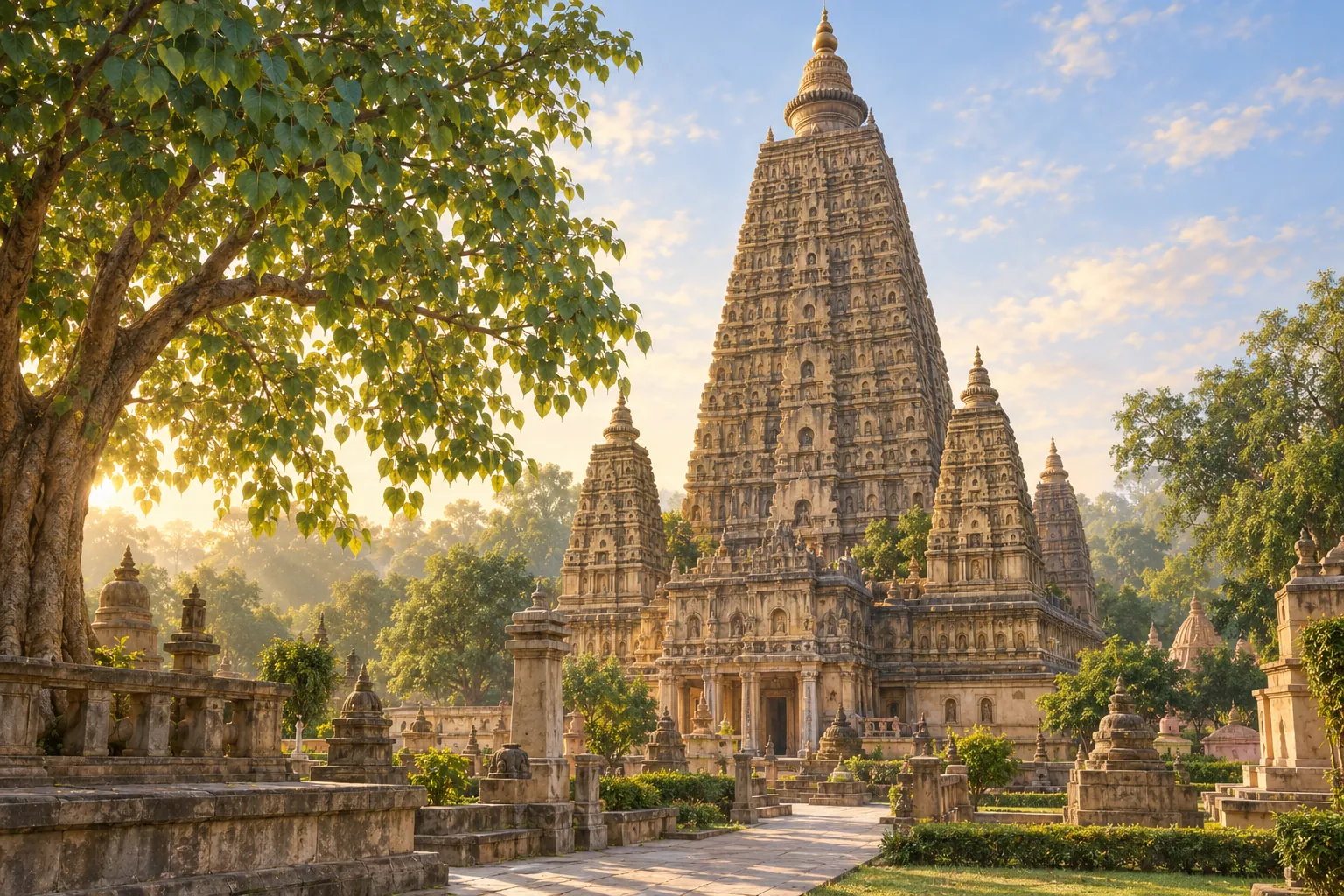
A place of awakening in Buddhist tradition
Bodh Gaya is a town in Bihar, India, associated in Buddhist tradition with the Buddha’s awakening. The Mahabodhi Temple complex is the sacred site and monument most closely connected with that association. UNESCO recognizes it as a major place of Buddhist pilgrimage. Distinguishing the town, the complex and the temple helps make sense of descriptions that use their names together. [1]
Calling it a place of awakening describes its religious significance. Archaeology and architectural history can investigate buildings, inscriptions and objects; they do not independently test the spiritual experience commemorated there. A careful introduction can respect the tradition while remaining clear about which claims concern belief and which concern surviving material evidence.
Several periods, rather than one construction date
UNESCO connects an early temple at the site with Ashoka in the third century BCE and dates the standing brick temple to the fifth or sixth century CE. It also records nineteenth-century restoration and later repairs. The building seen today therefore brings together an ancient sacred setting, a later monumental structure and subsequent conservation. [1]
The Rubin Museum’s study of Mahabodhi models explains that surviving representations helped restoration work, while warning that the result may not reproduce the precise historical form. A restoration is an interpretation informed by evidence. An illustration, miniature or modern photograph should therefore be identified for what it is, rather than treated as an exact view of the temple in every century. [2]
The tree, the seat and the surrounding space
The complex includes the Bodhi Tree, the Vajrasana or diamond throne, and places associated with the weeks following awakening. UNESCO describes the tree as a supposed descendant of the original and the sandstone seat as marking the place of meditation. It is misleading to describe the living tree simply as the same physical individual beneath which the Buddha sat. [1]
These features help explain why the site’s significance cannot be reduced to the height or silhouette of its tower. For a reader studying a plan or a photograph, a useful first step is to identify which feature is being described. Next, distinguish the religious association attached to it from the date of its present physical form.
A sacred place carried in miniature
LACMA holds a small black-schist model of the Mahabodhi Temple made in the twelfth century. Its imagery includes the Buddha, stupas, episodes from his life and a representation of the Bodhi Tree. The museum explains that such miniatures could serve as pilgrimage mementos and as a focus of meditation for people unable to visit the original site. [3]
That object helps answer a different question from “what did the building look like?” It shows how the meaning of a place could travel beyond its location. Its own twelfth-century date describes when the model was made; it should not be mistaken for the foundation date of either Bodh Gaya’s sacred site or the standing temple. [3]
Models are interpretations too
The Rubin Museum discusses a model whose imagery includes episodes not shown in the same way on the surviving structure. Its essay relates the central tower and four smaller towers to Buddhist symbolic interpretation. These are reminders that a miniature can be a religious object with its own purposes, rather than simply a scaled architectural drawing. [2]
Comparing a museum model with the present building can be rewarding if you ask two questions: what details are shared, and what work does each object perform for its audience? Do not assume that every difference proves damage or error. Artistic choices, devotional functions and changes over time may all matter, and the collection record should guide the comparison.
Approaching a living place of worship
Bihar’s tourism guidance asks visitors to dress modestly, observe footwear requirements and keep quiet, and it places restrictions on photography and electronic devices. Check current instructions before visiting, because access procedures can change. A heritage listing does not make every part of a sacred complex freely accessible for sightseeing or photography. [4]
Allow time to read signs and observe where other visitors wait, walk or pray. Ask staff before entering a restricted area or taking a photograph. For an introduction from home, begin with the UNESCO site description and one of the museum models linked below. Looking closely at a single documented object can be more informative than a large collection of images with uncertain captions.
Sources & further reading
The numbered links connect claims to the sources below. Sources checked October 14, 2026 by a separate AI fact-checking agent. This is not human or specialist review. Read our editorial approach.
- Mahabodhi Temple Complex at Bodh Gaya ↗UNESCO World Heritage Centre · Accessed October 14, 2026
- Mahabodhi Temple Model: Representing the Sacred Site of the Buddha’s Awakening ↗Rubin Museum of Himalayan Art, Project Himalayan Art · Accessed October 14, 2026
- Votive Model of the Mahabodhi Temple, Bodh Gaya, India ↗Los Angeles County Museum of Art (LACMA) · Accessed October 14, 2026
- Mahabodhi Temple ↗Department of Tourism, Government of Bihar · Accessed October 14, 2026
Found a problem? Send a correction with the passage and a supporting source.
Continue your reading
All articles ↗
History · 4 min read
Nalanda’s history: the ancient mahavihara and the modern university
Explore Nalanda through archaeology, Buddhist learning, surviving art and its modern revival, with clear distinctions between early remains and university history.

History · 3 min read
How Buddhism spread: routes, texts, patrons and pilgrims
Trace Buddhist transmission through South, Central and East Asia using evidence from monuments, trade routes, texts and artistic exchange.
Beliefs & ideas · 4 min read
The Four Noble Truths: suffering, its causes and the Buddhist path
A clear guide to the Four Noble Truths, the meaning of dukkha, the difference between craving and purpose, and the four tasks attached to the teaching.