History · 4 min read
Nalanda’s history: the ancient mahavihara and the modern university
Explore Nalanda through archaeology, Buddhist learning, surviving art and its modern revival, with clear distinctions between early remains and university history.
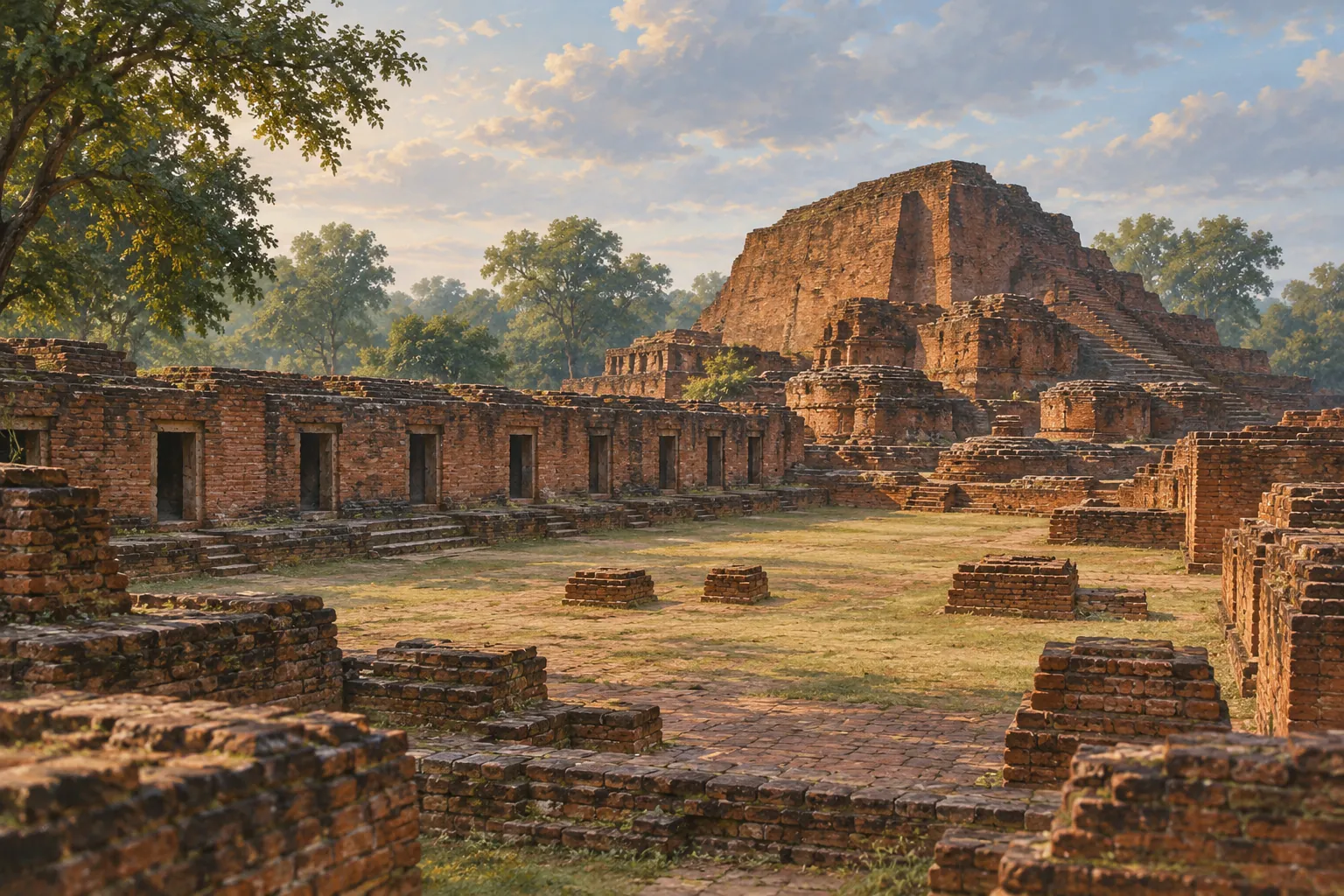
Which Nalanda are we talking about?
Nalanda in Bihar was a major Buddhist monastic and scholarly center. Its surviving archaeological site includes monasteries, temples and other religious structures. UNESCO describes the great institution as flourishing from the fifth through the thirteenth centuries CE, while identifying remains at the site that reach back to around the third century BCE. These dates refer to different layers of its history. [1]
The modern Nalanda University is a new institution near Rajgir, inspired by the earlier center. Its own history records the 2010 legislation establishing it and the enrollment of its first students in September 2014. The archaeological ruins and the present university are related through memory and inspiration, not through an uninterrupted sequence of classes from antiquity to today. [2]
Learning within a monastery
The term mahavihara identifies a great monastic establishment. Nalanda’s residential spaces, shrines and teaching environment belonged together. UNESCO’s account presents scholastic discussion as part of a Buddhist institutional setting, rather than describing a modern secular campus that happened to have a temple beside it. Using “university” is helpful if that historical difference remains visible. [1]
India’s Ministry of Culture attributes the fifth-century foundation to Kumaragupta I, with later patronage from Harsha and the Palas. It lists philosophy, logic, grammar and medicine alongside Buddhist study. Those achievements do not require an unqualified “world’s first university” claim. [3]
Connections across Asia
The modern university’s historical account highlights Xuanzang, the Chinese traveler whose writings describe Nalanda and whose journeys helped transmit Buddhist texts. Such accounts are valuable evidence for connections among places of learning. Large traditional estimates of students or teachers should still be identified as reported figures, not treated as if a complete modern enrollment register had survived. [2]
The ministry also describes Nalanda’s artistic influence spreading through scholars and their networks, including connections with Nepal, Myanmar and Tibet. Its history therefore includes the movement of people, ideas and objects beyond the surviving buildings. [3]
What a surviving object can show
The Metropolitan Museum holds a black-schist sculpture from Nalanda, dated to the late tenth or eleventh century. A seated Buddha reaches toward the earth, with the bodhisattvas Avalokiteshvara and Maitreya beside him. The central gesture represents awakening in Buddhist art. This object gives a specific example of the devotional images associated with the site’s later flourishing. [4]
The museum identifies details that help distinguish the attendant figures, including Amitabha in Avalokiteshvara’s headdress. Reading an object record alongside an image can show how historians connect material, place, period and iconography. It cannot tell us the number of students in a classroom or supply a portrait of the historical Buddha. Different questions require different evidence. [4]
Decline, abandonment and rediscovery
UNESCO records a sack and abandonment in the thirteenth century. The Ministry of Culture describes a decline involving multiple factors over centuries. Neither account establishes exact casualty totals or a precise number of books burned. [1][3]
The ministry records major excavation and consolidation campaigns in 1915–1937 and 1974–1982. The visible site combines archaeological remains with later conservation, rather than presenting an untouched campus frozen when teaching stopped. [3]
How to read Nalanda’s history clearly
Keep three timelines in your notes: early activity at the site, the flourishing of the monastic institution and the creation of the modern university. Then place each date you encounter on the appropriate timeline. If a source says “founded,” ask whether it means the earliest remains, the scholarly establishment or the new institution. Much confusion disappears once those meanings are separated.
For an image or an object, record what it actually documents: a surviving ruin, a conserved wall, a museum sculpture or a modern illustration. Use a source’s stated date range rather than replacing it with an attractive exact year. This approach leaves room for Nalanda’s remarkable history while keeping uncertainties visible and avoiding claims that the evidence cannot sustain.
Sources & further reading
The numbered links connect claims to the sources below. Sources checked October 14, 2026 by a separate AI fact-checking agent. This is not human or specialist review. Read our editorial approach.
- Archaeological Site of Nalanda Mahavihara at Nalanda, Bihar ↗UNESCO World Heritage Centre · Accessed October 14, 2026
- History and Revival ↗Nalanda University · Accessed October 14, 2026
- Archaeological Site of Nalanda Mahavihara (Nalanda University) Gets Inscribed in World Heritage List ↗Government of India, Ministry of Culture / Press Information Bureau · Accessed October 14, 2026
- Seated Buddha Reaching Enlightenment, Flanked by Avalokiteshvara and Maitreya ↗The Metropolitan Museum of Art · Accessed October 14, 2026
Found a problem? Send a correction with the passage and a supporting source.
Continue your reading
All articles ↗
History · 3 min read
How Buddhism spread: routes, texts, patrons and pilgrims
Trace Buddhist transmission through South, Central and East Asia using evidence from monuments, trade routes, texts and artistic exchange.

People & places · 4 min read
Bodh Gaya and the Mahabodhi Temple: significance and history
Learn why Bodh Gaya matters in Buddhism, how the Mahabodhi Temple developed, and what its tree, monuments and surviving pilgrimage models tell us.

Comparisons · 3 min read
Theravada vs Mahayana: texts, ideals and practice
Compare Theravada and Mahayana Buddhism without reducing them to selfish versus compassionate paths or treating either as one uniform school.