
Overview
Sikhism is a monotheistic religion that took shape in the Punjab, in north-west India, from about 1500, through the teaching of Guru Nanak and the nine Gurus who followed him. Sikhs call their path Gurmat, "the Guru's way", a revelation in its own right rather than a blend of the Hindu and Muslim traditions around it. Its scripture, the Guru Granth Sahib, is honoured as the living Guru. Sikhs aim to keep God in constant remembrance, earn an honest living and share what they have, and their teaching rejects caste. Initiated members of the Khalsa keep five articles of faith, including uncut hair. There are roughly 25 million Sikhs, most in India's Punjab state, with large communities in Canada, Britain and the United States.[2, 9–14]
History
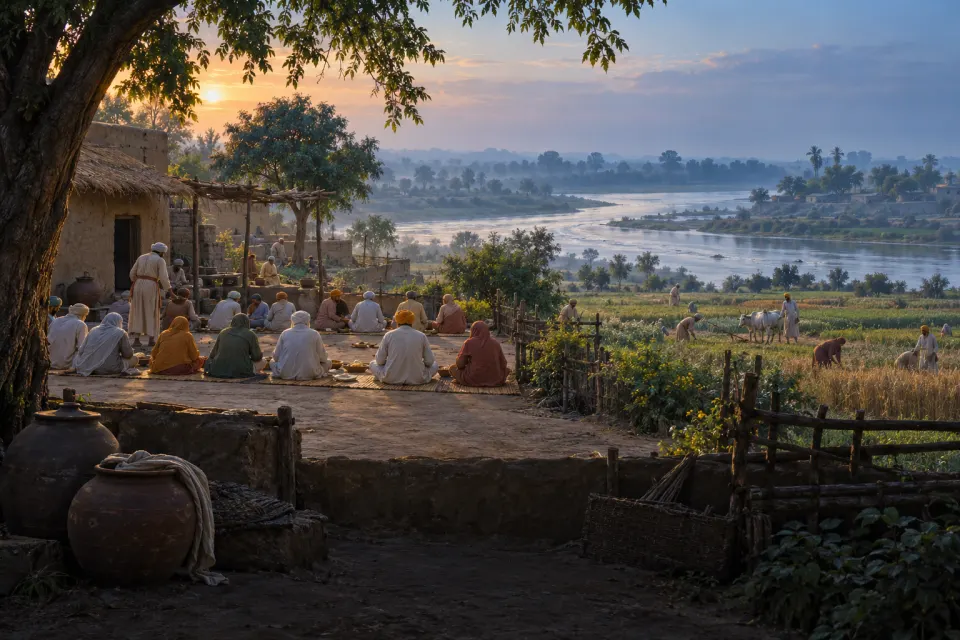
Guru Nanak and the first community 1469–1539
Nanak was born in 1469 into a Hindu Khatri family at Talwandi, now Nankana Sahib in Pakistan, and as a young man kept the stores of a Muslim official at Sultanpur Lodhi. Sikh tradition tells that around 1499 he vanished while bathing in the river there and returned after three days declaring there is no Hindu and no Muslim. He then travelled widely, singing hymns with a Muslim companion, Mardana, before settling at Kartarpur on the Ravi, where a community farmed, sang and ate together. Before dying in 1539 he named a disciple, Lehna, as successor, renaming him Angad.[15–20]
The Gurus build a Panth 1539–1606
Guru Angad spread the Gurmukhi script. Guru Amar Das, at Goindval, required all who came to see him to eat in the langar first, set up preaching districts called manjis, and gathered Sikhs at Vaisakhi and Diwali. Guru Ram Das founded the town that became Amritsar around a sacred pool. His son Guru Arjan built the Harimandir there and completed the Adi Granth in 1604, joining the Gurus' hymns with those of Hindu and Muslim devotees. In 1606 Arjan was tortured and executed in Lahore under Jahangir. Sikhs honour him as their first martyr; historians also point to Mughal unease at the community's growth.[21–25]
Saint-soldiers and the Khalsa 1606–1708
Arjan's son Hargobind wore two swords, for spiritual (piri) and worldly (miri) authority, raised the Akal Takht facing the Harimandir, and led armed Sikhs against Mughal forces. In 1675 the ninth Guru, Tegh Bahadur, was beheaded in Delhi on Aurangzeb's orders; Sikhs remember him as dying for others' freedom of belief, after Kashmiri Brahmins facing forced conversion sought his help. On Vaisakhi 1699 at Anandpur his son, Guru Gobind Singh, initiated five volunteers as the first Khalsa, whose men took the name Singh and women Kaur. Before dying in 1708 he ended the line of human Gurus, leaving authority to the scripture and the community.[26–29]
From persecution to a Sikh kingdom 1708–1849
Through much of the 18th century the Khalsa fought Mughal governors and Afghan invaders, enduring fierce persecution before Sikh bands came to control much of the Punjab. In 1799 Ranjit Singh took Lahore and ruled a kingdom across the region until his death in 1839; under his patronage the Harimandir's upper storeys were clad in gilded copper, becoming known as the Golden Temple. The British defeated the Sikh armies in the Anglo-Sikh wars, annexed the Punjab in 1849, and then recruited Sikhs into the Indian army far beyond their share of the population.[30–33]
Reform, Partition and a Punjabi state 1873–1966
From 1873 the Singh Sabha movement worked to restore a pure, distinct Sikh identity against Christian missions and Hindu reform societies, making the Khalsa form of Sikhism the norm. In the early 1920s a campaign wrested major gurdwaras from hereditary custodians, and the Sikh Gurdwaras Act of 1925 placed them under an elected body, the SGPC. Partition in 1947 cut the Punjab in two: Sikhs in the west fled to India, leaving Nanak's birthplace behind, amid killing by and against every community. In 1966 India redrew Punjab as a smaller state defined by the Punjabi language, where Sikhs are the majority.[34–37]
1984 and a worldwide community 1980s–today
In 1982 the militant preacher Jarnail Singh Bhindranwale and his armed followers occupied the Akal Takht. In June 1984 Prime Minister Indira Gandhi ordered the army in; Bhindranwale and many others were killed, including pilgrims caught in the fighting, and the Akal Takht was badly wrecked. On 31 October two of her Sikh bodyguards assassinated her, and for days mobs in Delhi and other cities killed thousands of Sikhs. Inquiries implicated Congress politicians and the police, yet few were ever convicted. By national censuses, Canada's Sikh community (771,790 in 2021) now outnumbers Britain's (524,140), with a further, mostly self-reported community in the United States.[14, 38–42]
Key moments
- c. 1450 CEKabīr the weaver · Varanasi (Banaras), northern India
- c. 1499 CEGuru Nanak's calling · Sultanpur Lodhi, Punjab
- 1604 CEThe Adi Granth at the Golden Temple · Amritsar, Punjab
- 1699 CEThe Khalsa is born · Anandpur Sahib, Punjab
- 1947 CEPartition of India · Punjab and Bengal, India and Pakistan
Beliefs
Ik Oankar · ੴ
"One Creator"
The scripture opens with the Mul Mantar, a creed that begins with the numeral one: there is one Supreme Being, eternal, creator, without fear or enmity, unborn and self-existent, known through the Guru's grace. Sikhs understand God as both beyond all qualities and present in everything. God takes no human incarnation, and Sikh teaching rejects image worship.[43]
Hukam · ਹੁਕਮ
"command, divine order"
Hukam is God's will and the order it sets in the universe; creation, birth and death all happen within it. Guru Nanak's Japji asks how a person can reach the truth, and answers that the seeker must submit to the hukam and walk in its way. Sikhs see understanding hukam as the means of overcoming the ego.[44]
Haumai · ਹਉਮੈ
"I-ness", self-centredness
In Sikh teaching the root problem of human life is haumai, the self-centred ego that hides God's presence and keeps a person bound to rebirth. It feeds five vices: lust, anger, greed, attachment and pride. A person ruled by it is manmukh, turned toward the self; the ideal is to become gurmukh, turned toward the Guru.[45]
Nām simran · ਨਾਮ ਸਿਮਰਨ
"remembering the Name"
The central discipline is loving remembrance of the divine Name. It ranges from repeating a word for God, usually Waheguru, through singing hymns with the congregation, to inward meditation on God's nature. Sikhs hold that such practice, together with God's grace, wears away the ego and brings growing peace and wonder.[46]
Mukti · ਮੁਕਤੀ
"liberation"
Sikhs accept karma and rebirth, as other religions born in India do, but teach that God's grace outweighs karma. Human birth is a rare chance to escape the cycle and merge with God, and liberation can be reached within this life. The tradition favours the life of a working householder over renunciation or asceticism.[47]
Practice

Daily prayer · ਨਿਤਨੇਮ
Devout Sikhs rise before dawn, bathe and meditate on the Name, then recite set prayers beginning with Guru Nanak's Japji. Many families then take the day's hukam or vak, a passage read from the scripture opened at random. Rehras is said in the early evening and Kirtan Sohila before sleep.[48]
Gurdwara worship and langar
Worshippers enter the gurdwara with heads covered and shoes removed and bow before the Guru Granth Sahib. Worship centres on kirtan, hymns from the scripture sung to music, and ends with the Ardas prayer and a share of karah prasad, a sweet offering. In the langar anyone, of any faith or caste, sits in a row with others to share a free vegetarian meal cooked and served by volunteers.[49–50]
Work, sharing and service
Sikh ethics are often summed up in three duties: remember God's Name, earn a living by honest work, and share its fruits with others. Living off alms is discouraged. Sevā, selfless service such as cooking in the langar, is a form of devotion, and Sikhs prize chardi kala, a spirit of hope in hard times.[51]
Initiation and the Five Ks · ਅੰਮ੍ਰਿਤ ਸੰਸਕਾਰ
At amrit sanskar five initiated Sikhs, standing for the first five Khalsa, stir sweetened water with a double-edged sword while reciting prayers, and the candidates drink it. Initiates keep the Five Ks: kes (uncut hair), kangha (comb), kara (steel bracelet), kirpan (sword) and kachera (undershorts). They must not cut their hair, use tobacco, commit adultery or eat ritually slaughtered (halal) meat. Tradition dates the Five Ks to 1699; reformers fixed the standard code around 1900.[52–53]
Rites of passage
A baby's name is chosen from the first letter of a hymn on a page opened at random; boys add Singh and girls Kaur. At an Anand Karaj wedding the couple walk four times around the Guru Granth Sahib as Guru Ram Das's wedding hymn, the Lavan, is sung. The dead are cremated, with hymns from the scripture.[54]
Holy days
The year ahead
| Date | Holy day | Reckoned |
|---|---|---|
| 8 November 2026 | Bandi Chhor Divas (Diwali) ਬੰਦੀ ਛੋੜ ਦਿਵਸ | Āśvina kṛṣṇa amāvāsyā, the tithi at sunset |
| 24 November 2026 | Guru Nanak's Gurpurab ਗੁਰਪੁਰਬ | Kārttika śukla pūrṇimā, the tithi at sunrise |
| 23 March 2027 – 25 March 2027 | Hola Mohalla ਹੋਲਾ ਮਹੱਲਾ | 2 days after Phālguna śukla pūrṇimā, the tithi at sunset |
| 14 April 2027 | Vaisakhi ਵਿਸਾਖੀ | the Sun's entry into sidereal Aries (Meṣa) |
Vaisakhi · ਵਿਸਾਖੀ
1 Vaisakh, usually 13 or 14 April
The Punjabi harvest and new-year festival, kept as the birthday of the Khalsa, founded on this day in 1699. Gurdwaras hold unbroken scripture readings and kirtan, and many hold initiations.[55]
Guru Nanak's Gurpurab · ਗੁਰਪੁਰਬ
Lunar calendar, usually November
One of the most widely celebrated gurpurbs, marking Guru Nanak's birth. As at other gurpurbs the scripture is read through without a break over about 48 hours, with processions, kirtan and shared meals.[56]
Diwali · ਦੀਵਾਲੀ
New moon of Kartik (October or November)
For Sikhs this festival of lights recalls Guru Hargobind's release from imprisonment by Jahangir in Gwalior fort. The Golden Temple is lit up for the night; it became a Sikh gathering day under Guru Amar Das.[57]
Hola Mohalla · ਹੋਲਾ ਮਹੱਲਾ
Day after Holi, in Chet (March)
Guru Gobind Singh turned the spring festival of Holi into a day of martial exercises and mock battles. It is still marked with processions and displays of fighting skill.[58]
People
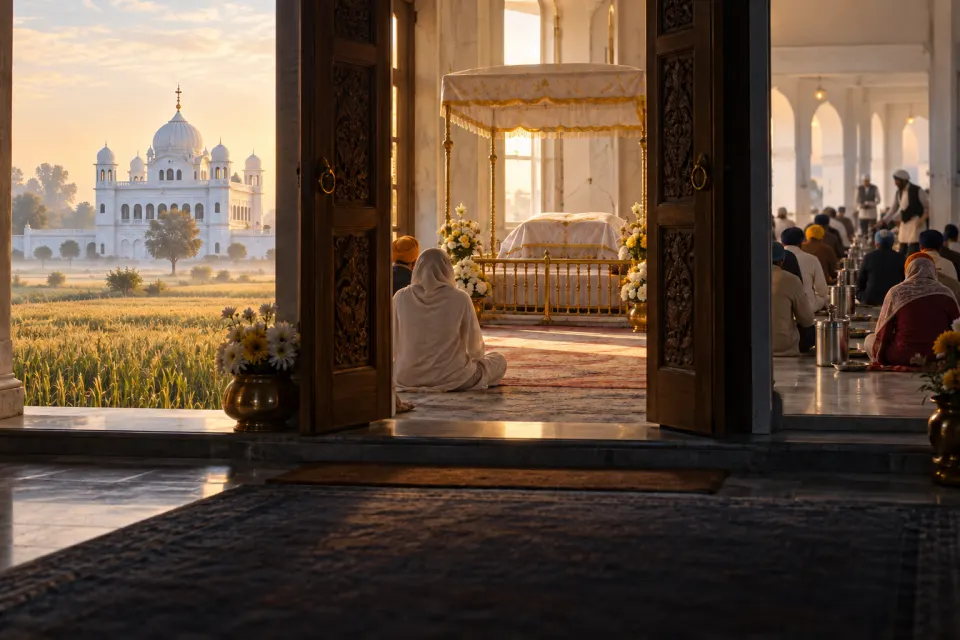
Guru Nanak · ਗੁਰੂ ਨਾਨਕ
founder · 1469–1539
The first Guru, whom Sikhs regard as the founder of their faith and the bearer of a divine message. His hymns, including the Japji that opens the scripture, lie at the heart of the Guru Granth Sahib. Historians place him in the world of the Sants, poet-saints of northern India who worshipped a God without form.[59]

Guru Arjan · ਗੁਰੂ ਅਰਜਨ
teacher · 1563–1606
The fifth Guru, son of Guru Ram Das. He built the Harimandir at Amritsar, compiled the Adi Granth in 1604 with Bhai Gurdas as his scribe, and founded towns such as Tarn Taran. His execution in Lahore in 1606 made him the first Sikh martyr.[60]

Guru Tegh Bahadur · ਗੁਰੂ ਤੇਗ਼ ਬਹਾਦਰ
teacher · 1621–1675
The ninth Guru, whose hymns were later added to the scripture by his son. Summoned to Delhi under Aurangzeb, he refused, by the usual account, to convert to Islam and was beheaded in Chandni Chowk on 11 November 1675. Sikhs mark his death as a martyrdom for freedom of conscience.[61]

Guru Gobind Singh · ਗੁਰੂ ਗੋਬਿੰਦ ਸਿੰਘ
teacher · 1666–1708
The tenth and last human Guru, born at Patna. He founded the Khalsa in 1699, wrote martial and devotional poetry, and fought long wars with hill chiefs and Mughal forces in which all four of his sons were killed. He died at Nanded in 1708, having named the scripture as Guru.[62]
Scripture
Guru Granth Sahib (Adi Granth) · ਸ੍ਰੀ ਗੁਰੂ ਗ੍ਰੰਥ ਸਾਹਿਬ
1604; final form by 1708
Compiled by Guru Arjan in 1604 and closed by Guru Gobind Singh, who added his father's hymns. It holds hymns by six Gurus and by bhagats such as Kabir, Namdev, Ravidas and the Sufi Shaikh Farid, arranged mostly by 31 musical modes (ragas). The standard printing runs to 1,430 pages, and Sikhs treat it as the living Guru.[63]
Dasam Granth · ਦਸਮ ਗ੍ਰੰਥ
compiled early 18th century
"The book of the Tenth Guru": a large collection attributed to Guru Gobind Singh and gathered after his death. It mixes hymns, autobiography and retold Hindu legends. Some of its hymns are used in worship, but it does not hold the scripture's status, and scholars disagree over how much of it the Guru himself wrote.[64]
Janamsakhis · ਜਨਮਸਾਖੀ
17th century onward
"Life stories": collections of anecdotes about Guru Nanak's life, travels and debates, in several traditions such as the Puratan and Bala versions. No surviving manuscript is earlier than the 17th century. They shaped popular Sikh piety, but historians treat them as hagiography rich in legend.[65]
Places

Harimandir Sahib (Golden Temple), Amritsar
IND
The central Sikh shrine stands in a sacred pool. Guru Arjan built it, by tradition with a foundation stone laid by the Sufi Mian Mir, with doors on all four sides. Its gilded upper storeys date from Ranjit Singh's reign; the Akal Takht faces it.[66]
Gurdwara Janam Asthan, Nankana Sahib
PAK
The shrine marking Guru Nanak's birthplace in the old village of Talwandi, now renamed Nankana Sahib, west of Lahore. Since Partition in 1947 it has lain in Pakistan, far from most of the Sikhs who revere it.[67]
Gurdwara Darbar Sahib, Kartarpur
PAK
Beside the Ravi river, Guru Nanak settled after his years of travel, gathered the first Sikh community of farmers and worshippers, and died here in 1539. The shrine, on the right bank of the Ravi, is now in Pakistan.[68]
Takht Sri Kesgarh Sahib, Anandpur Sahib
IND
The shrine where Guru Gobind Singh inaugurated the Khalsa on Vaisakhi 1699, one of the five takhts, with the Akal Takht and the takhts at Patna, Talwandi Sabo and Nanded.[69]
Where it spread
| Region | From | How |
|---|---|---|
| India | 1500 CE | Guru Nanak's mission |
| Pakistan | 1500 CE | Nankana Sahib, Guru Nanak's birthplace; most Sikhs left in 1947 |
| Malaysia | 1873 CE | IND. Punjabi police in Perak |
| Singapore | 1881 CE | IND. Sikh police contingent |
| Australia | 1890 CE | IND. Punjabi hawkers and farmers |
| Kenya | 1900 CE | IND. Uganda Railway |
| United States | 1900 CE | IND. California; Stockton gurdwara 1912 |
| Canada | 1904 CE | IND. British Columbia; first gurdwara 1908 |
| United Kingdom | 1911 CE | IND. First gurdwara in London; most migration after 1950 |
Art & objects
Public-domain objects from museum collections. Select one to see it at the museum.


![[Holy Sikh Tank and Golden Temple at Amritsar]](https://cdn.holymap.app/museum/met-287671.webp?v=adca9262227e)


Numbers
- Sikhs worldwide
- c. 25 million (estimate)[9]
Reference estimates for the early 21st century: Britannica (2025 text) nearly 25 million; Worldmark Encyclopedia of Religious Practices (2006) 23–24 million.
- Sikhs in India (2011 census)
- 20.8 million, 1.7% of the population[70]
- Sikhs in Indian Punjab (2011 census)
- c. 16 million, a majority of the state[71]
National censuses
| Country | Year | Count | Share |
|---|---|---|---|
| India Sikh | 2011 | 20,833,116 | 1.7% |
| Canada Sikh | 2021 | 771,790 | 2.1% |
| United Kingdom (England and Wales) Sikh | 2021 | 524,140 | 0.9% |
| Australia Sikhism | 2021 | 210,400 | 0.8% |
| New Zealand Sikhism | 2018 | 40,908 | 0.9% |
Source: Australian Bureau of Statistics, Census of Population and Housing 2021, 'Religious affiliation in Australia' (Table 4), CC BY 4.0. Source: Office of the Registrar General & Census Commissioner, India, Census of India 2011, Table C-01 Population by religious community and its appendix, under the Government Open Data License – India. Source: Office for National Statistics licensed under the Open Government Licence v.3.0 Adapted from Statistics Canada, Table 98-10-0342-01 Religion by visible minority and generation status: Canada, provinces and territories, census metropolitan areas and census agglomerations with parts, released 2022-10-26. This does not constitute an endorsement by Statistics Canada of this product. Source: Stats NZ, 2018 Census, licensed by Stats NZ for re-use under the Creative Commons Attribution 4.0 International licence.
How we know
Knowing the Gurus' lives
The Gurus' own hymns, preserved in the Adi Granth from 1604, are the firmest evidence for their teaching. Their lives are known mostly from later writing, above all the janamsakhis about Nanak, whose surviving manuscripts date from the 17th century. The historian W. H. McLeod judged that only a small part of these stories can be confirmed; many Sikh scholars give tradition more weight. This profile reports such accounts as tradition.[72]
Defining Sikh identity
Sikhs, and Sikh scholarship such as Punjabi University's Encyclopaedia of Sikhism, hold that Sikhism was distinct from Nanak's first preaching. Some Western scholars instead place early Sikhism within the Sant devotional movement of northern India. Historians note that the line between Sikh and Hindu practice was often blurred until Singh Sabha reformers made the Khalsa form standard around 1900.[73]
Common misconceptions
Myth Sikhism is a blend of Hinduism and Islam.
Fact Sikhs see their faith as a revelation given to Guru Nanak, not a mixture of older religions. Nanak shared ideas such as karma and rebirth with Indian traditions, and the scripture includes Hindu and Muslim devotees, but its teaching on God, the Guru and community is its own. Scholars who stress Indian roots point to the Sant movement and find little sign of direct borrowing from Islam.[74]
Myth Every Sikh wears a turban and has taken initiation.
Fact Only a minority of Sikhs, perhaps 15–20 percent, are initiated. Many more keep their hair uncut without initiation, and others cut their hair while still identifying as Sikh, especially in the diaspora. In a 2021 Pew survey in India, about three-quarters of Sikhs said they keep their hair long.[75]
Myth The kirpan is a weapon Sikhs carry for fighting.
Fact The kirpan is an article of faith worn by initiated Sikhs, standing for courage and the duty to defend the weak; Sikh teaching allows force only as a last resort. India's constitution protects the right to carry it, and courts elsewhere have often allowed small, sheathed kirpans in schools.[76]
Glossary
- gurdwārā · ਗੁਰਦੁਆਰਾ
- "Door of the Guru": any building where the Guru Granth Sahib is installed; the Sikh place of worship, marked by a saffron flag, the Nishan Sahib.[77]
- laṅgar · ਲੰਗਰ
- A gurdwara's communal kitchen and the free meal it serves to all comers, who sit together regardless of caste or status.[78]
- Khālsā · ਖ਼ਾਲਸਾ
- "The pure": the order of initiated Sikhs founded by Guru Gobind Singh in 1699, and by extension the Sikh community as a whole.[79]
- Pañj Piāre · ਪੰਜ ਪਿਆਰੇ
- "The five beloved": the five men of different castes who answered Guru Gobind Singh's call in 1699 and became the first Khalsa initiates.[80]
- Vāhigurū · ਵਾਹਿਗੁਰੂ
- "Wonderful Lord": the name for God most used by Sikhs, repeated in meditation and the Khalsa greeting.[81]
- Ardās · ਅਰਦਾਸ
- The set prayer closing worship and most ceremonies, recalling the Gurus and the community's history and asking for the good of all.[82]
- takht · ਤਖ਼ਤ
- "Throne": one of five seats of religious authority. Edicts of the highest, the Akal Takht in Amritsar, bind all Sikhs.[83]
- sahajdhārī · ਸਹਿਜਧਾਰੀ
- A Sikh who follows the Gurus' teaching but has not taken Khalsa initiation, usually cutting the hair.[84]
Sources
Each statement above was checked against published sources; the verdict says whether it stood as written, was corrected or was hedged.
- VerifiedWorldmark, Sikhism; Britannica/McLeod, Sikhism; EoS, Sikhism.
- VerifiedBritannica/McLeod, Sikhism; Britannica/McLeod, Guru Nanak section; Encyclopedia.com, Sikhism; EoS, Sri Guru Granth Sahib.
- VerifiedEncyclopedia.com, Sikhism; EoS, Sikhism; Britannica/McLeod, Sikh practice.
- VerifiedEncyclopedia.com, Sikhism; Britannica/McLeod, Sikh practice; EoS, Gurdwara.
- VerifiedEncyclopedia.com, Sikhism; EoS, Granthi.
- VerifiedEoS, Gurmukhi; Britannica, Singh Sabha; Encyclopedia.com, Sikhism.
- VerifiedBritannica, Golden Temple; Encyclopedia.com, Sikhism; EoS, Harimandar.
- VerifiedEncyclopedia.com, Sikhism; EoS, Five Symbols.
- HedgedBritannica/McLeod, Sikhism; Encyclopedia.com, Sikhism; Pew Research Center.
- VerifiedBritannica/McLeod, Sikhism; Encyclopedia.com, Sikhism; EoS, Sikhism.
- VerifiedEoS, Sikhism; Britannica/McLeod, Sikhism; Encyclopedia.com, Sikhism; BYU RSC (supporting).
- VerifiedEncyclopedia.com, Sikhism; EoS, Sikhism; Britannica/McLeod, Sikh practice.
- VerifiedBritannica, Guru Gobind Singh; Encyclopedia.com, Sikhism; UCLA MANAS, Sikhism.
- CorrectedStatistics Canada, 2021 Census of Population, Religion by visible minority and generation status; UK Office for National Statistics, Religion, England and Wales: Census 2021 / table TS031; UCLA MANAS, Sikhism (supporting); Sikh Coalition, About Sikhs (supporting).
- VerifiedEncyclopedia.com, Sikhism; EoS, Nankana Sahib; Britannica/McLeod, Guru Nanak.
- VerifiedEoS, Nanak, Guru; Encyclopedia.com, Sikhism.
- VerifiedEncyclopedia.com, Sikhism; EoS, Nanak, Guru; BYU RSC (supporting).
- VerifiedEoS, Nanak, Guru; Britannica/McLeod, Guru Nanak; BYU RSC (supporting).
- VerifiedEncyclopedia.com, Sikhism; Britannica/McLeod, Guru Nanak; EoS, Sikhism.
- VerifiedEncyclopedia.com, Sikhism; EoS, Sikhism; EoS, Kartarpur.
- VerifiedEoS, Sikhism; Encyclopedia.com, Sikhism; UCLA MANAS, Sikhism.
- VerifiedBritannica, Guru Amar Das; EoS, Amar Das, Guru; Encyclopedia.com, Sikhism.
- VerifiedBritannica/McLeod, Guru Nanak section; Encyclopedia.com, Sikhism; EoS, Sikhism.
- VerifiedBritannica, Golden Temple; Encyclopedia.com, Sikhism; EoS, Harimandar; UCLA MANAS, Sikhism.
- HedgedEncyclopedia.com, Sikhism; EoS, Arjan Dev, Guru; UCLA MANAS, Sikhism.
- VerifiedEncyclopedia.com, Sikhism; Britannica/McLeod, Guru Nanak section; EoS, Sikhism.
- VerifiedBritannica, Tegh Bahadur; Encyclopedia.com, Sikhism; EoS, Tegh Bahadur, Guru.
- VerifiedBritannica, Guru Gobind Singh; Encyclopedia.com, Sikhism; UCLA MANAS, Sikhism.
- VerifiedBritannica, Guru Gobind Singh; Encyclopedia.com, Sikhism; EoS, Sikhism.
- VerifiedEncyclopedia.com, Sikhism; EoS, Sikhism.
- VerifiedBritannica, Golden Temple; Britannica, Singh Sabha; Encyclopedia.com, Sikhism; EoS, Harimandar.
- VerifiedEncyclopedia.com, Sikhism; Britannica, Singh Sabha; UCLA MANAS, Sikhism.
- VerifiedUCLA MANAS, Sikhism; Kate Imy, Faithful Fighters: Identity and Power in the British Indian Army; IESS via Encyclopedia.com (supporting).
- VerifiedBritannica, Singh Sabha; Encyclopedia.com, Sikhism; EoS, Sikhism.
- VerifiedBritannica, gurdwara; EoS, Shiromani Gurdwara Parbandhak Committee; Encyclopedia.com, Sikhism.
- VerifiedEoS, Partition of the Punjab; UK National Archives, Partition of British India; Pew Research Center.
- VerifiedEoS, Punjabi Suba Movement; Encyclopedia of India via Encyclopedia.com.
- VerifiedBritannica, Golden Temple; Sciences Po Mass Violence & Resistance, L. Baixas, The Anti-Sikh Pogrom of October 31 to November 4, 1984, in New Delhi; Encyclopedia.com, Sikhism.
- VerifiedBritannica, Golden Temple; Sciences Po, Baixas; Britannica, Akal Takht; Human Rights Watch (supporting).
- VerifiedSciences Po, Baixas; Encyclopedia.com, Sikhism.
- VerifiedEncyclopedia.com, Sikhism; Sciences Po, Baixas; HRW (supporting).
- VerifiedSciences Po, Baixas; S. S. Thandi, 1984 Delhi Massacre Forty Years of Impunity, Journal of Sikh and Punjab Studies 31; HRW (supporting).
- VerifiedEncyclopedia.com, Sikhism; EoS, Sikhism; EoS, Mul Mantra.
- VerifiedEncyclopedia.com, Sikhism; EoS, Sikhism; EoS, Hukam.
- VerifiedEoS, Sikhism; Encyclopedia.com, Sikhism.
- VerifiedEncyclopedia.com, Sikhism; Britannica/McLeod, Guru Nanak.
- VerifiedEncyclopedia.com, Sikhism; EoS, Sikhism; Britannica/McLeod, Guru Nanak.
- VerifiedEncyclopedia.com, Sikhism; EoS, Sri Guru Granth Sahib; Britannica, Japji.
- VerifiedBritannica/McLeod, Sikh practice; Encyclopedia.com, Sikhism.
- VerifiedBritannica/McLeod, Sikh practice; EoS, Guru ka Langar; Encyclopedia.com, Sikhism.
- VerifiedEncyclopedia.com, Sikhism; EoS, Sikhism; EoS, Seva.
- VerifiedBritannica/McLeod, Sikh practice; Encyclopedia.com, Sikhism.
- VerifiedBritannica/McLeod, Sikh practice; Britannica, Rahit; Encyclopedia.com, Sikhism; EoS, Five Symbols.
- VerifiedBritannica/McLeod, Sikh practice; Encyclopedia.com, Sikhism.
- VerifiedEoS, Baisakhi; Encyclopedia.com, Sikhism; Britannica, Guru Gobind Singh.
- VerifiedEncyclopedia.com, Sikhism; EoS, Gurpurb; Britannica/McLeod, Sikh practice.
- VerifiedBritannica/McLeod, Sikh practice; EoS, Divali; Britannica, Guru Amar Das; Encyclopedia.com, Sikhism.
- VerifiedBritannica/McLeod, Sikh practice; EoS, Hola Mahalla; Encyclopedia.com, Sikhism.
- VerifiedBritannica/McLeod, Sikhism; Encyclopedia.com, Sikhism; EoS, Japu.
- VerifiedEncyclopedia.com, Sikhism; EoS, Sri Guru Granth Sahib; EoS, Sikhism; Britannica, Golden Temple.
- VerifiedBritannica, Tegh Bahadur; Britannica, Guru Gobind Singh; Encyclopedia.com, Sikhism; UCLA MANAS.
- VerifiedBritannica, Guru Gobind Singh; EoS, Gobind Singh, Guru; Encyclopedia.com, Sikhism.
- VerifiedEncyclopedia.com, Sikhism; EoS, Sri Guru Granth Sahib; Britannica, Guru Gobind Singh.
- VerifiedBritannica, Dasam Granth; EoS, Dasam Granth; Encyclopedia.com, Sikhism.
- VerifiedEoS, Janam Sakhi; Britannica/McLeod, Guru Nanak; Encyclopedia.com, Sikhism.
- VerifiedBritannica, Golden Temple; EoS, Harimandar; Encyclopedia.com, Sikhism.
- VerifiedEoS, Nankana Sahib; Britannica, gurdwara; UK National Archives.
- VerifiedEoS, Kartarpur; Britannica/McLeod, Guru Nanak; Encyclopedia.com, Sikhism.
- VerifiedEoS, Anandpur; Encyclopedia.com, Sikhism; Britannica, Akal Takht.
- VerifiedGovernment of India, Press Information Bureau, Ministry of Minority Affairs, Percentage of Population as Minorities; Pew Research Center; Immigration and Refugee Board of Canada, India: Treatment of Sikhs… (supporting).
- VerifiedBritannica, Punjab; Pew Research Center; IRB Canada (supporting).
- VerifiedBritannica/McLeod, Guru Nanak; EoS, Janam Sakhi; Britannica/McLeod, Sikhism.
- VerifiedEoS, Sikhism; Britannica/McLeod, Sikhism; Encyclopedia.com, Sikhism; UCLA MANAS.
- VerifiedEoS, Sikhism; Britannica/McLeod, Sikhism; Encyclopedia.com, Sikhism.
- VerifiedEncyclopedia.com, Sikhism; Pew Research Center; Britannica, Rahit.
- VerifiedEncyclopedia.com, Sikhism; UCLA MANAS, Kirpan.
- VerifiedEncyclopedia.com, Sikhism; EoS, Five Symbols; Britannica, gurdwara.
- VerifiedBritannica/McLeod, Sikh practice; EoS, Guru ka Langar.
- VerifiedEoS, Khalsa; Britannica, Guru Gobind Singh; Encyclopedia.com, Sikhism.
- VerifiedEncyclopedia.com, Sikhism; Britannica, Guru Gobind Singh; EoS, Panj Piare.
- VerifiedEncyclopedia.com, Sikhism; EoS, Vahiguru; Britannica/McLeod, Sikh practice.
- VerifiedBritannica/McLeod, Sikh practice; EoS, Ardas; Encyclopedia.com, Sikhism.
- VerifiedBritannica, Akal Takht; Encyclopedia.com, Sikhism; EoS, Takht.
- VerifiedEoS, Sahajdhari; Encyclopedia.com, Sikhism.
Last fact-checked 3 October 2026.