The story behind the day
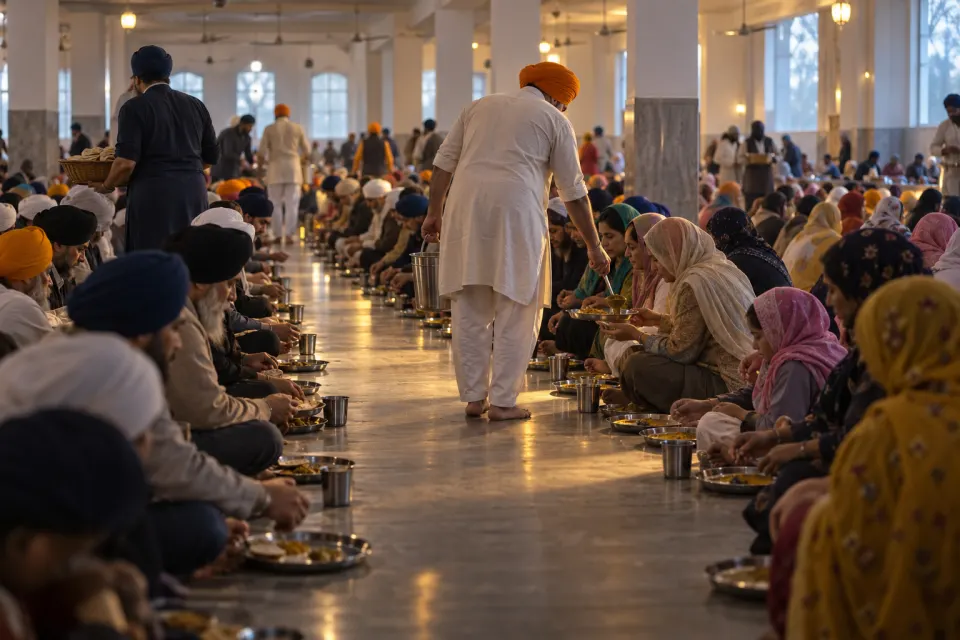
Guru Nanak's Gurpurab is the birthday of the founder of Sikhism, kept on the full moon of the lunar month of Kārttika, in October or November. Sikhs gather in gurdwaras for unbroken readings of the Guru Granth Sahib and for hymn-singing, march in processions, and share a free meal, the langar, with everyone present. The Sikh governing body, the SGPC, gives 15 April 1469 as his date of birth but celebrates the day in Kārttika, a difference that is explained below.[1–5]
Origins

Guru Nanak was born in 1469 at Talwandi, a village now called Nankana Sahib in Pakistan. His mother was Tripta, a pious woman, and his father is named Kalyan Chand in one reference work and Mehta Kalyan Das, better known as Mehta Kalu, by the SGPC. Stories of his birth and life are told in the janam-sākhīs, the birth stories, a genre that scholars have read as biographical, pseudobiographical and hagiographical.[2, 7–8]
What it marks
The Gurpurab marks the birth of the teacher who, in the Sikh account, travelled for twenty-four years across India and beyond, preaching divine unity, and then settled at Kartarpur, the village he founded on the banks of the Ravi, where he introduced the langar, a kitchen where all eat together irrespective of caste, religion or sex. His 974 hymns were included in the Guru Granth Sahib by Guru Arjan. He died at Kartarpur in 1539, having named Angad as his successor.[9–10]
How it came to be
The date of his birth is not settled. The SGPC gives 15 April 1469, the third day of the bright half of Baisakh in the year Samvat 1526, and notes that some chronicles say 20 October. A dictionary of world religions says that scholarly opinion, working from the other janam-sākhīs, places his birth in Baisākh, April to May, while the birthday is celebrated on the full moon of Kārttika. The SGPC states that the birthday is celebrated on the full moon day of Kārttika, so the Gurpurab falls in the autumn.[1, 3, 8]
How it is kept

Gurpurabs are holy days that commemorate events in the lives of the Gurus, and Guru Nanak's birthday is among the more important. Generally an akhaṇḍ pāṭh, a reading of the Guru Granth Sahib without interruption, is held in the gurdwara before the birthday. Sikhs take out processions in towns and cities, singing sacred hymns, and community meals are served in special langars so that everyone present eats together.[4–6, 11–12]
Sources
Each statement above was checked against published sources; the verdict says whether it stood as written, was corrected or was hedged.
- VerifiedSGPC, Gurpurbs; J. Bowker, Nānak, Gurū, Concise Oxford Dictionary of World Religions, via Encyclopedia.com; Mandair, Sikhism, Encyclopedia of India.
- VerifiedSGPC, Sri Guru Nanak Dev Ji; N.-G. Kaur Singh, Nānak, Encyclopedia of Religion.
- Verifiedsgpc.net, Guru nanak sahib; Bowker, Nānak, Gurū, via Encyclopedia.com.
- VerifiedSGPC, Gurpurbs; Encyclopaedia of Sikhism, Gurpurb.
- VerifiedEncyclopaedia of Sikhism, Gurpurb; SGPC, Gurpurbs.
- VerifiedEncyclopaedia of Sikhism, Gurpurb; Mandair, Sikhism, via Encyclopedia.com.
- Verifiedsgpc.net, Guru nanak sahib; Kaur Singh via Encyclopedia.com.
- VerifiedH. S. Grewal, Janamsakhis, in Sikhism; Kaur Singh via Encyclopedia.com.
- VerifiedKaur Singh via Encyclopedia.com; sgpc.net, Guru nanak sahib.
- VerifiedKaur Singh via Encyclopedia.com; sgpc.net, Guru nanak sahib.
- VerifiedEncyclopaedia of Sikhism, Gurpurb; Mandair via Encyclopedia.com.
- VerifiedEncyclopaedia of Sikhism, Gurpurb; SGPC, Gurpurbs.