
Overview
The bhakti movement is the wave of devotional poetry and practice that swept across the Indian subcontinent from about the 6th century, holding that loving devotion (bhakti) to a personal God matters more than caste, ritual correctness or philosophical learning. It began among Tamil poet-saints singing to Śiva and Viṣṇu and spread over the following centuries into Karnataka, Maharashtra, Bengal, Rajasthan and the Hindi-speaking north, producing some of India's best-loved vernacular literature, much of it composed orally and sung long before it was written down. Bhakti is not a single sect: it runs through Vaiṣṇava, Śaiva and Śākta worship alike, fed Sikhism's origins, and in its northern Sant form drew on Sufi Islam as well as Hindu tradition. Many, though not all, bhakti traditions welcomed women and people of every caste as equal devotees.[1–3, 7–8]
History
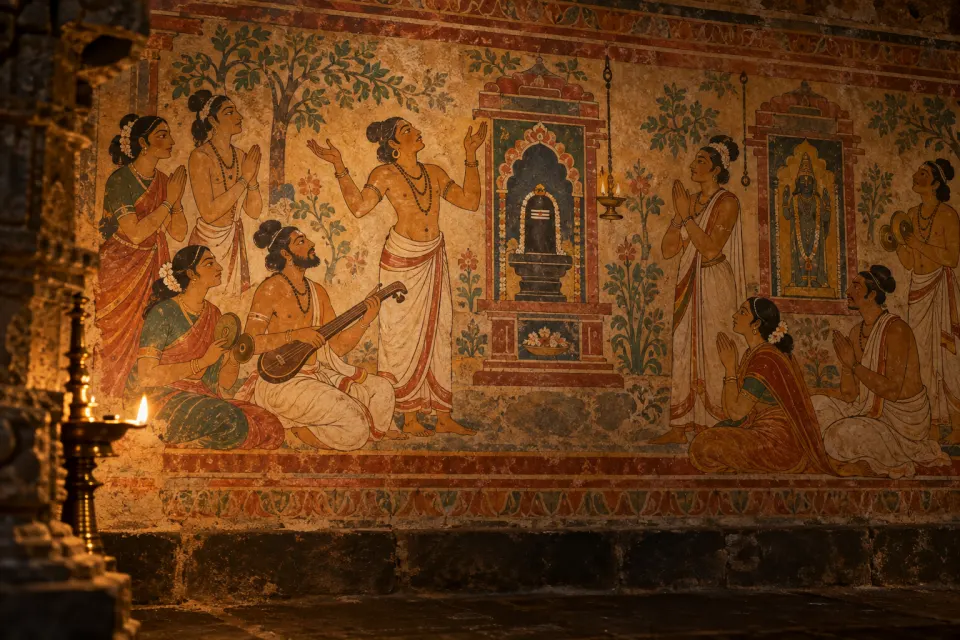
Tamil beginnings c. 6th–10th century
In the Tamil country, sixty-three Śaiva poet-saints, the Nāyaṉārs, and twelve Vaiṣṇava poet-saints, the Āḻvārs, sang ecstatic devotion to Śiva and Viṣṇu in their own language rather than Sanskrit. Drawing on older Tamil traditions of erotic and royal poetry, they addressed God as an absent lover or a king, and came from every caste, Untouchables and women among them. Their hymns, gathered as the Tirumuṟai and the Nālāyira Divya Prabandham, are still sung in Tamil temples today.[9–11]
A devotional wave across India 12th–18th century
Bhakti's "lit fuse" spread region by region: Basava's Vīraśaiva movement in 12th-century Karnataka; the Marathi poet-saints Jñāneśvar, Nāmdev, Eknāth and Tukārām, whose Vārkari pilgrims still walk to Paṇḍharpūr; the nirguṇa Sant poets Kabīr, Raidās and Dādū, who rejected images and scripture alike in favour of a formless God, a current that also shaped Gurū Nānak's new Sikh teaching; Mīrābāī's songs of love for Kṛṣṇa, composed as a Rajput princess in 16th-century Rajasthan; and Caitanya's ecstatic chanting in 16th-century Bengal. Muslim ideas of surrender to God likely shaped bhakti from an early stage, and Sufi language entered it openly through Kabīr and later poets.[12–16]
Key moments
- c. 650 CEThe Tamil poet-saints · Tamil country, southern India
- c. 1160 CEBasava and the Liṅgāyats · Karnataka, southern India
- c. 1450 CEKabīr the weaver · Varanasi (Banaras), northern India
- c. 1530 CEMīrābāī sings to Krishna · Merta and Mewar, Rajasthan, India
Beliefs
Nirguṇa and saguṇa bhakti · निर्गुण, सगुण
without qualities; with qualities
Saguṇa poets such as Tulsīdās and Mīrābāī adored God in a particular form, Rāma or Kṛṣṇa; nirguṇa poets such as Kabīr and Nānak insisted God is formless and beyond all images, found through the inward repetition of his name rather than any icon or temple.[17]
Guru · गुरु
teacher
Many bhakti poet-saints trace their awakening to a guru: Kabīr is said to have been shaped by the Hindu ascetic Rāmānanda, and Caitanya's own turn to devotion followed instruction from the guru Īśvara Purī on pilgrimage. A guru's teaching, rather than scripture or caste standing, often decided who counted as a legitimate voice within a bhakti lineage.[18]
Places

Paṇḍharpūr
IND
A Maharashtra town on the Bhīma River, home to the 12th-century Viṭhobā temple and goal of the Vārkari pilgrimage associated with the poet-saints Nāmdev and Tukārām, who walked there singing devotional songs.[19]
Art & objects
Public-domain objects from museum collections. Select one to see it at the museum.
 God Krishna Dancing on the Head of the Snake Demon Kaliya (Kaliyadamana)Tamil Nadu, Vijayanagar period, 14th century
 The Infant Krishna Killing the Ogress PutanaKerala, 17th century
 Friends of Krishna, folio 163 from a Bhakti Ratnavali of Vishnu PuriNorthwestern India, Rajasthan, Rajput Kingdom of Mewar, 1725–50
 Leaf from a Kalighat album: Krishna as Kali worshipped by Radha (recto); Krishna quells the serpent Kaliya (verso)Eastern India, Bengal, Kolkata, Kalighat, c. 1890
 Krishna and Radha Avoid Embarrassment: Mottaita Bhava, from a RasikapriyaCentral India, Madhya Pradesh, Malwa, c. 1640
 Krishna and Radha with Their Confidantes: Page from a Dispersed Gita GovindaIndia (Rajasthan, Mewar), ca. 1655–60
 The Gopis Plead with Krishna to Return Their Clothing: Folio from "Isarda" Bhagavata PuranaNorth India (Delhi -Agra area), ca. 1560–65
 Raja Balwant Singh’s Vision of Krishna and RadhaIndia, Punjab Hills, kingdom of Jasrota, ca. 1745–50
 Krishna and Radha in a Bower: Page From a Dispersed Gita GovindaIndia (Rajasthan, Mewar), ca. 1665
 The Gopis Plead with Krishna to Return Their Clothing, Page from a Bhagavata Purana (Ancient Stories of Lord Vishnu) seriesIndia (Rajasthan, Bikaner), ca. 1610
 Krishna (Shri Shri Guranga Avatara)India, Kolkata, West Bengal, 1895
 Radha, the Beloved of KrishnaIndia (Rajasthan, Kishangarh), ca. 1750
 Krishna Woos Radha: Page from the Dispersed "Boston" Rasikapriya (Lover's Breviary)India (Rajasthan, Amber), ca. 1610
How we know
How far did Islam shape bhakti?
Scholars debate how much Sufi and Islamic ideas of surrender to God shaped bhakti, especially its northern, image-rejecting nirguṇa current. Some bhakti milieus, such as the Bengali Bāuls, openly blend Hindu and Sufi mysticism, and Punjab's earliest vernacular devotional poetry came mostly from Muslim writers; but poets such as Kabīr criticised Hindu and Muslim practice equally rather than merging the two, so influence and independent parallel development remain hard to disentangle.[16, 20]
Common misconceptions
Myth Bhakti poets all rejected image worship and temple ritual.
Fact Saguṇa bhakti poets such as the Tamil Āḻvārs, Tulsīdās and Mīrābāī wrote devotedly of a God with form and worshipped in temples; only the nirguṇa Sant strand, Kabīr and Nānak among them, insisted God was formless and rejected icons.[17]
Myth Bhakti was a single organised movement with one founder or doctrine.
Fact Bhakti is a family of regional movements, in different languages and centuries, sharing an emphasis on personal devotion over caste and ritual but otherwise differing widely: some centred on Viṣṇu, others on Śiva, the Goddess, or a formless God.[6, 21]
Glossary
- Sant · सन्त
- A North Indian poet-saint of the nirguṇa current, such as Kabīr or Raidās, who taught devotion to a formless God through the repetition of his name.[14]
- Vārkari · वारकरी
- A Maharashtrian pilgrim-devotee of Viṭhobā who walks the traditional route to Paṇḍharpūr, following the path set by poet-saints such as Nāmdev and Tukārām.[13, 19]
- Vacana · ವಚನ
- A short Kannada free-verse utterance by a Vīraśaiva saint-poet such as Basava, voicing personal devotion to Śiva.[12]
- Kīrtana · कीर्तन
- Congregational singing of a deity's names, popularised in bhakti practice above all by Caitanya in 16th-century Bengal.[15]
- Panth · पन्थ
- A following organised around a Sant poet-saint's teaching, such as the Kabīr Panth, which split into twelve branches after Kabīr's death.[22]
Sources
Each statement above was checked against published sources; the verdict says whether it stood as written, was corrected or was hedged.
- VerifiedBritannica, bhakti; Encyclopedia of Religion, Poetry: Indian Religious Poetry, via Encyclopedia.com.
- VerifiedBritannica, bhakti; Encyclopedia of Religion, Poetry: Indian Religious Poetry, via Encyclopedia.com.
- VerifiedBritannica, bhakti; Encyclopedia of Religion, Poetry: Indian Religious Poetry, via Encyclopedia.com.
- VerifiedEncyclopedia of Religion, Poetry: Indian Religious Poetry, via Encyclopedia.com; Britannica, bhakti.
- VerifiedBritannica, bhakti; Encyclopedia of Religion, Poetry: Indian Religious Poetry, via Encyclopedia.com.
- VerifiedBritannica, bhakti; Encyclopedia of Religion, Poetry: Indian Religious Poetry, via Encyclopedia.com.
- VerifiedBritannica, bhakti; Encyclopedia of Religion, Poetry: Indian Religious Poetry, via Encyclopedia.com.
- VerifiedEncyclopedia of Religion, Poetry: Indian Religious Poetry, via Encyclopedia.com; Britannica, bhakti.
- VerifiedEncyclopedia of Religion, Poetry: Indian Religious Poetry, via Encyclopedia.com; Britannica, bhakti.
- VerifiedBritannica, bhakti; Encyclopedia of Religion, Poetry: Indian Religious Poetry, via Encyclopedia.com.
- VerifiedEncyclopedia of Religion, Poetry: Indian Religious Poetry, via Encyclopedia.com; Britannica, bhakti.
- VerifiedBritannica, Basava; Encyclopedia of Religion, Poetry: Indian Religious Poetry, via Encyclopedia.com.
- VerifiedEncyclopedia of Religion, Poetry: Indian Religious Poetry, via Encyclopedia.com; Britannica, Pandharpur.
- VerifiedEncyclopedia of Religion, Poetry: Indian Religious Poetry, via Encyclopedia.com; Britannica, Kabir.
- VerifiedBritannica, Chaitanya; Encyclopedia of Religion, Poetry: Indian Religious Poetry, via Encyclopedia.com.
- VerifiedBritannica, bhakti; Encyclopedia of Religion, Poetry: Indian Religious Poetry, via Encyclopedia.com.
- VerifiedEncyclopedia of Religion, Poetry: Indian Religious Poetry, via Encyclopedia.com; Britannica, bhakti.
- VerifiedBritannica, Kabir; Encyclopedia.com, Mahaprabhu, Caitanya.
- VerifiedBritannica, Pandharpur; Encyclopedia of Religion, Poetry: Indian Religious Poetry, via Encyclopedia.com.
- VerifiedBritannica, Kabir; Encyclopedia of Religion, Poetry: Indian Religious Poetry, via Encyclopedia.com.
- VerifiedEncyclopedia of Religion, Poetry: Indian Religious Poetry, via Encyclopedia.com; Britannica, bhakti.
- VerifiedEncyclopedia of Religion, Vaiṣṇavism: An Overview, via Encyclopedia.com; Britannica, Kabir.
Last fact-checked 3 October 2026.