
Overview
Vaiṣṇavism is, with Śaivism and Śāktism, one of Hinduism's three principal streams, centred on Viṣṇu as the supreme God, who sustains the world and descends among humankind in avatāras, above all as Kṛṣṇa and Rāma. It grew from ancient devotion to the heroes Vāsudeva and Kṛṣṇa, who merged with the Vedic god Viṣṇu in the centuries before the Common Era. From the Tamil Āḻvārs to the teacher Rāmānuja and the later saints Madhva, Vallabha and Caitanya, Vaiṣṇavas have built rival schools of philosophy around one shared conviction: that loving surrender to a personal, approachable God is the surest way to liberation. Today its devotion spans temple worship, pilgrimage and the global Hare Kṛṣṇa movement founded on Caitanya's teaching.[1–2, 8–9]
History
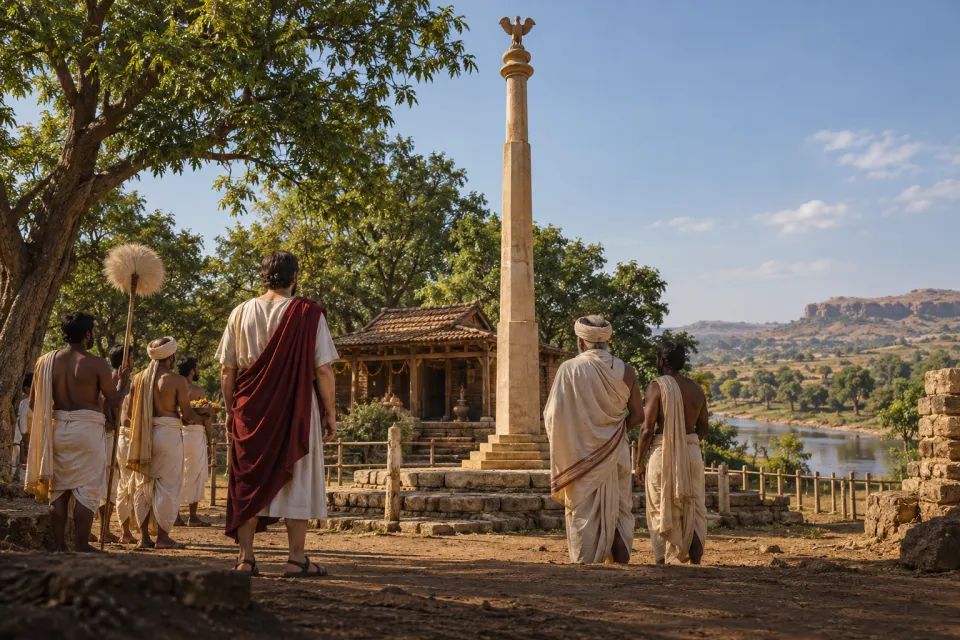
From Vāsudeva to Viṣṇu's avatāra c. 4th century BCE – 4th century CE
Vaiṣṇavism did not begin with the Vedic Viṣṇu, a minor sun-linked god, but with devotion (bhakti) to the deified hero Vāsudeva-Kṛṣṇa, attested by the 4th century BCE and honoured by the Greek envoy Heliodorus at Besnagar around 115 BCE. As this cult merged with Vedic religion, Kṛṣṇa came to be seen as an avatāra of Viṣṇu, now elevated to supreme godhead, and two early schools took shape: the Pāñcarātra, centred on Nārāyaṇa and Tantric ritual, and the Bhāgavata, centred on Vāsudeva-Kṛṣṇa and the ten avatāras. Gupta rulers (4th–6th century) were mostly devout Vaiṣṇavas, and Vaiṣṇava Purāṇas took shape in this period.[10–12]
Tamil Āḻvārs and Rāmānuja's theology c. 6th–12th century
From about the 6th century, twelve Tamil poet-saints called the Āḻvārs sang ecstatic devotion to Viṣṇu, rejecting caste distinctions; their hymns were gathered as the Nālāyira Divya Prabandham around the 10th century. The teacher Rāmānuja (traditionally 1017–1137), based at the temple town of Śrīraṅgam, gave their bhakti a rigorous Vedāntic foundation, teaching Viśiṣṭādvaita, "qualified non-dualism": souls and the world are real and together form the body of God. His Śrī Vaiṣṇava school later split into two: the southern Teṅkalai, holding that surrender (prapatti) alone brings grace, and the northern Vaṭakalai, which also required the devotee's own effort.[13–15]
Medieval schools of devotion 13th–16th century
Vaiṣṇava bhakti multiplied into regional schools across India. In Karnataka, Madhva (traditionally 1199–1278) taught Dvaita, "dualism": God and souls are eternally distinct, and devotion to Viṣṇu is the only path to release. In Gujarat and Rajasthan, Vallabha (1479–1531) founded Puṣṭimārg, "the path of grace", centred on the child and youth Kṛṣṇa. In Bengal, the ecstatic mystic Caitanya (1485–1533) sparked congregational chanting (saṅkīrtana) of Kṛṣṇa's names and taught that God and the world are joined in a bond beyond ordinary logic, achintya-bhedābheda; his Gauḍīya Vaiṣṇavism spread from Bengal to the Kṛṣṇa-pilgrimage town of Vṛndāvana.[16–18]
A global devotion 19th century–today
Vaiṣṇava worship travelled with Hindu migration to Southeast Asia from antiquity and later to the Caribbean, Africa and the West. Gauḍīya Vaiṣṇavism gained a worldwide following after A. C. Bhaktivedanta Swami Prabhupāda founded the International Society for Krishna Consciousness (ISKCON), the "Hare Kṛṣṇa" movement, in New York in 1966, drawing thousands of Western converts to kīrtan and temple life. Vaiṣṇava schools remain Hinduism's most numerous grouping, with major living centres at temples such as Tirumala, Śrīraṅgam and Puri.[19–20]
Key moments
- c. 400 CETemples of the Gupta age · Northern India
- c. 650 CEThe Tamil poet-saints · Tamil country, southern India
- c. 1100 CERāmānuja and qualified non-duality · Śrīraṅgam, Tamil Nadu, India
- c. 1150 CEAngkor Wat · Angkor, Cambodia
- c. 1530 CEMīrābāī sings to Krishna · Merta and Mewar, Rajasthan, India
Beliefs
Avatāra · अवतार
descent
Viṣṇu periodically takes bodily form to restore dharma when evil threatens the world. Lists vary, but ten avatāras are classically counted, from the fish Matsya to the future Kalki; Kṛṣṇa and Rāma, heroes of the Mahābhārata and Rāmāyaṇa, are by far the most loved and widely worshipped.[21]
Prapatti · प्रपत्ति
surrender
Śrī Vaiṣṇavas teach that complete surrender to Viṣṇu, trusting entirely in his grace, opens the way to liberation. Schools disagree on whether this surrender alone suffices, as the southern Teṅkalai held, or whether the devotee must also strive by the paths the scriptures prescribe, as the northern Vaṭakalai taught.[14]
Viśiṣṭādvaita, Dvaita and Śuddhādvaita
qualified non-dualism; dualism; pure non-dualism
Vaiṣṇava teachers built rival philosophies on devotion to Viṣṇu. Rāmānuja's qualified non-dualism holds souls and world to be real, forming God's body; Madhva's dualism insists God and souls remain eternally distinct; Vallabha's pure non-dualism denies that the world is illusion at all. Caitanya's followers instead held the bond between God and world to be "inconceivable", beyond such formulas.[16, 22]
Saṅkīrtana · संकीर्तन
congregational chanting
Gauḍīya Vaiṣṇavas treat the communal, often ecstatic singing of Kṛṣṇa's names, with drums and dance, as a direct path to God, open to everyone regardless of learning or caste. Caitanya popularised this practice in 16th-century Bengal, and it remains central to the Hare Kṛṣṇa movement today.[17, 23]
Practice

Temple worship of Viṣṇu's forms
At major Vaiṣṇava temples, priests follow an Āgamic ritual day of waking, bathing, dressing and feeding the consecrated image, and pilgrims come above all for darśan, the sight of the deity. Many devotees mark their foreheads and bodies with the tilaka, a U-shaped or vertical clay or sandalwood mark proper to their school, showing which God and teacher they follow.[7]
Chanting and congregational worship · कीर्तन, जप
Alongside quiet temple ritual, Vaiṣṇavas practise kīrtana, sung praise, and japa, repeated recitation of God's names on a strand of beads (often tulsī wood, sacred to Viṣṇu). The Hare Kṛṣṇa mantra, chanted since Caitanya's time, is the best known example and is central to ISKCON devotional life.[23–24]
Pilgrimage to Kṛṣṇa's and Rāma's places
Vaiṣṇavas travel above all to places tied to Viṣṇu's avatāras: Vṛndāvana and Mathurā, where Kṛṣṇa is said to have grown up, Ayodhyā, Rāma's city, and the great temple towns of Śrīraṅgam, Tirumala and Puri. At Puri, the annual Rathayātrā hauls the images of Jagannātha, a form of Kṛṣṇa, through the streets on huge chariots, the origin of the English word "juggernaut".[25–26]
Holy days
The year ahead
| Date | Holy day | Reckoned |
|---|---|---|
| 15 April 2027 | Rāma Navamī रामनवमी | Caitra śukla 9th, the tithi at noon |
| 5 July 2027 | Rathayātrā रथयात्रा | Āṣāḍha śukla 2nd, the tithi at sunrise |
| 24 August 2027 | Kṛṣṇa Janmāṣṭamī कृष्णजन्माष्टमी | Śrāvaṇa kṛṣṇa 8th, the tithi at midnight |
Kṛṣṇa Janmāṣṭamī · कृष्णजन्माष्टमी
8th day of dark Bhādrapada (August–September)
Kṛṣṇa's birthday, kept with fasting, midnight worship and re-enactments of his infancy; temples such as Mathurā's draw huge crowds and ISKCON centres worldwide mark it as their principal festival.[27]
Rāma Navamī · रामनवमी
9th day of bright Caitra (March–April)
The birthday of Rāma, marked with recitation of the Rāmāyaṇa or Tulsīdās's Rāmcaritmānas and, at Ayodhyā, major temple festivities.[28]
Rathayātrā · रथयात्रा
2nd day of bright Āṣāḍha (June–July)
At Puri, images of Jagannātha and his siblings are pulled through the streets on towering wooden chariots by thousands of devotees, in a festival now also kept at Gauḍīya Vaiṣṇava temples worldwide.[26]
People

Kṛṣṇa · कृष्ण
deity
For Vaiṣṇavas, Kṛṣṇa is not merely an avatāra but, for Gauḍīyas especially, Viṣṇu's own source, the supreme God in his most intimate and playful form. Devotion to him ranges from the Bhagavad Gītā's charioteer-counsellor to the flute-playing cowherd beloved of Rādhā and the gopīs.[3, 29]

Rāmānuja · रामानुज
teacher · traditionally 1017–1137
The great theologian of Śrī Vaiṣṇavism, based at Śrīraṅgam, who gave the Tamil Āḻvārs' devotion a Vedāntic foundation in Viśiṣṭādvaita and wrote the Śrī Bhāṣya, a commentary on the Brahma Sūtras. His school later split over how far human effort, alongside divine grace, contributes to liberation.[13, 22]

Madhva · माध्व
teacher · traditionally c. 1199–1278
Founder of Dvaita Vedānta in Karnataka, who taught an irreducible difference between Viṣṇu and the souls who depend on him, against both Śaṅkara's non-dualism and Rāmānuja's qualified version. He wrote 37 Sanskrit works and held that devotion to Viṣṇu alone secures release.[16, 30]

Caitanya · चैतन्य
saint · 1485–1533
A Bengali Brahmin who, after a religious crisis on pilgrimage, gave up his teaching career for a wandering ascetic's life devoted to Kṛṣṇa. His ecstatic public chanting founded Gauḍīya Vaiṣṇavism and, after a 20th-century revival, the worldwide Hare Kṛṣṇa movement.[17, 31]
Scripture
Bhāgavata Purāṇa · भागवतपुराण
probably 9th–10th century CE
The great scripture of Kṛṣṇa devotion, telling his life from mischievous child to cowherd lover of the gopīs, and teaching bhakti as the surest path to God. It shaped nearly every later Vaiṣṇava school and inspired centuries of poetry, music and painting.[32]
Nālāyira Divya Prabandham · நாலாயிர திவ்விய பிரபந்தம்
compiled c. 10th century
The "four thousand" Tamil hymns of the twelve Āḻvārs, gathered by Nāthamuni, forming a Tamil counterpart to the Vedas for Śrī Vaiṣṇavas and still sung in their temple liturgy today.[13, 15]
Śrī Bhāṣya · श्रीभाष्य
12th century
Rāmānuja's commentary on the Brahma Sūtras, the founding text of Viśiṣṭādvaita Vedānta, arguing that the Upaniṣads teach a real world and real souls united in God rather than Śaṅkara's single undifferentiated reality.[22]
Places

Ranganathaswamy Temple, Srirangam
IND
The spiritual home of Śrī Vaiṣṇavism, where Rāmānuja taught and is enshrined, and one of the largest functioning Hindu temple complexes in the world, dedicated to Viṣṇu reclining on the serpent Ananta.[13]
Jagannath Temple, Puri
IND
A 12th-century temple to Jagannātha, "Lord of the World", a form of Kṛṣṇa, where Caitanya spent his final years; its Rathayātrā chariots gave English the word "juggernaut".[25–26, 31]
Art & objects
Public-domain objects from museum collections. Select one to see it at the museum.
 Temple Strut Fragment with Boar God, VarahaNepal, 15th century
 Rama and Lakshmana Holding Bows, Seated under a TreeUttar Pradesh, Gupta period, c. 5th/6th century
 Narasimha, Man-Lion Incarnation of God Vishnu Destroying the Demon HiranyakashipuBangladesh, Pala period, 11th century
 Boar Incarnation of God Vishnu (Varaha)Madhya Pradesh, c. 10th century
 Pendant with Four-armed Green Vishnu on a lotus with NagasNepal, Kathmandu Valley, 1600s or 1700s
 Pendant with Matsya (fish incarnation of Vishnu) defeating HayagrivaNorthwestern India, Rajasthan Pratapgarh, 1800s
 Rumal with Vishnu temple and subsidiary shrinesNorthern India, Pahari Kingdom of Chamba, 1700s
 Feast where Vishnu decides he will incarnate as King Dasharatha’s sons, from Chapters 14–15 of the "Bala Kanda" (Book of Childhood) of a Ramayana (Rama’s Journey)Northern India, Pahari kingdoms, c. 1810
 Vishnu as Varaha, the Boar Avatar, Slays Banasur, A Demon General: Page from an Unknown ManuscriptIndia (Punjab Hills, Guler), ca.1800
 Vishnu Standing between His Consorts, Lakshmi and SarasvatiIndia (Tamil Nadu), Nayaka period, 17th–18th century
 The Combat of Rama and RavanaIndia, Coromandel Coast, late 18th century
 Vishnu enthronedIndia, Kerala, late 18th–19th century
How we know
Inscriptions of the Vāsudeva cult
No early text names the god Vāsudeva, but inscriptions trace his devotees for centuries before Vaiṣṇavism took that name. Pāṇini's Sanskrit grammar (6th–5th century BCE) already knows the word for his devotee, Megasthenes reports the worship of a Greek-named hero in the 4th century BCE, and the 2nd–1st-century-BCE Ghosundi, Nānāghāṭ and Besnagar inscriptions name Vāsudeva directly, the last raised by a Greek envoy who called himself his devotee.[33–34]
Common misconceptions
Myth The Hare Krishna movement is a modern cult with no roots in Hindu tradition.
Fact ISKCON, founded in New York in 1966, carries a direct lineage of teaching back to Caitanya's 16th-century Gauḍīya Vaiṣṇavism in Bengal, itself built on much older devotion to Kṛṣṇa as an avatāra of Viṣṇu; the 1966 date is the movement's modern Western organisation, not the birth of its theology.[17, 19]
Myth All Vaiṣṇavas worship Kṛṣṇa the same way, as in the Hare Krishna movement.
Fact Vaiṣṇava worship ranges from Rāmānuja's temple ritual and philosophical surrender, through Madhva's strict dualism, to Vallabha's tender devotion to the child Kṛṣṇa and Caitanya's ecstatic public chanting; these schools differ sharply on philosophy and practice even as they share devotion to Viṣṇu.[16, 18, 22]
Glossary
- Āḻvār · ஆழ்வார்
- One of twelve Tamil poet-saints, 6th–9th century, whose hymns of devotion to Viṣṇu form the Nālāyira Divya Prabandham.[13]
- Āchārya · आचार्य
- A founding or lineage teacher of a Vaiṣṇava school, such as Rāmānuja, Madhva or Vallabha.[22]
- Dashāvatāra · दशावतार
- The ten avatāras of Viṣṇu classically counted, from the fish Matsya to the future Kalki, including Rāma and Kṛṣṇa.[21]
- Bhakti-mārga · भक्तिमार्ग
- "The path of devotion": for Vaiṣṇavas, loving surrender to Viṣṇu, held in the Bhagavad Gītā to surpass the paths of ritual action and philosophical knowledge.[6]
- Tilaka · तिलक
- A mark of sandalwood paste or clay worn on the forehead and body, whose shape identifies a Vaiṣṇava's school.[7]
- Gopī · गोपी
- A cowherd woman of Kṛṣṇa's youthful circle at Vṛndāvana, above all Rādhā, read as a symbol of the soul's loving devotion.[29]
- Pāñcarātra · पाञ्चरात्र
- An early Vaiṣṇava school centred on Nārāyaṇa and Tantric temple ritual, as against the Bhāgavata school's devotion to Vāsudeva-Kṛṣṇa and the avatāras.[11]
- Vyūha · व्यूह
- In Pāñcarātra theology, one of four "emanations" of God, standing for the highest self, the individual self, mind and egoism.[35]
Sources
Each statement above was checked against published sources; the verdict says whether it stood as written, was corrected or was hedged.
- VerifiedBritannica, Vaishnavism; Encyclopedia of Religion.
- VerifiedBritannica, Hinduism: Vaishnavism and Shaivism; Encyclopedia of Religion, Vaiṣṇavism: An Overview, via Encyclopedia.com.
- VerifiedBritannica, Hinduism: Vaishnavism and Shaivism; Britannica, Vaishnavism; Encyclopedia of Religion, Vaiṣṇavism: An Overview, via Encyclopedia.com.
- VerifiedBritannica, Vaishnavism; Encyclopedia of Religion, Vaiṣṇavism: An Overview, via Encyclopedia.com.
- VerifiedBritannica, bhakti; Encyclopedia of Religion, Poetry: Indian Religious Poetry, via Encyclopedia.com.
- VerifiedBritannica, bhakti; Encyclopedia of Religion, Vaiṣṇavism: An Overview, via Encyclopedia.com.
- VerifiedBritannica, Hinduism: Vaishnavism and Shaivism; Encyclopedia of Religion, Poetry: Indian Religious Poetry, via Encyclopedia.com; Britannica, Hare Krishna.
- VerifiedBritannica, Shaivism; Encyclopedia of Religion, Ecumenism, via Encyclopedia.com.
- VerifiedBritannica, Hare Krishna; Encyclopedia.com, Mahaprabhu, Caitanya.
- VerifiedEncyclopedia of Religion, Vaiṣṇavism: An Overview, via Encyclopedia.com; Britannica, Hinduism: Early Hinduism.
- VerifiedEncyclopedia of Religion, Vaiṣṇavism: An Overview, via Encyclopedia.com; Britannica, Hinduism: Vaishnavism and Shaivism.
- VerifiedBritannica, Hinduism: Early Hinduism; Encyclopedia of Religion, Vaiṣṇavism: An Overview, via Encyclopedia.com.
- VerifiedEncyclopedia of Religion, Vaiṣṇavism: An Overview, via Encyclopedia.com; Britannica, Hinduism: Vaishnavism and Shaivism.
- VerifiedEncyclopedia of Religion, Vaiṣṇavism: An Overview, via Encyclopedia.com; Britannica, Vaishnavism.
- VerifiedEncyclopedia of Religion, Poetry: Indian Religious Poetry, via Encyclopedia.com; Britannica, Hinduism: Vaishnavism and Shaivism.
- VerifiedBritannica, Madhva; Internet Encyclopedia of Philosophy, Madhva.
- CorrectedBritannica, Chaitanya; Encyclopedia.com, Mahaprabhu, Caitanya.
- VerifiedBritannica, Vaishnavism; Encyclopedia of Religion, Poetry: Indian Religious Poetry, via Encyclopedia.com.
- VerifiedBritannica, Hare Krishna; Encyclopedia.com, Mahaprabhu, Caitanya.
- VerifiedBritannica, Hinduism: Vaishnavism and Shaivism; Encyclopedia of Religion, Vaiṣṇavism: An Overview, via Encyclopedia.com; Britannica, Puri.
- VerifiedBritannica, Hinduism: Vaishnavism and Shaivism; Encyclopedia of Religion, Vaiṣṇavism: An Overview, via Encyclopedia.com.
- VerifiedBritannica, Vaishnavism; Internet Encyclopedia of Philosophy, Madhva.
- VerifiedEncyclopedia.com, Mahaprabhu, Caitanya; Britannica, Hare Krishna.
- VerifiedBritannica, Hare Krishna; Britannica, Chaitanya; Encyclopedia.com, Mahaprabhu, Caitanya.
- VerifiedBritannica, Chaitanya; Encyclopedia of Religion, Vaiṣṇavism: An Overview, via Encyclopedia.com; Britannica, Puri.
- VerifiedBritannica, Puri; Encyclopedia.com, Mahaprabhu, Caitanya.
- VerifiedBritannica, Hare Krishna; Encyclopedia of Religion, Vaiṣṇavism: An Overview, via Encyclopedia.com.
- VerifiedBritannica, Tulsidas; Encyclopedia of Religion, Poetry: Indian Religious Poetry, via Encyclopedia.com.
- VerifiedBritannica, Vaishnavism; Encyclopedia of Religion, Goddess Worship: The Hindu Goddess, via Encyclopedia.com.
- VerifiedBritannica, Madhva; Internet Encyclopedia of Philosophy, Madhva.
- VerifiedBritannica, Chaitanya; Encyclopedia.com, Mahaprabhu, Caitanya.
- VerifiedBritannica, bhakti; Britannica, Hare Krishna; Encyclopedia of Religion, Vaiṣṇavism: An Overview, via Encyclopedia.com.
- VerifiedEncyclopedia of Religion, Vaiṣṇavism: An Overview, via Encyclopedia.com; Britannica, Hinduism: Early Hinduism.
- VerifiedEncyclopedia of Religion, Vaiṣṇavism: An Overview, via Encyclopedia.com; Britannica, Hinduism: Vaishnavism and Shaivism.
- VerifiedEncyclopedia of Religion, Vaiṣṇavism: An Overview, via Encyclopedia.com; Britannica, Hinduism: Vaishnavism and Shaivism.
Last fact-checked 10 October 2026.