
The story behind the day
Rāma Navamī celebrates the birth of Rāma, the hero of the Rāmāyaṇa and, for Hindus, an incarnation of Viṣṇu. It falls on the ninth day of the bright fortnight of Caitra, in March or April. By tradition Rāma was born to King Daśaratha and Queen Kauśalyā at noon, and the day is kept with fasting, stories of the god and temple celebrations at midday.[1–5]
Origins
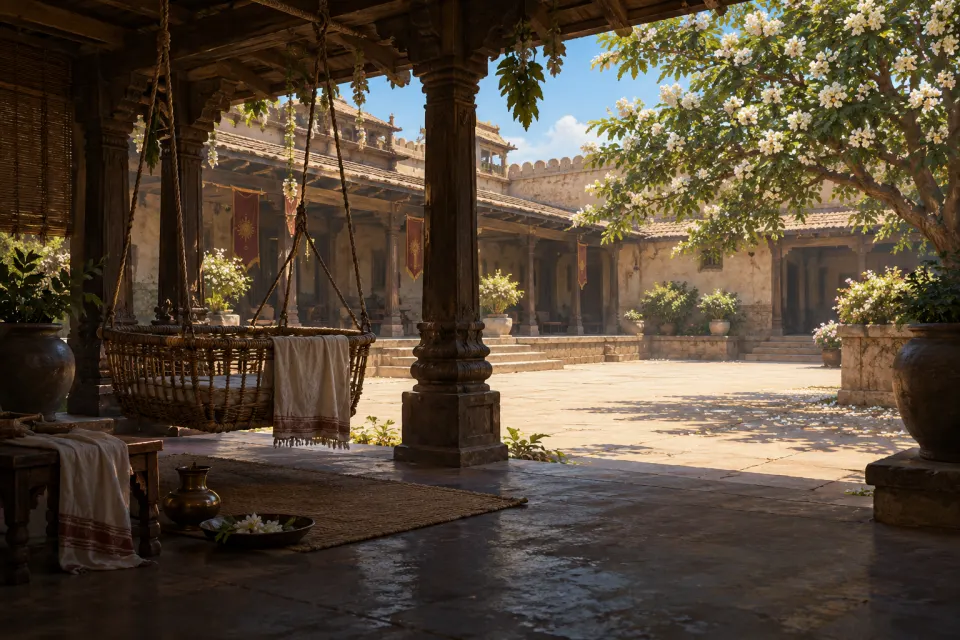
The epic ascribed to the sage Vālmīki sets the birth on the ninth day of Caitra. Hari Prasad Shastri's English translation dates it to the twelfth month under the Caitra moon, and in Ralph Griffith's verse version it is "Chaitra's ninth returning day." Both put the Moon in the asterism Punarvasu and mark the sky with exalted planets. The poem is widely considered the basis of later retellings, which carried the story through South and Southeast Asia. In the Middle Ages Rāma came to be counted an avatāra of Viṣṇu, and Hindu tradition places his birth in the Tretā Yuga. In Vālmīki's earliest text, scholars note, his divinity is mentioned only in the first and last books, which they think were later additions, and his worship became popular later than Kṛṣṇa's. Vernacular poets reshaped the tale. One retelling is Kamban's Tamil Rāmāyaṇa; another is Tulsīdās's Rāmcaritmānas, begun in 1574, which stresses devotion and the saving power of Rāma's name.[1–2, 6–9]
What it marks
For devotees the day is Rāma's birthday, a remembrance that, as Hindus hold, Viṣṇu came into the world as a divine king. It falls in the bright half of Caitra, the season of the spring Navarātri, the nine nights of the Goddess, which it is said to close, so that the festival of the Goddess ends in a festival of Rāma. The day is held most holy when the Moon is in Punarvasu. The Padma Purāṇa and the Agastya-saṃhitā say that he was born at noon, so the midday hour is the heart of the day.[2–3, 10–11]
How the observance took shape
The medieval digests treat Rāma Navamī as a vrata, a vow. They prescribe a whole day's fast, a night spent awake hearing the stories of Rāma, and worship of his image, and they promise freedom from sin to those who keep it.[4]
How it is kept
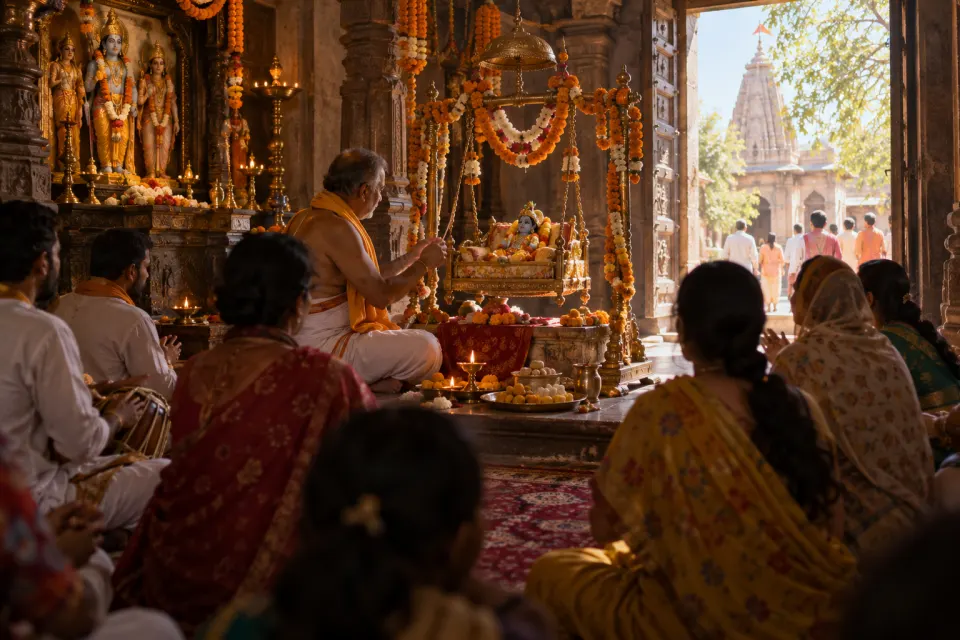
In modern times few keep the full fast and the long home rites, though many still worship at home, fast, attend religious discourses or visit temples. The festival is celebrated across India and especially in Ayodhyā, traditionally his birthplace, with great pomp also at Nasik, Tirupati and Rāmeśvaram. What most people share is the noon celebration of the birth in Rāma temples, with gatherings for kīrtan, music and bhajans and a distribution of sweets. Vaishnavas keep the birthdays of Rāma and Kṛṣṇa with sweets and special dishes.[5, 12]
Sources
Each statement above was checked against published sources; the verdict says whether it stood as written, was corrected or was hedged.
- VerifiedJ. G. Lochtefeld, The Illustrated Encyclopedia of Hinduism; P. V. Kane, History of Dharmaśāstra, vol. V part 1; Wisdom Library; Project Gutenberg.
- VerifiedJ. G. Lochtefeld, The Illustrated Encyclopedia of Hinduism; Project Gutenberg; Wisdom Library; Encyclopedia.com; Wisdom Library.
- VerifiedP. V. Kane, History of Dharmaśāstra, vol. V part 1; Wisdom Library.
- VerifiedP. V. Kane, History of Dharmaśāstra, vol. V part 1; Wisdom Library.
- VerifiedJ. G. Lochtefeld, The Illustrated Encyclopedia of Hinduism; P. V. Kane, History of Dharmaśāstra, vol. V part 1; Encyclopedia.com.
- VerifiedWisdom Library; Project Gutenberg.
- VerifiedUniversity of Michigan Library; Encyclopedia.com.
- VerifiedJ. G. Lochtefeld, The Illustrated Encyclopedia of Hinduism; Encyclopedia.com; P. V. Kane, History of Dharmaśāstra, vol. V part 1.
- VerifiedJ. G. Lochtefeld, The Illustrated Encyclopedia of Hinduism; Encyclopedia.com.
- VerifiedJ. G. Lochtefeld, The Illustrated Encyclopedia of Hinduism; P. V. Kane, History of Dharmaśāstra, vol. V part 1.
- VerifiedP. V. Kane, History of Dharmaśāstra, vol. V part 1; Wisdom Library.
- VerifiedJ. G. Lochtefeld, The Illustrated Encyclopedia of Hinduism; P. V. Kane, History of Dharmaśāstra, vol. V part 1.