
Overview
Śaivism is, with Vaiṣṇavism and Śāktism, one of Hinduism's three principal streams, worshipping Śiva as the supreme God. Śiva grew from the uncanny, dangerous Vedic god Rudra into a deity who is at once world-destroyer and world-maker, fearsome ascetic and loving husband. Organised Śaiva sects emerged by the 2nd century CE, and over the following centuries Śaivism branched into traditions as different as the ash-smeared Pāśupata renunciants, the monist philosophers of Kashmir, the devotional Tamil Śaiva Siddhānta, and the caste-rejecting Vīraśaivas of Karnataka. Worship centres on Śiva's abstract emblem, the liṅga, and on a vast mythology of his exploits shared, with variations, across all these schools.[1–2, 8–9]
History
From Rudra to organised Śaiva worship c. 1500 BCE – 2nd century CE
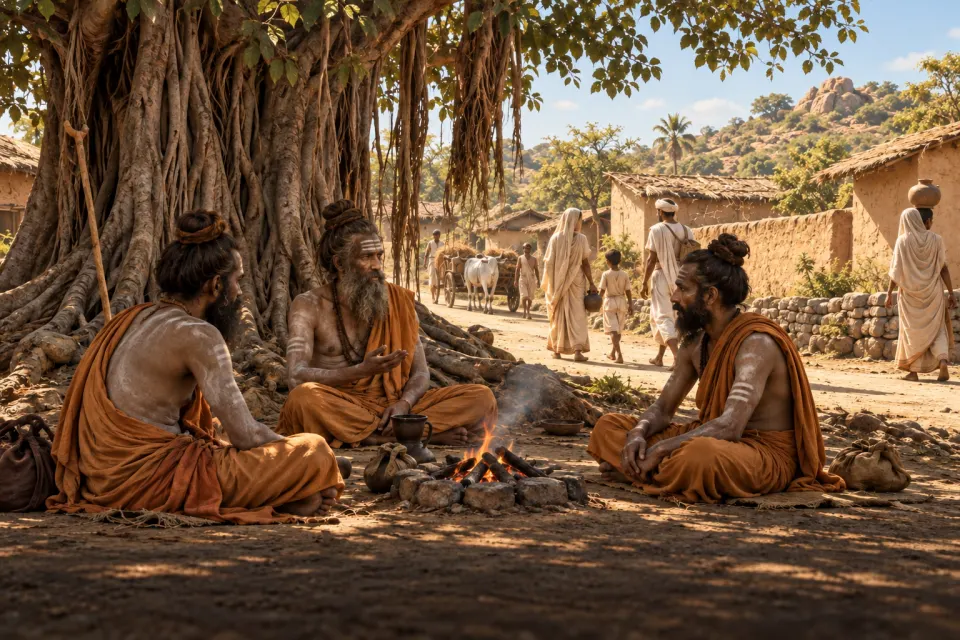
The Vedas call Rudra "the Howler", a marginal, dangerous god excluded from the sacrifice yet also a healer; the Śvetāśvatara Upaniṣad (last centuries BCE) is the first text to call him Śiva and treat him as paramount. Organised sectarian worship, however, began only with the Pāśupatas, the earliest Śaiva sect. Pāśupata ascetics took an "animal" vow of asceticism, bathing in ashes and behaving in deliberately antisocial ways to court public scorn.[10–12]
Tamil bhakti and Śaiva Siddhānta c. 6th–12th century
From about the 6th century, sixty-three Tamil poet-saints known as the Nāyaṉārs, from many castes, sang ecstatic devotion to Śiva across the Tamil country; their hymns were gathered as the Tirumuṟai. Out of this devotional ferment grew Śaiva Siddhānta, a dualist theology holding three eternal principles: Śiva the Lord (pati), the individual soul (paśu), and the bonds that confine it (pāśa). Alongside the Nāyaṉārs, more antinomian ascetic groups arose: the skull-carrying, cremation-ground-dwelling Kāpālikas and the closely related Kālāmukhas.[13–15]
Kashmir's philosophers of recognition 8th–11th century
In Kashmir, a monist school arose around texts said to have been revealed to the sage Vasugupta: the Śiva Sūtra and his own Spanda-kārikā. Its greatest systematiser, Abhinavagupta (10th century), wrote the vast Tantrāloka and taught that liberation comes through recognising (pratyabhijñā) one's own identity with Śiva, the sole reality behind the universe, against the dualist Śaiva Siddhānta of the south.[16–17]
Basava and the Vīraśaivas 12th century – today
In Karnataka, Basava, an official at the court of King Bijjala, either founded or revived the Vīraśaiva or Liṅgāyat movement, which rejected caste, Brahmin priesthood and the Vedas' authority; its members wear a small liṅga and sing Basava's Kannada vacanas to Śiva as "Lord of the Meeting Rivers". Its many schools remain active today from Kashmir to Tamil Nadu, and some Liṅgāyats now seek recognition as a religion distinct from Hinduism.[18–20]
Key moments
- c. 650 CEThe Tamil poet-saints · Tamil country, southern India
- c. 1160 CEBasava and the Liṅgāyats · Karnataka, southern India
Beliefs
Pati, paśu, pāśa · पति, पशु, पाश
Lord, soul, bond
Śaiva Siddhānta names three eternal principles: Śiva the Lord, the individual soul bound like a tethered animal, and the bonds of ignorance and matter that confine it. Liberation, the soul's own Śiva-nature (śivatva), is reached through external worship, intimate service to God, meditation and knowledge.[14, 21]
Pratyabhijñā · प्रत्यभिज्ञा
recognition
Kashmir Śaivism teaches that Śiva alone is real, both the material and efficient cause of the universe, known through five powers: consciousness, bliss, will, knowledge and action. Liberation is simply recognising one's own identity with this single reality, not attaining anything new.[17, 22]
Śiva as destroyer and creator
Within the Hindu Trimūrti, Śiva dissolves the universe after Brahmā creates and Viṣṇu preserves it; but for Śaivas he is supreme in all three roles at once. He is equally the ash-covered ascetic of the cremation ground and the devoted husband of Pārvatī, a tension that Śaiva myth resolves only partly: Pārvatī is said to have drawn him from deep meditation to marriage and family only after the god of desire, Kāma, shot his arrow and was burned to ash for the attempt.[2, 23–24]
Daksha's sacrifice and the Śakti Pīṭhas
By tradition, Śiva's father-in-law Dakṣa excluded him from a great sacrifice; Śiva's wife Satī, insulted, died, and Śiva carried her corpse in grief until it was dismembered, its pieces falling to earth as the Śākta pīṭhas, shrines sacred to the Goddess. The story both explains Śiva's admission into the Hindu pantheon and ties Śaiva and Śākta sacred geography together.[25]
Practice

Asceticism and world-renunciation
Śaivism has always prized the ascetic over the householder more than other Hindu streams. Pāśupatas, Kāpālikas and, in later centuries, the ten Daśanāmi orders said to descend from Śaṅkara and the Nāth yogis associated with Gorakhnātha took vows of renunciation, smeared themselves with ash and wandered in imitation of Śiva's own homeless, matted-haired asceticism. Living Śaiva ascetics are commonly known by their long matted hair, three horizontal ash or sandal-paste lines on the forehead, and a trident carried as Śiva's own weapon.[12, 26–27]
Worship of the liṅga · लिङ्गपूजा
Most Śaiva worship centres not on an anthropomorphic image but on the liṅga, bathed with water, milk and bilva leaves and marked with ash. Vīraśaivas additionally wear a small personal liṅga, the iṣṭaliṅga, on a cord around the neck in place of ordinary caste markers.[4, 18]
Pilgrimage to Śiva's high places
Śaiva pilgrims travel to remote and difficult sites felt to be charged with Śiva's presence: the ice liṅga that forms each year in the Amarnāth cave of Kashmir, and Nepal's Pashupatinath temple on the Bagmati river, where the dying seek to be purified by its waters.[28–29]
Holy days
The year ahead
| Date | Holy day | Reckoned |
|---|---|---|
| 24 November 2026 | Kārttikai Dīpam கார்த்திகை தீபம் | the day of Kṛttikā nakṣatra in the solar month of Scorpio (Vṛścika) |
| 6 March 2027 | Mahāśivarātri महाशिवरात्रि | Māgha kṛṣṇa 14th, the tithi at midnight |
Mahāśivarātri at Pashupatinath · महाशिवरात्रि
eve of the new moon in Māgha or Phālguna (February–March)
While kept by Hindus generally, Śaivism's chief festival draws its largest single gathering to Nepal's Pashupatinath temple, where hundreds of thousands of pilgrims and ash-smeared sādhus keep an all-night vigil.[29–30]
Kārttikai Dīpam · கார்த்திகை தீபம்
full moon of Kārttikai (November–December)
A Tamil Śaiva festival at which a vast beacon is lit atop Tiruvaṇṇāmalai hill, re-enacting Śiva's manifestation there as an infinite pillar of fire; lamps are also lit at homes and temples across Tamil Nadu.[31]
People

Basava · ಬಸವ
founder · traditionally c. 1106–1167
A Śaiva reformer at the Kalyāṇa court of King Bijjala, revered by the Vīraśaivas as their founder, though inscriptions suggest he revived rather than founded the sect. His Kannada poems to Śiva as "Lord of the Meeting Rivers" rank among Kannada literature's classics.[18, 32]

Abhinavagupta · अभिनवगुप्त
scholar · c. 950–1020 CE
The great systematiser of Kashmir Śaivism, who wrote the Tantrāloka, a vast synthesis of its ritual and philosophy, and Paramārthasāra, teaching that liberation lies in recognising one's own nature as Śiva.[16–17]
Scripture
Śiva Sūtra · शिवसूत्र
8th–9th century
The foundational aphorisms of Kashmir Śaivism, said to have been revealed to the sage Vasugupta; his own verse commentary, the Spanda-kārikā, expounds them.[16]
Tantrāloka · तन्त्रालोक
10th century
Abhinavagupta's sprawling synthesis of Kashmir Śaiva ritual, philosophy and practice, "Lights on the Doctrine", still studied as the tradition's central work.[17]
Śaiva Āgamas · शैवागम
c. 4th–9th century onward
Scriptures held by Śaivas to be revealed by Śiva himself, covering temple-building, initiation, ritual, yoga and mantra; the Śaiva Purāṇas of the same centuries instead gather Śiva's myths.[33]
Places

Pashupatinath Temple
NPL · UNESCO World Heritage, 1979
Nepal's holiest Śaiva site, on the Baghmati River, with a religious foundation attested since at least the 5th century BCE and the current gilt pagoda dating from the 15th century CE; it lies within the Kathmandu Valley World Heritage property.[29]
Amarnāth Cave
IND
A high Himalayan cave in Kashmir where an ice formation, read as a natural liṅga, waxes and wanes with the moon; pilgrims make an arduous summer trek to see it.[28]
Art & objects
Public-domain objects from museum collections. Select one to see it at the museum.
 Cosmic Form of Shiva (Sadashiva)Bangladesh, Pala period, c. 11th century
 Androgynous Form of Shiva and Parvati (Ardhanarishvara)Nepal, 11th century
 Marriage of God Shiva with Goddess Parvati (Kalyanasundara)Madhya Pradesh, c. 11th century
 God Shiva as the Supreme Teacher (Dakshinamurti)Kodumbalur, 10th century
 Shiva Saint: ManikkavachakarSouth India, Tamil Nadu, 12th-13th century, 1100s–1200s
 Standing Shiva MahadevaNorthern India, Kashmir, 8th century, 700s
 Women worshiping a Shiva linga: Devagandhari Ragini of Hindol Raga, from a RagamalaNorthern India, Pahari kingdoms, c. 1700
 Linga (Phallic Emblem of Shiva) with Architectural BaseCambodia, Angkor period, ca. 975
 Shiva as Lord of Dance (Shiva Nataraja)India, Tamil Nadu, Chola period, late 12th–early 13th century
 Linga Altar with Four Faces of ShivaNepal (Kathmandu Valley), Thakuri period, dated 1045
 Shiva as Vanquisher of the Three Cities (Shiva Tripuravijaya)South India (Tamil Nadu, Thanjavur district), Chola period, ca. 1000–1020
 BhairavaNepal, Kathmandu Valley, Malla period, 16th century
How we know
Is the Indus 'Pashupati seal' an early Śiva?
A seal from Mohenjo-daro (Indus civilization, c. 2600–1900 BCE) shows a horned, cross-legged figure surrounded by animals, popularly called the "Pashupati seal" after Śiva's epithet "Lord of Cattle". Some scholars read it as a proto-Śiva in meditation; others caution that the script is undeciphered, the Indus religion is poorly known, and the resemblance alone cannot prove continuity across more than a thousand years to the Vedic and later Śaiva Rudra-Śiva.[34]
Common misconceptions
Myth The liṅga is simply a phallic idol, and liṅga worship is a primitive fertility cult.
Fact Śaivas worship the liṅga as an abstract emblem of Śiva beyond form, often read together with its base (yoni) as male and female creative power in balance; its theology runs from simple village devotion to the intricate monist philosophy of Kashmir Śaivism, not a single "primitive" meaning.[4, 22]
Glossary
- Pāśupata · पाशुपत
- The earliest Śaiva sect, whose ascetics took an "animal" vow of ash-bathing and deliberately antisocial behaviour.[11–12]
- Kāpālika · कापालिक
- A cremation-ground-dwelling Śaiva ascetic who carried a skull and performed antinomian rites, closely related to the Kālāmukhas.[15]
- Nāyaṉār · நாயனார்
- One of sixty-three Tamil Śaiva poet-saints, 6th–9th century, whose hymns to Śiva make up the Tirumuṟai.[13]
- Vacana · ವಚನ
- A short Kannada free-verse utterance by a Vīraśaiva saint-poet, expressing personal devotion to Śiva, often with criticism of ritual hypocrisy.[32]
- Trika · त्रिक
- Another name for Kashmir Śaivism, from its threefold account of God, power (śakti) and the individual soul.[16]
- Daśanāmi · दशनामी
- Ten orders of Śaiva renunciant monks traditionally linked to Śaṅkara, distinguished by the suffix each order adds to a monk's name.[26]
Sources
Each statement above was checked against published sources; the verdict says whether it stood as written, was corrected or was hedged.
- VerifiedBritannica, Shaivism; Encyclopedia of Religion, Ecumenism, via Encyclopedia.com.
- VerifiedBritannica, Shaivism; Concise Oxford Dictionary of World Religions, Śaivism, via Encyclopedia.com.
- VerifiedBritannica, Shaivism; Concise Oxford Dictionary of World Religions, Śaivism, via Encyclopedia.com.
- VerifiedBritannica, Shaivism; Concise Oxford Dictionary of World Religions, Śaivism, via Encyclopedia.com.
- VerifiedConcise Oxford Dictionary of World Religions, Śaivism, via Encyclopedia.com; Britannica, Kashmiri Shaivism.
- VerifiedBritannica, Shaivism; Concise Oxford Dictionary of World Religions, Śaivism, via Encyclopedia.com.
- VerifiedBritannica, Shaivism; Concise Oxford Dictionary of World Religions, Śaivism, via Encyclopedia.com.
- VerifiedBritannica, Shaivism; Encyclopedia of Religion, Ecumenism, via Encyclopedia.com.
- VerifiedBritannica, Shaivism; Oxford Reference, The Concise Oxford Dictionary of World Religions, Rudra.
- VerifiedBritannica, Shaivism; Oxford Reference, A Dictionary of Hinduism, Śvetāśvatara Upaniṣad.
- CorrectedBritannica, Hinduism: Early Hinduism; Concise Oxford Dictionary of World Religions, Śaivism, via Encyclopedia.com; Britannica, Shaivism.
- VerifiedConcise Oxford Dictionary of World Religions, Śaivism, via Encyclopedia.com; Britannica, Shaivism.
- VerifiedEncyclopedia of Religion, Poetry: Indian Religious Poetry, via Encyclopedia.com; Britannica, Shaivism.
- VerifiedBritannica, Shaivism; Concise Oxford Dictionary of World Religions, Śaivism, via Encyclopedia.com.
- VerifiedConcise Oxford Dictionary of World Religions, Śaivism, via Encyclopedia.com; Britannica, Shaivism.
- VerifiedBritannica, Kashmiri Shaivism; Concise Oxford Dictionary of World Religions, Śaivism, via Encyclopedia.com.
- VerifiedBritannica, Kashmiri Shaivism; Encyclopedia of Religion, Poetry: Indian Religious Poetry, via Encyclopedia.com.
- VerifiedBritannica, Basava; Britannica, Lingayat; A Dictionary of Hinduism, read on Oxford Reference's own search-results page.
- VerifiedBritannica, Basava; A Dictionary of Hinduism, read on Oxford Reference's search-results page.
- VerifiedBritannica, Lingayat; Concise Oxford Dictionary of World Religions, Śaivism, via Encyclopedia.com.
- VerifiedBritannica, Shaivism; Concise Oxford Dictionary of World Religions, Śaivism, via Encyclopedia.com.
- VerifiedBritannica, Kashmiri Shaivism; Concise Oxford Dictionary of World Religions, Śaivism, via Encyclopedia.com.
- VerifiedBritannica, Shaivism; Oxford Reference, The Concise Oxford Dictionary of World Religions, Trimūrti.
- VerifiedBritannica, Shaivism; Encyclopedia of Religion, Goddess Worship: The Hindu Goddess, via Encyclopedia.com.
- VerifiedBritannica, Shaivism; Encyclopedia of Religion, Goddess Worship: The Hindu Goddess, via Encyclopedia.com.
- VerifiedConcise Oxford Dictionary of World Religions, Śaivism, via Encyclopedia.com; Britannica, Shaivism.
- VerifiedConcise Oxford Dictionary of World Religions, Śaivism, via Encyclopedia.com; Britannica, Shaivism.
- VerifiedConcise Oxford Dictionary of World Religions, Śaivism, via Encyclopedia.com; Britannica, Shaivism.
- VerifiedBritannica, Pashupatinath Temple; Concise Oxford Dictionary of World Religions, Śaivism, via Encyclopedia.com.
- VerifiedBritannica, Pashupatinath Temple; Concise Oxford Dictionary of World Religions, Śaivism, via Encyclopedia.com.
- VerifiedEncyclopedia of Religion, Poetry: Indian Religious Poetry, via Encyclopedia.com; Britannica, Shaivism.
- VerifiedBritannica, Basava; A Dictionary of Hinduism, read on Oxford Reference's search-results page.
- VerifiedConcise Oxford Dictionary of World Religions, Śaivism, via Encyclopedia.com; Britannica, Kashmiri Shaivism.
- VerifiedBritannica, Shaivism; Concise Oxford Dictionary of World Religions, Śaivism, via Encyclopedia.com.
Last fact-checked 3 October 2026.