
The story behind the day
Mahāśivarātri, the "Great Night of Śiva," is the Hindu night of fasting and vigil devoted to Śiva, the most important yearly festival for his devotees. It falls on the fourteenth night of the dark fortnight, in February or March, and devotees mark it with a day of fasting, a night-long vigil and the bathing of the liṅga. By tradition the night recalls Śiva's appearance as a boundless column of light, and the Purāṇas promise that keeping it faithfully brings blessing in this life and liberation beyond it.[1–6]
Origins
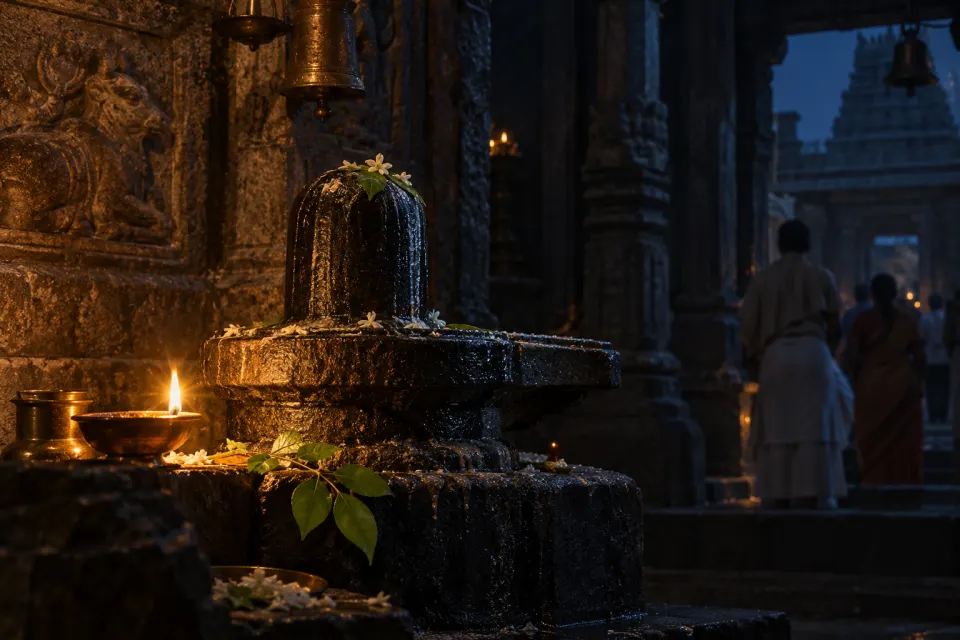
By tradition the night celebrates Śiva's showing himself as a jyotirliṅga, a pillar of light. In the myth as Hindu tradition tells it, Brahmā and Viṣṇu were quarrelling over which of them was greater when the pillar rose before them. Brahmā could find no top to it and Viṣṇu no base, and Śiva was revealed as supreme. A text cited in the medieval digests, the Īśāna-saṃhitā, places that first appearance on the dark fourteenth itself. The same night carries two month-names: Māgha where months are counted from new moon to new moon, and Phālguna where they run from full moon to full moon.[3, 7–8]
What it marks
The Purāṇas give the night a chapter of praise in several of their collections, among them the Garuḍa, Skanda, Padma and Agni. They teach that a person who fasts, worships Śiva with bilva leaves and stays awake all night is saved from hell and given happiness and liberation. The Śiva Purāṇa makes the point with a story: a hunter climbs a bilva tree with some water, and water and leaves fall on a liṅga below without his realising what night it is. Śiva, pleased with the rite, offers him a boon. The Garuḍa Purāṇa tells a similar tale of a king who goes hunting, and the Skanda of a fowler.[4, 9–10]
How it is kept
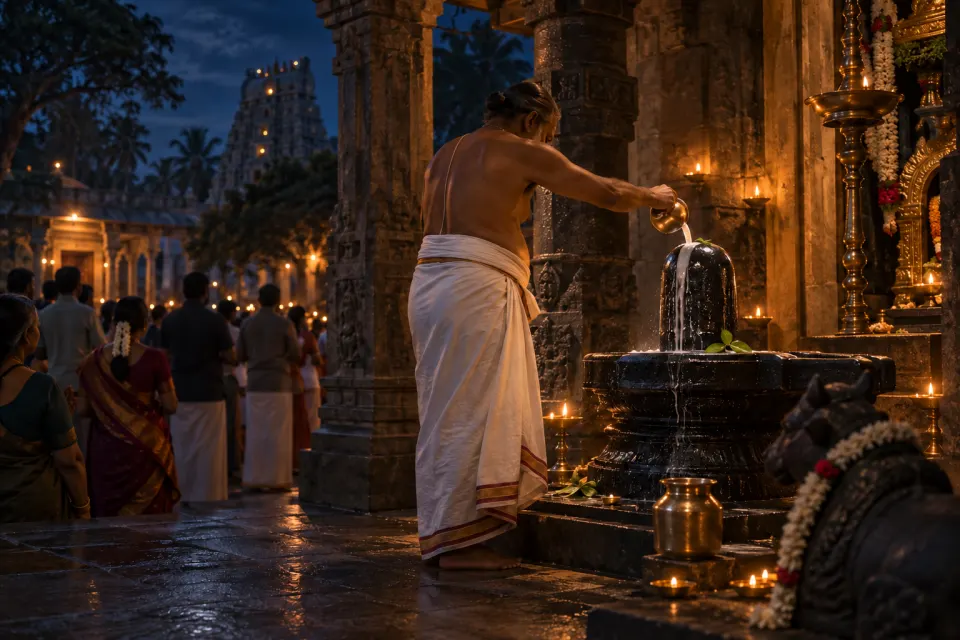
Devotees go without food by day, and through the night they pray and bring offerings to Śiva. Many keep a jāgaraṇa, staying awake with worship, music and stories of Śiva. The liṅga is bathed with milk, curds, ghee and honey, which medieval digests assign to the four watches of the night, one for each. Bilva leaves are the offering most closely tied to the night: the Śiva Purāṇa tells the worshipper to honour Śiva especially with them.[5–6, 11]
Regions and the diaspora
In Mauritius the night is a pilgrimage. Hindus whose ancestors came from India as indentured workers make the pilgrimage to Grand Bassin, a lake in a volcanic crater also called Ganga Talao. Scholars note that the island had no older pilgrimage site of its own and that this lake became the central destination for the community, a place that took on spiritual meaning over time.[12]
Sources
Each statement above was checked against published sources; the verdict says whether it stood as written, was corrected or was hedged.
- VerifiedJ. G. Lochtefeld, The Illustrated Encyclopedia of Hinduism; Encyclopedia.com; P. V. Kane, History of Dharmaśāstra, vol. V part 1.
- VerifiedJ. G. Lochtefeld, The Illustrated Encyclopedia of Hinduism; Encyclopedia.com; P. V. Kane, History of Dharmaśāstra, vol. V part 1.
- VerifiedEncyclopedia.com; P. V. Kane, History of Dharmaśāstra, vol. V part 1.
- VerifiedP. V. Kane, History of Dharmaśāstra, vol. V part 1; Wisdom Library.
- VerifiedJ. G. Lochtefeld, The Illustrated Encyclopedia of Hinduism; Encyclopedia.com; P. V. Kane, History of Dharmaśāstra, vol. V part 1.
- VerifiedEncyclopedia.com; P. V. Kane, History of Dharmaśāstra, vol. V part 1.
- VerifiedEncyclopedia.com; Los Angeles County Museum of Art, Shiva as the Cosmic Pillar.
- CorrectedP. V. Kane, History of Dharmaśāstra, vol. V part 1; Encyclopedia.com; Wisdom Library.
- VerifiedP. V. Kane, History of Dharmaśāstra, vol. V part 1; Wisdom Library.
- VerifiedJ. G. Lochtefeld, The Illustrated Encyclopedia of Hinduism; Wisdom Library; P. V. Kane, History of Dharmaśāstra, vol. V part 1; Wisdom Library.
- VerifiedWisdom Library; P. V. Kane, History of Dharmaśāstra, vol. V part 1.
- Verifiedlink.springer.com; Jagiellonian University repository.