
Overview
Reform Judaism is the branch of rabbinic Judaism that grew out of Jewish emancipation in Europe, holding that halakha, Jewish law, should develop to meet each generation's circumstances rather than bind Jews unchanged. It began in 1810 in Germany, where reformers shortened and translated the liturgy and added music, then became an organized American denomination under Isaac Mayer Wise later that century. Reform teaches that revelation continues and that individual conscience, not a fixed law code, should guide religious choice; it has championed the prophetic call to social justice, full equality for women and LGBTQ Jews, and a definition of Jewish identity that counts a child of either Jewish parent as Jewish. Today it is organized in North America through the Union for Reform Judaism and worldwide through sister Progressive and Liberal movements.[1, 3–4, 7, 9–11]
History

Rabbis for a modern age 1810 – 1845, Germany
Israel Jacobson, a Jewish philanthropist, opened a school chapel at Seesen in 1810 where boys and girls worshipped together partly in German, with organ and choir and a confirmation ceremony replacing bar mitzvah alone; it is counted as the first Reform service. Similar services spread to Berlin, Hamburg and other German cities over the following years, despite objection from Orthodox leaders. Rabbi Abraham Geiger, the movement's leading nineteenth-century theologian, argued that ethical monotheism, not ceremonial law, was Judaism's unchanging core. At an 1845 rabbinical conference in Frankfurt, Zacharias Frankel walked out over the retention of Hebrew in worship, a split later seen as the start of Conservative Judaism.[1–2, 12–14]
An American denomination 1824 – 1890s, United States
Reform's first American stirrings came in 1824, when members of a Charleston, South Carolina congregation petitioned unsuccessfully for an English-language service. Larger numbers of central European Jewish immigrants from the 1830s onward built a wider movement, as congregations adopted Reform practice to feel more at home in American life. Isaac Mayer Wise, a Bohemian-born rabbi who settled in Cincinnati, drove its institutions: the Union of American Hebrew Congregations in 1873, Hebrew Union College in 1875 to train rabbis, and the Central Conference of American Rabbis in 1889. In 1885 a conference of Reform rabbis in Pittsburgh adopted a Declaration of Principles, the creed of so-called Classical Reform, which stressed universal ethics over ritual, rejected a future return to Palestine, and reframed Jews as a religious community rather than a nation.[3, 8, 15–16]
From universalism to peoplehood 1920s – 1948
Rising antisemitism in the 1920s and 1930s pushed the movement back toward the shared Jewish peoplehood its founders had played down. The Central Conference of American Rabbis' 1937 Columbus Platform embraced Zionism and a greater diversity of practice, reversing Pittsburgh's universalism. Reform rabbis Stephen S. Wise and Abba Hillel Silver became leading American Zionists, and after the Nazi genocide of six million Jews the movement widely welcomed the State of Israel's founding in 1948.[17–21]
Equality and growth 1972 – today
Reform led American Judaism in ordaining women: in 1972 Hebrew Union College–Jewish Institute of Religion ordained Sally Priesand, the first woman trained and ordained as a rabbi by a North American seminary. In 1983 the Central Conference of American Rabbis resolved that a child of one Jewish parent, mother or father, could be presumed Jewish if raised and publicly identifying as a Jew, a break with the rabbinic rule that traces Jewish status through the mother alone. The movement has since ordained openly gay and lesbian rabbis and blesses same-sex marriages. It remains organized in North America through the Union for Reform Judaism and, worldwide, through the World Union for Progressive Judaism.[5, 7, 11]
Key moments
- 1935 CERegina Jonas, the first woman rabbi · Berlin
- 1944 CELi Tim-Oi and the ordination of women · Zhaoqing, Guangdong, China
Beliefs
Autonomy and ongoing revelation
Reform Judaism holds that Jewish belief and practice must keep adapting to each generation's circumstances, not stay bound to a law code fixed for all time. Rabbis teach and guide, but no rabbi or law code finally settles a question of practice for an individual Jew; both the individual and the congregation have real autonomy to decide. Orthodox and Conservative Judaism instead treat halakha as fixed, or as developing only within set bounds.[9, 22]
Ethical monotheism
Early Reform rabbis read the Hebrew prophets as calling Jews to a universal "mission of Israel": spreading belief in one God and working for justice among all peoples, more than preserving ritual distinctiveness. That prophetic emphasis still drives the movement's commitment to social action, increasingly described as tikkun olam, "repairing the world".[10]
Patrilineal descent
Since the Central Conference of American Rabbis' 1983 resolution, North American Reform Judaism has recognized as Jewish a child of one Jewish parent, either mother or father, when the child is raised Jewish and takes on a Jewish identity through acts such as bar or bat mitzvah. Rabbinic law instead traces Jewish status through the mother alone.[7]
Full equality
Reform congregations give women full equality in worship and synagogue government, counting them equally toward a prayer quorum and calling them to read Torah; since 1972 women have served as Reform rabbis. Most Reform congregations also fully welcome LGBTQ Jews into membership, the rabbinate and marriage.[5, 11, 23]
Practice
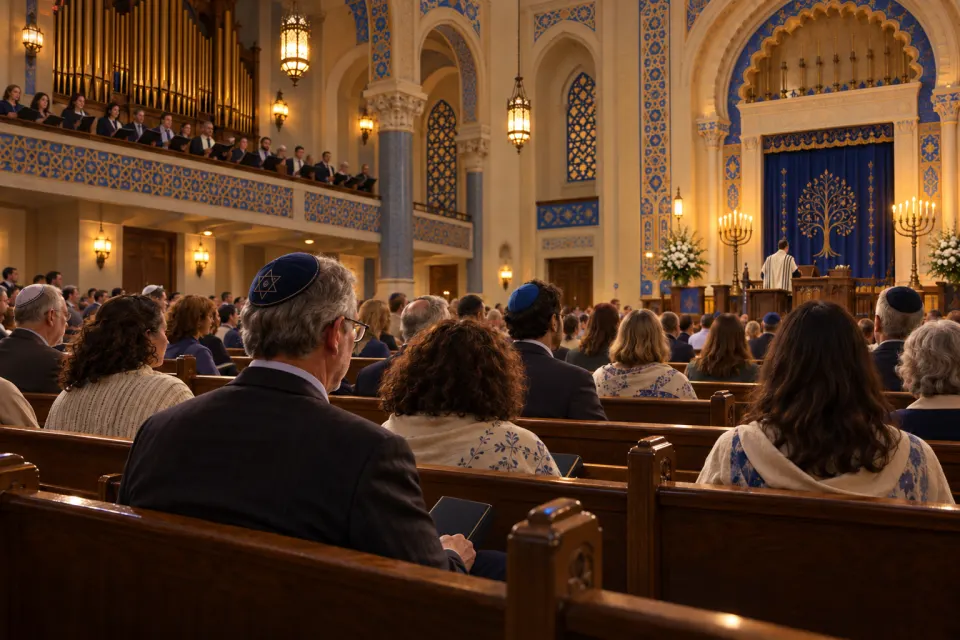
Worship in the vernacular
Reform services mix Hebrew with the vernacular, a practice dating to the movement's first German services. Especially in North America, Reform congregations also use instrumental music, choirs and mixed seating for men and women, all further breaks with Orthodox custom. Prayer books have been repeatedly rewritten to reflect new theology and more gender-inclusive language, from the Union Prayer Book of 1894 to Mishkan T'filah in 2007.[6, 24–25]
Confirmation
Reform introduced confirmation, typically held at Shavuot, as a ceremony in which older teenagers affirm their Jewish identity; the practice, begun at Jacobson's 1810 services, later spread well beyond Reform congregations and is now held alongside the traditional bar and bat mitzvah at age thirteen.[12, 26]
Social action
Congregations and the movement's Religious Action Center lobby and organize on causes from civil rights to the environment, continuing the "prophetic Judaism" nineteenth-century Reform rabbis preached; many Reform Jews treat this activism as itself a religious obligation rather than an optional add-on to worship.[10]
People
Abraham Geiger
scholar · 1810 – 1874
A German pulpit rabbi and the Reform movement's leading nineteenth-century theologian, Geiger argued that Judaism's unchanging core was ethical monotheism rather than ceremonial law, and that the tradition had always developed to meet new conditions.[2]
Isaac Mayer Wise
scholar · 1819 – 1900
A Bohemian immigrant who became rabbi of a Cincinnati congregation in 1854, Wise built Reform Judaism's American institutions, founding its congregational union, its rabbinical college and its rabbis' conference between 1873 and 1889.[3]
Sally Priesand
other · b. 1946
Ordained by Hebrew Union College–Jewish Institute of Religion in 1972, Priesand became the first woman trained and ordained as a rabbi by a North American seminary, opening the Reform rabbinate to women.[5]
Alexander M. Schindler
other · 1925 – 2000
President of the Union of American Hebrew Congregations from 1973 to 1996, Schindler championed outreach to intermarried families and non-Jewish spouses and backed the 1983 patrilineal descent resolution, reshaping how Reform Judaism defines Jewish identity.[7]
Scripture
Pittsburgh Platform
1885
The founding statement of Classical Reform, adopted by a conference of American Reform rabbis. It described Judaism as a progressive, rational religion of ethical monotheism, set aside most ceremonial law, and rejected both a future return to Palestine and belief in bodily resurrection.[8]
Union Prayer Book / Mishkan T'filah
1894; revised 1975, 2007
The Union Prayer Book, first issued in 1894, shaped Reform worship for generations. The Central Conference of American Rabbis replaced it with Gates of Prayer in 1975 and, in 2007, with the more traditional, Hebrew-rich Mishkan T'filah, reflecting decades of liturgical change.[25]
Places

Seesen, Germany
DEU
At Israel Jacobson's school chapel in this Lower Saxony town, the first Reform service was held in 1810, with German-language prayers, confirmation and mixed-gender attendance replacing customary Hebrew-only, male-led worship.[12]
Hebrew Union College, Cincinnati
USA
Isaac Mayer Wise founded Hebrew Union College here in 1875 to train Reform rabbis. Merged in 1950 with the Jewish Institute of Religion, it remains the Reform movement's flagship seminary, with further campuses in New York, Los Angeles and Jerusalem.[3]
Numbers
National censuses
| Country | Year | Count | Share |
|---|---|---|---|
| New Zealand Reformed Judaism | 2018 | 807 | 0.0% |
Source: Stats NZ, 2018 Census, licensed by Stats NZ for re-use under the Creative Commons Attribution 4.0 International licence.
Common misconceptions
Myth Reform Jews don't follow Jewish law at all.
Fact Reform Judaism does not treat halakha as binding, but it does not discard it either: congregations and individuals draw on dietary rules, Sabbath and festival observance, and life-cycle ritual selectively, as a guide rather than a command. Reform's 1885 and 1937 platforms themselves argued over how much ceremonial practice to keep, and recent decades have seen a return to more Hebrew and ritual in Reform worship.[4, 17]
Myth Reform Judaism is simply a watered-down, assimilated version of Judaism.
Fact Reform rabbis and theologians built a distinct theology around ongoing revelation and ethical monotheism, not simply lighter observance, and the movement has led American Judaism on gender equality, interfaith outreach and LGBTQ inclusion rather than merely following others' lead.[9, 11]
Glossary
- Haskalah
- The Jewish Enlightenment of the eighteenth and nineteenth centuries, which urged Jews to combine secular learning with Jewish tradition and helped prepare the ground for religious reform.[1]
- Tikkun olam · תיקון עולם
- "Repairing the world": a phrase Reform Judaism uses for the religious obligation to pursue social justice, rooted in the movement's reading of the biblical prophets.[10]
- Union for Reform Judaism
- The umbrella body for Reform congregations in North America, founded in 1873 as the Union of American Hebrew Congregations and renamed in 2003.[3]
- Hebrew Union College–Jewish Institute of Religion
- The Reform movement's rabbinical seminary, founded by Isaac Mayer Wise in Cincinnati in 1875 and merged in 1950 with the Jewish Institute of Religion, founded in New York in 1922.[3]
- Central Conference of American Rabbis
- The association of Reform rabbis in North America, founded in 1889, which issues the movement's platforms and resolutions, including those on patrilineal descent and LGBTQ inclusion.[3, 7]
- World Union for Progressive Judaism
- The international umbrella body linking Reform, Liberal and Progressive Jewish movements outside North America.[3]
- Patrilineal descent
- Jewish status traced through the father; recognized by North American Reform Judaism since 1983 alongside the rabbinic rule of descent through the mother.[7]
Sources
Each statement above was checked against published sources; the verdict says whether it stood as written, was corrected or was hedged.
- VerifiedBritannica, Reform Judaism; Encyclopedia.com, Reform Judaism.
- VerifiedBritannica, Reform Judaism; Encyclopedia.com, Reform Judaism.
- VerifiedBritannica, Reform Judaism; Encyclopedia.com, Reform Judaism.
- VerifiedEncyclopedia.com, Reform Judaism; Britannica, Reform Judaism.
- CorrectedOxford Reference search preview, REFORM JUDAISM, The Oxford Dictionary of the Jewish Religion; Encyclopedia.com, Reform Judaism.
- VerifiedBritannica, Reform Judaism; Encyclopedia.com, Reform Judaism.
- VerifiedOxford Reference preview, PATRILINEAL DESCENT, The Oxford Dictionary of the Jewish Religion; Encyclopedia.com, Reform Judaism.
- VerifiedBritannica, Reform Judaism; Encyclopedia.com, Reform Judaism.
- CorrectedEncyclopedia.com, Reform Judaism; Britannica, Reform Judaism.
- VerifiedEncyclopedia.com, Reform Judaism; Britannica, Reform Judaism.
- VerifiedBritannica, Reform Judaism; Encyclopedia.com, Reform Judaism.
- VerifiedBritannica, Reform Judaism; Encyclopedia.com, Reform Judaism.
- VerifiedBritannica, Reform Judaism; Encyclopedia.com, Reform Judaism.
- VerifiedEncyclopedia.com, Reform Judaism; Britannica, Reform Judaism.
- CorrectedEncyclopedia.com, Reform Judaism; South Carolina Encyclopedia.
- VerifiedBritannica, Reform Judaism; Encyclopedia.com, Reform Judaism.
- VerifiedEncyclopedia.com, Reform Judaism; Britannica, Reform Judaism.
- VerifiedBritannica, Reform Judaism; Encyclopedia.com, Reform Judaism.
- VerifiedEncyclopedia.com, Reform Judaism; Britannica, Reform Judaism.
- VerifiedEncyclopedia.com, Reform Judaism; Britannica, Reform Judaism.
- VerifiedEncyclopedia.com, Reform Judaism; Britannica, Reform Judaism.
- VerifiedEncyclopedia.com, Reform Judaism; Oxford Reference preview, REFORM JUDAISM, The Oxford Dictionary of the Jewish Religion.
- CorrectedOxford Reference search preview, REFORM JUDAISM, The Oxford Dictionary of the Jewish Religion; Encyclopedia.com, Reform Judaism.
- VerifiedBritannica, Reform Judaism; Encyclopedia.com, Reform Judaism.
- VerifiedEncyclopedia.com, Reform Judaism; Britannica, Reform Judaism.
- VerifiedBritannica, Reform Judaism; Encyclopedia.com, Reform Judaism.
Last fact-checked 3 October 2026.