
Overview
Hasidism is a pietistic revival movement within Rabbinic Judaism that began in the 1740s in Podolia, in today's Ukraine, around the mystic and healer Israel ben Eliezer, remembered as the Baal Shem Tov. It taught that joy, prayer and devekut, closeness to God, could sanctify even humble daily acts, open to ordinary people as well as scholars. Hasidism's central institution is the court of the tzaddik, or rebbe, a charismatic, usually hereditary leader to whom followers look for blessing and guidance; dynasties named for their European towns of origin, such as Belz, Ger and Chabad-Lubavitch, still define Hasidic identity today. Traditionalist rabbis in Lithuania fought it fiercely before an uneasy truce; the Holocaust later destroyed its heartlands, and Hasidism rebuilt itself chiefly in Israel and New York, where it now forms a conservative, often insular wing of Haredi Judaism.[1, 3–4, 8–10]
History

A pietistic revival c. 1700 – 1760
Israel ben Eliezer, remembered as the Baal Shem Tov ("Master of the Good Name") or Besht, worked as a healer and mystic in Podolia before settling at Medzhybizh around 1740 and drawing disciples through his ecstatic prayer and anti-ascetic teaching. He held that all human action, not only scholarship or ritual, could be done for God's sake, drawing on Lurianic Kabbalah while rejecting its self-denying austerities. During his lifetime his following remained a loose circle linked to earlier pietist and kabbalist groups; it grew into an organized movement only after his death in 1760.[1, 11–12]
Opposition and spread 1760 – 1815
Leadership passed to Dov Ber, the "Great Maggid" of Mezhirech, whose emissaries carried Hasidism into Belarus, Lithuania and Galicia. Lithuania's traditionalist rabbis, led by Elijah ben Solomon, the Gaon of Vilna, saw Hasidic ecstasy and veneration of charismatic leaders as a threat to Torah scholarship and excommunicated Hasidim from 1772 onward; both sides denounced each other to the authorities for two decades. By the early nineteenth century open conflict had given way to uneasy coexistence, as Hasidim and their opponents, the Mitnagdim, faced the common challenge of the Haskalah. A dynastic pattern of leadership, passing from a tzaddik to his son, took hold during this generation.[5–7, 13]
Dynasties and persecution 1815 – 1945
Through the nineteenth century Hasidism became the dominant form of Jewish religious life across Ukraine, Galicia and much of Poland, splitting into dynasties named for their towns of origin, among them Belz, Ger and the more intellectual Chabad-Lubavitch. Most Hasidic dynasties opposed Zionism and other modern Jewish political movements and aligned instead with the traditionalist Agudat Israel party, trusting their rebbe's court as the safest place on earth even as the Holocaust approached. The genocide destroyed Hasidism's east European heartlands: the great majority of Hasidim and their rebbes were murdered, and almost no Hasidic communities had been established in America or Palestine beforehand.[8–9, 14]
Rebuilding in Israel and America 1940 – today
Rebbe Joseph Isaac Schneersohn's move to New York in 1940 revived Chabad-Lubavitch in the United States; his successor, Menachem Mendel Schneerson, built it into the most publicly active Hasidic movement, sending emissary couples worldwide from its Brooklyn headquarters. Survivors of Hungarian and Polish Hasidism, including the Satmar and Belz dynasties, resettled chiefly in New York and, after the Holocaust, in Israel, where rebbes who had led courts in towns such as Belz and Gur took their communities' old names to new cities like Jerusalem and Ashkelon. Many Hasidim regard Schneerson, who died in 1994 without naming a successor, as the Messiah, a belief some of his followers still hold.[10, 15–16]
Key moments
- c. 1740 CEThe Baal Shem Tov · Podolia (Ukraine)
- c. 1941 CEThe Shoah · German-occupied Europe
Beliefs
Devekut · דְּבֵקוּת
clinging, communion with God
Hasidism teaches that a Jew should strive for constant closeness to God, devekut, in every circumstance of life, not only during prayer or study; some early Hasidic teachers held that God's presence fills all existence, so that no place or act is empty of the divine. This demand to spiritualize the whole of existence set Hasidism apart from a piety centred on textual mastery alone.[3]
Tzaddik · צַדִּיק
righteous one
The tzaddik, or rebbe, is held to be a spiritually perfected figure who mediates between heaven and earth for his followers, interceding in prayer for their health, livelihood and families. Followers visit his court bringing a written petition, usually with money for its upkeep; from the early nineteenth century, leadership normally passed from a tzaddik to his son.[4–5, 17]
Joy and ecstatic prayer
simcha, hitlahavut
Hasidism holds that serving God with joy, not only solemn discipline, is itself a religious duty, expressed through fervent, loud prayer, wordless melodies called niggunim, and dance. The Hasidic sermon and tale, recounting a rebbe's sayings and deeds, became the movement's main literary form, addressed to scholars and the unlearned alike.[18–19]
Worship through corporeality · עֲבוֹדָה בְּגַשְׁמִיּוּת
avodah be-gashmiyut
The Besht taught that even humble, physical acts, such as eating, business or ordinary conversation, could become service of God if performed with the right intention, not only formal prayer or study. Hasidic teachers framed this as sanctifying the "neutral" and mundane aspects of daily life, extending devekut beyond moments set aside for worship.[11]
Practice
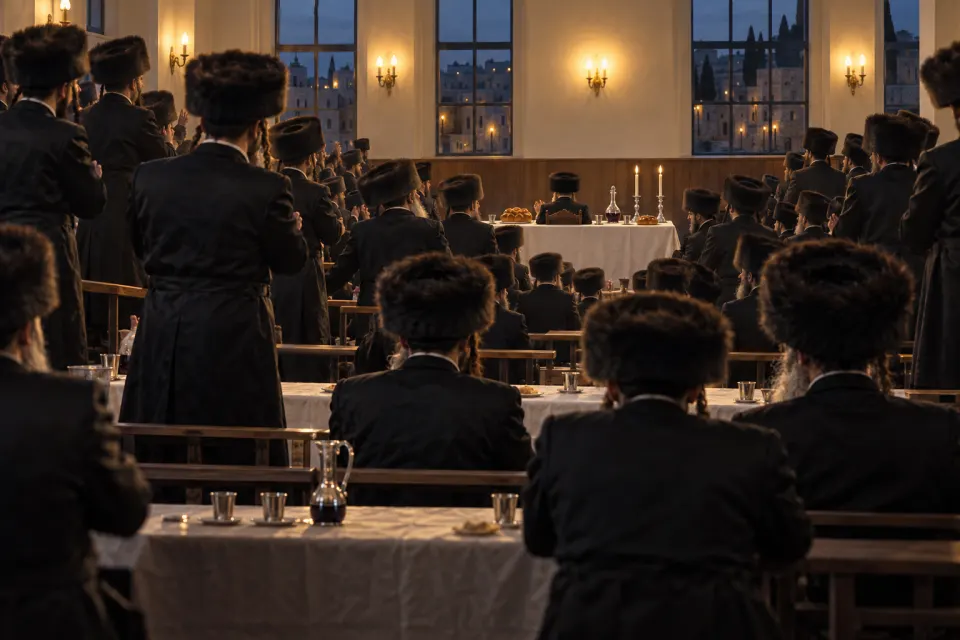
The rebbe's court
Followers gather at the tzaddik's court, especially for the Sabbath and festivals such as Rosh Hashanah, bringing a written petition, the kvitl, usually with a monetary gift, the pidyon, for the rebbe's blessing and advice. At the Sabbath table, the tish, the rebbe teaches and tastes food that is then distributed among followers as shirayim, believed to carry a blessing.[17]
Distinctive dress and language
Many Hasidic men wear long black coats, white shirts and, on the Sabbath and festivals, fur hats called shtreimels, and grow beards and sidelocks; married women cover their hair with a wig, scarf or hat. Yiddish, the language the Besht and early tzaddikim spoke, remains the everyday language of many Hasidic communities alongside Hebrew for prayer.[20–21]
Prayer rite
Hasidic communities pray according to a hybrid rite often called Nusach Sefard, blending the Ashkenazi liturgy with changes Isaac Luria introduced from Sephardi custom. Hasidic prayer is typically loud and physically expressive, with singing, swaying and clapping, reflecting the movement's emphasis on ecstatic devotion over the quieter, more formal style of other Orthodox Jews.[18, 22]
People
Israel ben Eliezer, the Baal Shem Tov · יִשְׂרָאֵל בַּעַל שֵׁם טוֹב
founder · c. 1700 – 1760
Though largely self-taught outside the rabbinic academies, the Besht drew on Lurianic Kabbalah while rejecting its ascetic self-denial, working as a healer who used "holy names" and amulets before his teaching drew a devoted following in his last two decades at Medzhybizh.[1, 11]
Dov Ber of Mezhirech
teacher · 1704 – 1772
The "Great Maggid," Dov Ber led the movement after the Besht's death and, unlike his more populist predecessor, drew young Talmudic scholars to his court; the missionaries he sent out carried Hasidism into Belarus, Lithuania and Galicia.[13]
Elijah ben Solomon, the Gaon of Vilna
scholar · 1720 – 1797
The leading rabbinic scholar of Lithuania, the Vilna Gaon regarded Hasidic ecstasy, miracle-working and veneration of charismatic leaders as a dangerous distortion of Judaism, and his influence led communities to excommunicate Hasidim from 1772.[6]
Shneur Zalman of Lyady
teacher · 1745 – 1812
A disciple of Dov Ber of Mezhirech, Shneur Zalman founded the more intellectual Chabad school of Hasidism in 1775, named for Lyubavichi, the Russian town that became its seat under his son and successor, Dov Ber.[23]
Nahman of Bratslav
teacher · 1772 – 1810
A great-grandson of the Besht, Nahman settled in Bratslav, Ukraine, and taught through tales and parables rather than systematic doctrine. He regarded himself as the only true tzaddik of his generation, so unlike other dynasties, his followers have never appointed a successor to lead them.[24]
Menachem Mendel Schneerson
teacher · 1902 – 1994
The seventh Chabad-Lubavitch rebbe, Schneerson led from Brooklyn's Crown Heights, sending emissary couples worldwide to found outreach centres among non-observant Jews; he died without naming a successor, and some followers believe he will return as the Messiah.[15–16]
Scripture
Toledot Ya'akov Yosef · תּוֹלְדוֹת יַעֲקֹב יוֹסֵף
1780
Written by Jacob Joseph of Polonnoye, a disciple of the Besht, this was the first published work of Hasidic teaching, transmitting the Besht's sayings and interpretations alongside the author's own homiletic commentary on the Torah.[25]
Places

Medzhybizh, Ukraine
UKR
The Besht lived and taught in this Podolian market town for the last twenty years of his life, drawing the circle of disciples who became Hasidism's founding generation.[1]
770 Eastern Parkway, Crown Heights, Brooklyn
USA
Since 1940 this building has been the headquarters of Chabad-Lubavitch, home in turn to Rebbe Joseph Isaac Schneersohn and his successor Menachem Mendel Schneerson; followers know it simply as "770."[15]
Mea Shearim, Jerusalem
ISR
After the Holocaust, surviving rebbes often kept their dynasty's old European town name while settling in new places; the Belzer rebbe, for example, re-established his court in Jerusalem, near this Haredi quarter, and the Gerer rebbe in Ashkelon.[10]
Common misconceptions
Myth Hasidic Jews are all basically the same.
Fact Hasidism is not one movement but dozens of distinct dynasties, each loyal to its own rebbe and often with its own customs, dress details and attitudes toward the outside world and the State of Israel. A person is a Hasid only through allegiance to a specific dynasty, such as Belz, Ger or Chabad-Lubavitch, not through a generic affiliation with "Hasidism."[4, 8]
Myth Chabad-Lubavitch speaks for Hasidism as a whole.
Fact Chabad is unusually visible because of its deliberate outreach to secular and non-observant Jews, but most Hasidic dynasties, including Satmar and Belz, remain inward-looking and do not proselytize. Chabad's leader's death in 1994 without a successor, and the belief among some followers that he will return as the Messiah, is itself unusual: most Hasidic groups maintain an unbroken line of hereditary tzaddikim.[5, 15–16]
Glossary
- Mitnagdim · מִתְנַגְּדִים
- "Opponents": traditionalist rabbis, chiefly in Lithuania, who resisted Hasidism from the 1770s onward; their heirs are still sometimes called Litvaks.[6]
- Niggun · נִגּוּן
- A wordless or semi-wordless Hasidic melody, sung to express religious feeling that words alone cannot carry.[18]
- Kvitl · קְוִיטְל
- A written petition a Hasid brings to the rebbe describing a spiritual or material need, usually accompanied by a monetary gift, the pidyon.[17]
- Shirayim · שְׁיָרַיִם
- Food left over from the rebbe's table, distributed among followers in the belief that it carries a blessing.[17]
- Tish · טיש
- The rebbe's Sabbath or festival table, where he teaches and followers gather to eat, sing and hear his discourse.[17]
- Admor · אַדְמוֹ״ר
- Hebrew acronym for "our master, our teacher, our rabbi," an honorific title for a Hasidic rebbe.[4]
- Shtreimel · שְׁטְרַיְמְל
- The fur hat many Hasidic men wear on the Sabbath and festivals, part of a dynasty's distinctive dress.[20]
Sources
Each statement above was checked against published sources; the verdict says whether it stood as written, was corrected or was hedged.
- VerifiedBritannica, Hasidism; YIVO Encyclopedia, Historical Overview; Encyclopedia.com, ?asidism.
- VerifiedBritannica, Hasidism; Encyclopedia.com, ?asidism.
- VerifiedYIVO Encyclopedia, Teachings and Literature; Britannica, Hasidism.
- VerifiedBritannica, Hasidism; YIVO Encyclopedia, Teachings and Literature.
- VerifiedBritannica, Hasidism; YIVO Encyclopedia, Teachings and Literature.
- VerifiedBritannica, Hasidism; Encyclopedia.com, ?asidism.
- VerifiedBritannica, Hasidism; Encyclopedia.com, ?asidism.
- VerifiedEncyclopedia.com, ?asidism; Britannica, Hasidism.
- VerifiedEncyclopedia.com, ?asidism; YIVO Encyclopedia, Teachings and Literature.
- VerifiedEncyclopedia.com, ?asidism; YIVO Encyclopedia, Everyday Life.
- VerifiedBritannica, Hasidism; YIVO Encyclopedia, Teachings and Literature.
- VerifiedEncyclopedia.com, ?asidism; YIVO Encyclopedia, Historical Overview.
- VerifiedEncyclopedia.com, ?asidism; YIVO Encyclopedia, Historical Overview.
- VerifiedEncyclopedia.com, ?asidism; YIVO Encyclopedia, Teachings and Literature.
- VerifiedBritannica, Hasidism; Encyclopedia.com, ?asidism.
- CorrectedBritannica, Hasidism; Encyclopedia.com, ?asidism; YIVO Encyclopedia, Teachings and Literature.
- VerifiedEncyclopedia.com, ?asidism; YIVO Encyclopedia, Everyday Life.
- VerifiedBritannica, Hasidism; Encyclopedia.com, ?asidism.
- VerifiedYIVO Encyclopedia, Teachings and Literature; Encyclopedia.com, ?asidism.
- VerifiedBritannica, Hasidism; YIVO Encyclopedia, Everyday Life.
- VerifiedYIVO Encyclopedia, Everyday Life; Britannica, Yiddish literature.
- VerifiedEncyclopedia.com, ?asidism; YIVO Encyclopedia, Everyday Life.
- VerifiedBritannica, Hasidism; YIVO Encyclopedia, Teachings and Literature.
- VerifiedEncyclopedia.com, ?asidism; YIVO Encyclopedia, Teachings and Literature.
- VerifiedEncyclopedia.com, ?asidism; YIVO Encyclopedia, Teachings and Literature.
Last fact-checked 3 October 2026.